

Post: $27K Payroll Error Decoded: How Make.com Error Codes Break HR Automation (And How to Fix It)
$27K Payroll Error Decoded: How Make.com™ Error Codes Break HR Automation (And How to Fix It)
Every Make.com™ error code is a confession. The platform is telling you exactly what broke, exactly where, and exactly why — in a standardized language that every connected HR system speaks. The problem is that most HR automation builds never construct the architecture to listen. For a deeper grounding in that architecture, start with the advanced error handling architecture in Make.com™ HR automation parent pillar. This case study focuses on the specific HTTP status code families that break HR workflows — and the exact failure that turned a $103K offer letter into a $27,000 payroll liability.
Snapshot: The $27K Error Event
| Factor | Detail |
|---|---|
| Client Profile | David — HR manager, mid-market manufacturing firm |
| Automation in Use | ATS-to-HRIS candidate record sync via Make.com™ |
| Error Class | 422 Unprocessable Entity on compensation field |
| Error Handler at the Time | Single catch-all set to Resume — workflow continued silently |
| Downstream Impact | HRIS defaulted to legacy salary tier; offer letter pulled $130K instead of $103K |
| Financial Cost | $27K payroll discrepancy; employee quit when error was corrected |
| Root Cause | No typed error route for 400-series validation failures |
| Time to Detection | Discovered at payroll run — weeks after the sync error fired |
Context: Why HR Automation Is Uniquely Vulnerable to Error Code Failures
HR automation workflows operate on data that is simultaneously high-volume, high-stakes, and highly structured. Every connected system — ATS, HRIS, payroll platform, background check provider, document management tool — enforces its own API contract. When your Make.com™ scenario sends a request that violates that contract, the receiving system returns an HTTP status code describing the violation. What happens next is entirely determined by how you built the error route — or whether you built one at all.
McKinsey Global Institute research consistently shows that knowledge workers lose significant time to process failures and error correction tasks. In HR, that lost time is not abstract — it is a recruiter who cannot close a requisition, an onboarding coordinator who cannot see a completed background check, or a payroll administrator who discovers a compensation discrepancy at month-end. Asana’s Anatomy of Work research similarly identifies process failure as a primary driver of duplicated work, with employees frequently reworking output because upstream data was corrupted by a failed automated step.
The Parseur Manual Data Entry Report quantifies the downstream cost of these failures at an average of $28,500 per employee per year in manual correction overhead. In HR, where data accuracy is a compliance requirement and not just an operational preference, that figure underestimates the true cost. David’s $27K single-event loss from one unhandled 422 error is not an outlier — it is what happens when error architecture is absent.
The 400 Series: Client Errors That Are Always Your Responsibility
400-series errors are deterministic. The same malformed input will produce the same error every single time. This makes them the most fixable error class in HR automation — and the least excusable to leave unhandled.
400 Bad Request: Data Structure Violations
A 400 error means the request body your Make.com™ scenario constructed did not conform to the target API’s expected schema. In HR automation, the most frequent triggers are date format mismatches (MM/DD/YYYY sent where YYYY-MM-DD is required), missing required fields when a candidate record is partially populated, and array formatting errors when submitting multi-value fields like skills or certifications to an ATS.
The fix is never in the error route — it is upstream. Implement a data validation gate before every API write module that checks field presence, type, and format. Build this as a dedicated Router branch that halts the scenario and fires an alert before a malformed record ever reaches the target system. For a detailed implementation approach, see our guide on data validation in Make.com™ for HR recruiting.
401 Unauthorized and 403 Forbidden: Authentication Failures That Halt Pipelines
A 401 error means the credential is absent or expired. A 403 means the credential is valid but lacks the permission scope for the requested operation. Both errors halt the scenario entirely — but they require different remediation paths.
For 401 errors, the solution is a credential rotation protocol: document the expiry cycle for every API token in your integration stack and build a calendar-based reminder to rotate credentials before they expire. For 403 errors, the solution is a permissions audit: map every API operation your scenario performs against the permission scopes of the service account or OAuth application you’re using to connect.
In David’s environment, a secondary integration to a background check provider was returning 403 errors on status write-back because the service account had read-only permissions. The ATS showed background check status as “Pending” for candidates who had already cleared. This is a compliance exposure, not just an operational inconvenience — and it was invisible because the scenario’s error handler was set to Ignore on that module.
404 Not Found: The Data Model Drift Signal
A 404 error in an HR scenario means the Make.com™ workflow is referencing a resource that no longer exists in the target system. The most common HR triggers: a candidate record deleted from the ATS after a GDPR erasure request, an employee ID deprecated after an HRIS migration, or a document template removed from a cloud storage path that a scenario hard-coded six months prior.
Persistent 404 errors are a data model drift signal. They indicate that your automation was built against a snapshot of the system’s data structure and that the system has since changed. The correct response is a quarterly integration audit — not a one-time fix. Every resource reference in your scenario (IDs, file paths, endpoint URLs) should be stored as a variable in a centralized configuration module, not hard-coded into individual modules.
422 Unprocessable Entity: The Most Dangerous 400-Series Error in HR
A 422 error is structurally correct but semantically invalid. The server received a well-formed request that it cannot process because the content violates a business rule. In HR, this appears when a salary value exceeds a permitted band, when a requisition ID references a position that’s already been filled and closed, or when an employment type code doesn’t match the accepted enum in the HRIS.
The 422 is the error class most likely to produce a silent failure when a Resume directive is in place. The scenario marks the operation as “continued” while the data write either failed entirely or applied only the non-conflicting fields — leaving the record in an indeterminate state. David’s scenario applied a 422 to the compensation field and resumed. The HRIS wrote the record with a blank compensation value and defaulted to a legacy salary tier. No alert fired. The scenario showed green in the execution log.
The correct treatment for a 422 in HR: halt, log the full error payload including the field-level rejection reason, notify the integration owner, and require manual review before reprocessing. A 422 is not retryable without human input — the data must change before resubmission.
The 500 Series: Server Errors That Require Typed Retry Logic
500-series errors are non-deterministic. The same input that failed with a 500 error yesterday may succeed today, because the failure originated in the target system, not in your data. This is what makes them more architecturally complex — and more dangerous when handled incorrectly.
500 Internal Server Error: The Default Server Failure
A 500 error means the target API encountered an unexpected condition it could not recover from. In HR automation, this commonly appears during high-concurrency periods: mass applications from a job fair campaign, bulk onboarding document generation, or simultaneous payroll sync runs. The target system was overwhelmed, and it failed on a specific request.
The correct error route for a 500: log the full request payload, wait 30 seconds, retry once, wait 2 minutes, retry a second time, wait 10 minutes, retry a third time. After three failures, route to a human escalation alert and halt. Do not retry indefinitely. Unlimited retries on 500-series errors in HR write operations generate duplicate records — a problem we consistently see after high-volume recruiting events. See our analysis of rate limits and retry logic in Make.com™ HR automation for the full back-off implementation.
503 Service Unavailable: The Duplicate Record Generator
A 503 error means the target system is temporarily unavailable — typically due to planned maintenance, an unexpected outage, or capacity throttling. In Make.com™, if your scenario does not have typed retry logic, the default behavior depends on the error handler in place. Resume continues the scenario without the write. Break halts the scenario and marks it as failed. Neither handles the core problem: the operation needs to succeed, and the data needs to be written exactly once.
Idempotency handling is the architectural requirement for 503 scenarios. Before each write operation, query the target system to check whether a matching record already exists using a unique identifier (candidate email, employee ID, requisition number). If the record exists, update it. If it does not, create it. This prevents duplicate creation regardless of retry count. For webhook-triggered scenarios, this is especially critical — see our detailed treatment in webhook error prevention in recruiting workflows.
429 Too Many Requests: The Rate Limit Event
A 429 error means your Make.com™ scenario exceeded the API rate limit of the connected HR system. This is not a server failure — it is an enforcement event. The correct response is entirely different from a 500 or 503: do not retry immediately, and do not treat it as a data error. Parse the Retry-After header the API returns (most HR APIs include one), wait the specified duration, then resume from the exact bundle that triggered the limit.
Rate limit errors in HR automation most frequently appear in ATS integrations during high-volume application periods and in background check API calls when multiple onboarding workflows fire simultaneously. The solution is request pacing — throttle your scenario’s API calls to stay below the limit rather than hitting it and recovering. Build a limiter module that enforces a maximum requests-per-minute value based on the target API’s documented threshold.
Implementation: The Error Architecture That Prevented the Next $27K Event
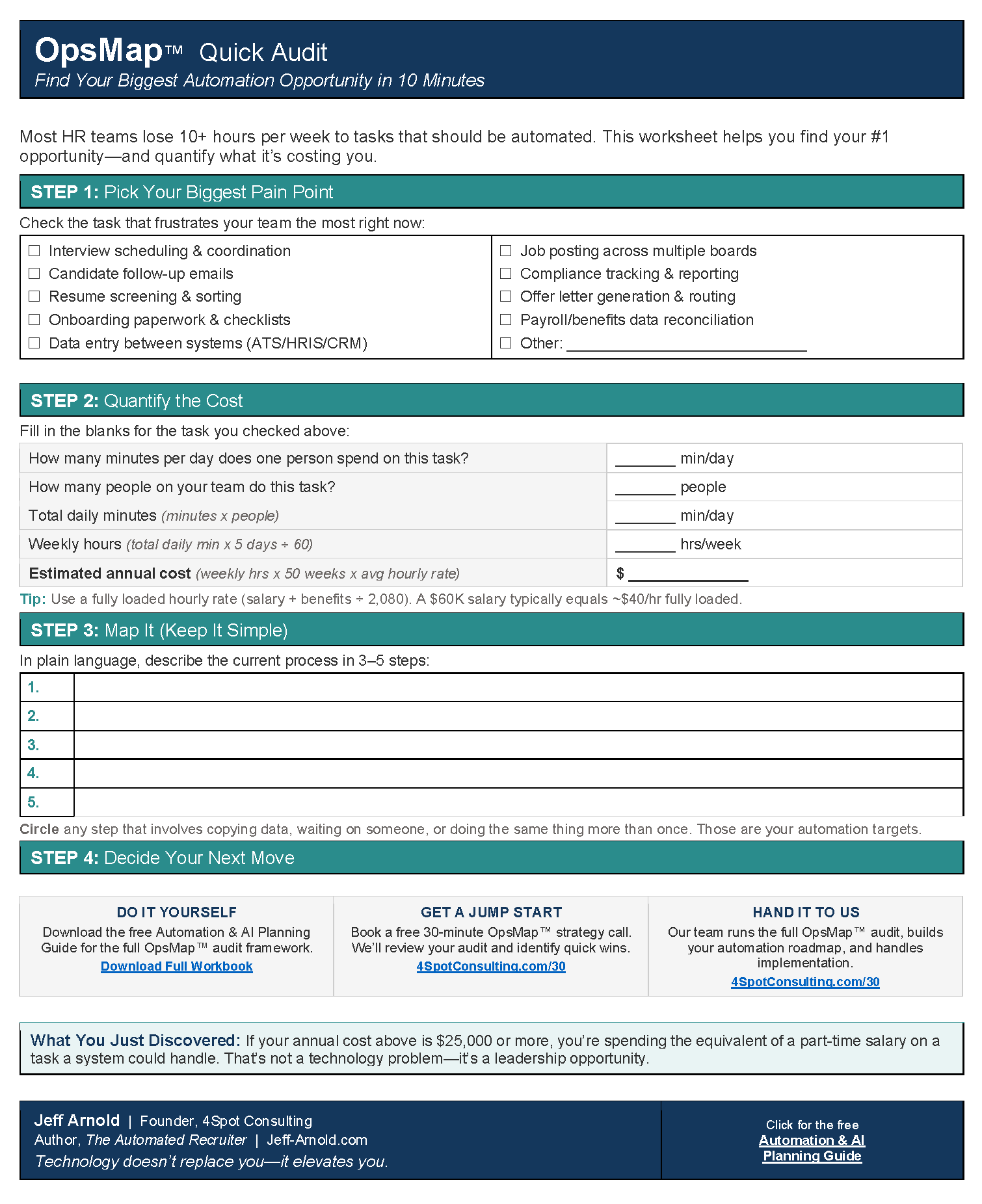
After the payroll discrepancy was identified and David engaged 4Spot Consulting, the remediation was not a patch — it was an architecture rebuild. The OpsMap™ discovery session produced an error taxonomy for every API call in the ATS-to-HRIS sync scenario. Each call was classified by its potential error class. Each error class received a typed route.
The rebuilt architecture included:
- Validation gate before compensation field writes: A Router branch checks that the compensation value is a number within the permitted salary band range before the HRIS write module fires. If the check fails, the scenario halts and sends a structured alert to David’s email and the integration log store — without attempting the write.
- Typed 422 error route: The HRIS module’s error handler was rebuilt with a dedicated route for 422 responses. The route logs the full API response body, extracts the field-level rejection reason, writes a structured error record to a Google Sheet audit log, and sends an alert with the specific field and rejection code.
- 401/403 credential monitoring: A separate daily Make.com™ scenario pings each connected API with a lightweight authentication check and logs the response status. A 401 or 403 on any integration fires an immediate alert to the integration owner — not the next time the workflow runs.
- Retry logic for 500/503 with exponential back-off: A custom retry handler using a loop module fires with 30-second, 2-minute, and 10-minute intervals. After three failed retries, a human escalation alert is sent and the scenario halts.
- Idempotency check on candidate record creation: Before any new candidate record is written to the HRIS, the scenario queries the HRIS by candidate email address. If a record already exists, it routes to an update module. If not, it routes to a create module. No duplicate records regardless of retry history.
The result: zero payroll discrepancies in the nine months following the rebuild. The integration log now shows an average of four handled 422 events per month — all of which were caught at the validation gate before reaching the HRIS, and all of which were resolved within one business day based on the structured error alert David receives.
Lessons Learned: What the Error Code Audit Revealed
The post-rebuild audit of David’s original scenario log — which Make.com™ retains for 30 days — revealed that the 422 on the compensation field had fired eleven times in the six weeks before the payroll event was discovered. Each instance was silently resumed. The scenario log showed green. No one was watching the execution detail.
Three structural lessons apply to every HR automation build:
- A green scenario execution does not mean a successful data operation. Make.com™ marks a scenario as successful when it completes without throwing an unhandled error. A Resume directive on a failed module makes the failure invisible at the scenario level. Monitor data outcomes, not scenario status lights.
- Error handlers must be typed, not global. A single catch-all error handler is the equivalent of catching every exception in a codebase with a single generic handler and logging “something went wrong.” It tells you nothing and enables silent failures. Type your routes by error class.
- The error log is the most valuable monitoring asset in your automation stack. Forrester research on automation ROI consistently identifies visibility into process failures as a leading driver of sustained automation value. A structured, queryable error log is not a reporting nicety — it is the mechanism by which you prevent the next $27K event. See our guide to error handling patterns for resilient HR automation for log architecture specifics.
What We Would Do Differently
In retrospect, the OpsMap™ session for David’s engagement should have included a review of the legacy scenario’s execution logs before recommending a rebuild. The eleven prior 422 events in the log would have accelerated our diagnosis by days and given us a full picture of all error classes present — not just the one that caused the payroll event. We now include a mandatory execution log audit in every engagement where an existing automation is in place. It is the fastest way to understand the actual error taxonomy of a live scenario versus the theoretical one.
We would also have implemented the compensation field validation gate as the very first module after the trigger — not as a pre-write check. Moving validation to the earliest possible point in the scenario reduces the compute cost of a failed run and eliminates any risk of partial writes to intermediate systems before the invalid data is caught.
Closing: Error Codes Are the Vocabulary — Error Architecture Is the Response
Make.com™ error codes are not failures. They are structured communications from connected systems describing exactly what they needed and did not receive. The failure is in the absence of a built response. Every 400-series code is a data quality signal. Every 401/403 is a credential management signal. Every 500-series code is a reliability signal that requires typed retry logic, not manual reconnection.
David’s $27K event was not caused by Make.com™. It was caused by the absence of a typed error route for a 422 on a compensation field. The platform logged the error. The error handler resumed past it. No one was informed. Build the error architecture before you build the workflow — and audit the execution logs before you trust the green status light.
For the complete implementation blueprint, return to the parent pillar: advanced error handling architecture in Make.com™ HR automation. For ATS-specific data integrity patterns, see our guide to building unbreakable ATS data syncs with Make.com™. For the full error management framework across the recruiting lifecycle, see error management for unbreakable recruiting automation.


RELATED POST

