Post: $312K Saved with Keap HR Automation: How TalentEdge Achieved 207% ROI in 12 Months
$312K Saved with Keap HR Automation: How TalentEdge Achieved 207% ROI in 12 Months
Most recruiting firms treat automation as a future initiative — something to revisit when headcount grows, when the budget frees up, or when the manual workload becomes genuinely unbearable. TalentEdge didn’t wait. A 45-person firm with 12 active recruiters, they were spending the majority of their operational capacity on tasks that added no client or candidate value: manual data entry, reminder follow-ups, scattered compliance tracking, and inter-system transcription that introduced errors at every handoff.
The intervention wasn’t a platform replacement or a headcount expansion. It was a structured process audit followed by a disciplined Keap™ automation buildout — the same framework detailed in the Keap™ consulting blueprint for future-proof talent management. Twelve months later: $312,000 in annual savings and 207% ROI. No new hires. No enterprise HRIS. No AI tools in the critical path.
This case study documents exactly how that result was achieved, what the numbers are based on, and what other recruiting firms can replicate from the model.
Case Snapshot
| Organization | TalentEdge (45-person recruiting firm) |
| Team Size | 12 active recruiters |
| Constraints | No dedicated ops staff; all process management owned by recruiters |
| Approach | OpsMap™ audit → 9 automation opportunities identified → phased Keap™ buildout |
| Annual Savings | $312,000 |
| ROI | 207% in 12 months |
| Headcount Added | Zero |
Context and Baseline: What Manual Operations Actually Cost
Before any automation was in place, TalentEdge’s 12 recruiters were absorbing the full operational overhead of a firm that had grown faster than its processes. The problems were not dramatic — no single catastrophic failure, no regulatory action. The costs were structural and cumulative.
Recruiters were manually transferring candidate data between their applicant tracking system and Keap™ contact records. Follow-up sequences for active candidates were managed through personal calendars and email reminders. Compliance touchpoints — consent acknowledgments, data-retention milestones for rejected candidates, opt-out processing — existed as policy documents rather than enforced workflows. When a recruiter left or transferred accounts, compliance history left with them.
Asana’s Anatomy of Work research found that knowledge workers spend an average of 60% of their time on “work about work” — status updates, data duplication, and coordination tasks — rather than the skilled work they were hired to perform. TalentEdge’s recruiters fit that pattern precisely. The skilled work — sourcing, qualifying, and advancing candidates — was being crowded out by administrative overhead that no recruiter’s job description included.
Parseur’s Manual Data Entry Report estimates the cost of maintaining a manual data entry–dependent employee at $28,500 per year when rework, error correction, and opportunity cost are included. Across 12 recruiters each spending a significant fraction of their week on manual tasks, the math reached six figures before a single compliance risk was priced in.
SHRM benchmarking data consistently shows that the cost of an unfilled position — positions that stay open because recruiters are consumed by administrative work rather than advancing candidates — compounds rapidly. The pressure wasn’t abstract. It was measurable in time-to-placement lag and in recruiter capacity that existed on paper but not in practice.
Approach: The OpsMap™ Audit as the Non-Negotiable First Step
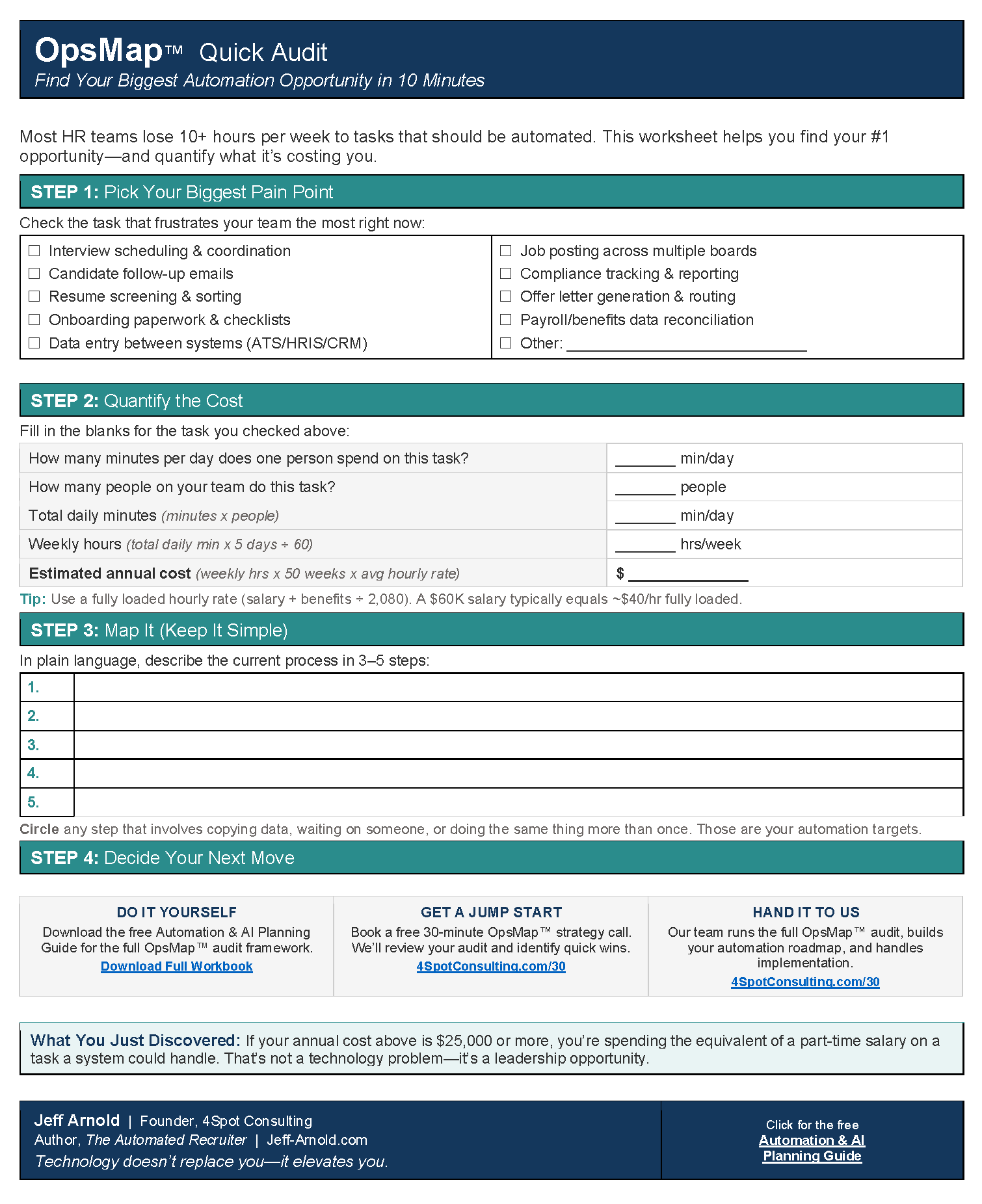
The OpsMap™ audit mapped TalentEdge’s current-state workflows from first candidate contact through placement — every step, every handoff, every system transition. The output wasn’t a process diagram. It was a prioritized list of 9 automation opportunities scored on two axes: weekly time cost and compliance exposure.
Scoring on both dimensions was deliberate. Time cost alone produces a list that optimizes for efficiency. Compliance exposure alone produces a list that optimizes for risk mitigation. Combining both surfaces the opportunities where automating a single workflow delivers efficiency gains and removes regulatory risk simultaneously — the highest-return targets in any recruiting operation.
The 9 opportunities identified were:
- Candidate intake and data capture — replacing manual CRM entry with form-to-Keap™ automation
- Initial follow-up sequencing — behavior-triggered email sequences replacing calendar-managed outreach
- Consent logging at intake — automated tagging of consent status at the point of candidate submission
- Rejection notification and data-retention triggers — automated workflows initiating retention countdown on candidate rejection
- Active candidate status updates — automated touchpoints replacing recruiter-initiated manual check-ins
- Interview scheduling coordination — automated confirmation and reminder sequences
- Placement milestone logging — automated record updates at offer acceptance and start date
- Opt-out and data-deletion request processing — automated workflow routing for candidate data removal requests
- Pipeline reporting data aggregation — automated tagging and segmentation enabling dashboard reporting without manual compilation
Each opportunity had a projected time-reclaim figure and a compliance-risk score before a single automation was built. That pre-build quantification is what made the ROI calculation predictable rather than retrospective.
Every firm that jumps straight to automation platform selection before mapping their workflows is buying a solution before they understand the problem. With TalentEdge, the OpsMap™ audit took priority. We mapped 12 recruiters’ daily workflows, timed every manual handoff, and scored each one on two axes: time cost and compliance exposure. That scoring matrix is what made the $312,000 number predictable before a single automation was built — not a guess, not a projection based on industry averages, but a calculation grounded in the firm’s own data. The firms that skip this step either automate the wrong things first or automate efficiently and still miss the highest-value gains.
Implementation: Phased Buildout Across 12 Months
Implementation proceeded in three phases, structured to deliver measurable time savings within the first 90 days while building toward the full 9-opportunity stack.
Phase 1 (Days 1–60): Candidate Intake, Follow-Up, and Consent Logging
The highest-frequency, highest-volume manual tasks came first. Candidate intake forms were connected directly to Keap™, eliminating manual CRM entry for every new candidate record. Behavior-triggered follow-up sequences replaced calendar-managed outreach — candidates received timely, personalized touchpoints without recruiter intervention. Consent logging was embedded at intake: every candidate record was automatically tagged with consent status, timestamp, and source at the moment of submission.
This is consistent with Harvard Business Review guidance on automation sequencing: high-frequency, rule-deterministic tasks deliver the fastest measurable return and create the operational momentum needed to sustain longer implementation cycles.
For a detailed walkthrough of the candidate nurturing workflow mechanics, see the guide on automated candidate nurturing with Keap™.
Phase 2 (Days 61–120): Compliance Automation and Status Workflows
Phase 2 targeted the compliance exposure risks identified in the OpsMap™ audit. Rejection events triggered automated data-retention countdowns. Opt-out requests routed through a defined Keap™ workflow that logged the request, initiated data suppression, and created an audit trail — all without recruiter action beyond the initial trigger.
The approach to automating HR compliance with Keap™ campaigns treats every compliance touchpoint as a deterministic rule rather than a human memory task. When a recruiter leaves, the workflow doesn’t. That institutional continuity is the compliance architecture — not the policy document.
Most recruiting firms treat compliance as a periodic review exercise — someone manually checks that consent records are current, that rejected candidates’ data has been purged on schedule, that opt-out requests have been honored. That approach works until it doesn’t. TalentEdge had compliance touchpoints buried in email threads and personal recruiter calendars. When a recruiter left, the institutional knowledge walked out with them. Moving consent logging, retention triggers, and audit-trail tagging into deterministic Keap™ campaign steps removed the human-memory dependency entirely. The workflow fires the same way every time, regardless of who is managing the candidate record. That consistency is the compliance architecture — not the policy document that nobody reads.
Active candidate status update sequences replaced recruiter-initiated manual check-ins. Interview confirmation and reminder automations went live. Each of these reduced the number of decisions a recruiter had to hold in working memory at any given time.
Gartner research on talent management technology consistently identifies manual status management as one of the leading sources of recruiter cognitive overload. UC Irvine’s Gloria Mark research found that the average knowledge worker takes more than 23 minutes to return to deep work after an interruption. Eliminating the cognitive overhead of status-management interruptions compounds across a 12-person recruiting team into substantial recovered capacity.
Phase 3 (Days 121–365): Pipeline Reporting and Full Stack Integration
Phase 3 automated the data aggregation that previously required manual compilation for pipeline reporting. Keap™ tags and campaign milestones were mapped to reporting dimensions, enabling dashboard views of candidate pipeline health without recruiter data-entry overhead. Placement milestone logging was automated, creating clean historical records for performance analysis.
This reporting layer is what transforms Keap™ from a workflow execution tool into a strategic HR data asset — the foundation for the analytics capability described in the guide on scaling HR operations without HRIS cost.
Results: What the Numbers Mean and What They Don’t
The $312,000 annual savings figure is a client-side operational number, not a projected estimate. It is calculated from the annualized value of recruiter time reclaimed from the nine automated task categories, at each recruiter’s burdened hourly cost, combined with reduced rework costs from eliminated manual transcription errors.
The 207% ROI figure reflects the ratio of client-side savings to the total cost of implementation and tooling — achieved within 12 months of the OpsMap™ audit start date.
What the numbers don’t include is equally important to state clearly:
- No revenue attribution is claimed. Time reclaimed from manual tasks was redirected to higher-value recruiting work — sourcing, relationship development, candidate advancement — but the incremental revenue from that redeployment was not isolated or included in the ROI calculation.
- No headcount reduction occurred. The efficiency gains manifested as capacity expansion, not staff reduction.
- No AI tools were in the critical path. Every dollar of savings came from deterministic, rule-based Keap™ automation.
The last point matters because it directly challenges a common market assumption — that AI tools are required to achieve significant recruiting automation ROI. TalentEdge’s result is a counterexample. Forrester research on automation ROI consistently finds that firms achieve the highest returns from structured workflow automation in the first 12–24 months, before AI augmentation is introduced. The sequence — automate deterministic tasks first, then augment with AI at judgment points — is validated by the data.
For a deeper analysis of how Keap™ automation ROI is calculated and what variables drive the range of outcomes, see maximizing Keap™ HR automation ROI.
Lessons Learned: What Would Be Done Differently
Transparency about what worked less well is the mark of a credible case study. Three lessons from TalentEdge’s implementation carry forward to every subsequent engagement.
Lesson 1 — Data Hygiene Should Precede Automation, Not Follow It
Keap™ contact records imported from TalentEdge’s legacy system contained inconsistent field formatting — candidate source tags that had been applied manually without a controlled vocabulary, duplicate records from manual entry at different lifecycle stages, and missing fields that automation logic depended on. The first two weeks of implementation were consumed by data cleanup that should have been completed before the OpsMap™ audit surfaced automation opportunities. Future engagements now include a data audit phase before automation design begins.
The MarTech 1-10-100 rule (Labovitz and Chang) states that it costs $1 to verify data at entry, $10 to clean it after the fact, and $100 to act on incorrect data. TalentEdge’s remediation cost validated that rule in practice.
Lesson 2 — Recruiter Training Is an Implementation Deliverable, Not an Afterthought
Several of the Phase 1 automations were partially circumvented in the first 30 days because recruiters defaulted to manual processes they already knew. The automations were working — recruiters were bypassing them. Structured change management, including documented process changes and short training sessions on why each automation existed, reduced workaround behavior to near zero by day 45. Training time should be scoped as a project deliverable from the start.
A Keap™ consultant’s blueprint for HR efficiency through automation addresses the change management dimension in detail.
Lesson 3 — Compliance Automation Should Be Tested Against Real Scenarios, Not Just Logic
The retention-trigger workflow for rejected candidates passed logic testing — it fired correctly when a rejection tag was applied. What logic testing didn’t surface was a scenario where a candidate was rejected and then re-engaged in a later campaign cycle. The re-engagement sequence restarted the retention clock correctly, but the audit trail entry for the initial rejection was not preserved in the re-engagement record. The fix was straightforward once identified, but it required a real-scenario walkthrough that pure logic testing wouldn’t have caught. Compliance automation requires scenario-based QA, not just functional testing.
What Other Recruiting Firms Can Replicate
TalentEdge’s results are not unique to its size, market, or existing technology stack. The underlying model is transferable because it is methodology-driven, not tool-dependent. Three conditions made the 207% ROI achievable — and all three are replicable:
- A current-state audit before any automation decision. The OpsMap™ produces a ranked list of opportunities. Without that list, firms automate whatever is most visible, not whatever is most valuable.
- A phased implementation that delivers measurable wins in the first 60–90 days. Early wins build organizational momentum and validate the investment case before the full buildout is complete.
- Compliance automation treated as deterministic infrastructure, not a policy exercise. Every consent log, retention trigger, and opt-out workflow that fires automatically is a compliance risk removed from human working memory.
Firms with fewer than 12 recruiters can apply the same framework at smaller scale. The absolute savings figure will be lower; the percentage efficiency gain is often higher, because manual overhead represents a larger fraction of total capacity in smaller teams. For firms ready to build a sustained talent pipeline on this foundation, the guide on building a Keap™-driven talent pipeline is the logical next step.
There is a persistent assumption in the HR technology market that AI tools will eventually make workflow automation irrelevant — that an AI agent will simply figure out what needs to happen and do it. TalentEdge’s results challenge that assumption directly. The 207% ROI came from deterministic, rule-based automation: if-this-then-that logic built in Keap™ campaigns that execute without ambiguity. AI requires clean, structured data inputs and predictable trigger conditions to perform reliably. That infrastructure — the tagged records, the sequenced touchpoints, the logged consent events — is exactly what the Keap™ automation layer creates. Firms that skip the deterministic foundation and jump to AI are building on sand. The sequence matters: automate first, then augment.
How to Know the Model Is Working
TalentEdge tracked three leading indicators in the first 90 days that confirmed the implementation was producing real results rather than just completing technical milestones:
- Automation trigger rate vs. manual override rate. If recruiters are bypassing automated workflows and returning to manual processes, adoption has failed regardless of whether the automation works technically. TalentEdge’s override rate dropped below 5% by day 45.
- Compliance audit trail completeness. Spot-checking whether consent logs, retention triggers, and opt-out records were being created correctly and completely. A complete audit trail for every candidate processed through the system is the verification standard.
- Recruiter-reported time on administrative tasks. Subjective but directionally reliable. Recruiters reported the shift in how their time was spent before the formal savings calculation was completed.
These indicators don’t require sophisticated analytics infrastructure. They require the commitment to look at the data. The broader Keap™ analytics capability for tracking talent metrics is covered in depth in the guide on the broader Keap™ HR automation framework.