

Post: Secure HR Data: Compliance, AI Risks, and Privacy Frameworks
Secure HR data programs fail because organizations deploy AI and automation on top of uncontrolled data environments. The structural controls that prevent this — role-based access management, documented retention schedules, field-level anonymization protocols, tested breach response workflows, and bi-directional audit trails between systems — must be built and enforced before any AI governance layer is introduced.
What Is Secure HR Data, Really — and What Isn’t It?
Secure HR data is the discipline of building structural controls — access management, retention schedules, anonymization protocols, and breach response workflows — around the sensitive personal information that flows through every HR process. It is not an AI initiative, a vendor platform, or a one-time compliance audit. It is an ongoing operational discipline enforced through documented policies, tested workflows, and named accountability.
The data categories that require this discipline are broader than most HR teams acknowledge. They include direct identifiers — Social Security numbers, passport numbers, bank account details — but also sensitive inferred data: health and disability records, performance ratings, disciplinary history, compensation, biometric identifiers, and the behavioral signals generated by AI-powered screening and performance tools. Each category carries distinct legal obligations, distinct retention requirements, and distinct consequences when mishandled.
What secure HR data is not is equally important to establish. It is not a privacy policy posted on an intranet. It is not GDPR consent language appended to an offer letter. It is not an AI ethics statement published in an annual report. Those artifacts are required outputs of a mature program, but they are not the program itself. The program is the set of controls that govern how data is collected, stored, accessed, transferred, retained, and deleted — and the audit trail that proves those controls operated as designed.
The confusion between documentation and controls is the most common failure mode in HR data security. Organizations invest in the documentation layer — privacy notices, policy templates, vendor questionnaires — without building the operational layer that makes those documents meaningful. When a regulator or an auditor asks for evidence of compliance, documentation without operational controls is not a defense. It is evidence of a gap. The same principle applies to responsible AI in HR: structural controls come before the AI layer, not after it.
The discipline of secure HR data also requires distinguishing between what is legally required and what is operationally sufficient. Minimum compliance — meeting the letter of GDPR or CCPA — is not the same as a program that can withstand a breach, a subject access request surge, or a regulatory examination. The organizations that treat compliance as the ceiling rather than the floor are the ones that discover gaps under pressure.
Why Is HR Data Security Failing in Most Organizations?
HR data security fails for one structural reason: organizations deploy AI and automation on top of uncontrolled data environments before building the governance layer that makes those tools safe to operate. The result is not AI-powered HR — it is liability-amplified HR.
The failure pattern is consistent. An HR team adopts an AI-powered screening tool, a predictive analytics platform, or an automated onboarding workflow. The vendor’s implementation team configures the integration. Data begins flowing between systems. Nobody asks which fields are being transferred, who has access to the destination system, what the retention policy is for the data once processed, or what happens to that data if the vendor relationship ends. Within twelve months, the organization has created processing activities it cannot document, access rights it cannot audit, and data residency situations it cannot map. The structural controls that should have preceded the tool deployment were never built.
Research on knowledge worker productivity consistently shows that HR professionals spend a significant portion of their working week on tasks that are repetitive, manual, and low-judgment. Much of that time is spent on data handling: moving records between systems, formatting exports, reconciling fields, and managing access requests. That work is not inherently risky. When it is performed without logging, without field-level validation, and without a consistent process, every manual touch becomes a potential compliance event. The manual-process problem and the governance problem are inseparable.
The second failure pattern is the mistaken belief that buying a compliance-certified HR platform transfers the compliance obligation to the vendor. It does not. Under GDPR and most state privacy frameworks, the employer is the data controller. The vendor is a data processor. The controller retains liability for how the processor handles data — which means the data processing agreement, the subprocessor list, the access audit, and the breach notification obligation all remain with the HR team. The platform’s SOC 2 certification documents the vendor’s internal controls. It does not document yours.
Human error in manual data handling is a primary driver of data quality failures. In HR contexts, those quality failures compound: a compensation figure transcribed incorrectly flows into payroll, benefits calculations, and tax filings. The error cost is not isolated to the original entry — it propagates through every downstream system that consumed the corrupted record. Prevention costs a fraction of correction, and correction costs a fraction of downstream remediation. In HR, those downstream consequences include compliance findings.
What Are the Core Concepts You Need to Know About HR Data Security?
Every HR data security conversation involves a set of terms that carry specific legal and operational meanings. Misusing them — or treating them as interchangeable — creates real compliance gaps.
Personal data is any information that relates to an identified or identifiable individual. Under GDPR, this definition is broad: an IP address, an employee ID number, or a performance rating linked to a named individual all qualify. HR teams that assume personal data means only direct identifiers like SSNs are systematically underestimating their data inventory.
Special category data (GDPR terminology) and sensitive personal information (CCPA/CPRA terminology) refer to data types that carry heightened protection requirements: health and medical data, biometric identifiers, racial or ethnic origin, religious beliefs, sexual orientation, trade union membership, and certain financial data. Special category processing requires an explicit legal basis beyond the standard lawful bases — and HR teams handle special category data routinely, in disability accommodation records, FMLA documentation, background check results, and benefits enrollment data.
Data controller is the entity that determines the purposes and means of processing — in almost every HR context, that is the employer. Data processor is the entity that processes data on behalf of the controller — that is the ATS vendor, the payroll provider, the benefits administrator. The distinction matters because the controller is accountable for the processor’s conduct under GDPR. A data processing agreement (DPA) is required with every processor — not optional, not implied by a standard vendor contract.
Anonymization versus pseudonymization is a distinction HR analytics teams routinely collapse. Fully anonymized data — where re-identification is technically impossible — falls outside GDPR scope. Pseudonymized data — where a token replaces an identifier but a re-identification key exists — remains within scope. Most HR analytics datasets are pseudonymized, not anonymized. Treating them as the latter creates hidden compliance exposure. For a detailed breakdown of this distinction and its implications for workforce analytics programs, see 10 HR data governance mistakes to avoid for strategic success.
Lawful basis is the GDPR mechanism that authorizes a specific processing activity. For HR, the most common lawful bases are contract performance (processing necessary to execute the employment contract), legal obligation (processing required by applicable law), and legitimate interests (processing that serves a genuine business need that is not overridden by individual rights). Consent is rarely the appropriate lawful basis for employee data processing — the power imbalance between employer and employee means consent is rarely freely given in the GDPR sense.
What Regulations Actually Govern HR Data — and How Do They Differ?
The regulatory landscape for HR data is not a single framework. It is a layered set of obligations — federal, state, and international — that apply simultaneously and do not always align. Understanding the distinctions is the prerequisite for building a program that holds up under examination.
GDPR is the governing framework for any employer with employees, contractors, or applicants located in the EU or EEA. It is not limited to European-headquartered companies. Any US employer with EU-based workers is a GDPR data controller. GDPR’s core requirements for HR include: a lawful basis for each processing activity documented in a Record of Processing Activities (ROPA), data subject rights honored within 30-day response windows, breach notification to the supervisory authority within 72 hours of discovery, a Data Protection Impact Assessment (DPIA) for high-risk processing activities, and a transfer mechanism (Standard Contractual Clauses or equivalent) for any cross-border data flow. GDPR Article 5 data processing principles — lawfulness, fairness, transparency, purpose limitation, data minimisation, accuracy, storage limitation, and integrity — govern every processing activity in scope.
CCPA/CPRA grants California employees and job applicants specific rights: the right to know what personal information is collected and how it is used, the right to delete (with exceptions), the right to correct inaccurate information, the right to opt out of the sale or sharing of personal information, and the right to limit the use of sensitive personal information. The CPRA’s enforcement arm — the California Privacy Protection Agency — began active enforcement in 2023. These rights map directly to specific HR workflows and require operational response processes, not just policy statements.
HIPAA governs employer access to employee health information specifically in the context of self-funded health plans and wellness programs. It does not govern all employee health data — FMLA records, for example, are governed by the Department of Labor, not HHS. The distinction matters because HR teams frequently conflate HIPAA obligations with general health data privacy, applying HIPAA controls where they are not required while missing the actual regulatory obligation that applies.
State-level proliferation — Virginia’s CDPA, Colorado’s CPA, Connecticut’s CTDPA, Texas’s TDPSA, and a growing list of state frameworks — has made multi-state compliance a genuine operational challenge for any employer with workers in multiple states. The common thread across most state frameworks: data subject rights, breach notification obligations, and requirements for data processing agreements with vendors. The specific timelines, thresholds, and exemptions vary. A compliance matrix mapped to each state where the employer has workers is a non-negotiable operational document.
What Structural Controls Must Every HR Data Security Program Include?
Five structural controls are non-negotiable in any HR data security program that will survive regulatory scrutiny. Organizations that have all five in place as documented, tested, operational workflows are positioned to defend their practices. Organizations missing any one of them carry undisclosed compliance exposure regardless of how sophisticated their AI or analytics tooling is.
1. Role-based access management. Every HR system — HRIS, ATS, payroll, benefits, learning management — must have a documented access matrix that defines which roles can read, write, export, and delete which data categories. Access must be granted by role, not by individual request, and must be reviewed on a defined schedule (quarterly is the standard for systems containing sensitive data). Access for terminated employees and contractors must be revoked within a documented window — 24 hours is the operational standard. For a detailed breakdown of access matrix design requirements, see 10 non-negotiable RBAC features for your HR system upgrade.
2. A documented retention schedule. Every HR data category must have a defined retention period, a deletion trigger, and a named owner responsible for executing deletion. The retention schedule must account for federal minimums (I-9s, OSHA records, ERISA records), state-specific requirements, and GDPR’s storage limitation principle for EU-based individuals. Without this document, deletion requests cannot be honored consistently, and storage limitation audits cannot be passed.
3. A field-level anonymization or pseudonymization protocol. Any HR dataset used for analytics, reporting, or AI model training must have a documented protocol specifying which fields are anonymized, which are pseudonymized, and how the pseudonymization key is protected. The protocol must be applied consistently, not ad hoc. Datasets that are pseudonymized but treated as anonymized are the most common source of hidden GDPR scope creep in HR analytics programs.
4. A tested breach response workflow. The breach response workflow must be documented with named roles, documented escalation paths, regulatory notification timelines, and communication templates. It must be tested — tabletop exercise at minimum, simulated incident response annually. A workflow that exists only in a policy document and has never been exercised will not operate correctly under the time pressure of an actual incident.
5. A bi-directional audit trail between systems. Every automated data flow between HR systems — ATS to HRIS, HRIS to payroll, payroll to benefits — must generate a log that records what data was transferred, when, from which system, to which system, and in what state. The log must capture before-and-after field values for any transformation or mapping that occurs in transit. This is the evidence layer that proves data integrity and supports subject access requests, audit findings, and breach scope determination. See 12 automation strategies to bulletproof HR data in recruiting for implementation patterns.
Where Does AI Actually Belong in an HR Data Governance Program?
AI belongs at exactly two points in a mature HR data governance program: bias detection in algorithmic decision-making, and anomaly flagging in access and processing logs. At every other point, deterministic automation — structured rules, conditional logic, defined workflows — is more reliable, more auditable, and more defensible than an AI model.
This is the thesis the industry is not prepared to accept. The vendor market for AI-powered HR compliance is substantial, and the marketing narrative — that AI will automate compliance, detect violations, and manage data governance at scale — is compelling. The problem is sequencing. AI models require clean, structured, consistently governed data to produce reliable outputs. The structural controls described in the previous section are the prerequisites for AI, not the alternatives to it. Deploying AI before those controls are in place produces AI-generated outputs from an ungoverned data environment — which is a compliance liability with a modern interface.
Bias detection is a genuine and high-value AI application in HR. AI models trained on historical hiring, promotion, and performance decisions carry the biases embedded in those decisions. Systematic algorithmic auditing — using statistical methods to detect disparate impact across protected categories — requires analytical capability that exceeds what manual review can deliver at scale. This is a judgment point where AI earns its place, but only when the underlying data quality is sufficient to make the audit meaningful.
Anomaly flagging in access logs is the second high-value AI application. Rule-based access monitoring — alerting on known bad patterns, like access outside business hours or bulk data exports — is table stakes. AI-powered behavioral analytics can detect anomalies that fall outside predefined rules: unusual query patterns, gradual privilege escalation, or access sequences that correlate with historical breach precursors. This capability is meaningful, but it requires a logging infrastructure — the bi-directional audit trail described above — to operate on. AI anomaly detection without comprehensive logs is not a security control. It is a dashboard with nothing to analyze.
Research on HR data analytics consistently identifies data quality as the primary constraint on analytics value delivery. Organizations that invest in analytics tooling before resolving data quality and governance gaps produce analytics outputs that cannot be trusted for decision-making — a dynamic that applies equally to AI-powered compliance tools. The correct sequencing is structural controls first, then AI layers built on top of a governed foundation.
What Are the Highest-ROI HR Data Security Controls to Prioritize First?
Not every control delivers equal return on the investment required to build and maintain it. In a resource-constrained HR environment — which describes most HR environments — sequencing matters. The controls that resolve the highest compliance risk and the highest operational cost first are the ones that produce the business case for funding the rest of the program.
Access reviews and deprovisioning automation. The single highest-risk finding in HR data audits is orphaned access — accounts for terminated employees, transferred employees with accumulated permissions, or vendor accounts that were never scoped down after implementation. Automated deprovisioning — triggered by HRIS termination events — eliminates this risk at the source. The control is not complex to build; it is commonly deferred because it requires coordination between HR, IT, and each vendor. That coordination cost is real but bounded. The risk of orphaned access to payroll, benefits, or HRIS systems is unbounded.
Data minimization at intake. Collecting only the data required for a specific, documented purpose is the most effective way to reduce compliance exposure — because data that is never collected cannot be breached, misused, or subject to deletion requests. HR intake forms — job applications, onboarding documents, benefits enrollment — frequently collect fields that were added historically and have no current business justification. An annual data minimization review removes those fields and reduces the data estate requiring governance.
Data Processing Agreements with all vendors. A DPA is a contractual requirement under GDPR for any vendor processing personal data on behalf of the controller. It is also the document that creates the contractual foundation for vendor security requirements, breach notification obligations, and subprocessor transparency. Most HR teams have DPAs with their primary HRIS and payroll vendors. Most lack DPAs with their ATS, background screening, engagement survey, and wellness platform vendors — each of which processes significant volumes of sensitive employee or candidate data.
Retention schedule execution. A retention schedule that exists but is not executed is a liability — it documents an obligation the organization is not meeting. Building the operational workflow that actually executes deletions on schedule, confirms deletion, and logs the confirmation is the step that converts the policy document into a compliance control. See 12 proactive strategies to future-proof HR recruiting data in the AI era for retention execution patterns.
Encryption in transit and at rest. Encryption is the last line of defense if access controls fail. Field-level encryption for special category data — health records, SSNs, financial information — within the HRIS is the standard, alongside TLS for all data in transit between systems. For a detailed look at encryption implementation requirements for HR systems, see 10 non-negotiable encryption features for unbreakable HRIS backups.
How Do You Implement HR Data Security Step by Step?
Every HR data security implementation follows the same structural sequence. Organizations that skip steps in this sequence create downstream gaps that require more expensive remediation later.
Step 1: Inventory. Map every HR data category, every system that holds it, every role that can access it, and every vendor that processes it. This is the data inventory — the foundational document for every control that follows. Without it, access reviews are incomplete, retention schedules are partial, and vendor DPA coverage has gaps. For a structured inventory methodology, see 11 HR data mapping mistakes to avoid for seamless workflows.
Step 2: Gap analysis. Map the current state of each structural control against the required state: access management, retention schedule, anonymization protocol, breach response workflow, audit trail. Each gap becomes a remediation item with a priority, an owner, and a target completion date.
Step 3: Remediation sequencing. Prioritize by risk exposure. Orphaned access and missing vendor DPAs carry the highest immediate regulatory risk. Retention schedule gaps and missing audit trails are high-priority operational risks. Anonymization protocol gaps affect analytics programs specifically. Address them in that order.
Step 4: Control implementation with logging built in. Every control must generate evidence of its own operation. Access reviews must produce a signed-off access matrix with a date. Retention executions must produce a deletion log with field-level confirmation. Breach response tests must produce an exercise report. The evidence layer is not optional — it is the defense artifact.
Step 5: Data Protection Impact Assessment for new processing activities. Before any new tool, workflow, or AI system is deployed that involves employee or candidate personal data, a DPIA must be completed. The DPIA documents the processing purpose, the data categories involved, the risks identified, and the mitigations applied. GDPR Article 35 requires a DPIA for any processing likely to result in high risk — including large-scale processing of sensitive data, systematic employee monitoring, and automated decision-making with legal or significant effects.
Step 6: Ongoing monitoring and review cadence. Access reviews quarterly. Retention schedule execution on documented schedule. Vendor DPA and subprocessor review annually. Breach response tabletop exercise annually. Data inventory update on any material system change. Controls without a maintenance cadence degrade — and degraded controls fail at the moment they are most needed.
How Do You Make the Business Case for HR Data Security?
The business case for HR data security runs on three parallel tracks that must be tailored to the audience receiving them.
For the legal and compliance audience, the case leads with regulatory exposure. GDPR fines run to the higher of a fixed ceiling or four percent of global annual turnover — whichever is greater. CCPA/CPRA authorizes statutory damages per consumer per incident for qualifying data breaches. State attorney general enforcement actions, class action risk, and the full cost of regulatory investigation — legal fees, forensic costs, remediation expenses, management time — routinely exceed the direct fine. The business case is not speculative: it is the cost of the controls compared to the probability-weighted cost of a regulatory finding.
For the CFO audience, the case leads with operational cost reduction. Manual HR data processing — including compliance-related tasks like managing data subject requests, conducting access reviews, and maintaining retention logs — is a significant source of HR administrative burden. Automating those workflows reduces the hours required per task and the error rate per execution. Fewer errors mean fewer downstream corrections and fewer compliance findings.
For the CHRO or HR Director audience, the case leads with trust. Research on human capital trends consistently identifies employee trust as a material driver of engagement, retention, and productivity. Employees who believe their personal data is protected, used only for disclosed purposes, and governed by transparent policies report higher organizational trust scores. That trust is not a soft metric — it is a retention variable with a quantifiable replacement cost.
The three-track business case survives an approval meeting because it addresses the question each stakeholder is actually asking. Lead with hours recovered for HR; pivot to fine risk avoidance for the CFO and General Counsel; close with the employee trust dimension for the CHRO. Track three baseline metrics before the program begins — compliance incidents per quarter, hours spent on data subject requests, and audit finding counts — so that program ROI is measurable from day one.
What Are the Common Objections to HR Data Security Programs and How Should You Think About Them?
Three objections appear in every conversation about building a formal HR data security program. Each has a defensible answer.
“We’re too small to be a target.” Breach data consistently shows that mid-market and smaller organizations are disproportionately targeted precisely because their security controls are assumed to be weaker than enterprise-scale programs. HR data — compensation, Social Security numbers, health records, banking information — is high-value data that has a ready market. The size of the organization does not determine the value of the data it holds.
“Our HRIS vendor handles compliance.” This conflates processor security with controller compliance. The vendor’s SOC 2 certification and their contractual data handling commitments govern how they protect data within their platform. They do not govern your access management practices, your retention schedule, your breach response workflow, or your cross-border transfer mechanisms. Those remain your obligations as the data controller regardless of how mature your vendor’s internal controls are. The confusion between controller and processor accountability is the most expensive misconception in HR data security.
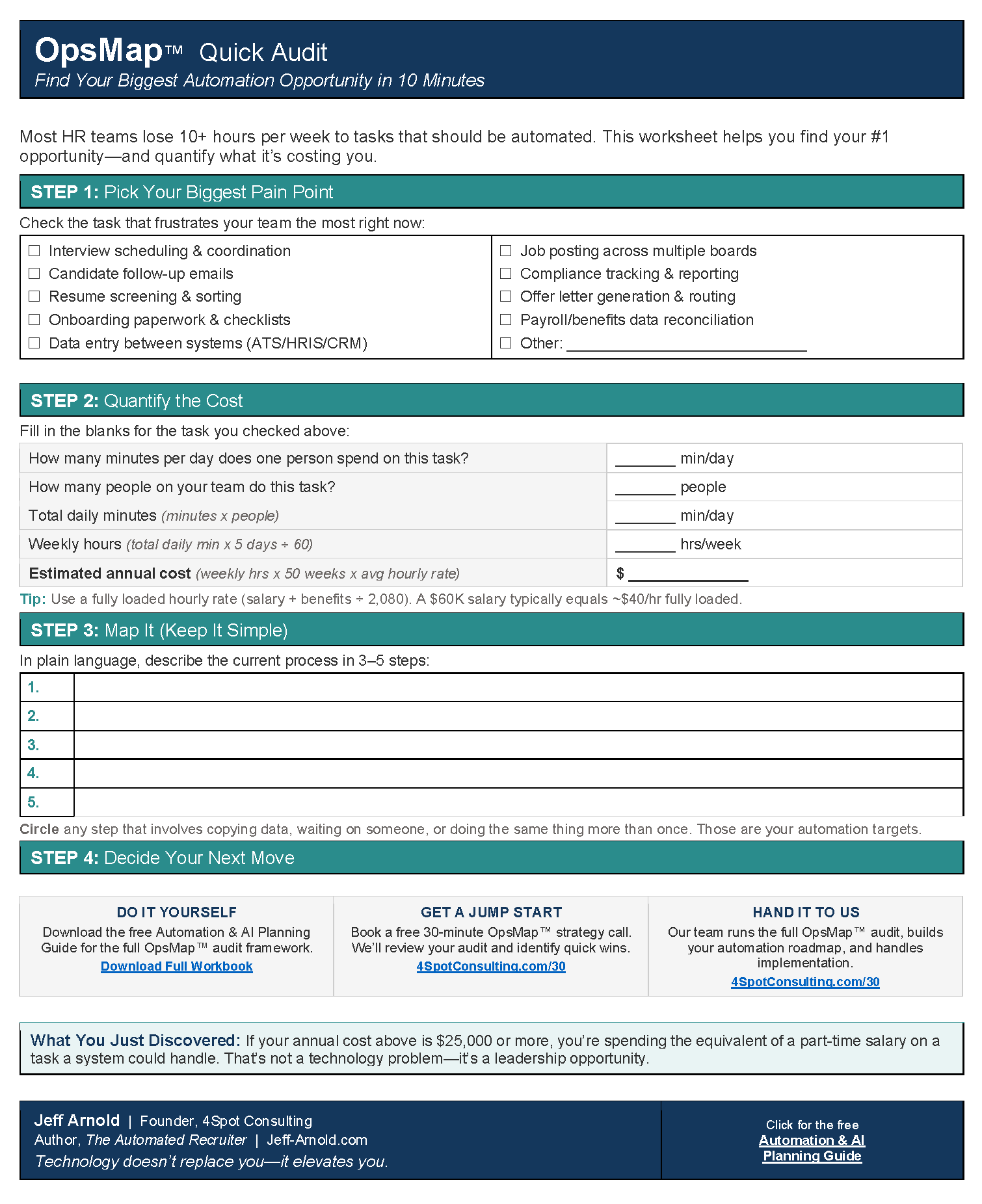
“We don’t have budget for a full compliance program.” The OpsMap™ audit is the entry point that resolves this objection operationally. The OpsMap™ identifies the specific gaps, quantifies the risk exposure associated with each, and sequences the remediation by ROI — so the first investments close the highest-risk gaps first. The OpsMap™ carries a 5x guarantee: if it does not identify at least 5x its cost in projected annual savings or risk reduction, the fee adjusts to maintain that ratio. Budget objections are best resolved by knowing what the gaps actually are before estimating the cost to close them.
The fourth objection — “AI will handle this eventually” — is addressed directly in the contrarian take section below. The short answer: AI cannot govern data it cannot reliably access, classify, or audit. The structural controls must precede the AI deployment. Every quarter spent waiting for AI to solve the governance problem is a quarter of compounding compliance exposure.
What Does a Successful HR Data Security Engagement Look Like in Practice?
Expert Take
In every OpsMap™ engagement involving HR data governance, the highest-risk findings cluster in the same three areas: orphaned vendor access (vendors with active system credentials from implementations that concluded one to three years prior), retention schedule gaps (data categories with no documented retention period and no deletion workflow), and missing or incomplete data processing agreements with secondary vendors. These three findings account for the majority of the regulatory exposure in most mid-market HR operations — and all three are resolvable with structural controls, not technology investments.
A successful HR data security engagement follows the OpsMap™ → remediation sequence. The OpsMap™ audit produces a prioritized gap list with quantified risk exposure and a sequenced remediation plan. The remediation plan distinguishes between quick-win controls — access reviews, vendor DPA execution, retention schedule documentation — that complete within thirty to sixty days, and structural builds — automated deprovisioning workflows, audit trail infrastructure, DPIA processes — that require sixty to one hundred twenty days.
The engagement shape varies by organizational maturity. For organizations with no formal program, the first phase is inventory and documentation — building the data map, the access matrix, and the retention schedule that make subsequent controls possible. For organizations with documented policies but no operational controls, the first phase is operationalization — converting the policy documents into tested, logged workflows. For organizations with operational controls but no AI governance layer, the first phase is the DPIA process for existing AI deployments and the anomaly detection infrastructure for ongoing monitoring.
Outcome metrics for a mature HR data security program include: zero unresolved orphaned access accounts at any quarterly review, one hundred percent DPA coverage for all vendors processing personal data, data subject requests honored within the regulatory response window, and zero retention schedule gaps for any active data category. These are binary measures — either the control is operational or it is not. The audit finding count is the summary metric: a program with zero open audit findings is a program that has closed its structural gaps.
For a detailed look at the full engagement sequence — including gap analysis findings and remediation timelines — see how 4Spot Consulting delivered automation transformation for Global Talent Solutions.
What Is the Contrarian Take on HR Data Security the Industry Is Getting Wrong?
Expert Take
The industry has decided that AI governance is the solution to HR data security. Every major consulting firm, every HR technology vendor, and every regulatory guidance document published in the last twenty-four months frames AI ethics, algorithmic accountability, and responsible AI as the governing frameworks for HR data protection. That framing is backwards. AI governance is a layer on top of data governance — not a substitute for it. You cannot govern AI decisions made on ungoverned data. The structural controls — access management, retention schedules, anonymization protocols, breach response workflows — are the prerequisites for AI governance, not the things AI governance replaces. Organizations that build AI ethics frameworks before building operational data controls have produced a sophisticated-looking document that will not survive a regulatory examination.
The contrarian thesis for HR data security is this: most of what vendors call “AI-powered HR data protection” is automation with a few AI features bolted on in the marketing copy. The honest position is that AI belongs inside the governance program at two specific judgment points — bias detection and anomaly flagging — and nowhere else until the structural controls are fully operational. Everything else is deterministic automation: access control logic, retention schedule triggers, breach notification workflows, consent management processes. None of those require AI. All of them require disciplined engineering and documented accountability.
Research on generative AI and knowledge work identifies governance and data quality as the primary constraints on AI value delivery in enterprise contexts. That finding applies directly to HR data security: the organizations capturing value from AI in compliance contexts are the ones that built the data infrastructure first. The ones that deployed AI on top of governance gaps are still explaining audit findings.
The second contrarian position is that compliance is a floor, not a ceiling. Organizations that optimize for minimum compliance — the letter of GDPR, the specific requirements of CCPA — are building the smallest possible defense against the largest possible risk surface. A data breach that is technically compliant in its notification timeline but preventable by access controls the organization chose not to build is not a success. The goal of an HR data security program is not to pass an audit. It is to protect the people whose data the organization holds. Those are different objectives, and the controls required to achieve them are different in scope.
What Are the Next Steps to Move From Reading to Building?
The distance between reading about HR data security and building an operational program is not a knowledge gap — it is a sequencing and prioritization gap. Most HR leaders understand what needs to be done. The gap is in knowing which of the twenty things that need to be done should happen first, which require external expertise, and which can be resolved with internal resources in the next thirty days.
The OpsMap™ resolves that gap. It is a structured audit of the current HR data environment — data inventory, access management, retention schedule, vendor DPA coverage, breach response readiness, and AI deployment documentation — that produces a prioritized remediation plan with quantified risk exposure for each gap and a sequenced build plan with timelines, dependencies, and a management buy-in narrative. The OpsMap™ is the document that converts the generic obligation to “do HR data security” into a specific, resourced, sequenced program.
The OpsMap™ guarantee is operational: if the audit does not identify at least 5x its cost in projected annual savings or quantified risk reduction, the fee adjusts to maintain that ratio. For HR data governance specifically, that ratio is almost always exceeded in the first two findings — orphaned vendor access and missing data processing agreements alone represent regulatory exposure that dwarfs the audit cost.
The near-term actions that do not require an OpsMap™ but should begin immediately: conduct an access review of every HR system against a current employee roster and terminate any access that cannot be justified by a current business need. Pull the vendor list for every system that processes employee or candidate personal data and identify which vendors have executed data processing agreements and which have not. Review 12 critical HR data privacy mistakes your organization must prevent against your current program and identify which apply.
The medium-term actions — retention schedule, breach response workflow, DPIA process, audit trail infrastructure — require the OpsMap™ sequencing to execute correctly. They are interdependent, and the order in which they are built affects the cost and completeness of each. That sequencing is what the OpsMap™ produces.
Related Resources
- 12 critical HR data privacy mistakes your organization must prevent
- 10 HR data governance mistakes to avoid for strategic success
- 12 proactive strategies to future-proof HR recruiting data in the AI era
- 10 ways AI automation elevates data protection and business continuity
- 12 automation strategies to bulletproof HR data in recruiting
- 11 HR data mapping mistakes to avoid for seamless workflows


RELATED POST

