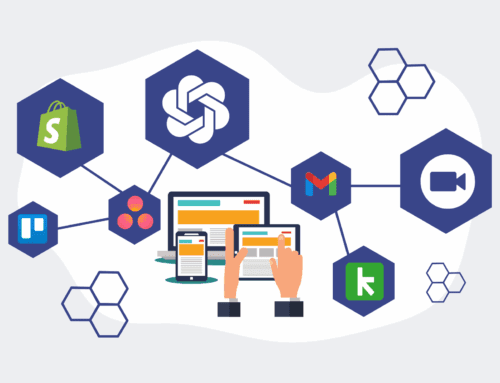
Beyond API Limitations: Exploring Make.com and Zapier’s Advanced Integration Capabilities
Businesses today operate on a complex web of SaaS applications. The promise of integration platforms like Make.com and Zapier is compelling: connect your tools, automate workflows, and reclaim precious time. However, many leaders find themselves hitting a wall, believing they’ve exhausted these platforms’ capabilities when faced with intricate, multi-step processes or specific API requirements. This perception often stems from a fundamental misunderstanding of what truly advanced integration entails, and how these powerful tools can be leveraged far beyond basic trigger-action functions. At 4Spot Consulting, we’ve seen countless organizations bottlenecked by this assumption, missing out on opportunities for genuine hyper-automation and significant operational savings.
Beyond the Basics: Understanding API Boundaries and Their Impact
Modern SaaS applications offer an Application Programming Interface (API) to communicate. Integration platforms simplify this, providing pre-built connectors that abstract away technical complexities. For many straightforward tasks – a new lead in CRM triggering an email, for instance – these basic connectors are perfectly sufficient.
However, business operations are rarely simple. We often encounter scenarios where an API lacks a specific endpoint, rate limits restrict data exchange, data needs extensive transformation, or sophisticated error handling is required. These are moments when a perceived “API limitation” isn’t a limitation of the API itself, but rather a limitation in how the integration platform is being deployed. This is where the strategic power of Make.com and Zapier, guided by expert orchestration, truly shines.
The Strategic Edge: Make.com and Zapier’s True Power
Dismissing Make.com or Zapier as merely “simple automation tools” misses their advanced capabilities. When understood and implemented strategically, their advanced features transform them into sophisticated orchestration engines capable of complex business logic, data manipulation, and resilient workflow execution.
Make.com: The Orchestration Maestro
Make.com (formerly Integromat) is renowned for its visual, modular approach, building scenarios like intricate flowcharts. Its true strength lies in its ability to directly interact with any REST API, even without a pre-built connector, allowing specific requests and nuanced data retrieval. It offers robust error handling with sophisticated error routes, retries, and fallback mechanisms for unparalleled resilience, ensuring critical processes continue. Furthermore, Make.com provides advanced data manipulation through extensive functions for parsing JSON/XML, text manipulation, and array processing, transforming raw data into the exact structure required. It can also act as a listener for incoming data via webhooks and email parsing, extracting structured data from virtually any source. Finally, its conditional logic and iterators enable highly complex decision trees, processing lists of items efficiently and executing different workflow branches based on data characteristics.
For businesses building a truly interconnected digital ecosystem – our OpsMesh™ – Make.com provides the granular control and flexibility to weave together dozens of disparate SaaS systems. We’ve leveraged Make.com to orchestrate entire HR onboarding sequences, from ATS to HRIS to payroll, with dynamic document generation and automated compliance checks, eliminating hundreds of hours of manual work.
Zapier: Bridging the Gaps with Advanced Features
Zapier is celebrated for its user-friendliness and extensive app directory. While often seen as an entry point, it too possesses advanced capabilities that extend far beyond simple two-step Zaps. These include Code Steps (Python/JavaScript) for highly specific data transformations, complex calculations, or unique API interactions. Webhooks by Zapier allow Zaps to receive data from any system capable of sending an HTTP request, greatly expanding its integration surface. Paths by Zapier introduce conditional branching into workflows, allowing different actions based on specific criteria, making Zaps more intelligent. Additionally, Filters and Formatters ensure Zaps only proceed when conditions are met and prepare data for its next destination.
While perhaps not offering the same visual orchestration depth as Make.com, Zapier’s advanced features provide a robust solution for complex, data-driven workflows, especially for organizations prioritizing rapid deployment. We often deploy Zapier for clients needing quick, reliable integrations involving custom data handling.
Unlocking True Hyper-Automation: The 4Spot Consulting Approach
At 4Spot Consulting, our expertise lies not just in understanding the technical nuances of Make.com and Zapier, but in applying them strategically to solve genuine business problems. We don’t just connect systems; we engineer solutions that eliminate human error, reduce operational costs, and increase scalability. Our OpsMap™ strategic audit is designed to uncover where your business is hitting these “API limitations” and how advanced integration can turn them into pathways for efficiency.
We focus on creating a “Single Source of Truth” by ensuring data flows seamlessly and accurately across your critical systems. For instance, we helped an HR tech client save over 150 hours per month by automating their resume intake and parsing process using Make.com and AI enrichment, then syncing to Keap CRM. This wasn’t about simply moving a file; it was about intelligently transforming unstructured data, applying conditional logic, and orchestrating multiple systems to remove low-value work from high-value employees. This is what true hyper-automation looks like.
The Future of Business Integration is Strategic, Not Just Technical
The perception that you’ve “maxed out” your automation platform’s capabilities is often an invitation to explore deeper, more strategic implementations. Make.com and Zapier, when wielded by experts, offer a powerful arsenal against operational bottlenecks and inefficiencies. They are not merely connectors; they are enablers of advanced business logic, intelligent data orchestration, and ultimately, greater profitability and agility. Moving beyond basic integrations requires a strategic mindset, a clear understanding of your business processes, and the expertise to translate complex needs into resilient, automated workflows.
If you would like to read more, we recommend this article: The Automated Recruiter’s 2025 Verdict: Make.com vs Zapier for Hyper-Automation