Jeff Arnold – Top 100 Innovators and Entrepreneurs Magazine
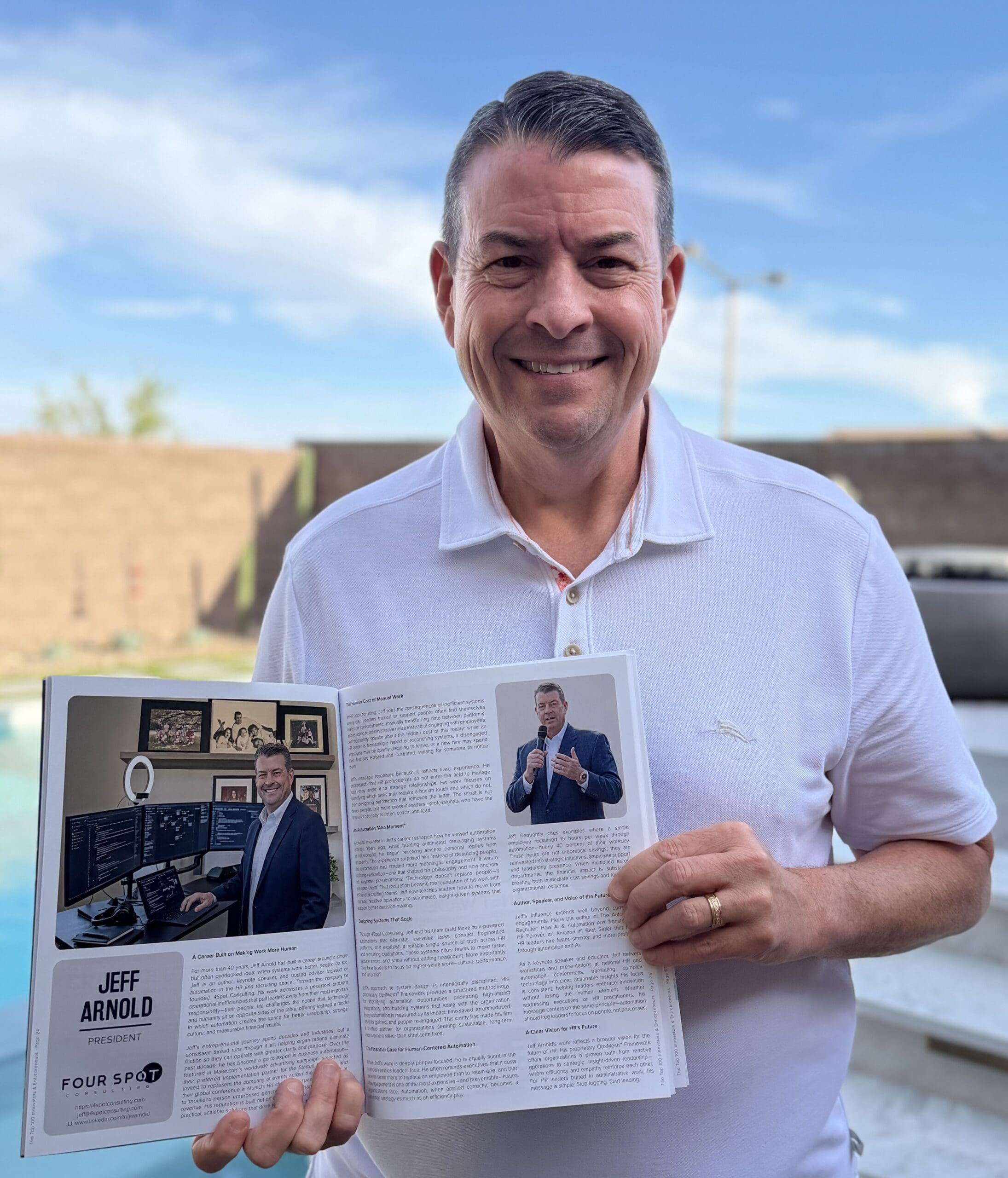
A magazine showed up in the mail a few weeks ago, and inside it was a two-page spread about me, my company, and the work I've spent years building. I'm not going to pretend that wasn't a strange feeling. Most of what I do day-to-day happens on Zoom calls, in Make.com scenarios, and inside HR systems most people will never see. So holding a printed feature in my hands — about that work — landed differently than I expected.
I was included in the 2026 edition of The Top 100 Innovators & Entrepreneurs Magazine, and I want to use this post less to talk about the feature itself and more to talk about what I tried to communicate in it. Because if anyone reads the spread and walks away with one idea, this is the one I'd want them to take.
Technology Doesn't Replace People — It Elevates Them
That sentence is the through-line of almost everything I do at 4Spot Consulting, and it's the line I kept coming back to during the interview for the magazine. It sounds like a slogan. It's not. It's a working principle I've had to defend in client meetings, on stage, and in every conversation I've had with HR leaders who are nervous about what AI is going to do to their teams.
Here's what I told the magazine, and what I tell every HR director who asks me whether automation is going to put their people out of work:
The threat to HR isn't AI. The threat to HR is the slow, invisible erosion of time that happens when smart, capable people spend their days copying data between systems, chasing signatures, generating reports that nobody reads, and translating one platform's output into another platform's input. I call this death by a thousand cuts — and it's the single biggest reason HR teams feel stuck in reactive mode no matter how hard they work.
You don't lose your strategic capacity in one big chunk. You lose it ninety seconds at a time, dozens of times a day, until there's nothing left of your week.
What Automation Actually Does
When I build automation systems for HR teams — whether through Make.com, Zapier, Keap, or a custom OpsMesh™ implementation — the goal isn't to remove humans from the work. The goal is to remove the drag from the work. The repetitive transfers. The fragile manual handoffs. The compliance documentation that has to happen but doesn't require human judgment.
What's left when that drag is gone is the work HR was always supposed to be doing: coaching managers, supporting employees, making strategic decisions about culture and headcount and compensation, sitting in rooms where business decisions get made and being the person who actually understands what those decisions will mean for people.
That's not a future state. That's what happens within the first ninety days of a properly built automation rollout, when you do it right.
Where AI Fits — and Where It Doesn't
The other thing I wanted to make clear in the feature is the line I draw between automation and AI, and between AI as decision support versus AI as decision authority.
Automation is the foundation. It moves data, triggers actions, and enforces process. It's deterministic, auditable, and boring in the best possible way. That's where most of the time savings live, and most of the compliance protection.
AI is a layer on top of that foundation. It's useful for drafting, summarizing, ranking, surfacing patterns, and helping humans decide faster. It is not — and in my work, never will be — the thing that makes the final call on hiring, firing, promotion, accommodation, or anything else where a human being's livelihood is at stake. I take a compliance-first approach for a reason: the law, the ethics, and the practical realities of HR all point to the same conclusion. Decision support belongs to AI. Decision authority stays with humans.
Anyone who's selling you a different version of that story is selling you something you'll regret buying.
Why I'm Sharing This
I've never been comfortable with the kind of self-promotion that treats every accolade like a trophy on a shelf. But I do think there's value in sharing the work, sharing the message, and putting the ideas in front of more people who might need to hear them. HR leaders are under more pressure than they've been in a generation. They're being asked to do more with less, adopt new technology faster than they can evaluate it, and somehow keep their teams whole through all of it.
If a magazine feature gets even one of those leaders to look at automation differently — to see it as the thing that gives them their week back instead of the thing that threatens their team — then the spread did its job.
To everyone who's been part of this work over the years: clients, peers, audiences at conferences, the readers of The Automated Recruiter, the HR community on LinkedIn, the SHRM chapters that have hosted me — thank you. None of this happens without you.
And to anyone reading this who's stuck in the death-by-a-thousand-cuts loop right now and wondering if there's a way out: there is. Let's talk.
Keep Automating.
— Jeff
Jeff Arnold is the founder of 4Spot Consulting, an HR Automation & AI Strategist, and the Amazon #1 Best Selling author of The Automated Recruiter. He is the creator of the OpsMesh™ Framework and holds credentials as a Make.com Gold Partner, Zapier Gold Partner, and Keap Certified Consultant. The full feature can be viewed at The Top 100 Magazine.