How to Choose the Right Keap Consultant for HR Tech Integration: A Step-by-Step Guide

Most HR automation projects don’t fail because of the software. They fail because the consultant who configured it didn’t understand the workflows, the data dependencies, or the compliance requirements specific to human resources. Selecting the right Keap consultant for HR tech integration is the highest-leverage decision you will make in your automation initiative — and it deserves a deliberate, structured evaluation process, not a quick vendor comparison. This guide gives you that process. If you’re starting from the strategic level, our parent resource on Keap consultant for AI-powered recruiting automation establishes the broader framework this guide operationalizes.

Before You Start: What to Have in Place Before You Interview Anyone

Before you contact a single consultant, document three things internally. If you skip this step, you won’t be able to evaluate whether a consultant’s methodology actually addresses your situation — you’ll be comparing pitches instead of solutions.

  • Your current HR tech stack inventory: List every platform your HR team touches — ATS, HRIS, onboarding tool, scheduling software, communication platforms. Note which ones already integrate natively and which require custom connections.
  • Your top three workflow pain points: Where are staff spending time on manual, repetitive tasks? Where do errors most frequently occur? Where does candidate or employee data fall through the cracks between systems?
  • Your baseline metrics: Time-to-hire, average HR admin hours per week per staff member, error rate on data entry tasks (even a rough estimate), and candidate communication response rates. These become your pre-engagement benchmark — a credible consultant will want them on day one.

Time required: Two to four hours of internal alignment before your first consultant conversation.
Risk if skipped: You will evaluate consultants on presentation quality rather than methodological fit — and presentation quality does not correlate with outcome quality.


Step 1 — Define the Scope Before You Issue Any Brief

Before asking consultants what they can do, define what you actually need. Scope ambiguity is the primary driver of HR automation project overruns and underperformance.

Divide your requirements into three tiers:

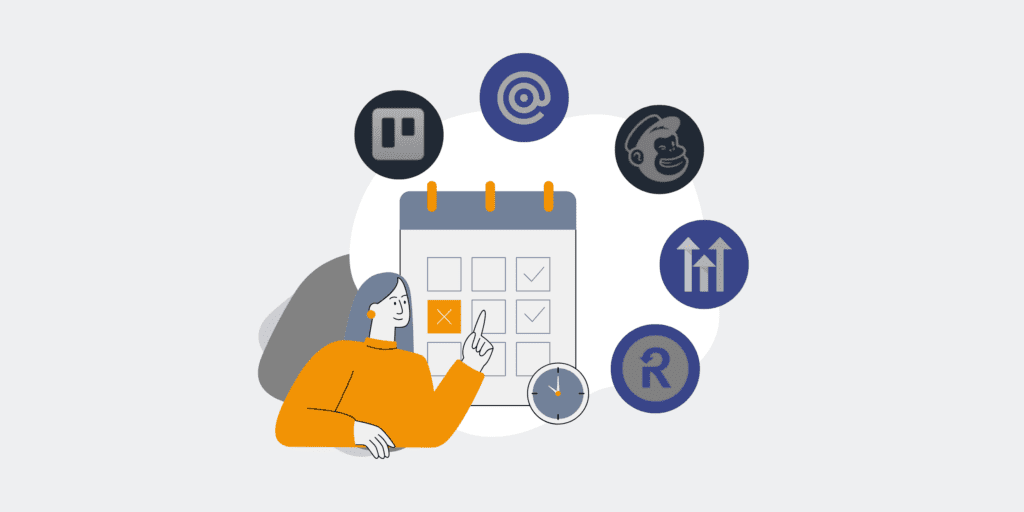
  • Must-have automations: Workflows that are currently fully manual and consuming measurable staff time — candidate status update emails, interview scheduling sequences, offer letter triggers, new hire document collection.
  • High-value integrations: Connections between Keap and your ATS or HRIS that eliminate duplicate data entry. Parseur’s Manual Data Entry Report documents that manual re-keying costs organizations an average of $28,500 per employee per year in lost productivity — this tier targets that number directly.
  • Future-state capabilities: AI-assisted resume scoring, predictive candidate ranking, dynamic content personalization. These belong in phase two — after the deterministic automation foundation is solid.

Commit this scope document to writing before any consultant conversation. It becomes your evaluation rubric: does the consultant’s proposed methodology address your must-haves before pitching future-state capabilities?

Jeff’s Take

The single biggest mistake HR leaders make when hiring a Keap consultant is treating it like a software purchase decision. They compare feature lists and price points when they should be evaluating methodology. Ask any prospective consultant what the first two deliverables are before they touch a single automation. If the answer isn’t a workflow map and a baseline metrics audit, walk away. The build quality of your automation architecture is determined entirely in those first two weeks — everything downstream flows from that foundation.


Step 2 — Screen for HR Domain Fluency, Not Just Keap Certification

Keap certification confirms platform knowledge. It does not confirm that a consultant understands candidate lifecycle management, employee data compliance, or the difference between a lead nurture sequence and an interview scheduling workflow. Screen for both.

During initial screening conversations, ask each prospective consultant these specific questions:

On HR Process Knowledge

  • “Walk me through how you would automate the handoff between an ATS application status change and a Keap candidate nurture sequence.”
  • “What compliance considerations do you build into automations that touch candidate personal data?”
  • “How do you handle the difference between active candidates in process versus passive talent in a nurture pool inside Keap’s contact structure?”

On Integration Architecture

  • “Which ATS platforms have you integrated with Keap, and were those native integrations or custom API builds?”
  • “How do you handle data conflicts when the same candidate record exists in both Keap and the ATS?”
  • “What is your approach to documenting the integration architecture so your builds are maintainable after the engagement ends?”

A generalist consultant will give confident but generic answers. An HR-specialist consultant will ask clarifying questions back — because the right answer depends on your specific ATS, your data model, and your compliance jurisdiction. Asana’s Anatomy of Work research finds that workers spend a significant portion of their week on work about work — duplicative status updates, manual data transfer, and redundant communication — precisely the gaps that HR-specific automation is designed to close. A consultant without HR domain fluency will build technically sound automations that still leave those gaps open.

Review our resource covering 10 critical questions to ask before hiring a Keap HR consultant for a complete pre-hire question set.


Step 3 — Evaluate Their Discovery and Workflow Audit Methodology

The highest-signal question you can ask any consultant is: “What does your discovery phase look like, and what do you deliver at the end of it before any build begins?”

The answer tells you everything. A structured discovery process should include:

  • Current-state workflow mapping: A visual map of every HR process that will touch the automation — from job posting through candidate communication, offer, and onboarding trigger. This surfaces the gaps that neither you nor the consultant can see without doing the work.
  • Integration dependency audit: A documented inventory of every system connection required, with confirmation of integration method (native, API, or automation platform layer) and known limitations of each.
  • Data integrity assessment: A review of your current Keap contact database for duplicate records, missing fields, and tagging inconsistencies that will break automations at scale if not addressed before build.
  • Prioritized automation roadmap: A sequenced list of automation builds ranked by time-savings impact, with phase-one scope clearly separated from phase-two enhancements.

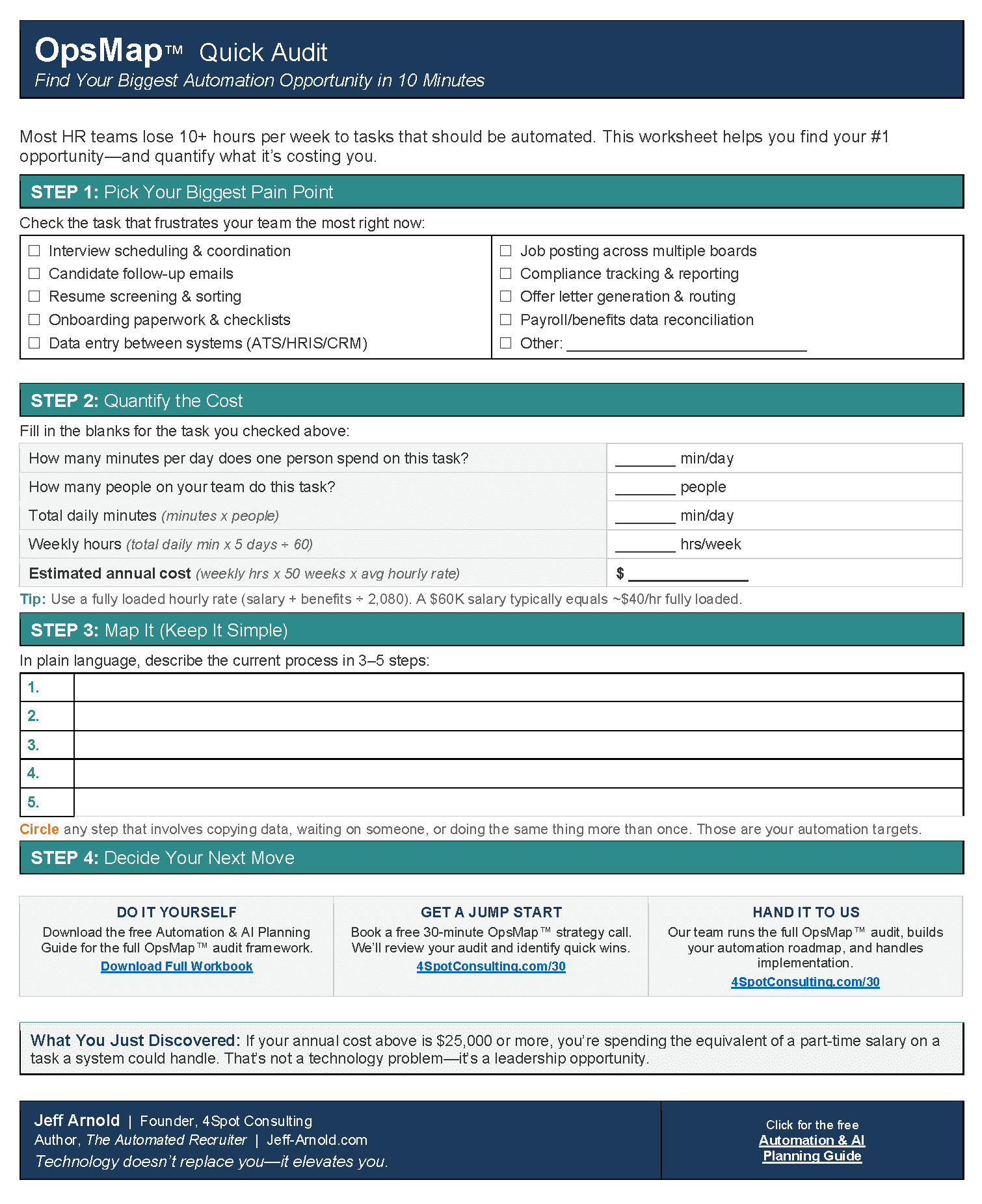
Our OpsMap™ engagement is built around exactly this structure — the discovery deliverable precedes any automation build because the map determines the architecture. A consultant who moves directly to building without this phase is constructing on an unknown foundation.

In Practice

When we conduct an OpsMap™ engagement before any Keap HR build, we consistently surface two to four workflow gaps that the HR team didn’t know existed — not because they were hidden, but because no one had mapped the end-to-end process on paper first. The most common is a data handoff break between the ATS and Keap that forces a staff member to manually re-enter candidate information. That single gap, compounding across every hire, represents hours of recoverable time per week. Mapping first makes the invisible visible.


Step 4 — Verify Data Integrity Standards and Error Prevention Protocols

Data errors in HR carry disproportionate consequences. A transcription error in a sales CRM might cost a follow-up opportunity. A transcription error in an HR system can cascade into payroll overages, compliance exposure, or a broken employment relationship. The stakes are categorically different.

Evaluate each consultant’s approach to data integrity with these specific criteria:

Error Prevention at the Architecture Level

Does the consultant design automations with validation logic built in — field format checks, required field enforcement, duplicate detection — rather than relying on users to enter data correctly? Prevention at the system level is the only reliable approach. McKinsey Global Institute research on automation consistently identifies data quality as the primary determinant of whether automation delivers its projected value or erodes trust through errors.

Audit Trail Design

For HR workflows specifically, can the consultant demonstrate how their builds maintain a traceable record of automated actions? Interview scheduling confirmations, offer letter sends, and onboarding task completions all carry accountability requirements. The automation layer should produce the audit trail, not create a gap in it.

Reference Scenario: The Cost of One Error

Consider what happens when an ATS-to-HRIS transcription error converts a $103K offer into a $130K payroll entry — a $27K cost that compounds through the employee lifecycle. An HR-specialist consultant designs integration architecture to make that class of error structurally impossible, not just unlikely. SHRM data consistently shows that bad hires and compensation errors represent some of the most expensive operational failures in HR — the automation layer should eliminate, not create, those risks.

For a deeper look at how this plays out across the full HR operation, see our guide on how a Keap consultant transforms HR operations from admin burden to strategic asset.


Step 5 — Test Their AI-Versus-Automation Sequencing Philosophy

The fastest way to identify a consultant who will build a fragile system is to ask them where AI fits in their Keap HR builds. A consultant who leads with AI features — “we’ll use AI to score resumes and rank candidates automatically” — before establishing the deterministic automation foundation is building in the wrong order.

The correct sequence is:

  1. Build the automation spine first: Deterministic, rules-based workflows for candidate communication timing, status-triggered sequences, interview scheduling, and data routing. These must work reliably every time before any AI layer is introduced.
  2. Identify the genuine judgment points: Where do your HR staff currently make decisions that involve real ambiguity — resume evaluation nuance, candidate sentiment, dynamic content selection? These are the candidates for AI augmentation.
  3. Layer AI precisely at those points: AI belongs where deterministic rules genuinely break down, not as a replacement for the rules that should be deterministic in the first place.

A consultant who understands this sequence will tell you that 80% of their HR automation build is rule-based and the AI layer represents a targeted overlay, not the foundation. Forrester research on enterprise automation adoption consistently identifies premature AI implementation — before process standardization — as a leading cause of automation project failure.

Our resource on integrating AI recruiting tools with Keap CRM covers this sequencing in operational detail.


Step 6 — Require ROI Measurement Commitment from Day One

A credible Keap HR consultant will commit to measuring outcomes, not just delivering builds. This commitment should be built into the engagement structure from the first conversation, not offered as an afterthought when the project wraps.

The three primary ROI metrics for HR automation are:

  • Time reclaimed per HR staff member per week: Measured in hours, compared against the pre-engagement baseline you established in Step 0. Sarah, an HR director in regional healthcare, reclaimed six hours per week after automating interview scheduling — a concrete, measurable outcome that justified the entire engagement within the first quarter.
  • Data entry error rate reduction: Track the frequency of detected data errors before and after integration. Even a rough pre-engagement baseline is sufficient — the directional change is what matters.
  • Time-to-hire delta: Average days from job posting to accepted offer, measured across a comparable hiring volume pre- and post-automation. McKinsey’s research on talent acquisition productivity identifies time-to-fill as one of the most sensitive leading indicators of HR operational efficiency.

Secondary metrics worth tracking include candidate response rates to automated sequences, onboarding completion rates and time-to-productivity for new hires, and HR staff satisfaction scores. Gartner research on HR technology adoption consistently shows that teams who establish baseline metrics before implementation achieve significantly higher reported satisfaction with automation outcomes than those who measure retrospectively.

Our dedicated resource on how to quantify Keap automation ROI across HR and recruiting metrics provides the full measurement framework.


Step 7 — Evaluate Ongoing Support Structure Before You Sign

Your HR tech stack will change. Your ATS will release updates. Keap will evolve its feature set. Your hiring volume will fluctuate seasonally. An automation architecture built for your current state will require ongoing optimization to remain performant as those conditions change — and a consultant who disappears after delivery is not a strategic partner.

Evaluate ongoing support with these specific questions:

  • “What is your process when a third-party platform update breaks one of our automations?”
  • “Do you offer a retained optimization model, and what does it include?”
  • “How do you handle automation expansion when we add a new tool to our HR stack?”
  • “What documentation do you provide at project close that would allow another qualified consultant to take over if needed?”

Our OpsCare™ model is designed specifically for this ongoing relationship — not periodic check-ins, but active monitoring and proactive optimization as the operational environment evolves. The distinction between a one-time implementer and a strategic partner becomes most visible twelve months after project completion: one produces a system that requires increasing manual intervention as it ages, the other produces a system that compounds value over time.

What We’ve Seen

HR teams that skip the consultant vetting process and hire on price alone almost universally report the same outcome: a working automation that solves 60% of the problem and creates two new manual workarounds for the other 40%. The cost isn’t just the wasted build — it’s the months of staff time spent compensating for an architecture that was never designed around their actual workflow. Gartner research consistently shows that technology implementations without adequate process mapping produce significantly lower adoption rates and ROI. The consultant selection decision is the highest-leverage moment in any HR automation initiative.


How to Know It Worked: Verification Checkpoints

At thirty days post-launch, verify these outcomes against your pre-engagement baseline:

  • Every candidate status change in your ATS triggers the correct Keap sequence automatically — no manual intervention required.
  • HR staff report zero instances of manual data re-entry between integrated platforms in the previous two weeks.
  • Candidate communication timing is consistent — no emails delayed or missed because a staff member forgot to trigger them manually.
  • Your Keap contact database contains no duplicate records for candidates active in the current hiring cycle.
  • Time-per-hire-process-task for HR staff has measurably decreased from the baseline figure you established before the engagement.

At ninety days, evaluate whether the automation is holding under increased hiring volume — the true stress test of architectural quality. Harvard Business Review research on organizational effectiveness identifies scalability under load as the defining characteristic of durable operational improvements versus fragile tactical fixes.


Common Mistakes and How to Avoid Them

Hiring on Price Without Evaluating Methodology

Price is a constraint, not a selection criterion. A low-cost generalist build that creates new manual workarounds costs more in staff time over twelve months than a properly scoped specialist engagement. Evaluate methodology first, then negotiate scope to fit budget.

Skipping the Baseline Metrics Step

Without a pre-engagement baseline, you cannot measure ROI, you cannot hold a consultant accountable to outcomes, and you cannot make the business case for future automation investment. Thirty minutes of baseline data collection before the first consultant conversation is the highest-ROI activity in this entire process.

Letting the Consultant Define the Scope Alone

A consultant who scopes the project without your internal workflow documentation is scoping from assumptions. Your must-have/high-value/future-state tier document (from Step 1) prevents scope drift and keeps the engagement anchored to your actual operational priorities.

Treating AI as the Starting Point

AI capabilities are compelling in a sales conversation. They are not the right starting point for an HR automation build. Any consultant who leads with AI features before establishing deterministic workflow foundations is optimizing for the demo, not for your long-term operational reliability.

Neglecting Integration Documentation

An automation that works but isn’t documented is a liability. When platforms update, when staff turn over, or when you need to expand the system, undocumented builds require complete reconstruction. Require a documented integration architecture deliverable as a contract term, not a nice-to-have.


Next Steps: From Selection to Strategic Partnership

Choosing the right Keap consultant for HR tech integration is the foundation of every automation outcome that follows. The steps in this guide — internal scope definition, domain fluency screening, discovery methodology evaluation, data integrity assessment, AI sequencing philosophy, ROI commitment, and ongoing support structure — are not bureaucratic overhead. They are the difference between an automation system that compounds value over time and one that requires increasing manual intervention as it ages.

For organizations ready to move from selection to implementation, our resources on maximizing HR AI ROI with a Keap integration consultant and automating HR recruiting and onboarding with a Keap consultant provide the operational frameworks that follow this selection decision. For the strategic context that frames why the consultant selection decision matters so much, return to our parent pillar on how Keap and AI transform HR tech into a strategic advantage.

The right consultant builds infrastructure, not just automations. That distinction compounds over every hire, every onboarding cycle, and every retention intervention your HR team executes. Make the selection decision with the same rigor you would apply to any other strategic hire — because that is exactly what it is.