Post: Case Study: Why Clean Processes Must Come Before Any HR Automation
HR automation fails when the underlying process is broken. 4Spot Consulting ran an OpsSprint™ for Global Talent Solutions and discovered their workflows were inconsistent, undocumented, and siloed — before a single automation fired. The path forward required documenting and standardizing every process first. The results proved the approach works.
The Problem: Automating a Broken Process
Global Talent Solutions came to 4Spot Consulting with a familiar complaint: their recruiting coordinators spent hours on repetitive manual tasks, every platform they adopted promised automation, and nothing connected the way the vendor claimed it would. The real issue was not the technology — it was the foundation beneath it.
Before any automation gets built, someone has to answer: what exactly happens, step by step, when a new candidate enters the pipeline? At GTS, no one could give a consistent answer. Three different coordinators described three different processes. Some steps happened in the ATS. Others happened in email. A few critical handoffs existed only in someone’s head.
Automating on top of that structure does not fix it — it locks it in. When a broken process connects to a Make.com scenario, the scenario fires exactly as designed. It just propagates the inconsistency at machine speed.
What the OpsSprint™ Revealed
The OpsSprint™ diagnostic exposed three core problems inside the first two days of the engagement.
No single source of truth for process. Different team members followed different steps for the same workflow. Some variations were intentional. Most were not. The result was a patchwork of tribal knowledge that no automation tool can interpret.
Undefined decision points. Automation requires explicit logic: if X happens, do Y. GTS had several workflow steps where the right action depended on recruiter judgment in the moment — with no documented criteria for that judgment. That is a human decision point masquerading as a repeatable process step.
Data that did not exist where the automation needed it. Several planned automations required candidate status fields that were either absent from the ATS or populated inconsistently. You cannot trigger a workflow off a field that has three different values meaning the same thing.
None of these problems appeared in a demo. All of them surfaced the moment the team mapped the real workflow against the proposed automation logic.
Expert Take
The firms that struggle most with automation are not the ones with bad technology — they are the ones with undocumented operations. An automation consultant cannot fix what the client has not defined. The first deliverable of any engagement should be a written, agreed-upon process map. Everything after that is implementation.
The Process-First Fix
4Spot Consulting built a complete process map using the OpsMesh™ framework before writing a single automation scenario in Make.com.
The mapping exercise covered:
- Every step in the candidate intake workflow, from form submission to first recruiter touch
- Every handoff point between systems — ATS, CRM, email, and calendar
- Every decision point, with documented criteria for each branch
- Every data field the automation would need, verified to exist and be consistently populated
This work took three weeks. It felt slow. It was not — it was the fastest path to working automation. Teams that skip this step routinely rebuild their automations two or three times post-launch as edge cases surface and gaps compound.
Once the process map was locked and signed off by the GTS operations lead, the automation build had a real spec to work from. No guesswork. No mid-build discoveries requiring rewired scenarios.
For a wider view of the patterns this phase surfaces, see 10 Real Examples of Why Clean Processes Must Come Before Any HR Automation and the supporting data in 12 Stats That Explain Why Clean Processes Must Come Before Any HR Automation.
Implementation: The OpsBuild™ Phase
OpsBuild™ translated the finalized process map directly into Make.com scenarios — one scenario per major workflow, with every decision branch documented inside the scenario as a named module.
Key decisions made during this phase:
- One trigger, one outcome. Each scenario fired on a single, clearly defined event. No multi-purpose triggers that loosely serve several different workflows.
- Error handling on every external call. Every HTTP module reaching the ATS, CRM, or a third-party API carried a configured error handler with a retry interval and a fallback alert routed to the operations lead.
- Named modules throughout. No scenario shipped with a module labeled “HTTP” or “Module 7.” Every step was named for what it does — “Send Candidate Status to Keap,” “Create Teamwork Task for Recruiter Review.”
These are not optional nice-to-haves. They are the difference between a scenario that runs for two years without incident and one that silently fails on a Tuesday while a candidate falls through the cracks undetected.
For the full catalog of failure modes this approach prevents, see 11 Common Mistakes HR Teams Make Automating Internally.
Results: What Clean Processes Unlock
GTS reclaimed substantial recruiting coordinator time within 60 days of going live — time previously consumed by manual status updates, inter-system data entry, and chasing down information that should have been logged automatically.
More important than the time savings: the automations ran without the constant firefighting that had characterized every previous automation attempt at the firm. The process documentation done up front meant that when a scenario needed adjustment, the team knew exactly which step to change and why. No archaeology involved.
The outcomes reinforced what the earlier 100 Hours Reclaimed engagement established: sustainable automation results from documentation first, not from deploying the most sophisticated tool available. The broader transformation is captured in the full GTS automation case study.
OpsCare™ keeps the automations running after handoff — monitoring for errors, reviewing scenario performance quarterly, and updating logic whenever the underlying process changes. That ongoing maintenance layer is what separates a working automation from one that silently drifts out of sync with reality.
What This Means for Your HR Operation
Every HR automation project follows the same sequence: map the process, clean the data, build the automation, then maintain it. Skipping the first two steps does not accelerate the third — it guarantees the fourth becomes a full rebuild.
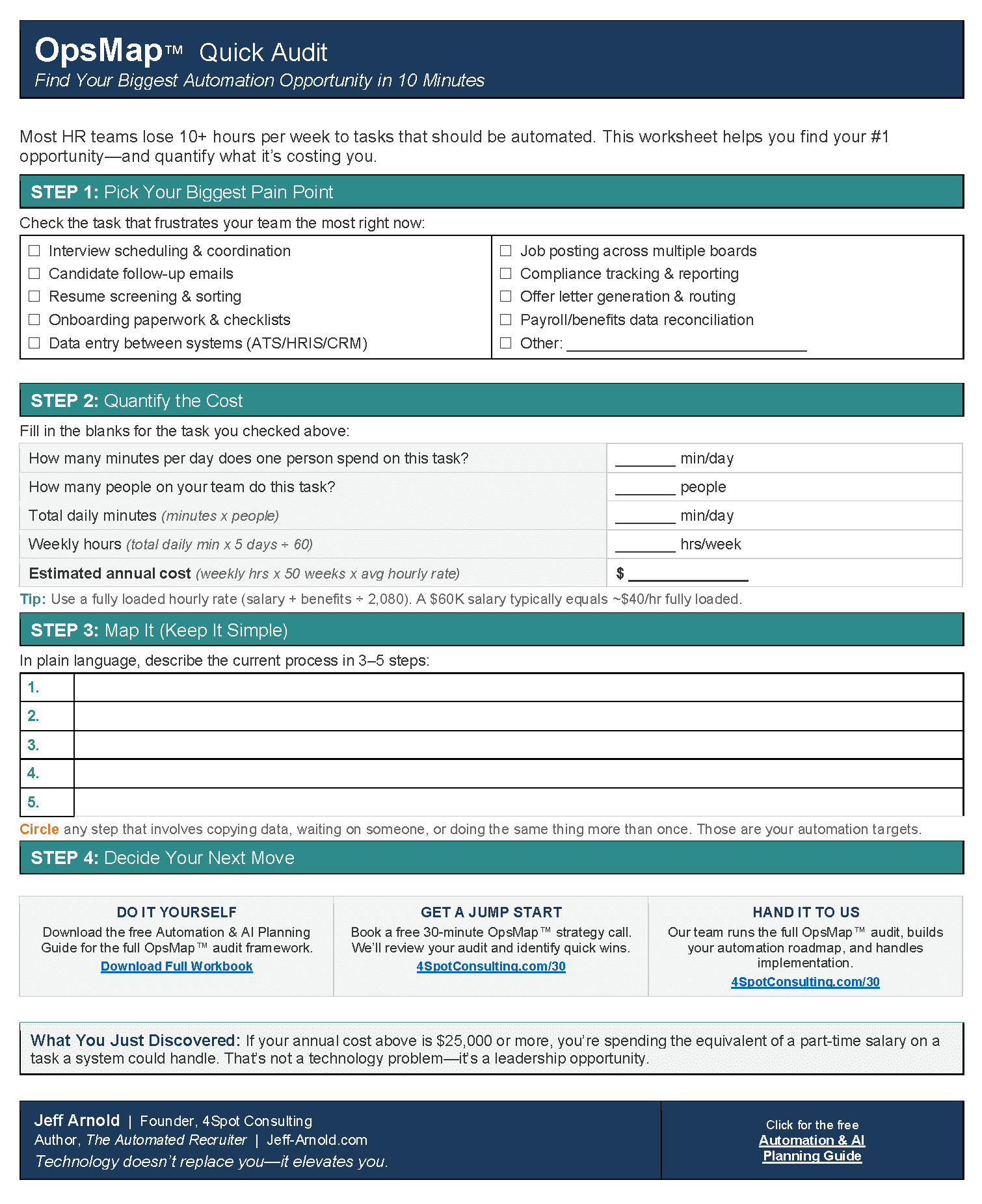
If your current automation efforts produce inconsistent results, the problem is almost never the tool. Start with the 10 Signs You Need Clean Processes Before HR Automation checklist to audit your starting point before your next build.
HR leaders evaluating whether their operation is ready to automate will find a structured pre-investment framework in 13 Essential Questions for HR Leaders Before Investing in Automation. And for a look at what the build phase looks like when the foundation is right, see the 103K Annual Labor Hours Make Automation Case Study.
Frequently Asked Questions
How long does a process documentation phase take before automation can begin?
For most mid-sized HR operations, a thorough process documentation phase takes two to four weeks. That timeline covers workflow mapping, decision-point documentation, data field verification, and sign-off from operations leadership. Teams that compress this phase below two weeks routinely surface missing requirements mid-build and extend the overall project timeline past what the documentation phase would have cost.
What is the most common process problem found during an OpsSprint?
Undocumented decision points are the most common finding. The team follows a process they know, but no one has written down the criteria for the judgment calls embedded in that process. Automation requires explicit if-then logic — those undocumented decisions have to be extracted, documented, and agreed upon before any scenario gets built.
Does automation ever help fix a broken process over time?
No — automation locks in the process it automates. A broken process running at automation speed produces broken outcomes faster and at higher volume than the same process running manually. The discipline of process documentation before automation is not optional; it is the prerequisite for extracting any value from the investment.
How does 4Spot Consulting handle the handoff after automations go live?
OpsCare™ handles ongoing maintenance after launch: error monitoring, quarterly scenario reviews, and logic updates when underlying processes change. The handoff package includes full scenario documentation and a runbook so the internal team understands what each automation does and what to check when something unexpected happens.
Part of our complete guide: Why Clean Processes Must Come Before Any HR Automation.