Post: AI’s Strategic Revolution in Modern Talent Acquisition
5 Ways AI is Revolutionizing Talent Acquisition for Modern Businesses
The landscape of talent acquisition has never been more competitive or complex. For HR leaders, COOs, and recruitment directors, the relentless pursuit of top talent often feels like a bottleneck, consuming vast amounts of time and resources. Traditional methods, while foundational, struggle to keep pace with the demands of a dynamic workforce and the sheer volume of applicants. From sifting through countless resumes to scheduling interviews across multiple time zones, the manual overhead can stifle growth and divert high-value employees from strategic initiatives. This is where artificial intelligence (AI) steps in, not as a replacement for human judgment, but as a powerful co-pilot, fundamentally reshaping how businesses identify, attract, and onboard their most valuable asset: people.
At 4Spot Consulting, we understand that true efficiency comes from smart systems, not just hard work. We’ve seen firsthand how integrating AI can transform a sluggish recruitment process into a lean, data-driven machine, saving companies like yours up to 25% of their day. This isn’t about futuristic concepts; it’s about practical, implementable solutions available right now. AI empowers HR and recruiting professionals to move beyond administrative burdens and focus on building meaningful connections and strategic talent pipelines. The shift is profound, allowing organizations to achieve higher quality hires, reduce time-to-fill, and significantly improve the candidate experience. Let’s explore five transformative ways AI is actively revolutionizing talent acquisition and how these advancements can be leveraged to give your business a decisive edge.
1. Enhanced Candidate Sourcing and Precision Matching
In the vast sea of potential candidates, finding the needle in the haystack has historically been one of recruitment’s most time-consuming challenges. AI, however, is turning this arduous task into a highly efficient, data-driven science. AI-powered sourcing tools can scour billions of data points across various platforms—job boards, professional networks like LinkedIn, social media, and even proprietary talent databases—to identify passive and active candidates who might otherwise be missed. Unlike traditional keyword matching, AI algorithms utilize natural language processing (NLP) and machine learning to understand the nuances of job descriptions and candidate profiles. This means recognizing transferable skills, inferring potential based on project work, and even assessing cultural fit by analyzing communication styles and engagement patterns.
For HR and recruiting professionals, this translates into a dramatically expanded and higher-quality talent pool. Instead of manually reviewing hundreds of resumes, AI provides a prioritized list of truly relevant candidates, often including those who didn’t explicitly use the exact keywords but possess the desired competencies. Furthermore, AI can help mitigate unconscious bias that often creeps into manual sourcing by focusing solely on objective data points related to skills and experience, rather than demographic information. This leads to a more diverse and inclusive candidate pipeline, aligning with modern business values and providing a broader spectrum of perspectives. Our work with clients often begins by identifying these sourcing inefficiencies, and then implementing automated solutions, often leveraging platforms like Make.com, to seamlessly connect these AI sourcing tools with existing CRMs like Keap, ensuring a single source of truth for candidate data and eliminating redundant efforts. This strategic approach ensures that every sourcing effort is precise, productive, and geared towards identifying the best possible talent for your organization.
2. Automated Candidate Screening and Assessment
Once candidates have been sourced, the next hurdle is screening and assessment—a phase notorious for its manual intensity and potential for human error. AI is fundamentally transforming this stage by automating initial screenings, providing objective assessments, and accelerating the qualification process. AI-powered chatbots can conduct initial interviews, asking pre-defined qualification questions, responding to candidate FAQs 24/7, and gathering crucial information about their experience, salary expectations, and availability. This not only saves recruiters countless hours but also provides an instant, personalized experience for candidates, reducing drop-off rates.
Beyond basic qualification, advanced AI tools can analyze video interviews for speech patterns, sentiment, and even subtle non-verbal cues (with ethical considerations and transparency always at the forefront). Gamified assessments, driven by AI, can evaluate problem-solving skills, cognitive abilities, and cultural fit in an engaging manner, providing deeper insights than traditional tests. AI can also parse resumes and cover letters with unparalleled speed and accuracy, identifying key skills and experiences that align with job requirements, and even flagging potential red flags or inconsistencies. This means that when a human recruiter finally reviews a candidate, they are already highly qualified and pre-vetted, allowing for more strategic and impactful conversations. For high-growth B2B companies, this automation is critical. It frees up your high-value employees from low-value, repetitive work, allowing your recruitment team to focus on relationship building, strategic decision-making, and closing top talent, rather than drowning in administrative tasks. Through our OpsBuild framework, we implement these kinds of AI-powered screening tools, often integrating them directly into existing HR tech stacks to streamline the entire applicant journey.
3. Personalized Candidate Experience and Communication
In today’s talent market, the candidate experience is paramount. A poor experience can not only deter top talent but also damage an employer’s brand reputation. AI is enabling organizations to deliver highly personalized, engaging, and efficient communication throughout the recruitment lifecycle, mimicking the individualized attention once only possible in smaller-scale hiring. From the moment a candidate applies, AI can power intelligent chatbots that provide instant answers to common questions about the role, company culture, or application status. This immediate feedback keeps candidates informed and engaged, reducing the anxiety of waiting and significantly cutting down on inbound inquiries to your recruitment team.
Moreover, AI can automate and personalize follow-up communications, such as scheduling interview reminders, sending tailored content about the company, or providing updates on their application progress. These communications can be dynamically adjusted based on the candidate’s stage in the pipeline, their expressed interests, and their engagement levels. For instance, if a candidate expresses interest in a specific department during a chatbot interaction, subsequent automated emails can highlight relevant team success stories or leadership insights from that department. By leveraging AI to manage these high-volume, personalized interactions, recruiters are freed from the manual burden of scheduling and repetitive messaging. This allows them to dedicate their time to more meaningful, human-centric conversations, building rapport, and closing deals with top prospects. At 4Spot Consulting, we design and implement these intelligent communication workflows, often linking AI tools with CRMs like Keap to ensure every candidate touchpoint is impactful, timely, and contributes positively to the overall candidate journey, fostering a stronger employer brand and a better experience for everyone involved.
4. Predictive Analytics for Talent Forecasting
Moving beyond reactive hiring, AI empowers businesses with predictive analytics, transforming talent acquisition into a proactive, strategic function. By analyzing vast amounts of historical data—including hiring trends, employee performance, turnover rates, market demands, and even economic indicators—AI algorithms can forecast future talent needs with remarkable accuracy. This allows HR and recruiting leaders to anticipate skill gaps, identify potential future roles, and build robust talent pipelines long before a vacancy even arises. Instead of scrambling to fill urgent positions, organizations can strategically nurture relationships with potential candidates, ensuring a steady stream of qualified individuals.
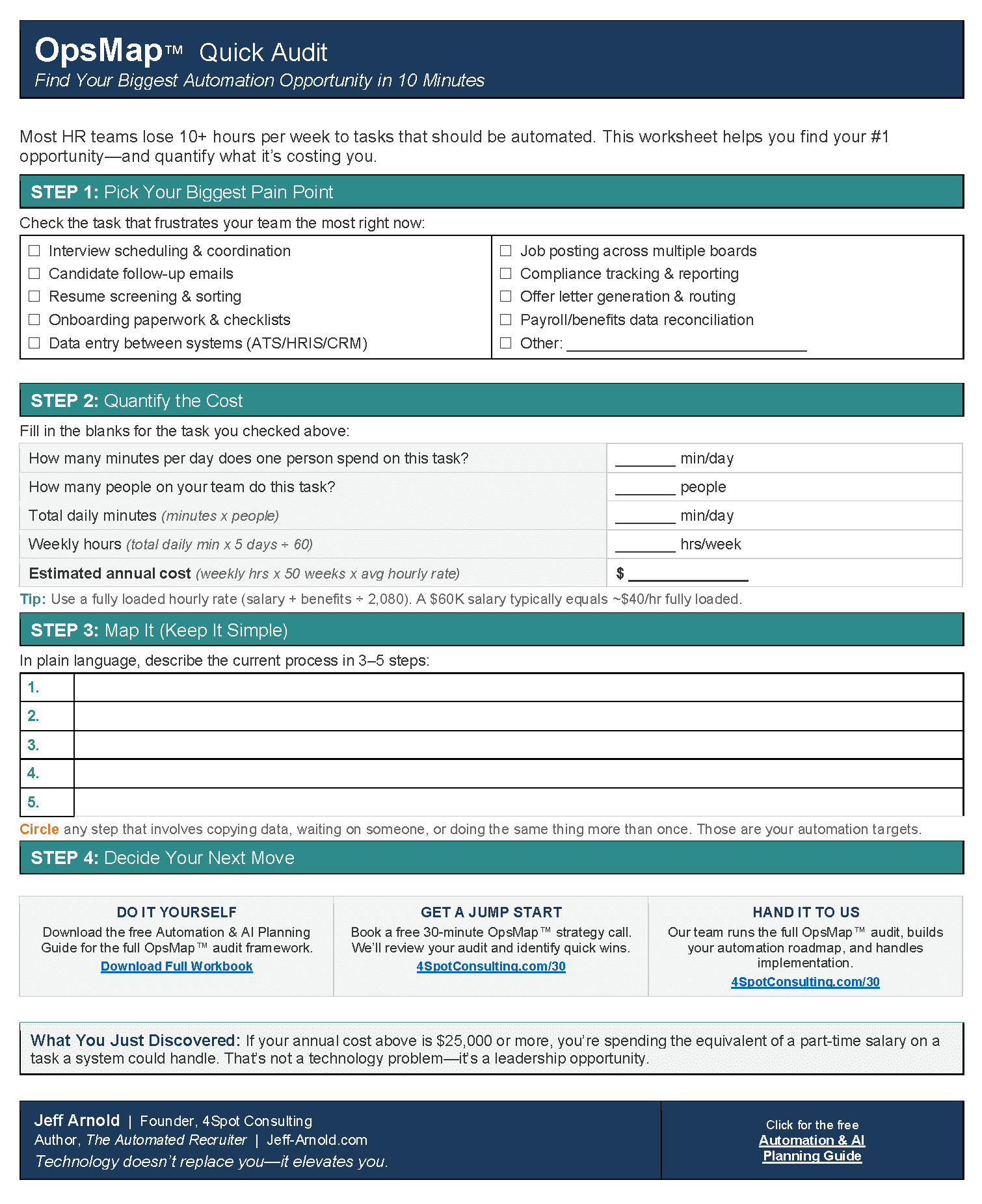
Predictive analytics also extends to understanding employee retention. AI can identify patterns and factors that contribute to employee turnover, allowing companies to implement proactive retention strategies tailored to at-risk individuals or departments. For example, if data suggests that employees in certain roles are more likely to leave after a specific period due to lack of growth opportunities, HR can intervene with targeted development programs. Furthermore, AI can help optimize recruitment marketing spend by predicting which channels and messages yield the highest quality candidates, ensuring that budgets are allocated effectively for maximum ROI. This strategic foresight is invaluable for high-growth B2B companies looking to scale efficiently without compromising talent quality. At 4Spot Consulting, our OpsMap™ diagnostic often uncovers these hidden opportunities for predictive insights, leading to the implementation of AI-driven analytical tools that provide a clear roadmap for future talent strategies, helping clients save money and hire smarter by focusing on foresight rather than hindsight.
5. Streamlined Onboarding and HR Operations
The impact of AI in talent acquisition doesn’t end with the job offer; it seamlessly extends into streamlining the critical onboarding process and broader HR operations. A clunky or inefficient onboarding experience can undermine all the effort put into recruitment, leading to early disengagement or even turnover. AI can automate numerous administrative tasks associated with onboarding, such as generating offer letters (often integrated with tools like PandaDoc), distributing pre-boarding materials, setting up IT access, and assigning initial training modules. Chatbots can serve as a new hire’s personal guide, answering common questions about company policies, benefits, and team structures, ensuring a smooth transition into their new role without burdening HR staff with repetitive inquiries.
Beyond onboarding, AI can optimize various HR operations, reducing the manual burden on high-value employees. This includes automating compliance checks, managing employee data updates, and even categorizing and routing internal HR requests to the appropriate departments. Imagine an AI system that automatically flags expiring certifications, initiates renewal processes, or personalizes learning and development recommendations for employees based on their career goals and performance data. These automations significantly reduce human error, ensure consistency, and free up HR professionals to focus on strategic initiatives like talent development, employee engagement, and culture building. At 4Spot Consulting, we specialize in implementing these full-lifecycle automation solutions. By connecting disparate systems and processes using tools like Make.com, we create an “OpsMesh” that ensures a seamless flow of information from recruitment through onboarding and beyond. This not only saves hundreds of hours but also enhances the overall employee experience, making your company a more attractive and efficient place to work.
The integration of AI into talent acquisition is no longer a luxury but a strategic imperative for businesses aiming to thrive in a competitive market. From enhancing candidate sourcing and automating screening processes to personalizing the candidate experience, providing predictive insights, and streamlining onboarding, AI empowers HR and recruiting professionals to operate with unprecedented efficiency and precision. It allows teams to pivot from reactive administrative tasks to proactive, strategic talent development, ensuring better hires, reduced time-to-fill, and significant operational cost savings. By embracing these AI advancements, organizations can build stronger, more agile workforces prepared for future challenges.
At 4Spot Consulting, we help high-growth B2B companies leverage these powerful technologies to save up to 25% of their day, eliminate human error, and achieve scalable growth. Ready to uncover the automation opportunities that could transform your recruitment and HR operations? Book your OpsMap™ call today and let’s map out a strategy tailored to your unique business needs.
If you would like to read more, we recommend this article: Driving Business Growth Through Strategic Automation
RELATED POST