Post: AI-Powered Sales: Transforming Lead Qualification and Follow-up
AI-powered lead qualification and automated follow-up eliminate the manual bottlenecks stalling your sales pipeline. By connecting lead sources directly to your CRM, scoring prospects instantly with AI enrichment, and triggering personalized outreach sequences automatically, your sales team receives warm, pre-qualified leads with full context—ready for meaningful conversations and faster closes.
The Hidden Costs of Manual Lead Qualification
Manual lead qualification drains your most expensive resource—skilled sales professionals—on work that machines do better and faster. Without automation, every inbound lead from a web form, ad campaign, or referral triggers a chain of human tasks: cross-referencing databases, researching company fit on LinkedIn, deciding on routing, and crafting an initial outreach. Multiply that by hundreds of leads per month and the math becomes brutal.
The damage extends beyond lost hours. Manual processes introduce inconsistent scoring criteria, delayed follow-ups, and CRM data that lags reality. A prospect who waits 48 hours for a response has already evaluated three competitors. Inaccurate pipeline data compounds the problem, degrading forecast accuracy and undermining the strategic decisions leadership depends on. The result is a sales operation that is simultaneously overworked and underperforming.
The financial stakes are real. Our work with Global Talent Solutions documented over $1.2 million saved through AI and automation transformation—a large portion of which traced back to eliminating exactly these kinds of high-volume, low-value manual workflows.
Expert Take
The hidden cost of manual lead qualification is not just the hours logged—it is the compound effect of slower cycles, inconsistent handoffs, and demoralised salespeople who feel like data-entry clerks. Automation removes the friction at the front of the funnel, which is where deals are won or lost before a single conversation happens.
Automating Initial Engagement: Precision at Scale
The OpsMesh™ integration framework is where lead qualification transforms from a bottleneck into a competitive advantage. By connecting every lead source—website forms, paid ad platforms, event registrations—directly into your CRM through orchestration tools like Make.com, the manual handoff disappears entirely.
The moment a prospect submits a form, an automated workflow fires. It pulls structured data from the submission, cross-references it against existing client records and known disqualified contacts, and enriches it with third-party company intelligence using AI. Based on predefined criteria—industry vertical, company size, stated pain point, firmographic signals—the lead receives an instant score. High-scoring leads route immediately to the appropriate sales executive, triggering a personalised outreach sequence that includes emails, internal Slack or CRM notifications prompting a direct call, and an automated scheduling link. The sales rep opens their queue to find a warm lead with a full context brief already populated.
Low-scoring leads do not disappear—they enter structured nurturing sequences that maintain engagement without consuming senior sales time. No opportunity is abandoned; no high-value hour is wasted on premature outreach. This is precision and personalisation at scale, two outcomes that manual processes cannot deliver simultaneously.
Sustained Engagement: Automated Follow-up That Converts
Qualification gets the lead into the pipeline; consistent follow-up closes it. Sales professionals are busy, and follow-up tasks are the first casualty when volume spikes. Systematic automation eliminates that gap entirely.
Using tools like Keap integrated through Make.com, 4Spot Consulting designs behaviour-triggered follow-up sequences that respond to what a prospect actually does—not just when a calendar reminder fires. Did the prospect open the intro email? Visit the pricing page? Download a case study? Each action triggers the next appropriate automated step, keeping communication contextually relevant and timed to peak prospect interest.
When a prospect goes quiet, the system does not. A calibrated series of re-engagement messages deploys automatically, offering alternative resources or a direct scheduling link. After a defined inactivity window, the lead escalates to a sales manager for human review. Nothing falls through the cracks because the process is not dependent on human memory.
The compounding effect of this approach is significant. Clients who implement structured automated follow-up report reclaiming 25% of their sales team’s workday and driving meaningful lifts in pipeline conversion rates. For context on what that kind of systematic automation looks like in a high-volume environment, see our detailed breakdown of $103K in annual labor hours recovered through Make.com automation.
Expert Take
Behaviour-triggered follow-up outperforms calendar-based sequences because it meets the prospect at their moment of intent. When a lead visits a pricing page at 9 PM and receives a relevant message at 9 AM the next morning, the conversion rate climbs—not because the salesperson worked harder, but because the system worked smarter.
From Bottleneck to Growth Engine
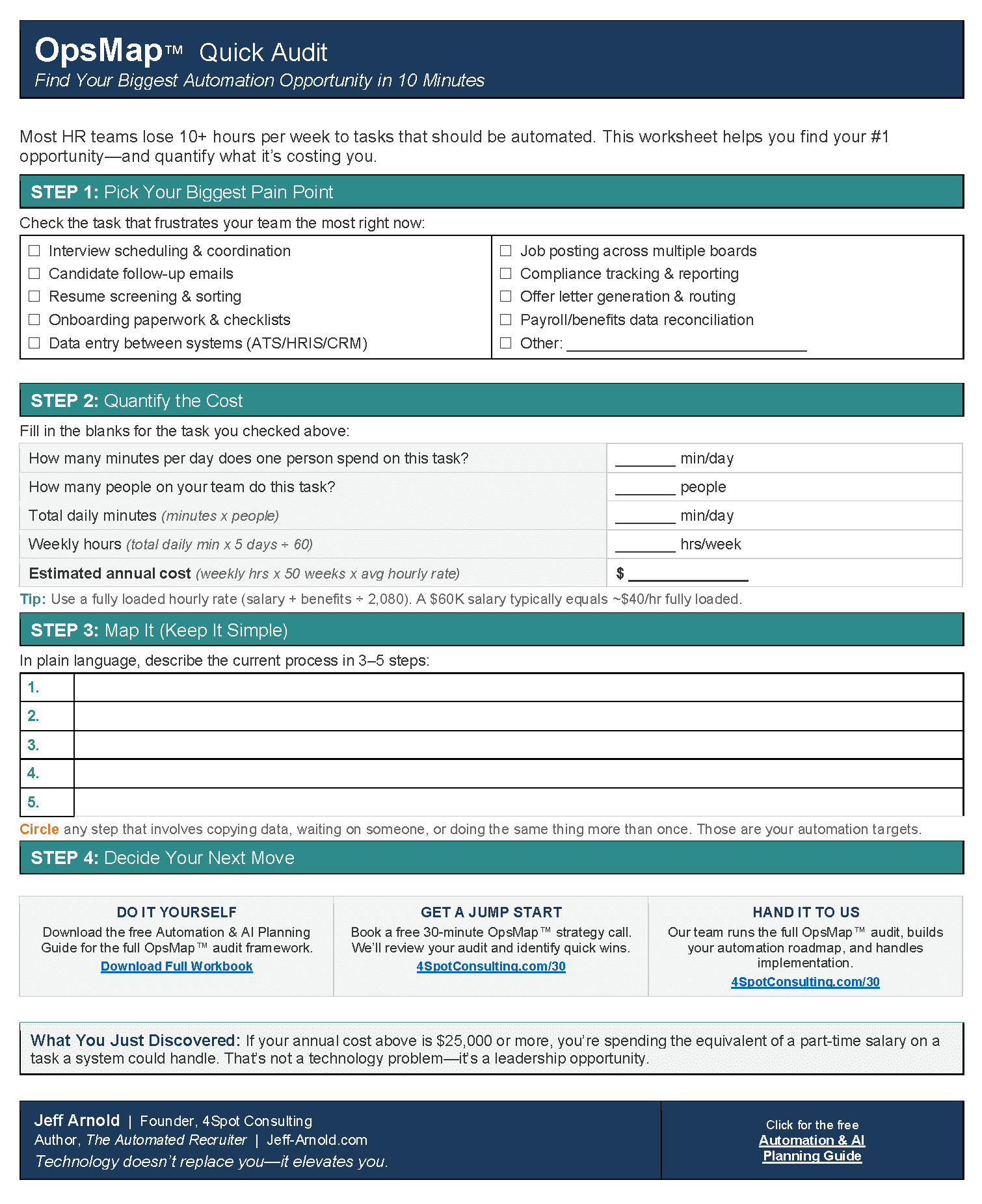
The OpsMap™ strategic audit is the starting point for every sales automation engagement at 4Spot Consulting. Before recommending a single tool, we map your current lead flow end-to-end, surface the specific friction points costing you revenue, and design an ROI-driven roadmap that integrates automation without disrupting your team’s existing strengths.
The OpsMap™ process uncovers three categories of opportunity in nearly every sales operation: tasks that machines handle faster and more accurately than humans, handoffs where leads fall out of the pipeline silently, and data gaps that prevent accurate forecasting. Resolving all three is the difference between an incremental improvement and a structural transformation.
Following the audit, an OpsSprint™ engagement delivers the core automation build—typically within two to four weeks—using OpsBuild™ for custom workflow architecture where standard integrations fall short. OpsCare™ post-launch support ensures the system adapts as your lead volume, product mix, or market positioning evolves.
The promise of AI-powered sales automation is not replacing your best people. It is removing everything that prevents them from doing their best work. When your sales team arrives each morning to a queue of pre-scored, context-rich leads with automated sequences already running, they spend their day building relationships and closing deals—which is exactly the work they were hired to do.
Ready to recover 25% of your sales team’s day and build a pipeline engine that scales without adding headcount? Start with the OpsMap™—a strategic audit that surfaces inefficiencies, quantifies the opportunity, and roadmaps the automations that deliver measurable ROI. Contact 4Spot Consulting to get started.
Frequently Asked Questions
How long does it take to implement automated lead qualification?
A foundational lead scoring and routing system goes live in two to four weeks through an OpsSprint™ engagement, assuming your CRM and lead sources are already in place. More complex multi-source integrations with custom AI enrichment layers take four to eight weeks. The OpsMap™ audit defines the scope and timeline before any build begins.
Will automation replace our sales team?
Automation handles repetitive, rules-based tasks—data entry, lead scoring, routing, initial email sequences, and follow-up cadences. Your sales team focuses on conversations, relationship development, and closing. The outcome is a smaller team producing more revenue, not a smaller team doing the same work with less support.
What CRM and automation tools does 4Spot Consulting use for sales automation?
4Spot Consulting builds on Keap for CRM automation, Make.com for workflow orchestration, and AI enrichment tools for lead scoring and data enhancement. The specific stack is determined by the OpsMap™ audit based on your existing systems, team capabilities, and growth objectives.
How do you measure ROI on sales automation?
ROI measurement focuses on four metrics: hours recovered per week, lead response time reduction, pipeline conversion rate improvement, and revenue per sales rep. Baseline data is captured during the OpsMap™ audit so post-implementation results are directly comparable.

RELATED POST