Post: Strategic AI: Supercharging HR & Recruiting Operations
8 Strategic Ways AI Can Supercharge Your HR & Recruiting Operations
In today’s fiercely competitive talent landscape, the traditional approaches to HR and recruiting are no longer sufficient to secure top-tier talent or maintain operational efficiency. Businesses are grappling with mountains of resumes, endless scheduling challenges, and the constant pressure to identify candidates who not only possess the right skills but also align with company culture. The sheer volume of manual tasks often leaves HR and recruiting teams overwhelmed, prone to errors, and struggling to focus on strategic initiatives that truly move the needle. This is precisely where Artificial Intelligence (AI) steps in, not as a replacement for human expertise, but as a powerful amplifier, transforming the very fabric of how organizations attract, engage, and retain talent. For business leaders and HR professionals, understanding and strategically implementing AI isn’t just about adopting new technology; it’s about unlocking unprecedented levels of efficiency, accuracy, and strategic insight. At 4Spot Consulting, we’ve seen firsthand how integrating AI with robust automation frameworks can save businesses 25% of their day, reduce operational costs, and eliminate human error, paving the way for scalable growth. This article explores 8 practical applications where AI can revolutionize your HR and recruiting processes, making them faster, smarter, and more impactful.
The promise of AI in HR isn’t just theoretical; it’s being realized in tangible, measurable ways across diverse industries. From automating repetitive administrative burdens to providing deeper insights into candidate behavior and performance, AI tools are redefining what’s possible. Our approach focuses on pragmatic, ROI-driven solutions that directly address the bottlenecks hindering your talent acquisition efforts. We aim to equip you with actionable strategies to leverage AI, ensuring your high-value employees can shift their focus from low-value, time-consuming tasks to more impactful, human-centric interactions. By embracing these AI-driven transformations, you’re not just modernizing your HR department; you’re building a resilient, agile, and highly effective talent engine capable of sustaining your company’s growth trajectory.
1. Automated Candidate Sourcing and Identification
One of the most time-consuming initial steps in recruiting is sifting through vast candidate pools to identify potential matches. Traditionally, recruiters manually comb through job boards, professional networks, and internal databases, a process that is not only labor-intensive but also susceptible to human biases and missed opportunities. AI fundamentally transforms this by automating the sourcing process, allowing algorithms to analyze millions of profiles across various platforms (LinkedIn, GitHub, industry-specific forums, etc.) in a fraction of the time it would take a human. These AI tools can go beyond simple keyword matching, understanding context, identifying adjacent skills, and even predicting cultural fit based on a candidate’s digital footprint and engagement patterns. For instance, an AI system can learn from your past successful hires, identifying common traits, experiences, and qualifications that might not be immediately obvious. It can then proactively search for candidates who possess these nuanced characteristics, often surfacing passive candidates who aren’t actively looking but would be an excellent fit. This capability means your recruiting team spends less time on initial search and more time engaging with a highly qualified, pre-vetted pool of candidates, drastically improving efficiency and the quality of leads. At 4Spot Consulting, we implement solutions using platforms like Make.com to integrate various data sources, enabling a unified AI-powered sourcing strategy that feeds directly into your CRM, creating a streamlined, efficient, and continuously self-optimizing talent pipeline.
2. Intelligent Resume Screening and Parsing
The sheer volume of applications for a single job opening can be overwhelming, with hundreds, if not thousands, of resumes often landing in a recruiter’s inbox. Manually reviewing each resume for relevant experience, skills, and qualifications is an arduous and error-prone task that can lead to qualified candidates being overlooked. AI-powered resume screening tools move beyond basic keyword searches, utilizing Natural Language Processing (NLP) to understand the context and nuance of a candidate’s experience. These systems can extract specific data points, identify transferable skills, and even rank candidates based on predefined criteria and the specific requirements of the job description. Moreover, AI can be trained to recognize patterns in successful past hires, predicting which candidates are most likely to excel in a given role and within your organization’s unique culture. This not only significantly reduces the manual workload on your HR team but also enhances the objectivity of the initial screening process. By establishing consistent, data-driven criteria, AI helps mitigate unconscious biases that can creep into human review, leading to a more diverse and equitable candidate pool. The result is a more efficient, fair, and effective screening process that quickly surfaces the best candidates, allowing your team to focus their valuable time on deeper assessments and interviews. We help clients configure these systems to ensure seamless data flow from initial application to candidate management, ensuring no valuable data or time is lost.
3. AI-Powered Interview Scheduling and Coordination
The administrative burden of coordinating interviews across multiple candidates and hiring managers can be a significant drain on HR resources. The endless back-and-forth emails, calendar clashes, and follow-ups consume valuable time that could be better spent on candidate engagement or strategic planning. AI-powered scheduling tools virtually eliminate this bottleneck. These intelligent assistants can integrate directly with calendars (like Outlook or Google Calendar) for both candidates and hiring teams, automatically finding optimal time slots that work for all parties. They can send out invitations, handle rescheduling requests, provide directions, and send timely reminders, all without human intervention. This automation ensures a seamless, professional experience for candidates, reflecting positively on your organization’s efficiency and respect for their time. For your internal teams, it frees up countless hours previously spent on administrative tasks, allowing recruiters to focus on building rapport with candidates and managing the overall recruitment pipeline. Furthermore, some advanced systems can even factor in interviewer preferences, time zones, and the complexity of different interview stages (e.g., panel interviews vs. one-on-one). The time savings are immediate and substantial, contributing directly to a faster time-to-hire and a more positive overall experience for everyone involved in the recruitment process. This type of automation is a cornerstone of our OpsMesh framework, ensuring your systems work harmoniously to save time and reduce errors.
4. Personalized Candidate Engagement and Communication
Maintaining consistent and personalized communication with candidates throughout the hiring journey is crucial for a positive candidate experience, yet it’s often neglected due to time constraints. Candidates frequently express frustration over a lack of communication or generic, impersonal responses. AI-powered tools, particularly chatbots and conversational AI, are revolutionizing candidate engagement. These systems can provide instant answers to frequently asked questions about the company, the role, benefits, or the application process, available 24/7. They can guide candidates through the application, provide updates on their status, and even conduct preliminary screening questions in a conversational, engaging manner. This level of personalized, on-demand interaction significantly improves the candidate experience, making them feel valued and informed, which is critical in attracting top talent. Beyond initial queries, AI can also help automate follow-up emails, send personalized content (e.g., articles about company culture, testimonials), and nurture passive candidates over time, ensuring they remain engaged until the right opportunity arises. By taking over routine communication, AI allows human recruiters to focus on high-value interactions, such as deeper discussions with shortlisted candidates, building genuine relationships that lead to stronger hires. This strategic application of AI ensures your talent pipeline remains warm, engaged, and actively interested, reducing candidate drop-off rates and enhancing your employer brand.
5. Predictive Analytics for Hiring Trends and Performance
Beyond individual candidate interactions, AI offers powerful capabilities in analyzing historical data to predict future hiring trends, identify potential performance indicators, and optimize overall recruitment strategies. Traditional HR often relies on retrospective analysis, looking at what has already happened. AI, however, leverages vast datasets—including past hiring success rates, employee tenure, performance reviews, industry trends, and even external economic indicators—to forecast future talent needs and potential challenges. For example, an AI system can analyze the characteristics of your top-performing employees to identify common traits that correlate with success in specific roles, informing future job descriptions and screening criteria. It can predict which source channels yield the highest quality hires, allowing you to reallocate your recruiting budget more effectively. Furthermore, AI can identify patterns that lead to early employee turnover, helping you adjust your hiring process or onboarding strategies to improve retention. This shift from reactive to proactive decision-making empowers HR leaders to move beyond guesswork, making data-driven choices about workforce planning, talent development, and recruitment investments. By understanding what drives success and retention within your organization, you can continuously refine your talent acquisition strategy, ensuring you’re always one step ahead in securing the human capital essential for your business’s growth. 4Spot Consulting helps businesses integrate disparate data sources to build these predictive models, turning raw data into actionable insights.
6. Enhanced Onboarding and Employee Lifecycle Automation
The hiring process doesn’t end when a candidate accepts an offer; a seamless and efficient onboarding experience is critical for new hire retention and productivity. While often seen as separate from initial recruiting, a clunky onboarding process can undermine all the effort put into attracting talent. AI and automation play a pivotal role here by personalizing and streamlining the entire new hire journey. Imagine an AI assistant that guides new employees through pre-boarding paperwork, answers common questions about benefits or company policies, and even helps them navigate internal systems before their first day. This reduces the administrative burden on HR and managers, ensuring all necessary documentation is completed accurately and on time. AI can also personalize onboarding content based on the employee’s role, department, and preferences, providing a tailored experience that makes them feel valued and prepared. Beyond onboarding, AI can continue to support employees throughout their lifecycle, from suggesting relevant training modules to facilitating internal transfers or promotions. By automating routine tasks and providing intelligent support, AI frees up HR professionals to focus on the human aspects of onboarding and employee development, fostering a stronger sense of belonging and engagement from day one. This holistic approach ensures that the investment made in recruiting translates into long-term employee success and retention, directly contributing to your organization’s bottom line.
7. Skill Matching for Internal Mobility and Development
In a rapidly evolving job market, identifying and developing the existing talent within your organization is just as crucial as external hiring. Companies often overlook the wealth of skills and potential within their current workforce, leading to unnecessary external recruitment drives and missed opportunities for employee growth. AI is exceptionally good at creating a dynamic, real-time inventory of employee skills, experiences, and career aspirations. By analyzing performance reviews, project contributions, training records, and even internal communication patterns, AI can build comprehensive skill profiles for each employee. This data can then be used to intelligently match employees to internal job openings, special projects, or mentorship opportunities that align with their development goals and the organization’s needs. Such systems foster a culture of internal mobility, reducing the need for costly external hires and boosting employee engagement and retention. When employees see clear pathways for growth within the company, they are more likely to stay and invest in their careers there. Furthermore, AI can identify skill gaps within teams or across the organization, recommending personalized learning and development paths to upskill or reskill employees, ensuring your workforce remains competitive and adaptable. This strategic application of AI optimizes human capital utilization, turning your existing employees into your most valuable and renewable resource.
8. Bias Reduction and Diversity Enhancement
Despite best intentions, human decision-making in recruiting can be susceptible to unconscious biases related to gender, ethnicity, age, and other factors, leading to less diverse and less innovative workforces. AI offers a powerful means to identify and mitigate these biases throughout the recruitment process, promoting true meritocracy and enhancing diversity. AI tools can analyze job descriptions for gender-coded language or phrases that might unintentionally deter certain demographics, suggesting neutral alternatives. During resume screening, AI can be configured to anonymize certain demographic data or focus purely on skills and experience, reducing the potential for bias in initial reviews. Some advanced AI platforms can even analyze interview responses or video snippets for patterns of bias in interviewer behavior, providing feedback and training opportunities. While AI itself must be carefully developed and trained on unbiased data to avoid perpetuating existing biases, when implemented thoughtfully, it provides a consistent, objective framework for evaluation. By standardizing criteria and focusing on measurable competencies rather than subjective impressions, AI helps ensure that every candidate is evaluated fairly based on their qualifications and potential. This not only leads to a more diverse and inclusive workforce but also unlocks the documented benefits of diversity: increased innovation, better problem-solving, and enhanced financial performance. 4Spot Consulting works to implement these systems with a strong emphasis on ethical AI, ensuring your automation truly serves your goals of equity and efficiency.
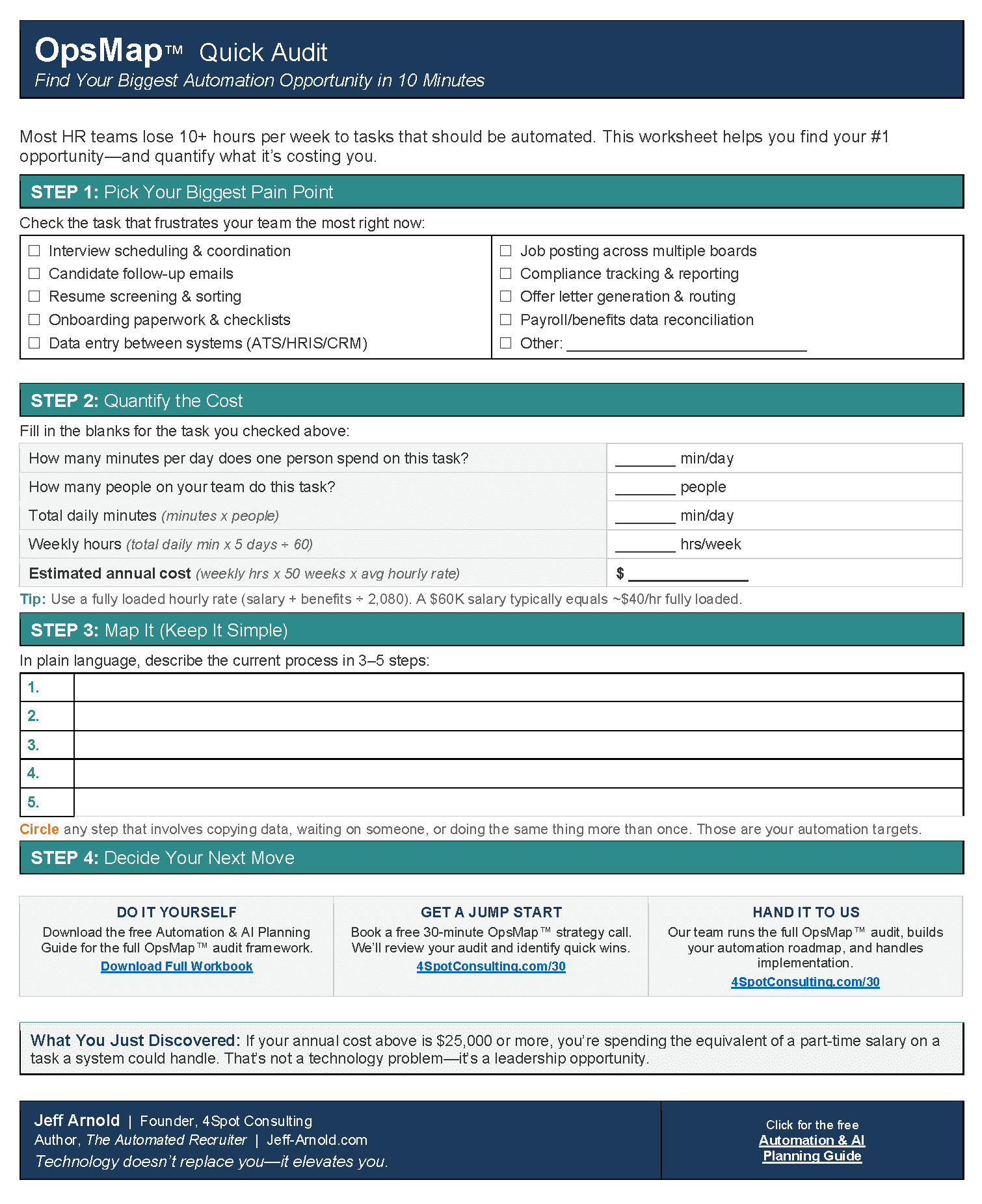
The integration of AI into HR and recruiting is no longer a futuristic concept but a present-day imperative for organizations seeking a competitive edge. From automating tedious administrative tasks to providing deep predictive insights, AI empowers HR teams to transcend operational bottlenecks and elevate their strategic impact. The benefits are clear: reduced time-to-hire, improved candidate quality, enhanced candidate and employee experience, significant cost savings, and a more diverse, engaged workforce. By embracing these AI-driven transformations, businesses can ensure their talent acquisition strategies are not just reactive but proactive, intelligent, and scalable. At 4Spot Consulting, we specialize in helping high-growth B2B companies strategically integrate AI and automation into their HR and recruiting operations, ensuring every investment yields tangible ROI. Our OpsMap™ diagnostic identifies precisely where AI can create the most significant impact for your unique challenges, paving the way for systems that truly save you 25% of your day. Don’t let manual inefficiencies hold your talent strategy back; the future of recruiting is intelligent, automated, and here now.
If you would like to read more, we recommend this article: The Ultimate Guide to AI-Powered HR & Recruiting Automation
RELATED POST