Post: Elevate Your HR & Recruiting: 9 Practical AI Applications for Strategic Talent Management
9 Practical AI Applications Transforming HR and Recruiting
The landscape of Human Resources and Recruiting is undergoing a seismic shift, driven by the rapid evolution of Artificial Intelligence. For too long, HR professionals have been mired in manual, repetitive tasks that drain valuable time and resources, diverting their focus from strategic initiatives that truly impact business growth. From sifting through mountains of resumes to scheduling endless interviews, the operational overhead can be staggering, leading to burnout, inconsistencies, and missed opportunities. At 4Spot Consulting, we understand that for high-growth B2B companies, time is money, and every minute saved translates directly into increased productivity and profitability. This isn’t just about adopting new tech; it’s about fundamentally reshaping how you attract, hire, and retain talent, saving you 25% of your day and enabling your team to focus on what matters most. The promise of AI in HR is no longer a futuristic concept; it’s a present-day reality offering tangible, transformative benefits. This article will explore nine practical applications of AI that are redefining HR and recruiting, providing actionable insights for leaders ready to leverage these innovations to gain a competitive edge.
The transition from theoretical discussions of AI to its practical implementation is where the real value lies. Our OpsMesh framework is designed to help businesses strategically integrate such technologies, ensuring they solve real problems and deliver measurable ROI. By eliminating human error and reducing operational costs, AI empowers HR and recruiting teams to be more agile, data-driven, and ultimately, more effective. The goal isn’t to replace human judgment but to augment it, providing powerful tools that enhance decision-making and streamline workflows. Let’s delve into the specific ways AI is making an impact right now, offering a roadmap for how your organization can harness these capabilities to build a more efficient and impactful talent function.
1. AI-Powered Candidate Sourcing and Discovery
One of the most time-consuming aspects of recruiting is identifying and engaging with qualified candidates. Traditional methods often rely on keyword searches, manual database sifting, and limited professional network connections, which can lead to overlooking exceptional talent and perpetuating bias. AI-powered sourcing tools revolutionize this process by analyzing vast datasets—including professional networks, public profiles, and even academic papers—to identify candidates who not only match specific skill sets but also possess traits indicative of cultural fit. These tools can go beyond simple keywords, understanding semantic nuances and predictive analytics to suggest candidates who might not explicitly list every required skill but whose experience demonstrates proficiency. For example, an AI system might identify a candidate who has excelled in project management in a related industry, even if “agile methodologies” isn’t explicitly in their profile, by understanding the context of their previous roles. This approach significantly expands the talent pool and uncovers passive candidates who aren’t actively looking, giving your organization a crucial competitive advantage. Using tools like Make.com, we can integrate these AI sourcing platforms directly into your existing CRM (like Keap or HighLevel), ensuring that a continuous stream of relevant, pre-qualified leads automatically populates your pipeline, reducing manual data entry and ensuring no promising candidate slips through the cracks.
2. Intelligent Resume Screening and Shortlisting
The sheer volume of applications for a single role can be overwhelming, often leading to qualified candidates being overlooked due to human fatigue or unconscious bias during manual review. AI-driven resume screening tools automate the initial filtering process with remarkable efficiency and objectivity. These systems can quickly parse thousands of resumes, extracting key information, identifying relevant experience and skills, and ranking candidates based on predefined criteria. Unlike human screeners, AI doesn’t get tired, nor does it carry inherent biases related to names, alma maters, or unconventional career paths. It focuses solely on the data that matters. For instance, an AI can be trained to recognize nuanced qualifications for a niche tech role that a generalist recruiter might miss, or to prioritize candidates with specific certifications over those with less relevant degrees. This not only dramatically reduces the time spent on manual screening but also improves the quality and diversity of the shortlisted candidates. At 4Spot Consulting, our OpsBuild services often involve setting up such systems, integrating AI parsing engines with CRM and ATS platforms to ensure a seamless flow from application to qualified lead, a process that can save an HR firm over 150 hours per month, as we’ve demonstrated with past clients.
3. AI-Enhanced Interview Scheduling and Coordination
The back-and-forth of interview scheduling is a notorious time sink for both candidates and recruiters. Coordinating schedules across multiple interviewers, time zones, and availabilities can quickly become a logistical nightmare. AI-powered scheduling assistants eliminate this friction entirely. These tools can access calendars of all involved parties, propose optimal interview slots, and send automated invitations and reminders. They can even adapt to last-minute changes, rescheduling without human intervention. Imagine a system that not only finds the best time for a panel of five interviewers but also automatically sends pre-interview briefs to the interviewers and confirmation details to the candidate, complete with virtual meeting links. This frees up administrative staff and recruiters to focus on more strategic, candidate-facing activities. For businesses leveraging Keap or similar CRMs, we can integrate these scheduling bots to automatically trigger follow-up communications, capture candidate feedback, and even update candidate statuses in the pipeline, ensuring a smooth, professional, and efficient candidate experience from start to finish. This level of automation is critical for high-growth companies where every hour counts.
4. Personalized Candidate Experience with AI Chatbots
Providing a responsive and informative experience for every candidate, especially at scale, is challenging for any HR team. AI chatbots offer a scalable solution for delivering instant support and personalized information 24/7. These chatbots can answer frequently asked questions about job roles, company culture, benefits, and application status, significantly reducing the inbound query load on recruiters. They can also guide candidates through the application process, offering tips and ensuring all necessary information is provided. For example, a candidate applying at 2 AM can get an immediate answer about the company’s parental leave policy or the typical timeline for an interview process. Moreover, advanced chatbots can pre-qualify candidates by asking structured questions, gathering initial data that can inform subsequent human interactions. Utilizing platforms like Bland AI for voice interactions or custom chatbot integrations through Make.com, we help clients deploy intelligent assistants that enhance candidate engagement, improve satisfaction, and ensure that human recruiters step in only when truly necessary, focusing on meaningful conversations rather than repetitive inquiries. This elevates the perception of your brand as a modern, candidate-centric employer.
5. Predictive Analytics for Talent Retention and Turnover
Employee turnover is a costly problem, impacting productivity, morale, and recruitment budgets. AI offers powerful predictive capabilities to identify employees at risk of leaving before they even start looking for new opportunities. By analyzing various data points—such as performance reviews, compensation, tenure, engagement survey results, management feedback, and even external market trends—AI algorithms can pinpoint patterns and predict flight risks with surprising accuracy. This allows HR leaders to proactively intervene with targeted retention strategies, such as personalized development plans, compensation adjustments, or mentorship programs. For example, an AI might flag an employee who hasn’t received a promotion in two years, whose peer group is rapidly advancing, and whose engagement scores have slightly dipped, prompting a manager to check in. This shift from reactive to proactive talent management is a game-changer. Our OpsMap diagnostic helps identify the data points within your organization that can fuel such predictive models, allowing us to build custom dashboards and automated alert systems that ensure you can strategically address retention challenges before they escalate, protecting your most valuable asset: your people.
6. AI-Driven Performance Management and Feedback
Traditional annual performance reviews are often seen as bureaucratic, backward-looking, and ineffective. AI is transforming performance management into a continuous, data-driven, and forward-looking process. AI tools can collect and synthesize feedback from multiple sources (peers, managers, direct reports), identify performance trends, and even suggest personalized coaching and development opportunities. Beyond simple sentiment analysis, these systems can identify skill gaps across teams or the organization as a whole, enabling more strategic training investments. For instance, an AI might analyze project outcomes and identify that a specific team consistently struggles with a particular software, prompting the system to recommend targeted training modules or internal knowledge-sharing sessions. This moves beyond subjective opinions to objective, actionable insights. By integrating these systems with existing HRIS platforms via custom automation, 4Spot Consulting helps clients create a dynamic performance ecosystem where employees receive timely, constructive feedback, fostering continuous improvement and alignment with organizational goals. This ensures that performance management becomes a tool for growth, not just evaluation.
7. Automated Onboarding Workflows and Experience
The first few weeks are critical for new hires, setting the tone for their entire tenure with your company. A disjointed or manual onboarding process can lead to frustration, disengagement, and early attrition. AI and automation, central to 4Spot Consulting’s core offerings, can streamline and personalize the entire onboarding journey. Imagine a system that automatically triggers all necessary paperwork (integrating with tools like PandaDoc), assigns mandatory training modules, sets up IT accounts, introduces the new hire to key team members, and schedules initial check-ins—all tailored to their role and department. AI can even analyze progress and nudge new hires or their managers about pending tasks. For instance, if an employee hasn’t completed their benefits enrollment by a certain date, the system can automatically send a reminder email or trigger a task for an HR representative to follow up. This ensures a consistent, positive experience for every new hire, reduces administrative burden on HR, and accelerates time-to-productivity. Our OpsBuild framework specializes in creating these interconnected, intelligent workflows, ensuring a smooth transition for new employees and a significant reduction in human error and manual effort for your HR team.
8. AI for Compensation and Benefits Benchmarking
Attracting top talent requires competitive compensation and benefits packages, but staying abreast of market trends can be a complex and time-consuming endeavor. AI tools can analyze vast amounts of compensation data from various sources—industry reports, job boards, salary surveys, and even real-time market fluctuations—to provide accurate, up-to-date benchmarks. These systems can factor in location, industry, company size, specific skill sets, and experience levels to recommend optimal salary ranges for new hires and ensure internal equity for existing employees. For example, an AI could highlight that your entry-level software engineer salaries are 10% below market average in a specific geographic area, allowing you to adjust offers strategically. Furthermore, AI can help model the impact of different benefits packages on employee satisfaction and retention, enabling HR to make data-driven decisions that align with organizational goals and budget constraints. This ensures that your compensation strategy is not only competitive but also fair and transparent, a key factor in both attracting and retaining high-quality professionals. 4Spot Consulting can help integrate these AI-driven insights into your overall HR data strategy.
9. AI-Driven Employee Engagement and Culture Insights
Understanding and fostering a positive company culture is crucial for employee satisfaction and productivity. AI tools can provide unprecedented insights into employee sentiment and engagement levels. By analyzing data from internal communication platforms, sentiment in surveys (while maintaining anonymity and privacy), and even patterns in activity and collaboration, AI can identify potential issues or areas for improvement within the organizational culture. For instance, AI might detect a dip in team collaboration on a specific project or an increase in employee feedback related to workload, prompting management to investigate further. These systems don’t replace human empathy but provide early warning signs and data points that help leaders make informed decisions. They can also recommend personalized interventions, such as connecting employees to mentorship programs or suggesting relevant internal resources based on their feedback. By integrating these insights into an “OpsMesh”-style framework, 4Spot Consulting empowers businesses to create a more responsive, supportive, and engaging workplace, ensuring that employee well-being and cultural health are continuously monitored and optimized. This proactive approach leads to a more stable and motivated workforce, directly impacting long-term business success.
The integration of AI into HR and recruiting is not merely an optional upgrade; it’s a strategic imperative for any business aiming to thrive in today’s competitive talent market. From revolutionizing how you source and screen candidates to personalizing the employee journey and predicting turnover risks, AI offers unparalleled opportunities to enhance efficiency, reduce costs, and elevate the human experience within your organization. The days of manual drudgery and reactive HR are drawing to a close, replaced by a future where data-driven insights and intelligent automation empower teams to be more strategic, proactive, and impactful. At 4Spot Consulting, we specialize in making this future a reality for high-growth B2B companies, providing the expertise to navigate complex integrations and build bespoke automation solutions that deliver tangible ROI.
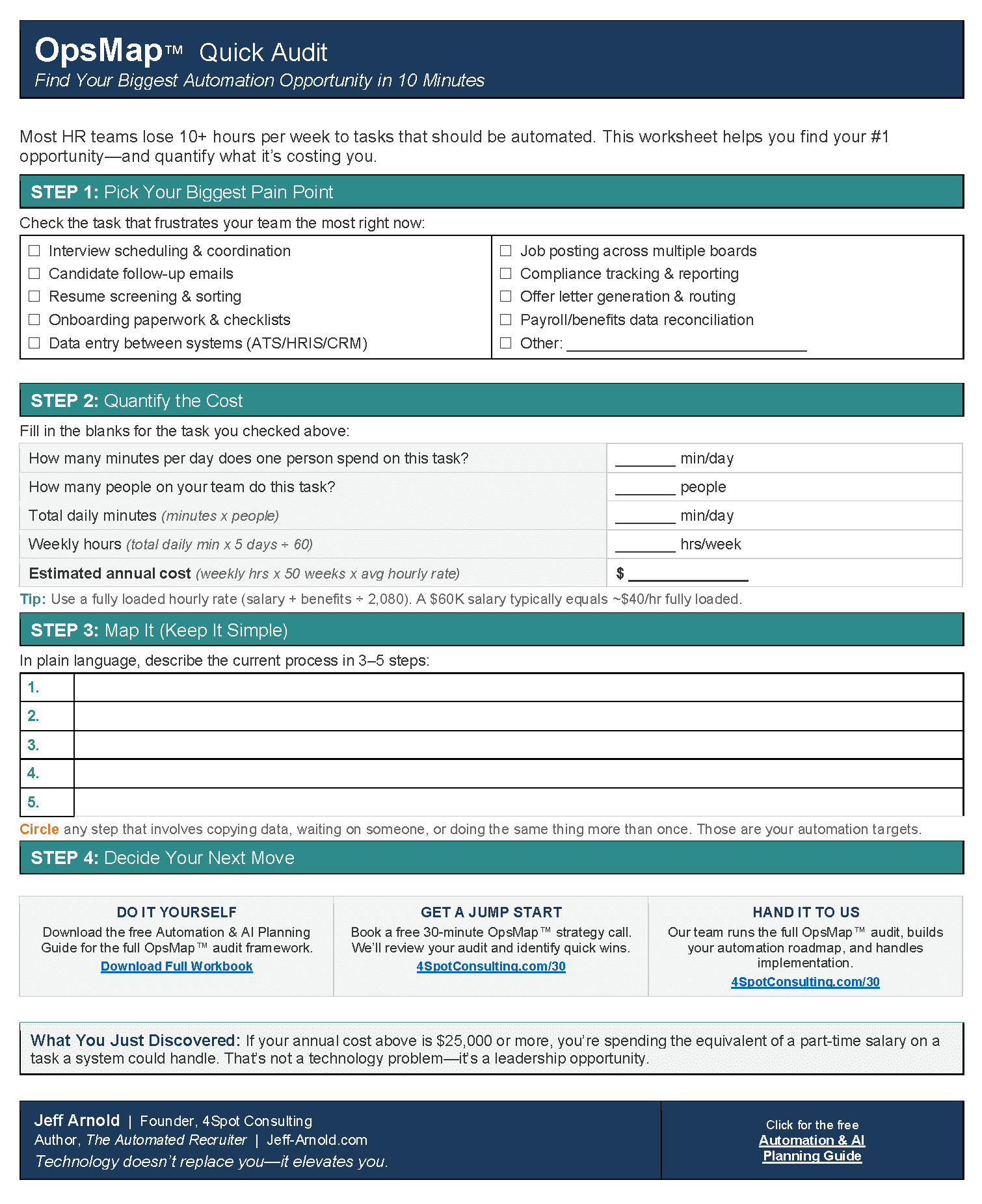
Embracing these AI applications isn’t about adopting technology for its own sake; it’s about fundamentally transforming your operations to save valuable time—up to 25% of your day—and liberate your most valuable employees to focus on high-value, strategic work. If you’re ready to uncover how AI and automation can revolutionize your HR and recruiting functions and unlock significant operational efficiencies, the first step is a strategic audit. Ready to uncover automation opportunities that could save you 25% of your day? Book your OpsMap™ call today and let us help you chart a course to a more automated, intelligent, and profitable future.
If you would like to read more, we recommend this article: The Strategic Imperative of AI & Automation in Modern Business

RELATED POST