Post: Strategic HR Transformed: 7 AI Pathways to Efficiency and Growth
7 Transformative Ways AI is Reshaping HR Operations for Efficiency and Growth
In today’s fast-paced business landscape, HR departments often find themselves grappling with a dual challenge: managing an ever-increasing volume of administrative tasks while simultaneously striving to deliver strategic value to the organization. The traditional HR model, heavily reliant on manual processes, often leads to bottlenecks, human error, and a significant drain on valuable employee time. For HR leaders, COOs, and founders running high-growth B2B companies with $5M+ ARR, the question isn’t whether to adopt new technologies, but how to strategically leverage them to eliminate inefficiencies, reduce operational costs, and accelerate scalability. This is where Artificial Intelligence (AI) emerges not just as a buzzword, but as a pivotal force for transformation.
At 4Spot Consulting, we’ve seen firsthand how the intelligent integration of AI and automation can save teams up to 25% of their day, freeing up high-value employees to focus on initiatives that truly drive growth. We understand that time is money, and every manual process is a potential point of failure or delay. By strategically deploying AI-powered solutions, HR operations can move beyond reactive problem-solving to proactive, data-driven decision-making. This shift not only enhances the employee experience but also directly impacts the bottom line, turning HR from a cost center into a strategic partner. Let’s explore seven practical applications where AI is making the most significant impact.
1. Revolutionizing Candidate Sourcing and Screening with AI
The initial stages of recruitment—sourcing, screening, and shortlisting candidates—are notoriously time-consuming and often riddled with unconscious bias. AI is dramatically changing this by automating and optimizing these critical processes. AI-powered platforms can scour vast databases, job boards, and social media networks to identify passive and active candidates who precisely match the required skill sets and experience. Beyond keyword matching, advanced AI models can analyze resume content, project histories, and even public contributions to assess a candidate’s potential fit for a role and company culture. This includes natural language processing (NLP) to parse complex resumes, extracting relevant data points, and ranking candidates based on predefined criteria.
Furthermore, AI-driven screening tools can conduct initial interviews via chatbots or video analysis, evaluating responses for relevant keywords, tone, and even emotional intelligence, providing an objective, standardized first pass. This not only significantly reduces the time-to-hire but also helps HR professionals focus their energy on interviewing the most qualified candidates, leading to better hires and a more diverse talent pool. For a company focused on eliminating human error and reducing operational costs, the precision and speed offered by AI in sourcing and screening translate directly into financial savings and enhanced recruitment ROI. Our OpsMesh framework often identifies these early recruitment stages as prime candidates for automation, leveraging tools like Make.com to connect sourcing platforms with CRM systems like Keap, ensuring a seamless, data-rich talent pipeline.
2. Enhancing Employee Onboarding and Offboarding Processes
First impressions matter, and a streamlined onboarding experience is crucial for employee retention and productivity. Conversely, an efficient offboarding process protects company data, ensures compliance, and maintains a positive employer brand. AI and automation are transforming both ends of the employee lifecycle. For onboarding, AI-powered systems can personalize the experience by delivering relevant information, training modules, and task lists tailored to the new hire’s role and department, ensuring all necessary paperwork is completed digitally and correctly. This can range from automatically generating offer letters and contracts using tools like PandaDoc, to setting up IT accounts and assigning initial training paths based on their role profile.
Imagine a system that automatically triggers welcome emails, schedules introductory meetings, provides access to internal knowledge bases, and tracks completion of mandatory compliance training – all without manual intervention. For offboarding, AI helps ensure that all necessary steps, from equipment return and access revocation to final payroll processing and exit interviews, are completed systematically and securely. This minimizes compliance risks and ensures a smooth transition. The automation of these processes, often orchestrated through platforms like Make.com, liberates HR teams from tedious administrative burdens, allowing them to focus on meaningful engagement with employees rather than chasing forms. This aligns perfectly with our OpsBuild philosophy, creating robust, error-free workflows that enhance the employee journey from start to finish.
3. Powering Personalized Learning and Development (L&D)
In a rapidly evolving professional landscape, continuous learning is not just a benefit; it’s a necessity for talent retention and organizational agility. AI is revolutionizing L&D by moving beyond one-size-fits-all training programs to highly personalized learning paths. AI algorithms can analyze an employee’s current skills, career aspirations, performance reviews, and even internal project data to recommend specific courses, certifications, and development opportunities that align with their individual needs and the company’s strategic goals. This means employees receive relevant, timely training that directly impacts their effectiveness and career trajectory.
Furthermore, AI-powered platforms can track learning progress, identify skill gaps across the organization, and predict future skill requirements based on industry trends and business objectives. This enables HR to proactively develop talent pipelines and address potential shortages before they become critical. For example, if an AI detects a looming need for data science skills within a department, it can suggest relevant training to current employees, upskilling the existing workforce rather than relying solely on external hiring. This strategic approach to L&D, driven by AI, not only improves employee engagement and retention but also builds a more resilient and adaptable workforce, directly supporting the scalability goals of high-growth companies. It’s about empowering employees with the right knowledge at the right time, a core tenet of efficient operations.
4. Predictive Analytics for Strategic Workforce Planning
One of the most strategic applications of AI in HR is its ability to provide predictive insights for workforce planning. Historically, workforce planning has been a reactive exercise, but AI transforms it into a proactive, data-driven discipline. By analyzing vast datasets—including historical hiring trends, employee performance, attrition rates, compensation data, market trends, and even external economic indicators—AI models can forecast future talent needs with remarkable accuracy. This allows HR and leadership to anticipate skill gaps, predict potential employee turnover, and understand the optimal team structures required to achieve future business objectives.
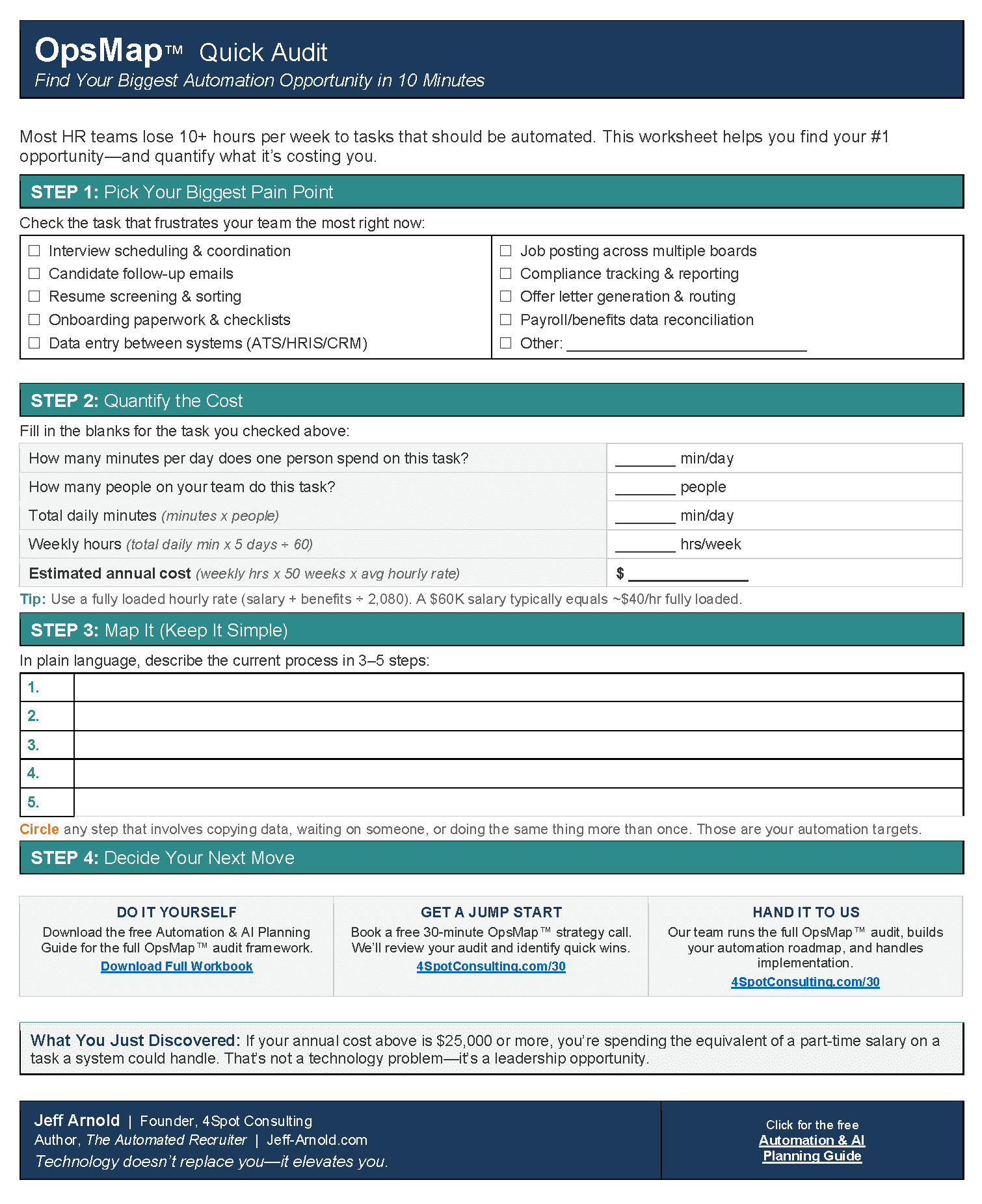
For example, AI can identify patterns that indicate which employees are at risk of leaving, enabling HR to intervene with targeted retention strategies. It can also suggest optimal internal mobility opportunities, matching employee skills with internal vacancies before external recruitment becomes necessary. This capability extends to modeling the impact of different hiring scenarios or organizational restructuring, providing leaders with data-backed insights to make informed decisions. This level of foresight is invaluable for companies aiming for sustainable growth and operational stability, allowing for strategic talent acquisition and development initiatives rather than crisis management. Our OpsMap diagnostic often reveals the disconnects in workforce planning, and AI offers a powerful solution to bridge those gaps, turning raw data into actionable intelligence for business leaders.
5. Implementing Intelligent HR Chatbots and Self-Service Portals
HR departments spend a significant portion of their day answering repetitive employee queries regarding benefits, policies, payroll, time-off requests, and more. This drains valuable HR staff time that could be dedicated to more strategic initiatives. AI-powered chatbots and self-service portals offer an elegant solution. These intelligent systems can provide instant, accurate answers to common questions 24/7, across multiple channels, including internal messaging platforms, company intranets, or dedicated HR portals. Utilizing natural language processing (NLP), these chatbots can understand complex queries and retrieve information from a vast knowledge base, guiding employees to the resources they need.
Beyond simple Q&A, advanced chatbots can facilitate routine transactions, such as submitting expense reports, updating personal information, or requesting IT support, by integrating with various HRIS and other enterprise systems. This significantly enhances the employee experience by providing immediate support, reducing wait times, and empowering employees with greater autonomy. For HR teams, it means a drastic reduction in inbound query volume, allowing them to focus on complex employee relations issues, strategic planning, and talent development. This efficiency gain aligns directly with 4Spot Consulting’s mission to eliminate low-value work from high-value employees, leveraging tools like Make.com to ensure seamless integration and a single source of truth for HR data.
6. Streamlining Performance Management with AI
Performance management, traditionally a time-consuming and often subjective process, benefits immensely from AI integration. AI can introduce objectivity, continuous feedback mechanisms, and predictive insights to make performance reviews more effective and less burdensome. AI-powered tools can analyze employee performance data from various sources – project outcomes, sales figures, learning module completion, peer feedback, and even communication patterns – to provide a holistic and unbiased view of an employee’s contributions. This helps in identifying high performers, spotting areas for improvement, and detecting potential biases in review processes, ensuring fairness and equity.
Furthermore, AI can facilitate continuous feedback loops by analyzing communication within team collaboration tools or suggesting prompts for managers to provide timely and constructive feedback. It can track progress against goals and key performance indicators (KPIs) in real-time, offering insights that help both employees and managers stay on track. This shifts performance management from an annual event to an ongoing development process. By automating data aggregation and analysis, AI allows HR professionals to spend less time on administration and more time on coaching, mentoring, and developing talent, driving better overall organizational performance and aligning individual goals with company objectives. This is about working smarter, not harder, a principle embedded in our OpsCare services for ongoing optimization.
7. Data-Driven Compensation and Benefits Optimization
Determining competitive and equitable compensation packages is a complex challenge, especially in dynamic markets. AI offers powerful capabilities for optimizing compensation and benefits strategies, ensuring that companies attract and retain top talent while maintaining budgetary discipline. AI algorithms can analyze vast amounts of market data – including salary benchmarks, industry trends, competitor offerings, economic indicators, and internal equity data – to recommend optimal salary ranges and benefits packages for specific roles and locations. This helps HR make data-backed decisions that are both competitive externally and fair internally, reducing the risk of pay discrepancies and fostering employee satisfaction.
Beyond initial compensation, AI can model the impact of different benefits offerings on employee engagement and retention. For instance, it can predict which benefits (e.g., specific health plans, wellness programs, professional development stipends) are most valued by different employee segments, allowing for tailored and cost-effective benefits administration. This level of granular insight ensures that every dollar spent on compensation and benefits yields the maximum return in terms of talent attraction, retention, and morale. For high-growth companies, this data-driven approach to total rewards is crucial for scaling effectively and maintaining a competitive edge in the talent market, turning a reactive cost center into a strategic investment. Our expertise in creating single sources of truth for data ensures that all critical compensation data is accurate, accessible, and actionable for AI analysis.
The integration of AI into HR operations is no longer a futuristic concept but a present-day imperative for businesses aiming for sustainable growth and efficiency. From automating tedious tasks to providing predictive insights that empower strategic decision-making, AI is fundamentally reshaping how HR functions, transforming it from an administrative overhead into a powerful engine for organizational success. By embracing these AI-driven transformations, HR leaders can liberate their teams from low-value work, reduce human error, and refocus on what truly matters: people, strategy, and business outcomes.
At 4Spot Consulting, we specialize in helping high-growth B2B companies strategically implement AI and automation to achieve these very benefits. Our OpsMap™ diagnostic is designed to uncover your unique inefficiencies and chart a clear path to automation that saves you time and money. Don’t let manual processes hold your business back. Ready to uncover automation opportunities that could save you 25% of your day? Book your OpsMap™ call today.
If you would like to read more, we recommend this article: Reducing Compliance Risk with HR Data Governance


RELATED POST