Post: The Real Cost of Manual Data Entry in HR
The Silent Drain: Unmasking the True Costs of Manual Data Entry in HR
In the bustling world of business, efficiency is often lauded as the ultimate goal. Yet, many organizations, especially within their Human Resources departments, continue to grapple with a silent, insidious drain on their resources: manual data entry. It’s often seen as an unavoidable chore, a necessary evil, or simply “how things are done.” But at 4Spot Consulting, we see it as a critical bottleneck, not just consuming precious time but eroding profitability, compliance, and employee morale in ways most leaders don’t fully realize.
The perception is that manual data entry is a minor, clerical task. The reality is that it’s a foundational vulnerability, creating ripples of inefficiency and risk across the entire enterprise. It’s not merely about the hours spent; it’s about the opportunities lost, the errors introduced, and the strategic potential left untapped.
The Invisible Drain: Beyond Just Time Saved
When we discuss automation with business leaders, the initial focus is almost always on “time saved.” While time is undeniably a valuable asset, the true costs of manual data entry extend far beyond a simple hourly calculation. We’re talking about accuracy issues that lead to costly corrections, compliance risks that expose the company to legal liabilities, and an insidious impact on employee satisfaction and strategic focus.
Error Proliferation and Compliance Headaches
Every keystroke, every copy-paste, every manual transfer of information carries with it the risk of human error. In HR, these aren’t minor mistakes. An incorrect entry in a payroll system can lead to frustrated employees and costly reconciliation. Mistakes in benefits enrollment can result in coverage gaps and legal challenges. Inaccurate candidate data can derail recruitment efforts or lead to compliance penalties related to EEO reporting.
Furthermore, maintaining an audit trail for compliance in a manual system is a herculean task. Ensuring data integrity, consistency, and proper documentation across disparate spreadsheets and paper files creates a significant overhead. The burden of proof for regulatory bodies becomes heavier, and the cost of an audit can skyrocket as teams scramble to stitch together fragmented information. This isn’t just about avoiding fines; it’s about safeguarding the company’s reputation and operational continuity.
The Erosion of Employee Morale and Strategic Focus
Consider your most talented HR professionals—the ones with a deep understanding of human capital strategy, talent development, and employee engagement. Are they spending a significant portion of their week inputting applicant details, updating employee records, or cross-referencing data points between systems? The answer, for many, is a resounding yes. This isn’t just inefficient; it’s demoralizing.
High-value employees thrive on impactful, strategic work. When they are mired in repetitive, low-value data entry, their engagement plummets, their innovation is stifled, and their strategic insights are lost. The opportunity cost here is immense: instead of developing robust talent pipelines, crafting engaging employee experiences, or analyzing workforce trends, your HR team is essentially acting as an expensive data clerk. This saps creativity, leads to burnout, and ultimately hinders the organization’s ability to attract and retain top talent.
Why HR Leaders Have Resisted (and Why That’s Changing)
Historically, HR departments have sometimes been slower to adopt comprehensive automation compared to other business functions like finance or sales. This has been due to a mix of factors: perceived complexity of HR processes, fear of technology replacing human interaction, or the notion that automation is solely an “IT problem.” Many believed their specific workflows were too nuanced for generic solutions, or that the cost of implementation outweighed the benefits.
However, the landscape has fundamentally shifted. The rise of intuitive low-code/no-code platforms like Make.com, coupled with accessible AI, has democratized automation. HR leaders are now recognizing that leveraging these tools isn’t about replacing human touch, but about amplifying it. By automating the mundane, HR professionals can reclaim their time to focus on the truly human elements of their role—strategic planning, mentorship, conflict resolution, and fostering a thriving company culture. The imperative for HR to be strategic, data-driven, and agile in a rapidly changing world has never been clearer.
Automation as a Strategic Imperative, Not a Technical Luxury
At 4Spot Consulting, we view automation for HR not as a mere cost-saving measure, but as a strategic imperative that fuels business growth, enhances scalability, and builds a formidable competitive advantage. Automating data entry transforms HR from a reactive administrative function into a proactive, data-driven powerhouse that contributes directly to the bottom line. We’ve seen firsthand how liberating HR from manual tasks enables them to focus on what truly matters: people.
From Data Entry to Data-Driven Decisions
Imagine an HR department where applicant tracking, onboarding documentation, benefits enrollment, and payroll preparations are seamlessly integrated and largely automated. This frees up HR professionals to move beyond basic data input and into advanced data analysis. They can identify patterns in hiring cycles, predict future staffing needs, track employee sentiment, and proactively develop talent retention strategies based on real-time insights rather than historical guesswork. This shift empowers HR to advise leadership with concrete data, making more informed decisions about the workforce and the business’s future trajectory.
The 4Spot Consulting Approach: OpsMesh™ in Action for HR
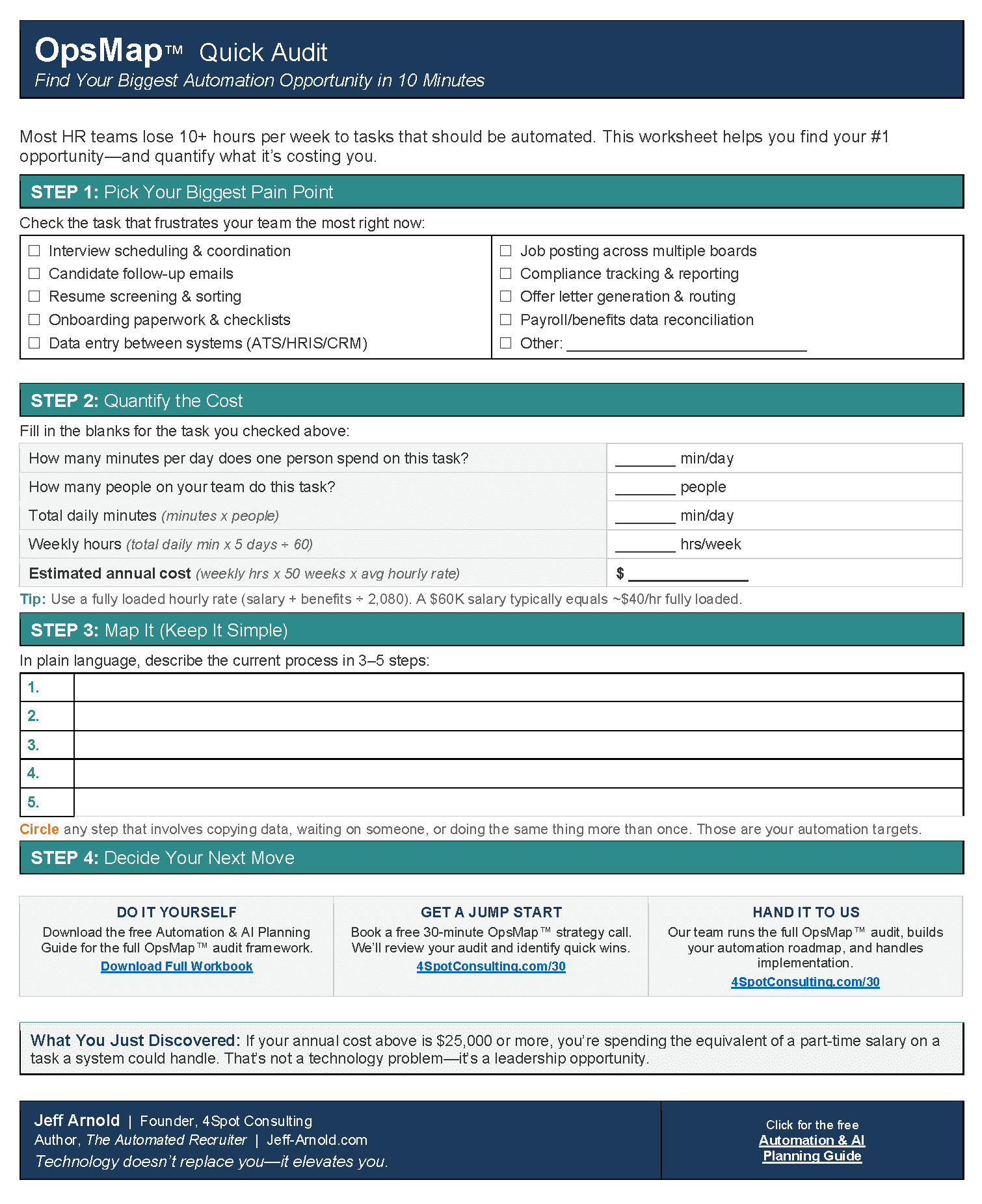
Our OpsMesh™ framework is specifically designed to identify and eliminate these hidden drains. Through our OpsMap™ diagnostic, we conduct a strategic audit to uncover the exact points where manual data entry is costing your HR team time, money, and morale. We then implement tailored solutions during OpsBuild™, leveraging tools like Make.com and AI to create intelligent workflows. For instance, we can automate the parsing of resumes from various sources directly into your CRM (like Keap or HighLevel), automatically trigger background checks, and even initiate onboarding documents, all with minimal human intervention.
We connect dozens of SaaS systems, ensuring that data flows effortlessly and accurately from one platform to another, creating a single source of truth for your HR operations. This strategic approach ensures every automation is tied to a clear ROI and tangible business outcomes, giving your high-value HR employees back 25% of their day to focus on what they do best.
The era of treating manual data entry as an unavoidable HR burden is over. It’s time to recognize it for what it is: a significant impediment to growth, compliance, and employee well-being. By embracing strategic automation, HR leaders can transform their departments into agile, efficient, and truly strategic partners within the organization, ready to tackle the challenges of the modern workforce with confidence and precision.
Ready to uncover automation opportunities that could save you 25% of your day? Book your OpsMap™ call today.
If you would like to read more, we recommend this article: Strategic AI & Automation: Revolutionizing Operations for Growth-Focused B2B Companies



RELATED POST