Post: Rethinking How to Evaluate an HR Automation Consultant: A CHRO’s Buyer’s Guide
Most CHROs evaluate HR automation consultants by checking certifications, platform badges, and demo polish – and end up with a shiny system that nobody actually uses. The right evaluation framework flips the script: you are not buying software expertise, you are hiring a process engineer who happens to automate things.
The standard buyer’s guide advice is backwards. “Check their certifications.” “Ask for client references.” “Request a demo.” Every one of those signals is a trailing indicator – evidence of what a consultant has done before, not proof of what they will actually deliver inside your organization.
CHROs who have burned through automation projects know the pattern. The vendor demo was flawless. The references were glowing. The contract was signed. Then six months later you have a connected system that nobody uses and a workflow that is more fragile than the one it replaced.
This post is a direct challenge to the conventional framework. Here is how to actually evaluate an HR automation consultant – and why most of the standard criteria are measuring the wrong thing entirely.
The Certification Trap
Platform certifications are a vendor marketing tool, not a quality signal for your organization. A Make.com certification tells you a consultant knows the platform. It says nothing about whether they understand HR workflows, change management, or what happens when your HRIS goes down mid-payroll cycle.
The consultants who have caused the most damage to HR operations are not the ones with no credentials. They are the ones with only credentials – technicians who see every problem as a configuration challenge and skip the messy human part of implementation.
What actually matters: does the consultant ask about your current process before proposing any solution? If someone walks into a discovery call ready to recommend a platform, they have already failed the most important test. You have not described your workflows yet. They are pattern-matching against their toolkit, not your reality.
See the 11 most common mistakes HR teams make when automating internally – number one is choosing a tool before defining the process. Outside consultants make the same mistake.
Expert Take
The consultants worth hiring slow down the timeline before speeding up the build. If your evaluation meeting ends with a recommended platform and a project timeline, you talked to a vendor. If it ends with a list of questions about your current state, you talked to a consultant.
What References Actually Reveal – and What They Don’t
Reference checks surface satisfaction, not success – and those are two different things. A client who loved working with a consultant is not necessarily a client whose automation is still running eighteen months later without needing a rescue call.
The questions most CHROs ask references: Was the project delivered on time? Was the team easy to work with? Would you hire them again? Those questions measure project management and relationship skills. They do not measure whether the automation actually stuck or whether the HR team can maintain it without the consultant in the room.
Ask references these instead:
- Is the automation still running exactly as built, or has it needed significant rework?
- Can your internal team modify it when your process changes, or do you have to call the consultant back?
- What happened the first time something broke?
- Did the consultant document the system in a way that a new HR director could understand without any outside help?
The last question is the most revealing. Documentation written for the next person – not for the consultant’s own team – signals that someone is building for your long-term independence, not their long-term retainer.
Expert Take
Consultants who build dependency into their designs are not always doing it maliciously. It is the natural result of optimizing for delivery speed over organizational resilience. The distinction shows up in references – if a client hired the consultant back for maintenance, ask why their own team could not handle it.
Process First, Automation Second
The single biggest predictor of a failed HR automation project is automating a broken process. A consultant who jumps to platform selection without a process audit is going to automate your problems at machine speed.
This is what separates a genuine HR automation consultant from a Make.com specialist. Specialists configure platforms. Consultants map your workflows, find the gaps, fix the upstream logic issues, and then build the automation layer on top of a clean foundation.
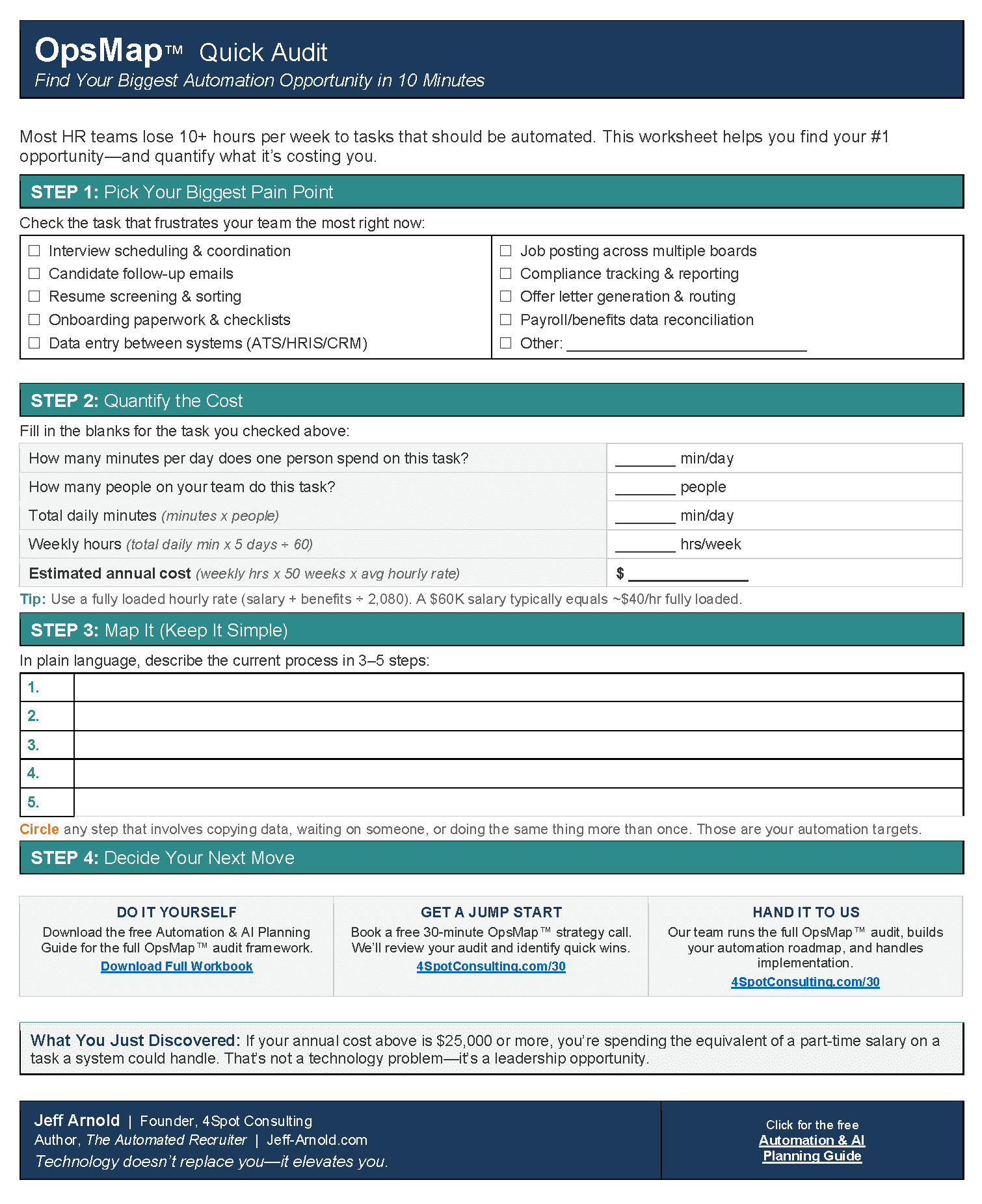
At 4Spot, we call this the OpsMap™ phase – the full workflow audit that happens before a single scenario gets built. It is the work most consultants skip because it does not feel exciting on a project timeline. But it is the work that determines whether the automation delivers or just creates a faster version of your current chaos.
When evaluating a consultant, ask directly: “What happens if you find that our current process needs to change before we automate it?” A consultant who says they will document that as a risk and build around it is telling you they will automate the mess. A consultant who says the project scope includes fixing the upstream process first is telling you they understand the actual job.
For more on why this matters: 10 signs your process must be cleaned up before any HR automation.
Expert Take
Clean process, then automate – in that order, always. The OpsMap is not overhead. It is the difference between a system that runs and a system that has to be babysat. If a consultant’s proposal skips the discovery phase to save on budget, they are transferring the risk to you.
Build-to-Own vs. Build-to-Depend
Every HR automation consultant either builds systems your team can own and modify, or builds systems that require the consultant to stay involved. Both are legitimate business models. Only one is the right fit for most HR organizations.
The build-to-depend model is not always bad. For highly complex, deeply custom automation that integrates multiple enterprise platforms and handles edge cases requiring ongoing expert judgment, having the consultant on retainer for maintenance is not unreasonable. You need to know going in that this is the model you are signing up for.
The problem is when consultants default to complexity because complexity creates recurring revenue, not because your use case requires it. Overcomplicated automation – unnecessary custom code, non-standard integrations, logic that only the builder understands – is a dependency trap dressed up as sophistication.
Ask to see documentation from a past project. Not a summary – actual documentation. If it reads like it was written for the consultant’s own team rather than for an HR manager who might inherit this system two years from now, you have your answer about the model you are buying into.
The OpsBuild™ phase at 4Spot includes a handoff documentation requirement for every project. The test: could a new HR director read it and understand what each automation does and why? If not, it ships back for revision before we close the engagement.
Expert Take
A consultant who wants you dependent on them is not a partner. They are a vendor. The distinction is not hostile – it is just a business model mismatch. Know which model you are evaluating before you sign, and write documentation standards into the contract if build-to-own is your requirement.
Scoping Red Flags That Predict Project Failure
The proposal scope tells you more about how an engagement will go than any reference check. These are the specific red flags that experienced CHROs learn to catch before the contract is signed.
Fixed-price proposals with no discovery phase. Any consultant who prices a project without first understanding your current workflows is pricing a standard template, not your actual situation. Fixed-price is fine – but only after a paid discovery engagement that defines the real scope.
Timeline pressure. “We can have this live in four weeks” for a complex HR workflow automation is a warning sign, not a selling point. Speed at the proposal stage signals shortcuts at the build stage.
Platform-first recommendations. If the first meeting ends with “you should be on Platform X” before the consultant has mapped your workflows, they are selling a product, not a solution. The platform recommendation belongs after the process audit – not before.
No change management component. Automation that HR teams don’t adopt is not automation – it is an expensive experiment. Any proposal that skips training, communication, and adoption planning is missing half the job.
See also: 13 essential questions HR leaders should ask before investing in automation.
Expert Take
The proposal is a consultant’s first deliverable. It tells you how they think, how they scope, and whether they are optimizing for your outcome or their revenue. A proposal that is vague about what happens if scope changes after discovery is protecting the consultant, not the client.
What a Real Delivery Methodology Looks Like
The right question in any evaluation is not “what platforms do they know?” – it is “what is their operating framework for delivery?” A consultant with a repeatable, documented methodology that scales from audit through build through handoff is fundamentally different from one who figures it out project by project.
Our delivery framework – OpsMesh™ – connects four phases that run in sequence: process mapping (OpsMap™), rapid configuration and testing (OpsSprint™), full build and integration (OpsBuild™), and long-term system health (OpsCare™). Each phase has defined outputs, defined handoff criteria, and defined ways for the client to verify progress without taking the consultant’s word for it.
Ask any consultant you are evaluating: “Walk me through your standard delivery framework from discovery to post-launch.” A strong consultant describes their methodology in ten minutes without looking at a slide deck. If the answer is “it depends on the client,” push further and ask what the framework looks like when everything goes right. Every experienced consultant has a pattern – they should be able to articulate it.
If they cannot describe a repeatable methodology, you are likely funding the development of one. That is a reasonable thing to fund if the price reflects the risk. It is a bad deal if you are paying senior rates for a consultant who is learning their delivery process on your project.
Read the Global Talent Solutions case study for a concrete example of what a full OpsMesh engagement looks like from discovery to results.
Expert Take
Methodology is not bureaucracy. It is the mechanism that makes results reproducible. A consultant who improvises every project is selling you access to their instincts. A consultant with a defined framework is selling you a process your team can verify, audit, and extend after they leave.
Frequently Asked Questions
What is the difference between an automation specialist and an HR automation consultant?
An automation specialist knows the platform. An HR automation consultant knows your workflows, your team dynamics, your compliance requirements, and your change management challenges – and uses automation as the delivery mechanism. The specialist builds what you spec. The consultant tells you what to spec and why.
Should CHROs require a paid discovery phase before a full proposal?
Yes – always. A proposal written before any discovery work is a guess dressed up as a scope. Paid discovery is how a legitimate consultant proves they understand your environment before committing to a price, timeline, or platform recommendation. Be skeptical of any consultant who skips this step to win the deal faster.
How should documentation requirements be written into a contract?
Write it as a delivery condition, not a preference. The language should be specific: documentation must enable a new HR operations manager with no prior knowledge of the system to understand the purpose, logic, and maintenance requirements of each automated workflow without vendor assistance. Make it a go-live gate, not an afterthought.
Is platform certification a meaningful signal when evaluating a consultant?
No – not in either direction. Certifications prove training completion, not consulting quality. Many strong HR automation consultants work on platforms where formal certifications don’t exist. Evaluate methodology, references, and documentation standards instead – those are the signals that actually predict outcomes.
What is the right scope to start with when working with a new consultant?
Start with a scoped process audit – the mapping phase only. This is a low-risk way to evaluate a consultant’s thinking and methodology before committing to a full build. If they cannot deliver a sharp, actionable process map, you have learned something important at a fraction of the cost of a failed implementation.
Part of our complete guide: How to Evaluate an HR Automation Consultant: A CHRO’s Buyer’s Guide.