Post: Stop the Data Drain: How a Single Source of Truth Fuels B2B Success
The Unseen Cost of Disconnected Data: Why Your Business Needs a Single Source of Truth
In today’s fast-paced business environment, data is hailed as the new oil. Yet, for many high-growth B2B companies, this invaluable resource often flows through a disconnected labyrinth of systems, leaving a trail of inefficiencies and missed opportunities. At 4Spot Consulting, we regularly encounter businesses struggling with fragmented data, a challenge that, while often overlooked, carries significant hidden costs. This isn’t merely a technical inconvenience; it’s a fundamental impediment to scalability, accurate decision-making, and sustained growth.
The Pervasive Problem of Data Silos
Think about your typical business operation. Customer information resides in your CRM, project details in a separate management tool, financial data in accounting software, and HR records in yet another system. Each department, often unknowingly, operates within its own data silo. While individual tools are powerful, their isolation creates a breeding ground for inaccuracies, duplications, and outdated information. Employees spend valuable hours cross-referencing, manually updating, and trying to reconcile discrepancies, diverting their focus from high-value, strategic tasks.
This fragmentation isn’t just about wasted time. It leads to critical business problems: inconsistent customer experiences, sales teams working with old leads, marketing campaigns misfiring due to incomplete segmentation, and leadership making decisions based on partial or misleading reports. The ripple effect touches every facet of the organization, eroding efficiency and ultimately, profitability. We’ve seen firsthand how a lack of data cohesion can slow down hiring processes, complicate compliance, and make it nearly impossible to gain a 360-degree view of the customer.
Beyond Integration: Defining a True Single Source of Truth (SSOT)
Many businesses attempt to mitigate data silos through basic integrations, linking a CRM to an email marketing platform, for example. While this is a step in the right direction, it often falls short of establishing a true Single Source of Truth (SSOT). An SSOT is more than just connecting systems; it’s a strategic framework that ensures all critical business data is centralized, consistent, and accessible from a unified, authoritative location. It’s about designing an architecture where data originates, is processed, and is ultimately stored in a way that eliminates redundancy and ensures integrity across the entire enterprise.
For us at 4Spot Consulting, this often begins with identifying the core data entities – customers, prospects, employees, products, projects – and then mapping how these entities flow through your various systems. We then architect automation layers, frequently leveraging powerful tools like Make.com, to not only integrate but also normalize and synchronize this data. The goal is that when an update occurs in one system, that change propagates accurately and instantly to all relevant connected systems, maintaining a consistent, reliable record everywhere.
The Foundational Role of a Robust CRM
For many B2B organizations, the CRM naturally serves as the gravitational center for a significant portion of their SSOT strategy. It’s where customer interactions, sales pipelines, and key contact details reside. However, even a robust CRM like Keap can only be a true SSOT if it’s fed accurate, up-to-date information from all other touchpoints – from initial lead capture and marketing engagement to service requests and project milestones. Without this holistic approach, your CRM becomes just another silo, albeit a larger one, rather than the unifying hub it’s designed to be.
This is where deep expertise in CRM architecture and data hygiene becomes paramount. We don’t just connect systems; we optimize the data flowing into and out of your CRM, ensuring it’s clean, structured, and genuinely reflective of your business reality. This includes critical functions like deduplication, data validation, and establishing clear data ownership protocols. The effort invested here pays dividends in empowering sales with precise insights, enabling marketing with targeted campaigns, and providing service teams with complete customer histories at their fingertips.
Tangible Benefits of an SSOT for High-Growth B2B Companies
Adopting an SSOT strategy is not merely a technical upgrade; it’s a strategic imperative that directly impacts your bottom line and scalability. The benefits are far-reaching:
- Enhanced Decision-Making: Leaders gain access to real-time, accurate data, enabling them to make informed strategic decisions based on a complete understanding of business performance.
- Operational Efficiency: Eliminating manual data entry, reconciliation, and information searching frees up employees to focus on productive, revenue-generating activities. This is where we consistently help clients save 25% of their day.
- Improved Customer Experience: With a unified view of every customer interaction, businesses can deliver personalized, consistent, and proactive service, fostering loyalty and driving retention.
- Reduced Risk & Compliance: A centralized, well-governed data environment simplifies compliance efforts and reduces the risk of errors, data breaches, and regulatory penalties.
- Scalability: An SSOT provides a solid foundation for growth. As your business expands, adding new systems or scaling operations becomes far less complex when your core data is harmonized.
- Automation Enablement: A clean, connected data architecture is the bedrock for sophisticated automation. When data flows seamlessly, repetitive tasks can be fully automated, from lead nurturing to invoice generation, without human intervention or error.
Implementing Your Single Source of Truth with 4Spot Consulting
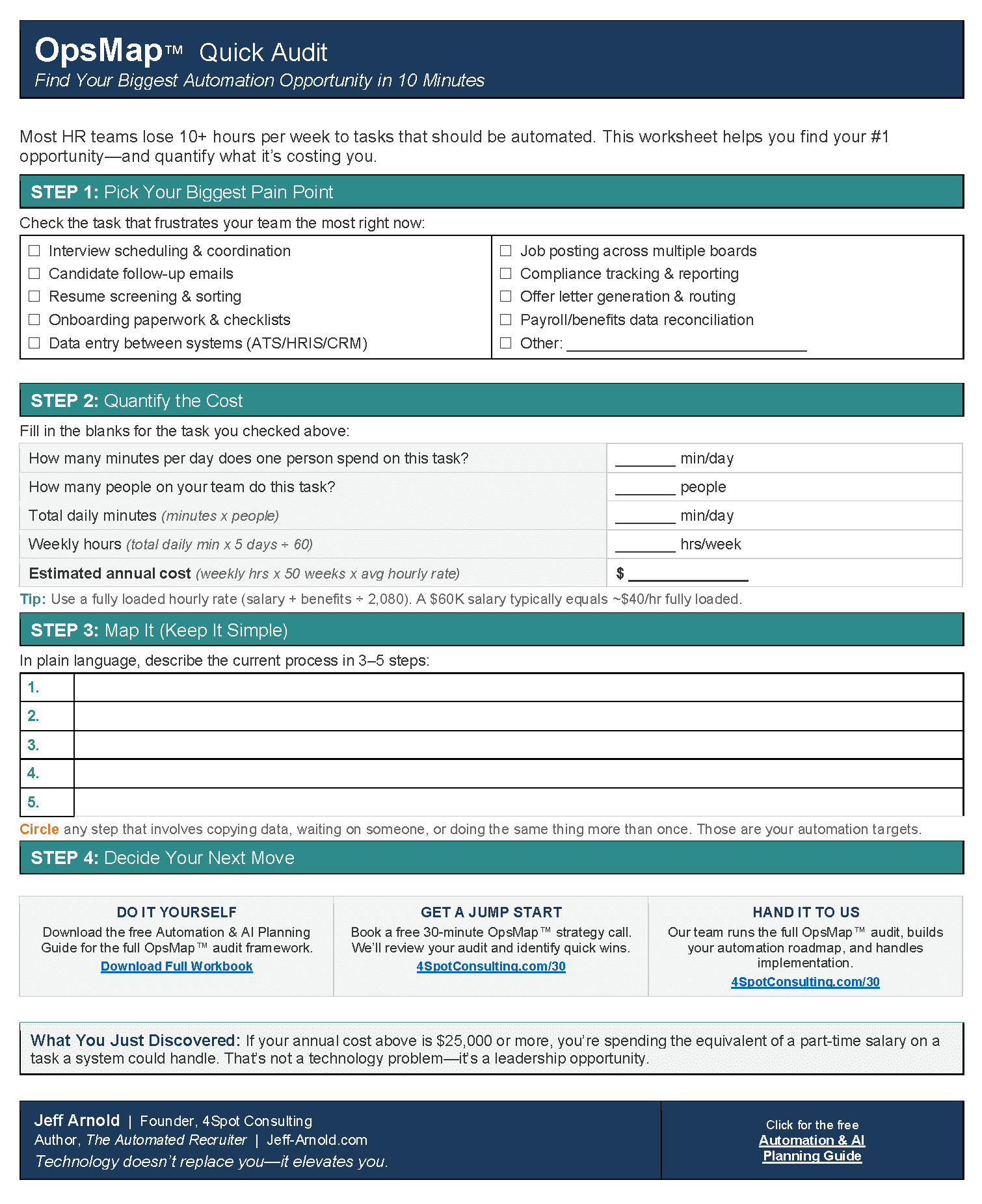
Building a comprehensive SSOT is a complex undertaking, requiring a deep understanding of business processes, technology, and data governance. At 4Spot Consulting, we approach this through our OpsMesh framework, starting with an OpsMap™ diagnostic. This strategic audit pinpoints your current data fragmentation points, identifies inefficiencies, and outlines a clear roadmap for establishing your SSOT. We then move to OpsBuild, implementing the necessary automation and AI systems to connect your data ecosystem, and OpsCare, ensuring ongoing optimization and support.
Don’t let disconnected data be the unseen cost holding back your business. Reclaiming control over your information is not just about tidiness; it’s about unlocking your full potential for growth and efficiency in an increasingly data-driven world. Ready to see how a unified data strategy can transform your operations? Let’s connect.
If you would like to read more, we recommend this article: Keap CRM Data Backup Best Practices for B2B Growth


RELATED POST