Post: Unlocking Real ROI: Practical AI Applications in HR & Recruiting
8 Practical Applications of AI in HR and Recruiting That Drive Real ROI
The modern landscape of HR and recruiting is characterized by increasing demands, tighter budgets, and a perpetual talent war. Companies are under immense pressure to optimize every aspect of their talent lifecycle, from attracting top candidates to retaining high-performing employees. In this environment, the traditional manual processes often fall short, leading to inefficiencies, missed opportunities, and ultimately, a detrimental impact on the bottom line. It’s no longer enough to simply “do HR”; organizations must strategically leverage technology to gain a competitive edge.
Enter Artificial Intelligence. Far from being a futuristic pipe dream, AI is already transforming how HR and recruiting teams operate, offering tangible solutions to long-standing challenges. At 4Spot Consulting, we’ve seen firsthand how intelligently applied AI and automation can eliminate bottlenecks, reduce human error, and free up high-value employees to focus on strategic initiatives rather than repetitive tasks. This isn’t about replacing human judgment; it’s about augmenting human capabilities, providing data-driven insights, and streamlining workflows to achieve unprecedented levels of efficiency and impact. The key is knowing where and how to apply these powerful tools for real, measurable return on investment.
For HR and recruiting leaders, the question isn’t whether to adopt AI, but how to strategically implement it to drive specific business outcomes. The following eight practical applications of AI are designed not just to save time, but to fundamentally enhance the effectiveness and strategic value of your HR and recruiting functions.
1. Automated Candidate Sourcing & Screening
One of the most time-consuming aspects of recruiting is sifting through countless resumes and profiles to identify qualified candidates. AI-powered sourcing and screening tools revolutionize this process by automating much of the initial heavy lifting. These platforms can scan vast databases of talent pools, including LinkedIn, job boards, and internal CRM systems, to identify passive candidates who match specific job requirements. Beyond simple keyword matching, advanced AI can analyze context, identify transferable skills, and even predict cultural fit based on linguistic patterns in profiles. When candidates apply, AI can parse resumes at scale, extracting relevant data points, and then automatically score applicants against predefined criteria. This significantly reduces the manual effort involved in reviewing applications, allowing recruiters to focus their valuable time on engaging with the most promising candidates. For instance, we helped an HR tech client save over 150 hours per month by automating their resume intake and parsing process, then syncing enriched data to their CRM. This not only accelerated their hiring cycle but also improved the quality of candidates making it to the interview stage, demonstrating a clear ROI by optimizing recruiter bandwidth and reducing time-to-hire.
2. Personalized Candidate Experience
In today’s competitive talent market, the candidate experience is paramount. A clunky, impersonal application process can deter top talent. AI can create highly personalized and engaging candidate journeys from the very first touchpoint. AI-powered chatbots, for example, can instantly answer frequently asked questions about job roles, company culture, or benefits, available 24/7. This immediate responsiveness improves candidate satisfaction and reduces the burden on recruiting teams. Beyond FAQs, AI can tailor job recommendations based on a candidate’s profile and interactions, ensuring they see roles most relevant to their skills and aspirations. Personalized communications, such as automated follow-ups with relevant content, keep candidates engaged throughout the hiring process. This not only enhances the employer brand but also significantly reduces candidate drop-off rates. By making the process smoother, more informative, and more engaging, companies can attract and retain top-tier talent who might otherwise have been lost to competitors offering a more seamless experience.
3. Predictive Analytics for Workforce Planning
Strategic workforce planning is critical for long-term business success, but it often relies on historical data and educated guesses. AI transforms this by providing robust predictive analytics capabilities. AI models can analyze vast datasets—including historical hiring trends, employee performance, demographic shifts, economic indicators, and internal mobility—to accurately forecast future talent needs. This allows HR leaders to anticipate skill gaps, predict potential attrition risks, and proactively plan for recruiting and development initiatives. For example, AI can identify patterns in employee data that indicate a higher likelihood of leaving the company, enabling HR to intervene with retention strategies before an employee departs. This proactive approach saves significant costs associated with turnover and allows organizations to maintain optimal staffing levels and skill sets. By moving from reactive hiring to proactive talent management, businesses can ensure they always have the right people with the right skills in the right roles, aligning HR strategy directly with overarching business objectives and avoiding costly last-minute hiring rushes.
4. Enhanced Employee Onboarding & Training
A strong onboarding experience is crucial for new hire retention and productivity, yet it’s often bogged down by administrative tasks and information overload. AI can streamline and personalize the entire onboarding and training journey. AI-driven platforms can create customized onboarding paths based on the new hire’s role, department, and prior experience, ensuring they receive relevant information at the right time. Automated task assignments handle administrative checklists, such as benefits enrollment, IT setup requests, and policy acknowledgments, reducing the manual burden on HR and managers. Intelligent virtual assistants can serve as a primary point of contact for new hires, answering common questions and guiding them through initial processes, accelerating their time-to-productivity. For ongoing training, AI can recommend personalized learning modules based on an employee’s performance data, career aspirations, and identified skill gaps. This adaptive learning approach ensures that training is effective, engaging, and directly contributes to skill development, ultimately fostering a more competent and engaged workforce while significantly reducing the administrative overhead traditionally associated with these critical HR functions.
5. Performance Management & Feedback
Traditional annual performance reviews are often seen as backward-looking, biased, and ineffective. AI is enabling a shift towards more continuous, objective, and development-focused performance management. AI tools can facilitate continuous feedback loops by analyzing employee communications (with appropriate privacy safeguards) to identify sentiment and engagement trends, providing real-time insights to managers. Natural Language Processing (NLP) can assist in summarizing performance data from various sources, making review writing more efficient and objective. AI can also help in setting clear, measurable objectives (OKRs or KPIs) and tracking progress automatically, providing employees and managers with instant visibility into performance. Furthermore, AI can identify high-performing behaviors and areas for improvement, recommending personalized development resources. This data-driven approach removes much of the subjectivity from performance evaluations, leading to fairer assessments, more actionable feedback, and a culture of continuous improvement. By transforming performance management from a compliance exercise into a strategic development tool, AI empowers employees and drives organizational growth, aligning individual contributions with broader company goals.
6. AI-Powered HR Service Delivery
HR departments are frequently inundated with routine employee inquiries regarding policies, benefits, payroll, and more. This constant stream of questions consumes valuable HR staff time that could be better spent on strategic initiatives. AI-powered HR service delivery platforms drastically improve efficiency and employee satisfaction. AI chatbots can act as a first line of defense, instantly resolving up to 80% of common employee questions, available 24/7. For more complex issues, AI can intelligently route inquiries to the appropriate HR specialist, ensuring a faster and more accurate resolution. Self-service portals, often enhanced with AI, allow employees to access information, update personal details, and manage benefits independently. AI can also automate the generation of HR documents, such as offer letters, employment verification letters, and contract amendments, pulling data from various HRIS systems to ensure accuracy and speed. This leads to a significant reduction in the HR team’s administrative burden, faster resolution times for employees, and an overall improvement in internal communication and operational efficiency. It essentially creates a “single source of truth” for internal HR queries, mirroring the efficiency businesses strive for in client service.
7. Compensation & Benefits Optimization
Attracting and retaining top talent requires a competitive and fair compensation and benefits strategy, but this is a complex and ever-changing area. AI can provide invaluable insights for optimizing total rewards. AI algorithms can analyze vast amounts of market data, including industry benchmarks, geographic variations, and skill scarcity, to recommend competitive salary ranges for specific roles. Internally, AI can identify pay disparities and potential biases, helping organizations ensure internal equity and compliance with fair pay regulations. Furthermore, AI can personalize benefits offerings by analyzing employee demographics, preferences, and utilization data, allowing companies to offer packages that are most valued by their workforce while optimizing costs. This might include recommending flexible benefits plans or identifying underutilized perks. By leveraging AI, HR leaders can make data-driven decisions about compensation and benefits, ensuring they attract and retain the best talent, control costs effectively, and maintain a highly motivated and satisfied workforce. It moves the discussion from subjective decisions to strategic, data-backed choices that demonstrate a commitment to employee well-being and market competitiveness.
8. Compliance & Risk Management
Navigating the complex and ever-evolving landscape of labor laws, regulations, and internal policies is a significant challenge for HR. Non-compliance can lead to substantial fines, legal battles, and reputational damage. AI can serve as a powerful ally in compliance and risk management. AI-powered tools can monitor internal communications and HR processes for adherence to company policies and legal requirements, flagging potential issues before they escalate. For instance, AI can analyze hiring practices to identify unconscious biases in job descriptions or resume screening, helping to ensure fairness and prevent discrimination claims. AI can also track changes in labor laws and regulations across different jurisdictions, providing HR with timely alerts and recommendations for policy updates. Furthermore, AI can identify anomalous activities or patterns in HR data that might indicate fraud, misconduct, or security breaches. By providing continuous monitoring and proactive alerts, AI helps HR mitigate legal risks, uphold ethical standards, and protect the organization from costly compliance failures, ensuring that the company operates within legal boundaries while fostering a fair and secure work environment for all employees.
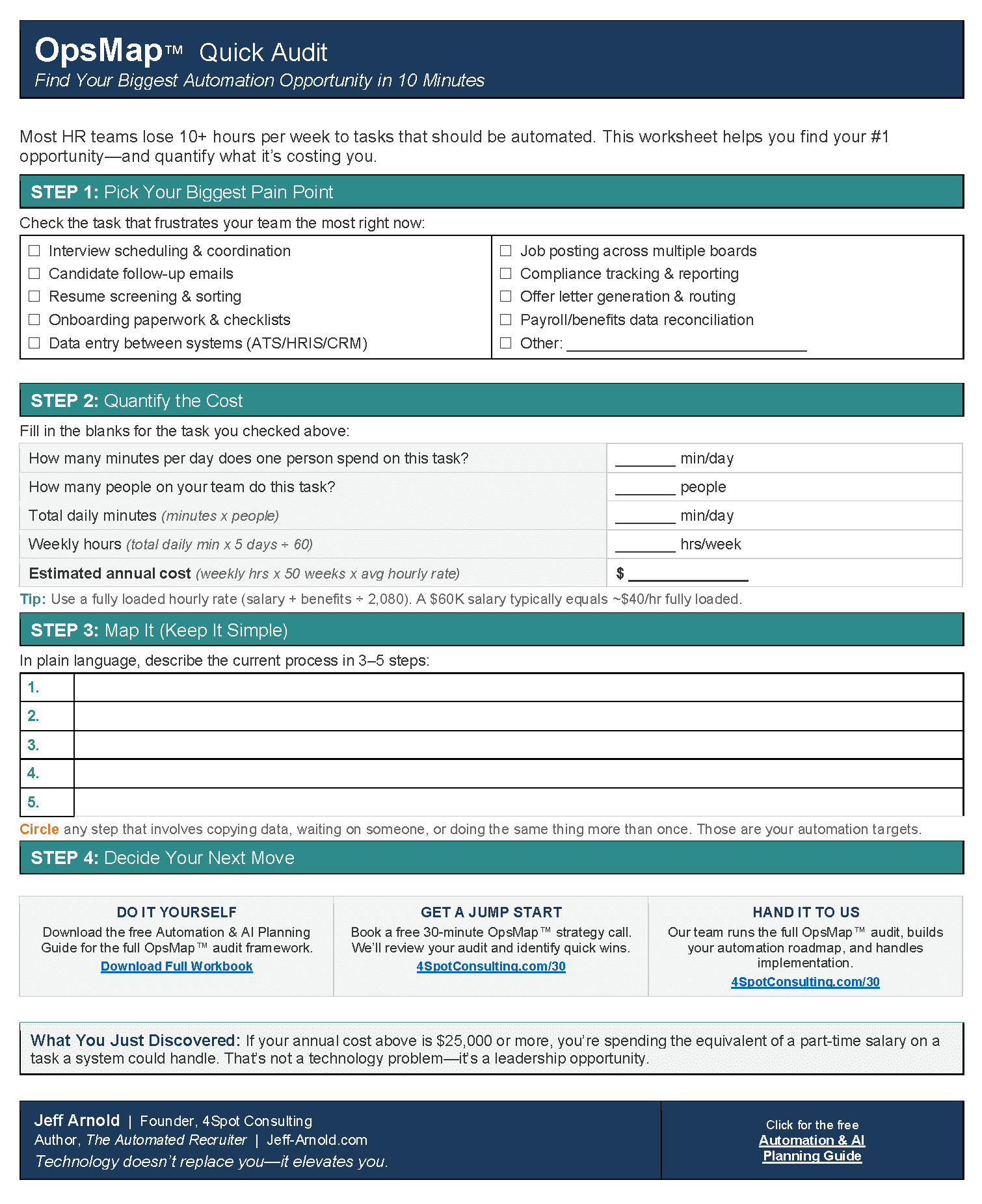
The integration of AI into HR and recruiting is no longer optional; it’s a strategic imperative for any organization aiming for efficiency, scalability, and competitive advantage. These practical applications demonstrate that AI isn’t about replacing the human element but enhancing it, freeing up your valuable HR professionals to focus on strategic initiatives, employee engagement, and high-touch interactions that truly matter. At 4Spot Consulting, we specialize in helping high-growth B2B companies identify and implement these types of AI and automation solutions. We understand that every business is unique, which is why our OpsMap™ strategic audit is designed to uncover your specific inefficiencies and roadmap profitable automations tailored to your needs.
Ready to uncover automation opportunities that could save you 25% of your day? Book your OpsMap™ call today.
If you would like to read more, we recommend this article: AI and Automation for HR & Recruiting: The Definitive Guide
RELATED POST