Post: The Strategic AI Revolution in HR & Recruiting Workflows
9 Strategic Ways AI is Revolutionizing HR and Recruiting Workflows
The landscape of HR and recruiting is undergoing a seismic shift, driven by the relentless pace of technological innovation. For decades, these critical functions have been burdened by manual, repetitive tasks – sifting through countless resumes, scheduling intricate interviews, managing onboarding paperwork, and grappling with fragmented data. This operational drag doesn’t just consume valuable time; it hinders strategic decision-making, leads to burnout among high-value employees, and ultimately impacts a company’s ability to attract and retain top talent. At 4Spot Consulting, we understand that for high-growth B2B companies generating $5M+ ARR, time is literally money, and inefficiency is a direct drain on profitability and scalability. The solution isn’t simply more technology, but smarter technology, strategically deployed to eliminate bottlenecks and amplify human potential. This is where Artificial Intelligence (AI) steps in, not as a replacement for human intelligence, but as a powerful co-pilot, fundamentally transforming how HR and recruiting teams operate. This article will delve into nine strategic ways AI is not just augmenting, but actively revolutionizing, HR and recruiting workflows, offering practical, ROI-focused insights for leaders looking to gain a competitive edge.
1. Automated Candidate Sourcing and Screening
One of the most time-consuming and often biased stages of the recruitment funnel is initial candidate sourcing and screening. Traditionally, recruiters manually review hundreds, if not thousands, of resumes for each role, a process prone to human error, fatigue, and unconscious bias. AI changes this paradigm entirely. AI-powered platforms can scour vast databases – job boards, LinkedIn, professional networks, and internal talent pools – to identify candidates whose profiles precisely match predefined criteria. Beyond simple keyword matching, advanced AI algorithms can analyze skills, experience, qualifications, and even predict cultural fit based on various data points. For instance, using tools like Make.com, we can integrate these AI parsers with your existing applicant tracking systems (ATS) or CRM (like Keap), creating a seamless workflow. Resumes are automatically extracted, parsed, enriched with public data, and then scored or ranked based on relevance. This not only dramatically reduces the time spent on initial screening, saving hundreds of hours per month for larger organizations, but also ensures a more objective, data-driven approach, presenting a shortlist of the most qualified candidates to human recruiters, allowing them to focus on qualitative evaluation and engagement. This strategic automation frees up your high-value employees from low-value, repetitive tasks, allowing them to engage more meaningfully with promising talent.
2. Enhanced Candidate Experience with AI Chatbots
In today’s competitive talent market, the candidate experience is paramount. A clunky, unresponsive, or impersonal application process can deter top talent, reflecting poorly on your employer brand. AI-powered chatbots are transforming this experience by providing instant, 24/7 support and personalized interactions. From answering frequently asked questions about company culture, benefits, or the application process to guiding candidates through specific steps, chatbots ensure no query goes unanswered. They can pre-screen candidates with structured questions, collecting essential information and qualifying them before a human recruiter even gets involved. Imagine a candidate landing on your career page and immediately being greeted by an intelligent assistant that can answer their specific questions about the role they’re interested in, share insights into the team, and even help them navigate the application form. With advancements in conversational AI, like those leveraged through platforms such as Bland AI, these interactions are becoming indistinguishable from human conversations, creating a warm, informative, and highly efficient initial touchpoint. This not only improves candidate satisfaction and engagement but also significantly reduces the administrative burden on your recruiting team, allowing them to allocate their time to more complex, strategic interactions.
3. Personalized Candidate Engagement and Nurturing
Attracting top talent isn’t a one-and-done activity; it requires consistent, personalized engagement and nurturing, often across extended periods. Traditional methods struggle to maintain this level of personalization at scale. AI, integrated with robust CRM systems like Keap, can analyze candidate data – their skills, aspirations, past interactions, and expressed interests – to deliver highly tailored communications. This might include personalized job recommendations, relevant company news, industry insights, or follow-up messages designed to keep them engaged with your employer brand. For example, if a candidate expressed interest in a specific department or technology, AI can trigger an automated email campaign sharing recent projects or successes from that area. This keeps your company top-of-mind and builds a stronger relationship even before a specific role opens up. Our OpsMesh framework emphasizes creating a “single source of truth” for candidate data, ensuring that every interaction, whether initiated by AI or a human, is informed by a comprehensive profile. This level of personalized nurturing creates a superior candidate journey, demonstrating that your company values individual talent, ultimately leading to higher conversion rates and a stronger talent pipeline.
4. Predictive Analytics for Retention and Performance
Beyond recruitment, AI offers profound insights into workforce management, particularly in predicting retention and optimizing performance. By analyzing vast datasets – employee demographics, performance reviews, compensation, tenure, engagement survey results, and even external factors – AI algorithms can identify patterns and predict which employees might be at risk of attrition. This foresight allows HR leaders to proactively intervene with targeted retention strategies, such as professional development opportunities, mentorship programs, or role adjustments, before it’s too late. Similarly, AI can analyze performance data to identify high-potential employees, pinpoint skill gaps within teams, and even suggest optimal team compositions for specific projects. This moves HR from a reactive function to a proactive, strategic partner in business success. For high-growth companies, retaining key talent and ensuring optimal team performance is directly tied to scalability and profitability. Integrating these predictive capabilities into your HR operations, often orchestrated through platforms like Make.com to pull data from various HRIS and performance management systems, provides leadership with actionable intelligence to make data-driven decisions that impact the bottom line.
5. Streamlined Onboarding Workflows with Intelligent Automation
The onboarding process is a critical phase for new hires, often marred by mountains of paperwork, fragmented information, and administrative bottlenecks. A poor onboarding experience can lead to early attrition and reduced productivity. AI-powered automation can transform this experience into a seamless, engaging, and highly efficient journey. Imagine a system where, upon accepting an offer, the new hire automatically receives a personalized onboarding portal. AI can then trigger a sequence of events: generating offer letters and contracts (using tools like PandaDoc for automated document generation), setting up necessary system access, enrolling them in benefits, assigning initial training modules, and even scheduling their first week’s meetings. Each step is tracked and managed through an automated workflow, often orchestrated via Make.com, ensuring no task is missed and all stakeholders (IT, HR, manager) are notified at the appropriate time. This not only eliminates human error and reduces the administrative burden on HR staff but also provides a superior experience for the new hire, making them feel welcomed, prepared, and productive from day one. This strategic application of AI and automation contributes directly to higher employee satisfaction and faster time-to-productivity, crucial metrics for any growing enterprise.
6. AI-Powered Interview Scheduling and Logistics
Coordinating interviews can be a logistical nightmare, especially when multiple stakeholders across different departments and time zones are involved. The back-and-forth emails, calendar clashes, and constant rescheduling consume significant recruiter time and can frustrate candidates. AI-powered scheduling tools virtually eliminate this headache. These systems integrate directly with calendars, automatically finding optimal time slots based on interviewer availability, candidate preferences, and interview duration. They can send automated invitations, reminders, and even pre-interview instructions, ensuring all parties are well-prepared. Some advanced solutions can even book meeting rooms or virtual conference links. By leveraging intelligent automation, like that facilitated by Make.com connecting various calendar and communication platforms, recruiters are freed from this purely administrative task. The benefits are multifold: reduced scheduling errors, faster time-to-interview, improved candidate experience through prompt and clear communication, and a significant boost in recruiter productivity. This automation allows high-value recruiters to focus on the qualitative aspects of talent assessment and relationship building, rather than getting bogged down in logistical arrangements.
7. Data-Driven DE&I Initiatives and Bias Mitigation
Diversity, Equity, and Inclusion (DE&I) are not just buzzwords; they are critical components of a robust, innovative, and successful workforce. However, unconscious bias can creep into every stage of the HR and recruiting process, from job description wording to resume screening and interview evaluations. AI is emerging as a powerful tool to identify and mitigate these biases. AI algorithms can analyze job descriptions to flag gender-coded language or phrases that might unintentionally deter certain demographics. During the initial screening phase, AI can anonymize candidate profiles, removing identifying information like names, photos, or university details that could trigger unconscious bias, allowing evaluators to focus purely on skills and experience. Furthermore, AI can analyze interview performance data to identify patterns of bias in interviewer feedback, providing insights for training and calibration. By adopting a data-driven approach to DE&I, HR leaders can ensure their recruitment practices are equitable and inclusive, broadening their talent pools and fostering a more diverse workforce. This aligns perfectly with 4Spot Consulting’s goal of eliminating human error and leveraging technology for more objective and fair outcomes.
8. Internal Mobility and Skill Gap Analysis with AI
As businesses evolve, so do their talent needs. Identifying internal talent for new roles or development opportunities, and understanding pervasive skill gaps across the organization, is crucial for fostering growth and employee retention. AI is revolutionizing internal mobility and skill gap analysis by creating intelligent talent marketplaces within organizations. By analyzing employee profiles, project histories, performance data, and expressed career aspirations, AI can match employees with internal job openings, mentorship opportunities, or training programs that align with their development goals. This not only encourages internal growth and reduces reliance on external hiring but also boosts employee engagement and retention. Furthermore, AI can scan external market data and internal project needs to identify emerging skill gaps within the workforce. It can then recommend targeted learning and development initiatives to upskill or reskill employees, ensuring the organization remains agile and competitive. This proactive approach to talent development, often integrated with HRIS and learning management systems through platforms like Make.com, empowers companies to build a future-ready workforce from within, leveraging their most valuable asset – their people.
9. Automated Compliance and Reporting
Staying abreast of ever-changing labor laws, industry regulations, and internal compliance standards is a monumental task for HR departments. Manual compliance checks and report generation are time-consuming, prone to error, and divert resources from strategic initiatives. AI and automation streamline compliance and reporting significantly. AI-powered systems can continuously monitor regulatory changes and automatically flag potential compliance risks within your HR data or processes. For example, they can ensure all necessary documents are collected and stored correctly for each employee, flag expired certifications, or track mandatory training completions. When it comes to reporting, AI can pull data from various HR systems (payroll, HRIS, ATS) to automatically generate comprehensive reports for internal audits, government agencies, or leadership reviews, eliminating hours of manual data consolidation. This not only ensures accuracy and reduces the risk of costly penalties but also provides HR leaders with real-time insights into their compliance posture. Establishing a “single source of truth” for all HR data, a core tenet of 4Spot Consulting’s OpsMesh framework, becomes indispensable here, allowing AI to efficiently access and analyze the necessary information for robust compliance and reporting.
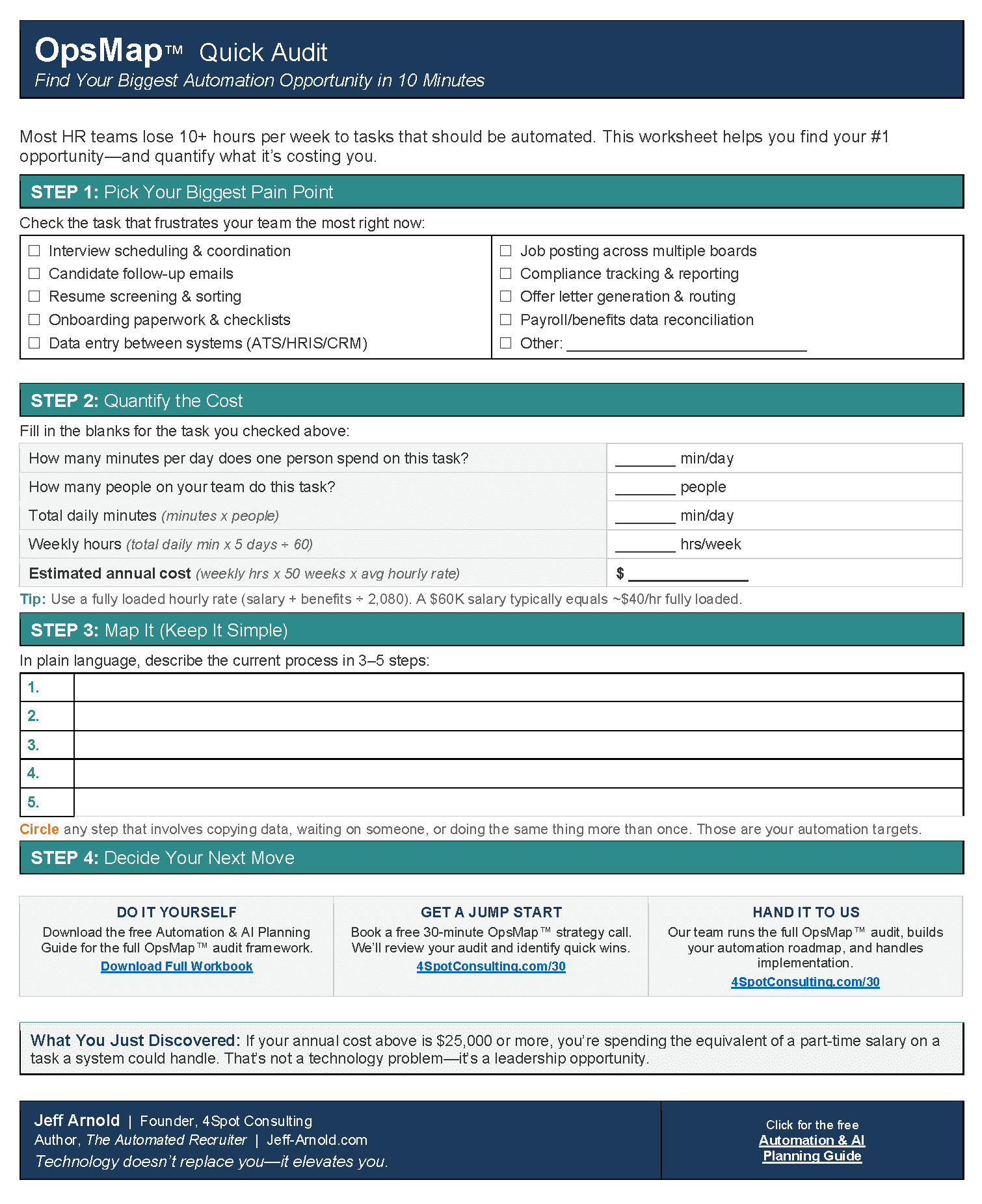
The integration of AI into HR and recruiting is no longer a futuristic concept; it is a present-day imperative for businesses striving for efficiency, scalability, and competitive advantage. From revolutionizing how talent is sourced and engaged to enhancing employee experiences and ensuring compliance, AI offers concrete, measurable benefits that directly impact your bottom line. At 4Spot Consulting, we’ve witnessed firsthand how the strategic implementation of AI and automation can eliminate human error, drastically reduce operational costs, and free up high-value employees to focus on what they do best – building relationships and driving strategic growth. We believe that the future of HR and recruiting isn’t just about adopting new tools, but about strategically integrating them into a cohesive, automated ecosystem. If you’re ready to move beyond manual inefficiencies and embrace a future where your HR and recruiting operations are both intelligent and streamlined, it’s time to explore how our OpsMap™ diagnostic can uncover your greatest opportunities.
If you would like to read more, we recommend this article: Building an Automated Future: Your Comprehensive Guide to the OpsMesh Framework
RELATED POST