Post: The AI Advantage: Redefining HR and Recruiting for High-Growth Business Success
8 Practical Ways AI is Redefining HR & Recruiting for High-Growth Businesses
In today’s rapidly evolving business landscape, HR and recruiting departments face unprecedented pressure. High-growth B2B companies, in particular, are grappling with the dual challenge of attracting top talent in a competitive market while simultaneously optimizing internal processes to ensure scalability and employee satisfaction. The traditional models, heavily reliant on manual tasks and reactive strategies, are simply no longer sufficient. This is where Artificial Intelligence (AI) emerges not just as a futuristic concept, but as a practical, indispensable tool transforming how organizations identify, engage, and retain their most valuable asset: people. At 4Spot Consulting, we consistently see how the strategic integration of AI can unlock significant efficiencies, reduce human error, and free up high-value employees from low-value work, saving businesses a remarkable 25% of their day. This shift isn’t about replacing human intuition, but augmenting it, providing HR and recruiting professionals with the data-driven insights and automated capabilities needed to operate with unparalleled precision and foresight. From the initial stages of talent acquisition to ongoing employee development and retention, AI is proving to be a game-changer, fundamentally reshaping the operational DNA of modern HR. This article explores 8 practical applications where AI is making the most significant impact, offering actionable insights for leaders ready to embrace the future of work.
1. AI-Powered Candidate Sourcing and Matching
The first hurdle in effective recruitment is often the sheer volume and complexity of candidate sourcing. Traditional methods, such as manual database searches and broad job board postings, are time-consuming and often yield a high percentage of unqualified applicants. AI-powered sourcing tools revolutionize this by intelligently scanning vast digital landscapes – including professional networks, public profiles, and industry-specific forums – to identify passive candidates who align precisely with job requirements and company culture. These systems go beyond keyword matching, utilizing natural language processing (NLP) to understand the nuances of a candidate’s experience, skills, and even career aspirations. For instance, an AI might analyze a candidate’s project history on GitHub or their contributions to industry discussions to assess their technical proficiency and problem-solving approach in ways a human reviewer simply couldn’t at scale. This proactive and highly targeted approach not only drastically reduces the time-to-fill for critical roles but also significantly improves the quality of the applicant pool, presenting recruiters with a pre-vetted list of individuals most likely to succeed. By automating the initial candidate identification, HR teams can redirect valuable human capital toward deeper engagement, relationship building, and strategic interviews, rather than sifting through countless irrelevant profiles. This is a clear example of how AI eliminates bottlenecks, allowing for more strategic focus.
2. Intelligent Resume Screening and Shortlisting
Once applications start flowing in, the next challenge is efficiently sifting through hundreds, if not thousands, of resumes. This manual process is notorious for being biased, inconsistent, and incredibly time-consuming, often leading to excellent candidates being overlooked. AI-powered resume screening tools address this head-on by using machine learning algorithms to analyze resumes against predefined criteria, job descriptions, and even successful employee profiles within the organization. These systems can identify relevant skills, experience, education, and even cultural fit indicators with far greater speed and objectivity than human screeners. They can quickly filter out unqualified candidates, highlight those who are a strong match, and even rank applicants based on their suitability. For example, an AI could be trained on data from previous successful hires for a specific role, learning which combinations of skills and experiences correlate with high performance. This not only dramatically accelerates the shortlisting process but also helps mitigate unconscious bias that can creep into human decision-making, promoting a more diverse and equitable talent pipeline. By automating this crucial initial review, recruiting teams can focus their expertise on evaluating soft skills, cultural alignment, and conducting meaningful interviews, rather than getting bogged down in administrative pre-screening. This empowers recruiters to be strategic partners, not just administrative processors.
3. Automated Interview Scheduling and Logistics
Coordinating interviews across multiple candidates, hiring managers, and panel members is a logistical nightmare for any HR department. The endless back-and-forth emails, calendar clashes, and last-minute cancellations consume an inordinate amount of time that could be better spent on strategic recruitment activities. AI-powered scheduling tools integrate directly with calendars and applicant tracking systems (ATS) to automate this entire process. Candidates can select available slots directly from a link, which then automatically books the interview, sends confirmations, reminders, and even integrates with video conferencing platforms. Beyond simple scheduling, advanced AI tools can optimize the interview sequence based on interviewer availability, candidate preferences, and even travel time for in-person meetings. They can handle rescheduling requests with minimal human intervention and provide real-time updates to all parties involved. For a growing B2B company, where agility and speed are paramount, streamlining interview logistics means a faster hiring cycle and an improved candidate experience. It eliminates a significant administrative burden from recruiters’ plates, freeing them to focus on candidate engagement and assessment. This type of automation is a prime example of how 4Spot Consulting helps businesses eliminate low-value work, ensuring high-value employees can focus on what truly matters.
4. Enhancing Candidate Experience with AI Chatbots
The candidate experience is a critical factor in attracting top talent, especially in a competitive market. Candidates expect timely responses, clear communication, and easy access to information throughout the application process. Unfortunately, busy HR teams often struggle to keep up with the volume of inquiries. AI-powered chatbots deployed on career pages, application portals, or even via messaging apps provide instant, 24/7 support to candidates. These intelligent assistants can answer frequently asked questions about job descriptions, company culture, benefits, application status, and interview processes. For instance, a candidate might ask, “What are the benefits for a software engineer?” or “Can I check the status of my application for the Marketing Manager role?” The chatbot can provide immediate, accurate information, personalizing the experience and setting clear expectations. This not only significantly improves candidate satisfaction by providing immediate gratification but also drastically reduces the administrative burden on HR staff who would otherwise be fielding these common questions. By ensuring a positive and responsive interaction from the very first touchpoint, companies can significantly boost their employer brand and reduce candidate drop-off rates, ultimately leading to a stronger talent pipeline. It creates a seamless, engaging experience that reflects positively on the organization.
5. Personalized Onboarding and Training Pathways
Effective onboarding is crucial for new hire retention and productivity, but generic, one-size-fits-all programs often fall short. AI offers the ability to personalize the onboarding and training experience, tailoring it to each new employee’s specific role, background, and learning style. AI-driven platforms can analyze a new hire’s resume, skills assessment, and even pre-onboarding survey data to recommend relevant training modules, resources, and internal mentors. For example, an AI might identify that a new sales hire has strong product knowledge but less experience with the company’s CRM system, and then automatically assign targeted training modules for that CRM. Furthermore, AI can monitor progress, provide intelligent feedback, and adapt learning pathways in real-time based on performance. This ensures new employees get exactly the information and support they need, when they need it, accelerating their time-to-proficiency. For HR, this means a more efficient onboarding process, less manual intervention, and significantly higher rates of successful integration and engagement for new hires. The result is a workforce that reaches full productivity faster, reducing costs associated with turnover and extended training periods, thereby directly impacting the company’s bottom line and scalability.
6. Predictive Analytics for Employee Retention and Performance
Retaining top talent is just as critical, if not more so, than acquiring it. Employee turnover is costly, disruptive, and can severely impact morale and productivity. AI-powered predictive analytics tools can analyze vast datasets, including performance reviews, engagement survey results, tenure, compensation data, and even communication patterns, to identify employees at risk of leaving the organization. These systems can pinpoint factors contributing to dissatisfaction or disengagement, such as lack of career progression, workload imbalances, or specific team dynamics. For instance, an AI might detect a trend where employees in a particular department with similar skill sets tend to leave after a certain tenure, prompting HR to investigate specific interventions like mentorship programs or skill development opportunities. By flagging these risks proactively, HR leaders can intervene with targeted retention strategies – whether it’s offering development opportunities, adjusting compensation, or facilitating team changes – before a valuable employee decides to depart. Beyond retention, AI can also predict future performance trends, identify high-potential employees, and recommend optimal team compositions, enabling more strategic workforce planning. This shifts HR from reactive problem-solving to proactive, data-driven strategy, significantly enhancing organizational stability and growth.
7. Reducing Bias and Enhancing Diversity in Hiring
Despite best intentions, human bias can inadvertently creep into various stages of the hiring process, from resume screening to interviews, hindering efforts to build a diverse and inclusive workforce. AI offers powerful tools to mitigate these biases and promote equity. For example, AI-powered text analysis can review job descriptions to identify and flag gender-coded language or exclusionary terms, suggesting neutral alternatives to attract a broader candidate pool. During screening, AI can be programmed to ignore demographic information or focus solely on skills and experience, ensuring that candidates are evaluated purely on merit. Some AI tools can even analyze voice patterns or facial expressions during video interviews, providing objective data on candidate engagement without human interpretation that could be influenced by bias. While AI itself must be trained on diverse and unbiased datasets to avoid perpetuating existing prejudices, when properly implemented, it can serve as a powerful check on human judgment. By systematically removing or reducing subjective elements from the initial stages of recruitment, AI helps organizations build a more diverse talent pipeline, foster a culture of inclusion, and ensure that hiring decisions are based on objective qualifications rather than unconscious stereotypes. This translates into stronger teams, richer perspectives, and enhanced innovation.
8. Automating Administrative Tasks for HR Efficiency
HR departments are often burdened by a mountain of administrative tasks that consume valuable time and resources, preventing professionals from focusing on strategic initiatives. From managing employee records and benefits administration to processing payroll changes and compliance documentation, these routine tasks are ripe for AI-driven automation. AI, often combined with Robotic Process Automation (RPA), can automate data entry, document generation, approvals, and information retrieval across disparate systems. For instance, an AI system can automatically process new hire paperwork, integrate data into HRIS and payroll systems, and trigger the creation of necessary accounts and access permissions, significantly reducing manual effort and eliminating transcription errors. It can also manage routine employee requests, such as updating personal information or requesting time off, through self-service portals powered by intelligent automation. This drastically reduces the transactional workload on HR staff, allowing them to shift their focus towards employee development, strategic planning, and fostering a positive work environment. For a high-growth company, this administrative efficiency is not just about saving time; it’s about reallocating human potential to higher-value activities that directly contribute to growth, scalability, and employee engagement. It’s about empowering HR to be a strategic driver, not just a processing center.
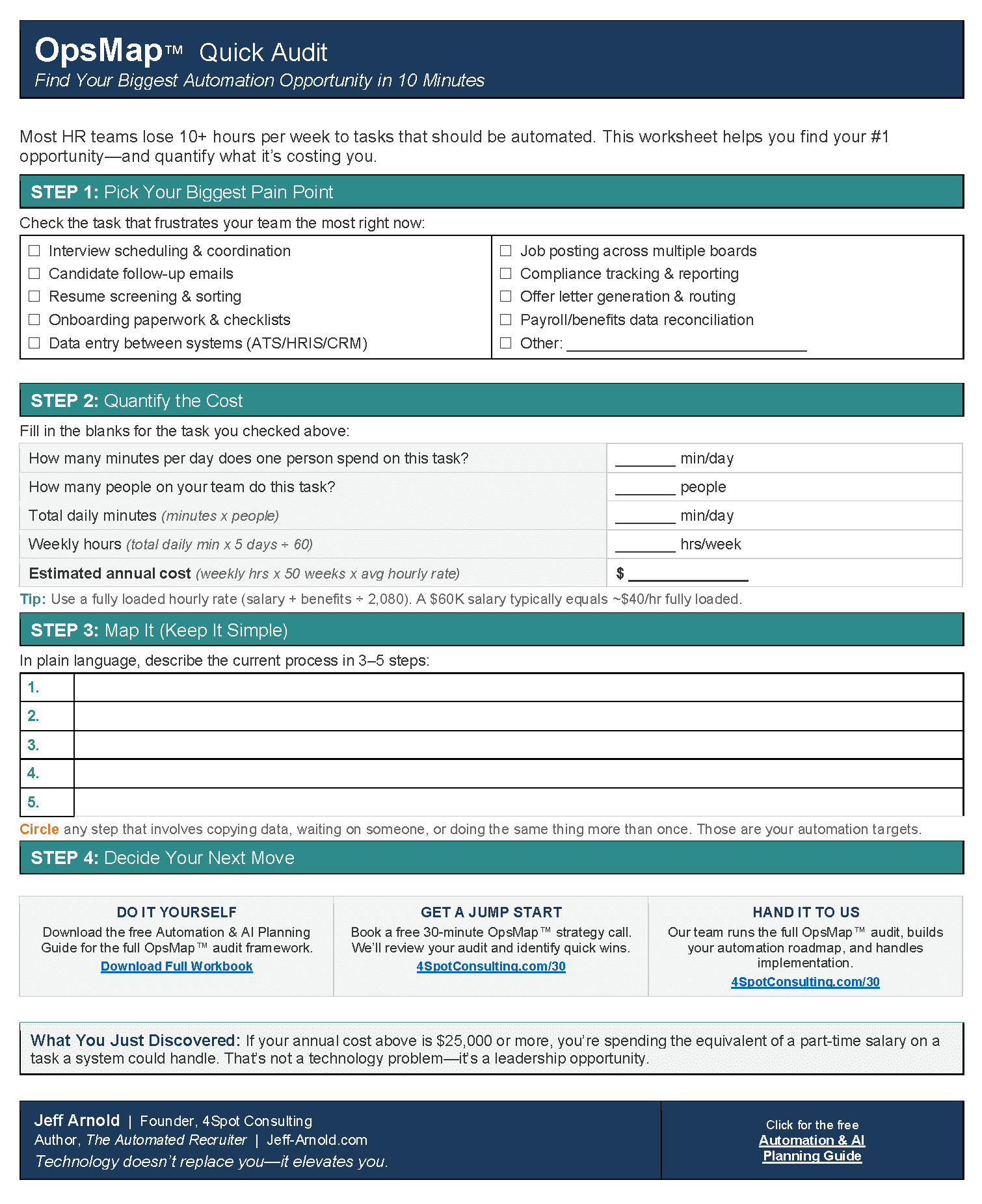
The integration of AI into HR and recruiting is no longer a luxury but a strategic imperative for high-growth businesses aiming for efficiency, scalability, and competitive advantage. From intelligent sourcing and unbiased screening to personalized onboarding and predictive retention analytics, AI offers transformative solutions that address the core challenges faced by modern HR departments. By leveraging these technologies, organizations can not only streamline operations and reduce costs but also cultivate a more engaged, diverse, and productive workforce. At 4Spot Consulting, we believe that strategic automation and AI integration are the keys to unlocking significant operational improvements, allowing your high-value employees to focus on what they do best. Ready to uncover automation opportunities that could save you 25% of your day? Book your OpsMap™ call today and let us help you chart a course for an AI-powered future in HR.
If you would like to read more, we recommend this article: The AI-Powered HR Department: A Blueprint for Efficiency


RELATED POST