
Post: Unlocking Growth: Eliminating Data Silos
The Hidden Drain: How Disconnected Data Silos Steal Your Business’s Edge
In the relentless pursuit of growth, businesses often invest heavily in new technologies, expecting immediate returns in efficiency and productivity. Yet, many find themselves caught in a frustrating loop: more tools, but not necessarily more time. The culprit? Often, it’s not the tools themselves, but the invisible walls that stand between them – data silos. These isolated pockets of information, residing in disparate systems that refuse to communicate, act as a silent saboteur, slowly draining resources, introducing errors, and stifling the very scalability you’re striving for. For a high-growth B2B company, the impact isn’t just an inconvenience; it’s a direct hit to your bottom line and your competitive advantage.
The Silent Saboteur: Understanding Data Silos
Data silos are an almost inevitable byproduct of modern business operations. As departments adopt specialized software – a CRM for sales, an ATS for HR, an ERP for finance, project management tools for operations – each system becomes a repository of critical information. The problem arises when these systems lack the capability or the integration to share data seamlessly. Sales data might live exclusively in HubSpot or Keap, recruiting data in a separate ATS, and financial records in QuickBooks, with no automated bridge between them. Each piece of information is valuable, but its isolation creates blind spots and bottlenecks across the entire organization.
Beyond Inefficiency: The Real Costs
The immediate consequence of data silos is inefficiency. Employees spend valuable hours on manual data entry, copying information from one system to another. This isn’t just tedious; it’s ripe for human error, leading to inaccuracies that can cascade through your operations. Imagine an incorrect salary entry affecting payroll, or an outdated client contact causing a missed sales opportunity. These small, frequent errors accumulate, leading to significant costs in correction, reputation damage, and lost revenue.
But the true cost runs deeper. Disconnected data prevents a holistic view of your business. Leaders lack a “single source of truth” for key metrics, making strategic decision-making speculative rather than data-driven. Opportunities for cross-selling, process optimization, and proactive problem-solving are missed because the necessary insights are scattered and inaccessible. Ultimately, data silos undermine scalability, preventing your business from growing without proportional increases in manual overhead and operational friction. This is precisely why we help companies save 25% of their day – by eliminating the low-value work that stems from these disjointed systems.
The Ripple Effect: How Silos Undermine Your Core Operations
HR and Recruiting: A Prime Example
Nowhere is the pain of data silos felt more acutely than in HR and recruiting. Candidates apply through an ATS, but their information might need to be manually re-entered into an HRIS once hired, or worse, into multiple spreadsheets for different stages. Onboarding checklists are separate from payroll systems, and performance reviews aren’t linked to training modules. This leads to disjointed employee experiences, compliance risks, and wasted time for highly paid HR professionals who should be focused on strategic talent management, not administrative busywork.
Sales and CRM: Missed Connections
Your sales team works tirelessly to build client relationships, meticulously documenting interactions in your CRM (like Keap or HighLevel). Yet, if that CRM data doesn’t automatically flow to your marketing automation platform, opportunities for targeted campaigns are lost. If it doesn’t integrate with your invoicing system, billing becomes a manual process. The result is a fragmented customer journey, inaccurate sales forecasts, and a poor experience that can erode trust and loyalty.
Operational Blind Spots
Beyond HR and sales, operations suffer from similar disconnects. Project management tools might not talk to resource allocation systems, inventory management might be separate from procurement, and financial reporting might require pulling data from half a dozen sources. Without a unified view, identifying bottlenecks, optimizing workflows, and ensuring efficient resource utilization becomes an exercise in guesswork, rather than data-backed precision.
Building Bridges: 4Spot Consulting’s Strategic Approach
At 4Spot Consulting, we understand that simply buying more software won’t solve the problem of data silos. Our approach begins with strategy, not just technology. Through our OpsMesh framework, we view your entire operational ecosystem as an interconnected network. We don’t just build; we plan.
From Chaos to Cohesion: The OpsMap™ Journey
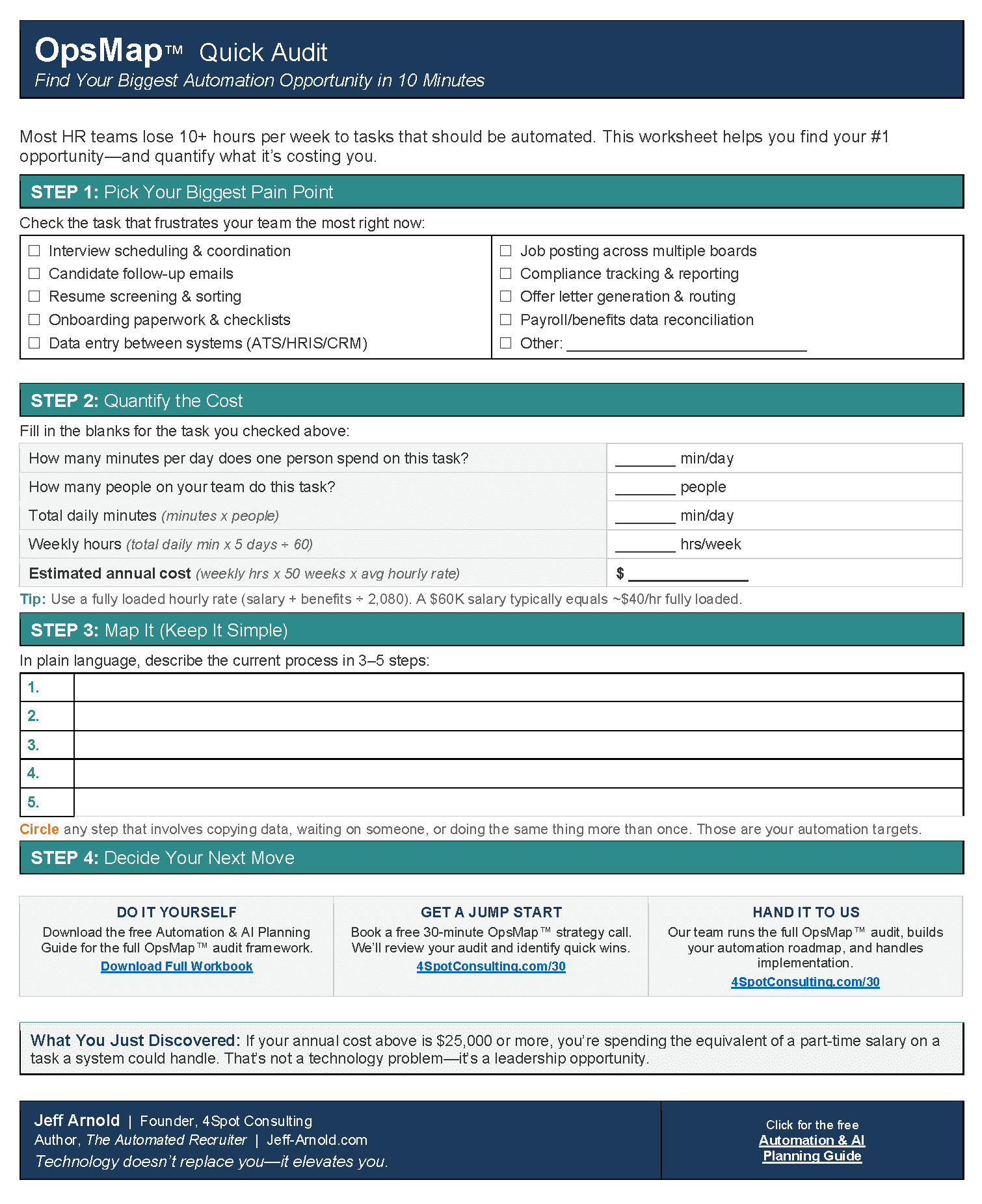
Our journey to eliminate your data silos starts with the OpsMap™ – a strategic audit designed to uncover every inefficiency, bottleneck, and manual workaround draining your business. We map out your current workflows, identify where data breaks down, and surface opportunities for integration and automation. This isn’t a theoretical exercise; it’s a deep dive into your specific operations, drawing on our 35+ years of experience in automating business systems. We use powerful integration platforms like Make.com to connect dozens of disparate SaaS systems, creating seamless data flows that eliminate manual entry and establish that elusive “single source of truth.”
Tangible Outcomes: What Integration Truly Delivers
The result of a strategically integrated system is profound. You regain valuable time, freeing your high-value employees from low-value, repetitive tasks. Human error is drastically reduced, leading to more reliable data and informed decisions. Your business becomes more agile, scalable, and resilient, capable of growth without the proportional increase in operational costs. We’ve seen clients achieve production increases of 240% and annual cost savings exceeding $1 million by strategically addressing these very issues. This isn’t just about making systems talk; it’s about transforming your business into a lean, data-driven machine.
Ready to stop the drain of disconnected data and reclaim your business’s efficiency and scalability? Don’t let data silos steal another day from your team. Book your OpsMap™ call today and let us help you build the integrated operational backbone your high-growth B2B company deserves.
If you would like to read more, we recommend this article: Elevating Your Business: The Strategic Imperative of Integrated Systems


RELATED POST