Post: The Silent Drain: Why Manual Data Management Cripples B2B Growth
The Hidden Costs of Manual Data Management in B2B Operations
In the relentless pursuit of growth, B2B companies often overlook a silent drain on their resources: the inefficiencies embedded within manual data management. It’s not just about the time spent; it’s about the compounding errors, the missed opportunities, and the invaluable employee hours diverted from strategic initiatives. For business leaders focused on scalability and profitability, understanding these hidden costs is the first step toward reclaiming significant operational capacity and financial performance.
Many organizations operate under the assumption that their current data handling processes, while cumbersome, are simply “the way things are done.” This mindset, however, prevents them from seeing the profound impact of disconnected systems, redundant data entry, and the constant need for human intervention. These aren’t minor inconveniences; they are foundational weaknesses that impede agility, compromise data integrity, and ultimately stifle a company’s ability to compete effectively in a fast-paced market.
The Erosion of Productivity and Employee Morale
Consider your high-value employees—your sales directors, HR managers, and operational leads. How much of their day is spent on tasks that could be automated? Manually updating CRM records, reconciling disparate spreadsheets, or chasing down information across multiple platforms are not only time-consuming but soul-crushing. This low-value, repetitive work doesn’t just eat into their day; it erodes morale and distracts them from the strategic thinking and relationship building that truly drives your business forward.
At 4Spot Consulting, we’ve observed this phenomenon across numerous B2B enterprises. The average professional spends a significant portion of their week on administrative tasks. When data isn’t flowing seamlessly between systems, this figure skyrockets. Employees become data clerks rather than innovators, impacting job satisfaction and contributing to burnout. The cost of turnover, especially among high-performing staff, far outweighs the investment in systems that can liberate them from these manual burdens.
The Ripple Effect of Human Error and Inconsistency
Where there is manual data entry, there is human error. It’s an unavoidable truth. A misplaced decimal, a misspelled name, or an incorrectly categorized lead might seem minor in isolation, but these errors proliferate throughout your systems, corrupting data integrity. Inaccurate data leads to flawed analytics, misinformed strategic decisions, and potentially costly mistakes in sales outreach, project delivery, or talent acquisition.
Moreover, inconsistent data practices across departments create data silos. HR might have one version of an employee record, while finance has another, and operations a third. This lack of a “Single Source of Truth” creates confusion, delays, and a perpetual state of data reconciliation. Our OpsMesh framework is specifically designed to interlink these disparate data points, ensuring that every department operates from the same, reliable foundation, eradicating inconsistencies and boosting decision-making confidence.
Missed Opportunities and Delayed Scalability
In today’s competitive landscape, speed and accuracy are paramount. Manual data processes inherently introduce delays. Onboarding a new client, processing a new hire, or launching a targeted marketing campaign can be significantly slowed down by the need for manual data validation and transfer. These delays translate directly into missed revenue opportunities, slower time-to-market for new services, and a hindered ability to scale operations rapidly when growth demands it.
Consider the growth ceiling imposed by manual operations. If every new client requires a proportionate increase in manual administrative effort, your capacity to grow is inherently limited by your human resources. True scalability means decoupling growth from linear increases in operational overhead. By automating data flows and leveraging AI, businesses can absorb significant increases in volume without a corresponding spike in manual workload, paving the way for exponential growth.
The Strategic Advantage of Automation and AI
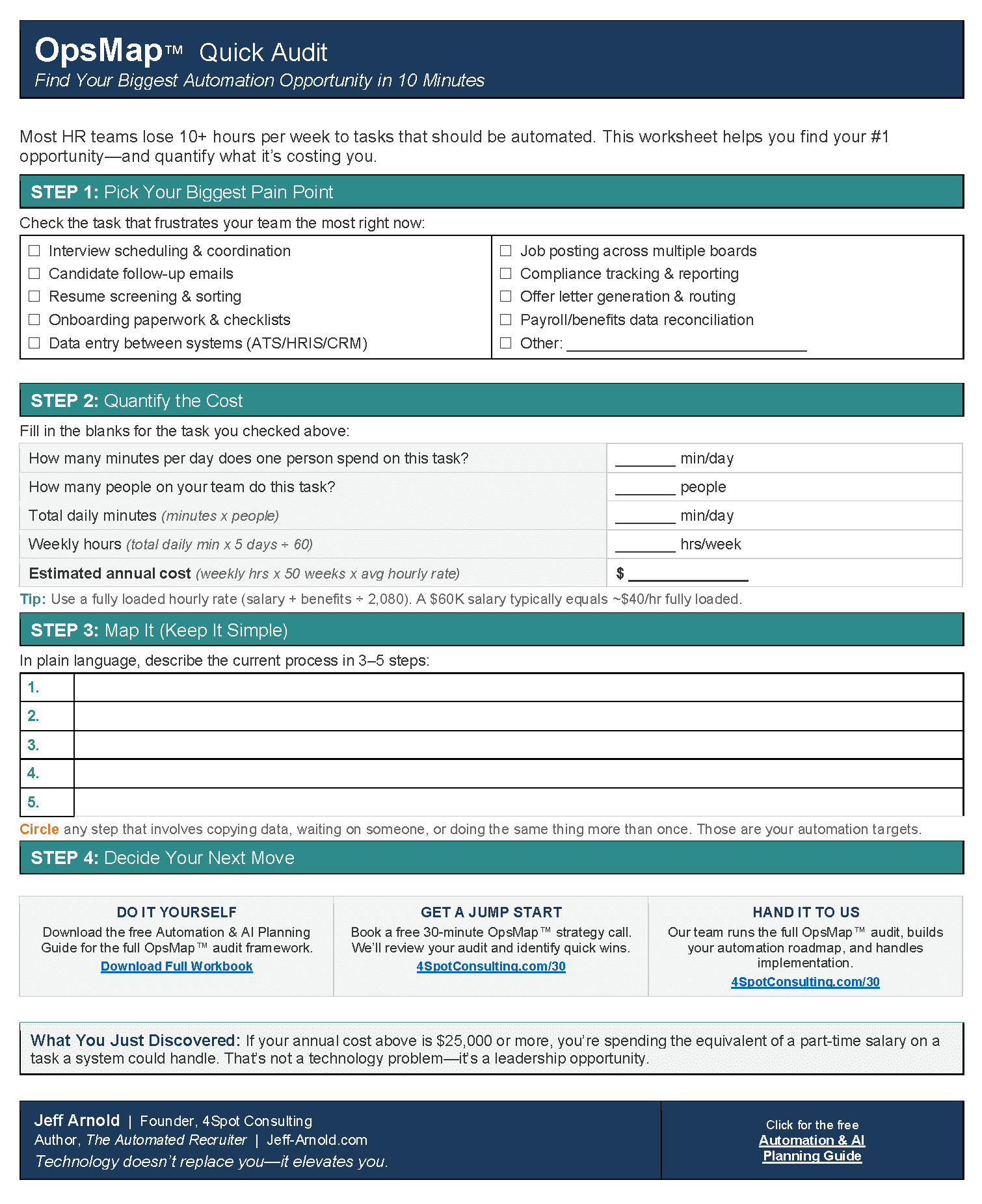
The solution lies in a strategic approach to automation and AI, not merely implementing technology for its own sake. At 4Spot Consulting, our OpsMap™ diagnostic is a testament to this philosophy. We begin by meticulously auditing your existing processes to uncover these hidden inefficiencies and identify precisely where automation will yield the greatest ROI. This isn’t about eliminating jobs; it’s about eliminating the drudgery of low-value work, freeing up your team to focus on innovation, client engagement, and core business development.
Our work with an HR tech client exemplifies this principle. By automating their resume intake, parsing, and CRM syncing processes using Make.com and AI enrichment, we helped them save over 150 hours per month. This allowed their team to shift from manual data entry to strategic candidate engagement, ultimately leading to faster placements and increased client satisfaction. That’s the power of transforming manual chaos into streamlined, intelligent workflows.
Reclaiming Your Day and Your Future
The hidden costs of manual data management are far too significant to ignore. They manifest as reduced productivity, increased errors, diminished morale, and constrained growth. By embracing intelligent automation and AI, B2B companies can move beyond these limitations, creating a more efficient, accurate, and scalable operational environment. It’s about empowering your team, strengthening your data integrity, and positioning your business for sustainable success.
If you’re a business leader ready to eliminate bottlenecks, reduce operational costs, and reclaim 25% of your day, the path forward is clear. Our strategic-first approach ensures that every automation is tied to a tangible business outcome, delivering real ROI. Don’t let manual data processes hold your business back any longer.
If you would like to read more, we recommend this article: The Automation Imperative: How to Reclaim 25% of Your Day


RELATED POST