Post: **The AI Antidote: Curing Inefficient Data’s Profit Drain**
The Silent Killer of Profit: How Inefficient Data Management Stifles Growth and How AI Automation Provides the Antidote
In the relentless pursuit of growth, businesses often focus on grand strategies and market expansion, overlooking a silent, insidious threat lurking within their own operations: inefficient data management. It’s not a headline-grabbing crisis, but a slow, persistent drain on resources, productivity, and ultimately, profitability. Manual data entry, disparate systems, and fragmented information aren’t just minor inconveniences; they are foundational weaknesses that can cripple scalability and innovation, trapping high-value employees in low-value work.
At 4Spot Consulting, we’ve witnessed firsthand how seemingly small operational inefficiencies compound over time, transforming into significant roadblocks for B2B companies generating $5M+ ARR. The promise of the digital age was efficiency, yet many organizations still operate with one foot firmly planted in the past, struggling to unify their data and leverage it effectively. This isn’t a problem that disappears on its own; it requires a strategic, proactive approach, one that increasingly involves the intelligent integration of AI and automation.
The Hidden Costs of Disconnected Data
Consider the daily reality for many businesses: customer data resides in one CRM, sales figures in another, HR records in a third, and project management tasks in yet another. The lack of a single source of truth necessitates constant manual data transfers, reconciliation, and validation. Each step in this convoluted process is an opportunity for human error, a time sink for skilled employees, and a potential compliance nightmare. These aren’t just abstract concerns; they manifest as tangible financial losses and missed opportunities.
We’ve observed companies losing hundreds of hours a month to these manual processes – hours that could be dedicated to strategic planning, client engagement, or product innovation. The cost isn’t just in wasted salaries; it’s in delayed decision-making, inconsistent customer experiences, and a diminished capacity to adapt to market changes. For instance, an HR department manually sifting through thousands of resumes isn’t just slow; it risks missing top talent and creates a poor candidate experience, impacting the brand’s ability to attract future employees.
From Error-Prone to Exceptionally Efficient
The reliance on manual inputs for critical data is a primary source of human error. A single misplaced decimal, a forgotten field, or an incorrect data transfer can ripple through an organization, leading to incorrect invoices, misdirected communications, or flawed analytical reports. These errors not only cost money to fix but erode trust and confidence both internally and externally. The antidote lies in systematically removing human touchpoints from repetitive, rules-based tasks.
This is where automation shines. By designing workflows that automatically capture, process, and transfer data between systems like Keap, PandaDoc, or custom databases, businesses can dramatically reduce error rates. Imagine a system where a new client’s information from a CRM automatically populates contract templates, triggers welcome emails, and initiates project setup, all without human intervention. This not only ensures accuracy but frees up valuable staff to focus on strategic client relationship building rather than data entry.
AI: Transforming Data from Burden to Breakthrough
While automation handles the “what” and “when” of data movement, AI enhances the “how” and “why.” AI-powered operations go beyond simple rule-based automation, introducing intelligence and predictive capabilities to data management. This means not just moving data, but understanding it, enriching it, and extracting actionable insights that were previously hidden or too time-consuming to uncover manually.
For example, in recruiting, AI can analyze resumes for specific skills and experience far more efficiently and objectively than a human, even identifying nuanced indicators of potential success. In sales, AI can predict customer churn based on historical data patterns, allowing proactive interventions. For general operations, AI can monitor system performance, identify anomalies, and even suggest process improvements, turning data into a strategic asset rather than an administrative burden.
Building a Single Source of Truth with Intelligent Systems
The ultimate goal for efficient data management is to establish a “single source of truth.” This means ensuring that all relevant data points about a customer, project, or employee are stored in one authoritative location, accessible and consistent across the entire organization. Achieving this requires more than just buying new software; it demands a strategic framework for integrating existing systems and designing intelligent workflows.
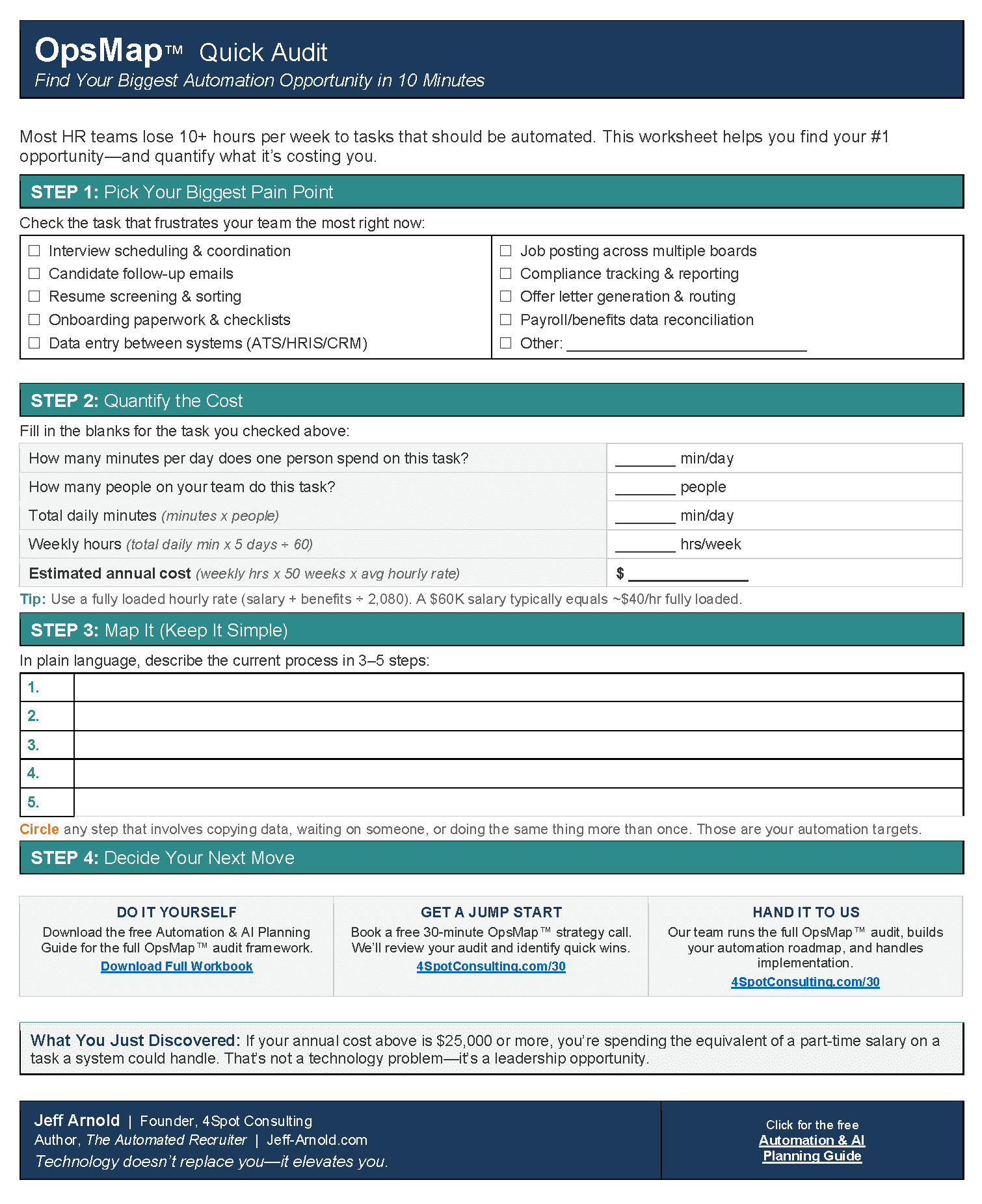
Our OpsMesh framework at 4Spot Consulting is designed precisely for this purpose. We start with an OpsMap™ diagnostic to uncover where your data is fragmented, where manual bottlenecks exist, and where the greatest opportunities for automation and AI integration lie. We then implement solutions using powerful low-code platforms like Make.com to connect disparate systems, automate data flows, and infuse AI where it can deliver the most impactful insights and efficiencies. The result is a cohesive, resilient operational infrastructure that supports growth rather than hindering it.
Reclaiming Your Day and Accelerating Growth
The shift from inefficient, manual data management to an AI-powered automated ecosystem is not merely a technological upgrade; it’s a fundamental transformation of how your business operates and grows. By eliminating human error, reducing operational costs, and freeing up high-value employees from low-value tasks, organizations can reclaim significant portions of their day – often 25% or more. This reclaimed time and resource can then be redirected toward innovation, strategic initiatives, and direct revenue generation.
The time for tolerating data inefficiency is over. Modern businesses, particularly those scaling rapidly in competitive B2B sectors, cannot afford the silent drain on their profits and potential. Embracing AI and automation in data management is not a luxury; it’s a strategic imperative for sustained growth, operational excellence, and lasting competitive advantage. It’s about turning data into your biggest ally, not your biggest headache.
If you would like to read more, we recommend this article: The Hidden Costs of Manual Operations in HR & Recruiting



RELATED POST