Post: Single Source of Truth: Unifying Business Through Automation
Beyond the Inbox: Unifying Your Business with a Single Source of Truth Through Automation
In today’s fast-paced business environment, leaders are constantly seeking efficiencies, not just to save money, but to unlock new levels of productivity and strategic insight. Yet, for many, the reality is a fragmented landscape of data scattered across disparate systems. Your CRM has some client data, your project management tool has another slice, HR uses a separate platform, and then there are the endless spreadsheets. This isn’t just inconvenient; it’s a silent killer of productivity, a breeding ground for errors, and a significant blocker to scalable growth.
The Silent Killer of Productivity: Data Silos
Consider the daily scramble. An employee needs to find critical information about a client, a project, or an internal process. They might check their email, then a cloud drive, then a specific SaaS application, perhaps even asking a colleague. Each moment spent hunting for data is a moment lost from higher-value work. This isn’t just about individual inefficiency; it creates a cascade effect across the organization. Decisions are made on incomplete or outdated information, leading to costly mistakes. Bottlenecks emerge as teams wait for manual data transfers or reconciliations. It’s a reactive mode of operation, a constant game of catch-up that prevents businesses from truly getting ahead.
This challenge is particularly acute in areas like HR and recruiting, where candidate data might reside in an applicant tracking system, onboarding documents in a separate HRIS, and payroll information elsewhere. The lack of a cohesive, centralized system leads to redundant data entry, compliance risks, and a frustrating experience for both employees and candidates. For business leaders, this fragmentation translates directly into operational drag, higher costs, and a significant drain on the time of your most valuable employees, forcing them to engage in low-value, repetitive tasks instead of strategic initiatives.
What is a “Single Source of Truth” (SSOT) and Why Does It Matter?
The solution to this data chaos lies in establishing a Single Source of Truth (SSOT). An SSOT is not a single piece of software; rather, it’s a strategic approach to data management where all critical information within an organization is centralized, consistent, and easily accessible from a single, authoritative point. Imagine all departments—sales, marketing, operations, HR, finance—pulling from the exact same, up-to-date data set. This eliminates discrepancies, reduces manual reconciliation, and ensures everyone operates from the same playbook.
The benefits are profound. With an SSOT, decision-making becomes faster and more informed because leaders have a clear, real-time picture of their operations. Operational efficiency soars as redundant data entry and manual transfers are eliminated. Accuracy improves dramatically, reducing human error and the costly repercussions that follow. Most importantly, an SSOT lays the groundwork for true scalability. As your business grows, your data infrastructure doesn’t buckle under the weight; instead, it expands gracefully, supporting new initiatives and increased volume without introducing new layers of complexity or inefficiency.
The Operational Impact: From Reactive to Proactive
Implementing an SSOT transforms your operational rhythm. Instead of constantly reacting to data inconsistencies or delays, your teams can become proactive. For instance, in recruiting, a unified system means that once a candidate’s data is entered, it flows seamlessly through screening, interviewing, offers, and onboarding, reducing the risk of errors and speeding up the entire process. Sales teams can access the most current customer interaction history, ensuring personalized and effective engagement. Customer service can resolve issues faster with a complete view of client interactions and preferences. This shift from manual, disconnected processes to automated, integrated workflows is not just about saving time; it’s about empowering your high-value employees to focus on what they do best: driving innovation and growth.
Automation: The Unsung Hero of SSOT Implementation
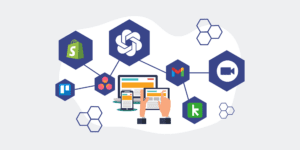
Achieving a true Single Source of Truth often feels like a monumental task, especially for businesses with multiple existing systems. This is where intelligent automation becomes the absolute game-changer. Tools like Make.com, at the core of our OpsMesh framework, are designed to seamlessly connect disparate applications, creating intelligent workflows that ensure data consistency across your entire ecosystem. Instead of relying on manual data entry or complex, brittle custom integrations, automation platforms act as the central nervous system, orchestrating data flow between your CRM, HRIS, accounting software, project management tools, and more.
For example, when a new lead enters your CRM, automation can instantly create a corresponding entry in your project management system, trigger an introductory email sequence, and even update a Slack channel for your sales team. When a project milestone is met, relevant data can automatically update client records, generate invoices via PandaDoc, and trigger internal reporting. This isn’t just about moving data; it’s about eliminating the friction points that lead to data silos, errors, and wasted time. It’s about ensuring that every piece of information, from a new hire’s details to a client’s project status, is current, accurate, and accessible from wherever it’s needed, when it’s needed.
Beyond Basic Integrations: A Strategic Approach
While many businesses attempt ad-hoc integrations, the true power of automation in creating an SSOT lies in a strategic-first approach. At 4Spot Consulting, our OpsMap™ diagnostic is designed to uncover precisely where these data silos exist and how they impact your operational efficiency and bottom line. We don’t just build connections; we architect an overarching automation strategy through our OpsMesh framework, ensuring that every integration serves a clear business objective and contributes to a unified data environment. This isn’t about implementing tech for tech’s sake; it’s about identifying opportunities for significant ROI, from reducing operational costs and eliminating human error to dramatically increasing your organization’s scalability.
Realizing the Vision: Practical Steps and Transformative Outcomes
The journey to an SSOT begins with a clear understanding of your current state. Our OpsMap™ strategic audit helps businesses identify their existing data landscape, pinpoint inefficiencies, and map out the ideal flow of information. From there, our OpsBuild™ phase focuses on implementing robust, AI-powered automation systems that connect your essential tools and create those crucial SSOTs. Finally, OpsCare™ ensures ongoing optimization and iteration, adapting your automation infrastructure as your business evolves.
The outcomes are tangible and transformative. We’ve seen clients reclaim hundreds of hours per month that were previously lost to manual data management, much like an HR tech client who saved over 150 hours monthly by automating resume intake and parsing. This isn’t just about efficiency; it’s about freeing up your high-value employees to focus on strategic initiatives that drive revenue and innovation. An SSOT, powered by intelligent automation, stops being a theoretical concept and becomes the backbone of a highly efficient, scalable, and error-resistant business. It’s how you save 25% of your day, not just for individual tasks, but across your entire operational footprint.
If you would like to read more, we recommend this article: The Strategic Imperative: Unlocking Business Growth with AI and Automation



RELATED POST