Post: The Silent Saboteur: Hidden Costs of Manual Data Entry in B2B Operations
The Hidden Costs of Manual Data Entry in Modern B2B Operations
In the high-stakes world of B2B operations, efficiency isn’t just a buzzword; it’s the bedrock of sustained growth and profitability. Yet, beneath the surface of sophisticated CRMs and project management tools, a silent saboteur often lurks: manual data entry. While seemingly innocuous and unavoidable, the cumulative impact of manual data input extends far beyond the time it takes, eating into profits, stifling scalability, and undermining the very data integrity businesses rely on for strategic decisions. For leaders at high-growth B2B companies, understanding these hidden costs is the first step toward reclaiming precious resources and accelerating their operational capabilities.
Consider the daily grind: an HR manager manually inputs candidate information from various sources into an ATS and CRM, a sales rep painstakingly updates client details across multiple platforms, or an operations team member transcribes order information from email into an ERP system. Each instance, on its own, seems minor. But when multiplied across departments, employees, and hundreds or thousands of daily transactions, these small tasks coalesce into a significant drag on productivity and an open invitation for errors. Our experience at 4Spot Consulting, working with B2B companies generating $5M+ ARR, consistently reveals that manual data entry is one of the primary culprits behind inefficiencies that cost businesses 25% or more of their day.
The Erosion of Productivity and Employee Morale
The most immediate and apparent cost of manual data entry is the sheer amount of time it consumes. High-value employees, hired for their strategic thinking and problem-solving abilities, are often relegated to repetitive, low-value tasks. This isn’t just inefficient; it’s demoralizing. When a skilled professional spends hours copying and pasting information, their engagement wanes, and their capacity to contribute to more impactful initiatives diminishes. The opportunity cost here is immense: every hour spent on manual data entry is an hour not spent on client acquisition, product innovation, or strategic planning.
Furthermore, this labor-intensive process slows down critical business cycles. Onboarding a new client might take longer because contract details are manually transferred between systems. Recruitment processes become sluggish as candidate data moves slowly through disparate platforms. This delay impacts revenue recognition, client satisfaction, and competitive agility. In today’s fast-paced market, the ability to act swiftly and decisively is a significant differentiator, and manual bottlenecks directly impede this.
The Pernicious Problem of Human Error
Humans are fallible, and when tasked with repetitive data entry, errors are inevitable. A misplaced decimal, a misspelled name, an incorrect date—these small mistakes can have cascading consequences. Inaccurate data can lead to erroneous financial reports, incorrect invoicing, compliance violations, or even flawed strategic decisions based on an incomplete or misleading picture of the business. For example, a single error in a CRM can impact sales forecasting, marketing personalization, and customer service quality across an entire quarter.
Rectifying these errors is another hidden cost. Data reconciliation, error tracking, and reprocessing add layers of complexity and demand even more valuable employee time. This “cleanup” work not only drains resources but also erodes confidence in the company’s data, making it harder to establish a “single source of truth.” Without reliable data, scaling operations becomes precarious, as foundational insights are questionable, and every growth initiative carries an elevated risk.
Stifling Scalability and Innovation
One of the most significant long-term impacts of manual data entry is its direct impedance to scalability. As a B2B company grows, the volume of data and transactions inevitably increases. Relying on manual processes means that scaling up requires a proportional increase in headcount dedicated to data entry, which is unsustainable and expensive. This creates a bottleneck that limits the company’s ability to onboard more clients, process more orders, or expand into new markets without significant operational strain.
Moreover, the time and resources locked up in manual tasks prevent businesses from exploring and adopting innovative technologies. If your team is constantly putting out fires caused by data inconsistencies or struggling to keep up with basic entry, they have little capacity to evaluate or implement advanced AI tools, predictive analytics, or more sophisticated automation solutions that could truly transform the business. The opportunity cost here is not just lost efficiency but lost future potential.
The 4Spot Consulting Solution: Strategic Automation and AI Integration
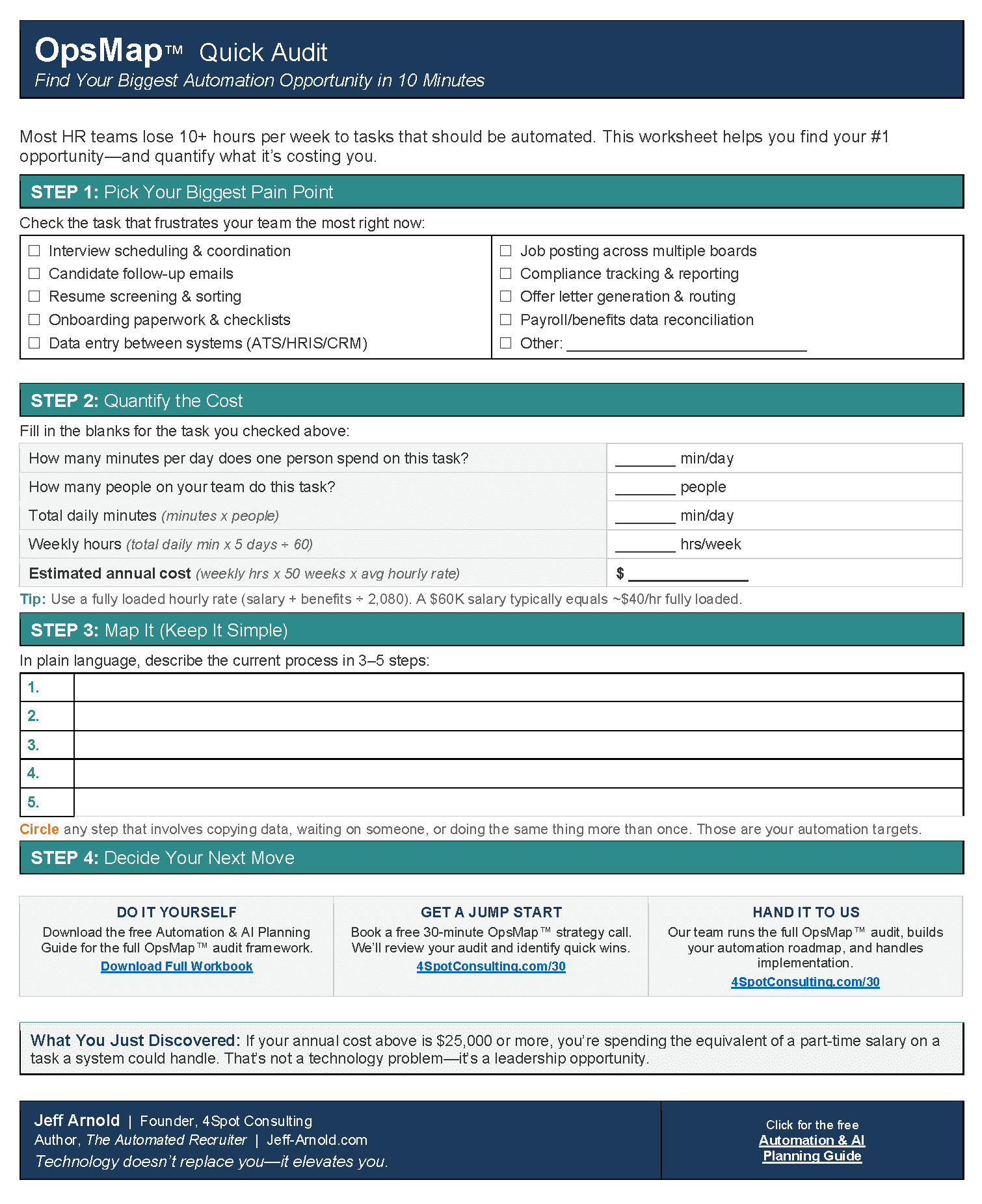
At 4Spot Consulting, we approach these challenges with a strategic, outcome-driven mindset. Our OpsMap™ diagnostic is designed precisely to uncover these hidden costs and inefficiencies related to manual data entry across HR, recruiting, CRM, and general operations. We don’t just identify the problem; we engineer tailored solutions using robust platforms like Make.com, integrating your existing SaaS systems to create seamless, automated workflows.
Imagine a recruiting process where candidate data automatically flows from application forms to your ATS and CRM, enriched by AI for immediate parsing and initial screening. Or a sales cycle where contract data automatically populates, is sent for e-signature, and then updates your billing system without human intervention. This is not just a theoretical possibility; it’s what we implement for our clients, saving them hundreds of hours monthly and millions in operational costs. We transform fragmented data entry points into an integrated, error-proof “single source of truth” system that liberates your high-value employees to focus on what they do best: driving your business forward. By eliminating the manual drag, we empower B2B companies to achieve unprecedented levels of efficiency, accuracy, and scalability.
Ready to uncover automation opportunities that could save you 25% of your day? Book your OpsMap™ call today.
If you would like to read more, we recommend this article: The Blueprint for B2B Operational Excellence


RELATED POST