Post: The Silent Killer of Scalability: Unmasking Manual Data Entry’s Million-Dollar Cost
The Silent Killer of Scalability: Why Manual Data Entry is Costing Your Business Millions
In the relentless pursuit of growth, businesses often focus on grand strategies and innovative products, overlooking a silent, insidious drain on their resources: manual data entry. It’s a seemingly innocuous task, a necessary evil, yet its cumulative impact can be devastating, quietly siphoning away millions in productivity, stifling scalability, and eroding the very foundation of efficient operations. For high-growth B2B companies, this isn’t merely an inconvenience; it’s a critical vulnerability.
The Hidden Costs of Human Touch in Data Management
Consider the traditional workflow in many organizations: an email arrives, data is manually copied into a CRM, then maybe into an ERP, a project management tool, or even a spreadsheet. Each step is an opportunity for human error, a point of delay, and a significant expenditure of high-value employee time. This isn’t just about the hourly wage of the person performing the task; it’s about the opportunity cost. What strategic initiatives could that employee be driving? What client relationships could they be nurturing?
The costs extend far beyond salaries. There’s the cost of errors – miskeyed information leading to incorrect invoices, failed deliveries, compliance issues, or skewed analytics that drive poor business decisions. Each correction requires more manual effort, creating a compounding negative effect. Then there’s the delay. In today’s competitive landscape, speed is paramount. Manual processes create bottlenecks, slowing down everything from lead qualification to order fulfillment and customer service response times. This directly impacts customer satisfaction and, ultimately, revenue.
Eroding Trust and Creating Data Silos
One of the most detrimental long-term effects of manual data entry is the fragmentation of information. When data lives in disparate systems, painstakingly updated by hand, it’s nearly impossible to maintain a “single source of truth.” Different departments often operate with slightly different versions of client records, sales figures, or project statuses. This lack of unified, reliable data creates internal mistrust, sparks inter-departmental friction, and makes accurate reporting and forecasting a Sisyphean task.
Imagine an HR department manually processing hundreds of resumes, then a recruitment team duplicating effort by re-entering candidate data into their CRM. A sales team updates a client’s contact details, but the finance department still has outdated information. These are not isolated incidents but systemic issues that plague businesses striving for scalability. Without a consistent, automated flow of information, every additional customer, every new hire, and every expanded service line adds exponential complexity and cost.
From Bottleneck to Breakthrough: The Power of Strategic Automation and AI
At 4Spot Consulting, we’ve witnessed firsthand how businesses can transform these bottlenecks into breakthroughs using strategic automation and AI. Our approach isn’t about simply digitizing existing manual tasks; it’s about re-architecting your operational infrastructure to eliminate the need for manual data entry wherever possible, establishing true data integrity and flow.
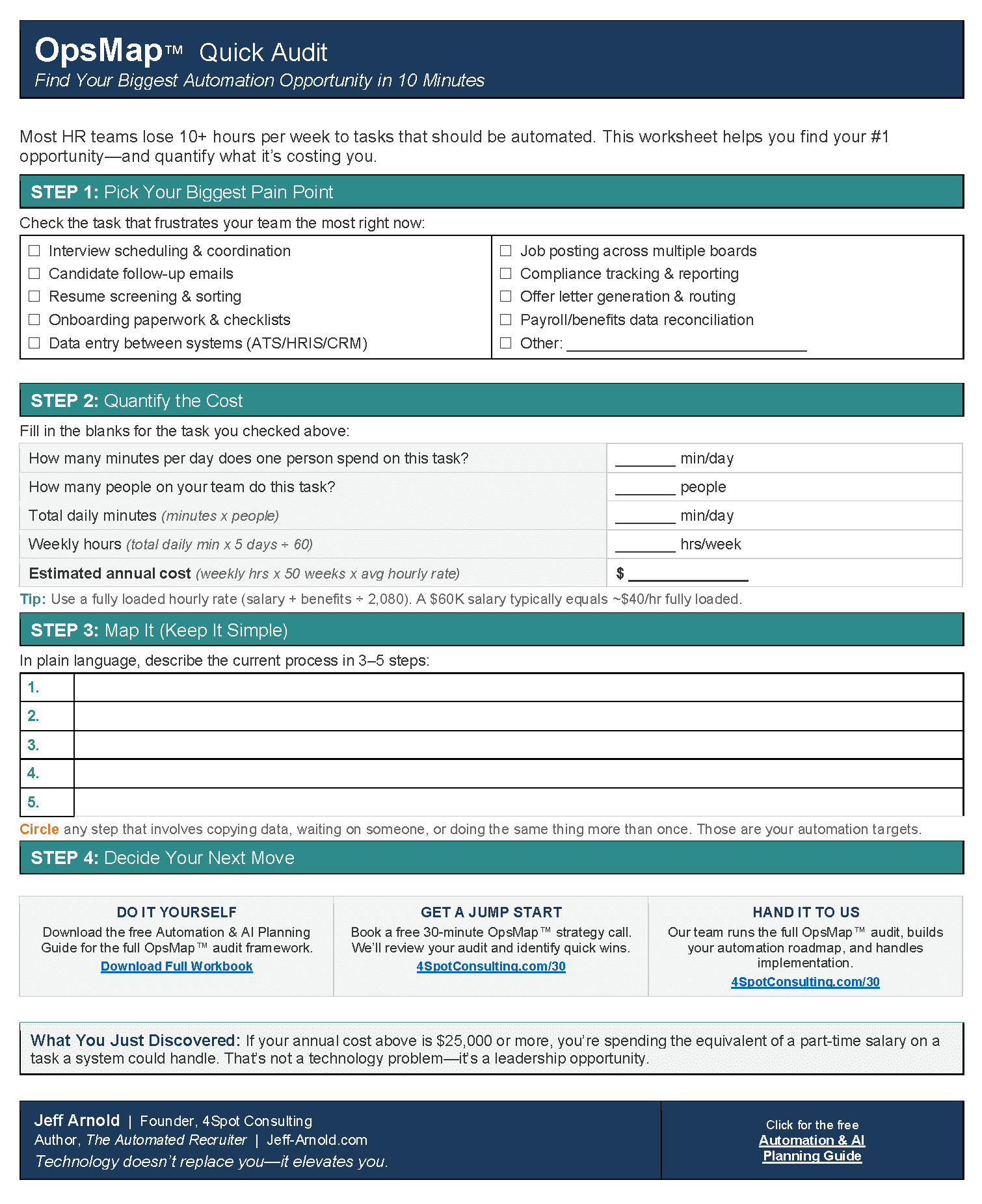
Consider the journey an HR tech client took with us. They were drowning in manual resume intake and parsing – a classic example of high-volume, repetitive data entry. Each resume represented several minutes of administrative work before a candidate could even be considered. This wasn’t just slow; it was costing them valuable talent opportunities and hundreds of hours per month. Through our OpsMap™ diagnostic, we identified this critical inefficiency.
Building an OpsMesh: Your Automated Data Backbone
Our solution involved leveraging platforms like Make.com to connect their applicant tracking system (ATS) with AI enrichment tools. When a resume was submitted, our automated workflows would instantly parse key information, enrich it with relevant data, and then sync it seamlessly into their Keap CRM. This eliminated the need for human intervention in the initial stages of candidate processing, saving them over 150 hours per month. The team went from “drowning in manual work to having a system that just works.” This is not an isolated incident; it’s the repeatable outcome of a strategic-first approach to automation.
This is the essence of an “OpsMesh” – our overarching automation strategy framework. It’s about creating an interconnected web of systems that communicate autonomously, ensuring data is accurate, up-to-date, and accessible across all relevant platforms. It’s about proactive data management, not reactive firefighting. When data flows freely and accurately, your teams gain clarity, make faster decisions, and can focus on high-value, human-centric tasks that genuinely drive growth and innovation.
Reclaiming Your Team’s Potential and Your Business’s Scalability
The true value of eliminating manual data entry isn’t just cost savings; it’s about reclaiming your employees’ potential. Imagine your HR leaders, COOs, and recruitment directors freed from mundane administrative burdens, empowered to focus on strategic planning, talent development, and optimizing customer experiences. This shift not only boosts morale but significantly enhances your competitive edge.
Our OpsMap™ diagnostic is precisely designed to uncover these hidden operational costs and identify the most impactful automation opportunities within your business. We don’t just build; we plan. We provide a clear roadmap to implement AI-powered operations that eliminate human error, reduce operational costs by saving 25% of your day, and prepare your business for scalable, sustainable growth. Stop letting manual data entry be the silent killer of your aspirations.
If you would like to read more, we recommend this article: Building an OpsMesh: Your Blueprint for Business Automation

RELATED POST