Post: Strategic AI: Eliminating Low-Value Work for Exponential Business Growth
Unlocking Productivity: How Strategic AI Integration Eliminates Low-Value Work
Every business leader understands the relentless pursuit of efficiency. In today’s fast-paced environment, the true differentiator isn’t just working harder, but working smarter. For too long, valuable employees across HR, recruiting, operations, and other critical departments have been bogged down by a relentless tide of repetitive, low-value tasks. These aren’t just minor irritations; they are significant drains on productivity, morale, and ultimately, your bottom line.
Consider the daily grind: manually entering data into multiple systems, chasing down approvals, formatting documents, screening hundreds of resumes for basic keywords, or meticulously backing up CRM data. Each of these tasks, while necessary, consumes precious hours that high-value employees could be dedicating to strategic initiatives, creative problem-solving, or client engagement. The cost isn’t just measured in wasted time; it’s also in missed opportunities for growth and innovation.
The Hidden Cost of Mundane Tasks
The cumulative effect of low-value work is often underestimated. It leads to burnout, reduces job satisfaction, and can contribute to high employee turnover. When your best people are spending 25% or more of their day on administrative drudgery, you’re not getting the full return on your investment in their talent. Furthermore, manual processes are inherently prone to human error, leading to inaccuracies, compliance risks, and subsequent corrective work that further compounds the inefficiency.
For B2B companies with $5M+ ARR, these inefficiencies scale dramatically. What starts as a minor bottleneck for a small team can become a systemic barrier to growth, preventing the company from scaling effectively without a corresponding, disproportionate increase in headcount and operational costs. The promise of technology has always been to alleviate this burden, but often, businesses adopt solutions in silos, creating new complexities rather than resolving old ones. This is where strategic AI integration comes into its own.
AI: Beyond the Hype, Towards Practical Elimination
The conversation around Artificial Intelligence often defaults to futuristic scenarios, but its most immediate and profound impact for businesses lies in its ability to automate and optimize the very tasks that drain productivity. We’re not talking about replacing human ingenuity, but augmenting it by offloading the repetitive, rule-based, and even some decision-support functions that currently monopolize employee time.
Imagine an HR department where initial resume screening, candidate communication, and interview scheduling are intelligently managed by AI, allowing recruiters to focus on engaging top talent. Or an operations team where data from various sources is automatically synthesized, organized, and backed up without manual intervention. This is not just a dream; it’s a practical reality achievable through platforms like Make.com, integrated with AI tools.
Strategic Integration for Real-World Impact
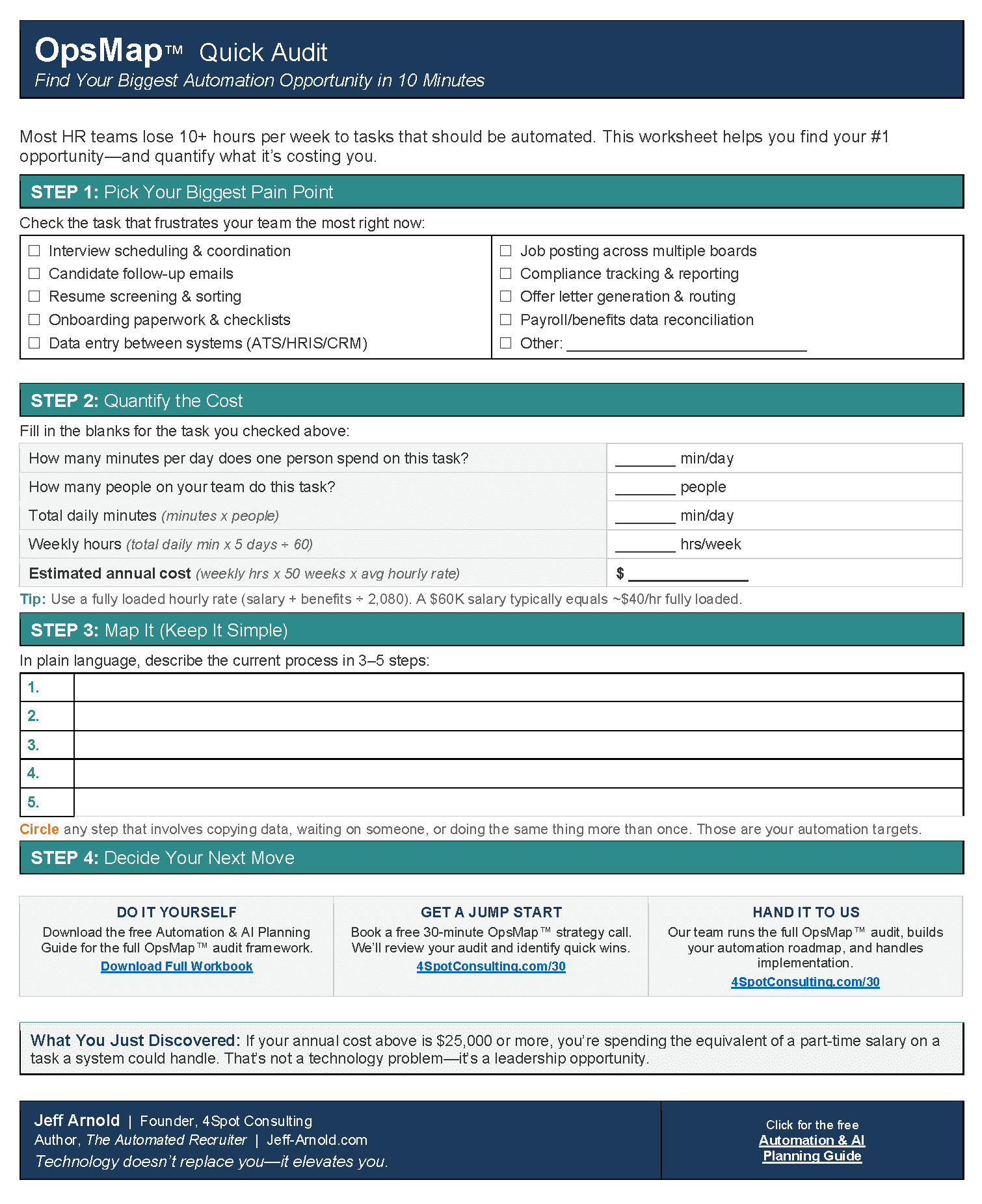
The key to successful AI integration isn’t just deploying the latest tool; it’s about a strategic, holistic approach. This is where the OpsMesh framework shines. It’s about understanding your entire operational ecosystem, identifying the true bottlenecks, and then weaving together intelligent automation and AI solutions that work in concert. It begins with an OpsMap™—a diagnostic deep dive that uncovers the hidden inefficiencies and maps out precise opportunities for eliminating low-value work.
For instance, consider the challenge of managing inbound leads or customer inquiries. Traditionally, this involves manual sorting, categorization, and routing. With AI, inbound communications can be instantly analyzed, prioritized, and directed to the correct department or individual, often with pre-populated responses or next steps. This not only saves hours but ensures a faster, more consistent customer experience. In HR, AI can analyze job descriptions and candidate profiles to predict fit, significantly reducing the manual review time for recruiters.
At 4Spot Consulting, we’ve witnessed firsthand how a strategic approach to AI and automation can transform operations. We helped one HR tech client save over 150 hours per month by automating their resume intake and parsing process using Make.com and AI enrichment, then syncing this data seamlessly to Keap CRM. This wasn’t just about saving time; it was about empowering their team to focus on building relationships and strategic talent acquisition, rather than being buried under administrative tasks. The outcome was a dramatic increase in efficiency and a palpable boost in team morale.
The Path to Reclaiming Your Day
The goal is clear: save your team 25% of their day by strategically integrating AI and automation to eliminate low-value work. This isn’t merely about cutting costs; it’s about reallocating human potential to areas where it can generate maximum value. It’s about creating systems that empower your employees to thrive, scale your operations without linear increases in headcount, and solidify your position as an agile, forward-thinking organization.
The journey starts with a clear understanding of where your operational inefficiencies lie. It demands a partner who can move beyond theoretical discussions to practical, implementable solutions that deliver measurable ROI. By focusing on strategic AI integration within a comprehensive automation framework like OpsMesh, businesses can genuinely unlock new levels of productivity, allowing their high-value employees to focus on what truly drives the business forward.
If you would like to read more, we recommend this article: The Strategic Imperative of Business Automation

RELATED POST