Post: AI: The End of Manual Data Entry Drudgery
Unlocking Efficiency: How AI is Eliminating the Drudgery of Manual Data Entry in Modern Businesses
Every business leader understands the critical need for accurate data. Yet, the process of getting that data into your systems often remains stubbornly manual, time-consuming, and prone to human error. From onboarding new hires to processing invoices or updating CRM records, manual data entry isn’t just a monotonous chore; it’s a silent killer of productivity, a drain on valuable resources, and a bottleneck to scalability. At 4Spot Consulting, we’ve witnessed firsthand how this operational friction can cost businesses 25% or more of their day, impacting everything from employee morale to the bottom line.
For high-growth B2B companies generating $5M+ ARR, these inefficiencies aren’t minor inconveniences; they’re significant impediments to achieving strategic objectives. Imagine the cumulative effect of countless hours spent by high-value employees on low-value data transcription. This isn’t just about saving a few minutes here and there; it’s about fundamentally reshaping how your organization handles information, liberating your team to focus on strategic initiatives that truly drive growth and innovation.
The Hidden Costs Lurking in Your Manual Processes
The true cost of manual data entry extends far beyond just wages paid for transcription. It encompasses a spectrum of hidden drains on your business:
Productivity Drain and Opportunity Cost
When your skilled team members are manually inputting data, they’re not engaging in sales, developing new strategies, or serving clients. This directly translates to lost opportunities and a squandering of their unique expertise. The more time spent on repetitive tasks, the less time available for high-impact activities that move your business forward. We’ve seen businesses gain back hundreds of hours a month by tackling this head-on.
Increased Human Error and Inaccuracy
To err is human, but in the realm of data, errors can be catastrophic. A single misplaced decimal, a misspelled name, or an incorrect date can cascade through your systems, affecting everything from financial reporting to customer communication. Correcting these errors is often more time-consuming and costly than the initial entry, eroding trust and operational integrity.
Delayed Decision-Making and Stifled Scalability
Manual processes inherently slow down the flow of information. If data takes days to be entered and verified, your leadership team is making decisions based on stale or incomplete information. Furthermore, scaling a business built on manual data entry is like trying to accelerate a car with a parking brake on. Each new client, project, or employee exponentially increases the manual burden, quickly reaching a breaking point.
AI-Powered Automation: Not Just a Trend, But a Strategic Imperative
The good news is that advancements in AI and automation technologies have provided a robust solution to this age-old problem. We’re not talking about science fiction; we’re implementing practical, ROI-focused systems today that transform how businesses operate. At 4Spot Consulting, our core offering revolves around leveraging these tools – like Make.com, Keap, and specialized AI services – to create seamless, error-free workflows.
Transforming HR and Recruiting Operations
Consider the HR and recruiting landscape, an area ripe for AI intervention. Resume intake, parsing, and candidate data entry into CRM systems (like Keap or HighLevel) traditionally demand significant manual effort. We’ve helped an HR tech client save over 150 hours per month by automating their resume intake and parsing using Make.com and AI enrichment, then syncing directly to their Keap CRM. This isn’t just about speed; it’s about accuracy and ensuring a single source of truth from the first interaction. As their team put it, “We went from drowning in manual work to having a system that just works.”
Ensuring Data Integrity Across Systems
The concept of a “Single Source of Truth” is paramount in modern business. AI-powered automation excels at maintaining this by automatically extracting, validating, and routing data across disparate systems. Whether it’s syncing client details from a sales call to your CRM, updating project statuses in your PM tool, or reconciling financial records, automation ensures consistency and eliminates discrepancies.
From Low-Value Work to High-Impact Strategy
Our goal is to reduce the low-value work for your high-value employees. By automating routine data entry and processing, we free up your team to engage in strategic thinking, client engagement, and problem-solving – the activities that truly differentiate your business. This isn’t about replacing people; it’s about empowering them to perform at their highest potential, increasing job satisfaction, and fostering a culture of innovation.
Your Path to a More Automated Future with 4Spot Consulting
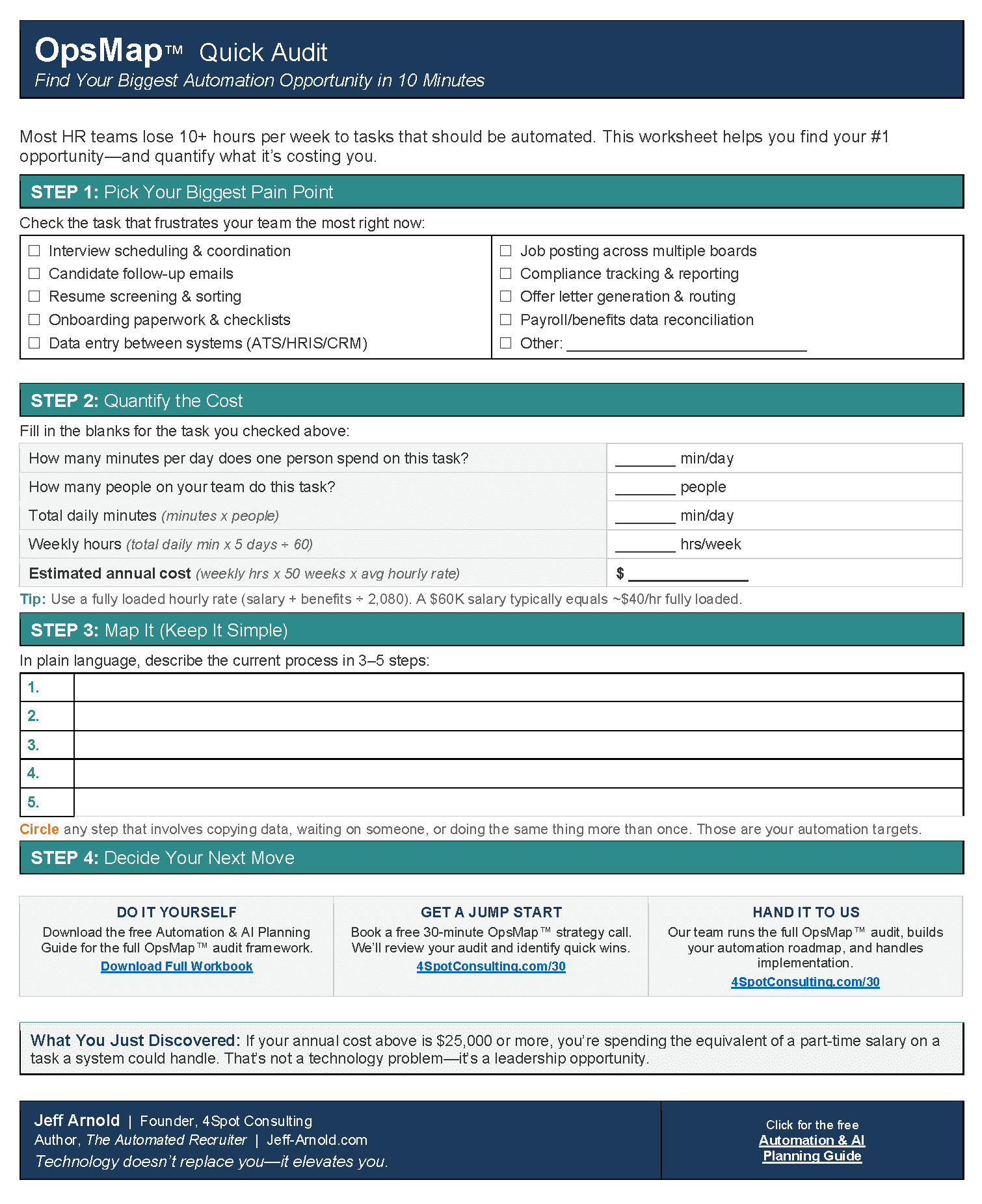
Implementing AI and automation is not a one-size-fits-all endeavor. It requires a strategic, tailored approach that begins with a deep understanding of your current operational landscape. That’s why our process starts with the OpsMap™ – a strategic audit designed to uncover inefficiencies, surface opportunities, and roadmap profitable automations specific to your business challenges.
We believe in a strategic-first approach. We don’t just build; we plan. Our track record includes helping clients achieve 240% production increases and realizing over $1M in annual cost savings. We connect dozens of SaaS systems, but crucially, every solution is tied directly to ROI and tangible business outcomes. You’re not just getting tech for tech’s sake; you’re getting a clear path to greater efficiency, reduced error, and enhanced scalability.
Ready to reclaim those 25% of your day currently lost to manual drudgery? It’s time to stop managing processes and start automating outcomes. The future of work is here, and it’s smarter, faster, and more profitable.
If you would like to read more, we recommend this article: Transforming Operations with AI and Automation

RELATED POST