Post: Harnessing AI: The Key to Predictive & Strategic HR
Beyond Basic Automation: Harnessing AI for Predictive Power in Modern HR
Many HR departments have embraced basic automation—streamlining onboarding forms, automating payroll, or digitizing record-keeping. While these steps are valuable, they often represent a reactive approach, solving today’s immediate problems. But what if HR could move beyond reaction to proactive foresight? What if your HR operations could predict future talent needs, identify retention risks, or even optimize recruitment strategies before issues arise? This is the profound promise of integrating advanced AI with existing automation frameworks.
The Evolution from Automation to Intelligent Prediction
The modern HR landscape is a complex tapestry of talent acquisition, employee experience, retention, and compliance. Traditional automation tackles the repetitive, low-value tasks, freeing up HR professionals from manual drudgery. However, AI elevates this by adding intelligence, learning from vast datasets to uncover patterns and make informed predictions. For instance, in talent acquisition, AI can analyze application data, interview performance, and even external market trends to predict which candidates are most likely to succeed and stay long-term, far surpassing simple keyword matching.
Consider the ever-present challenge of employee retention. Reactive HR might only intervene when an employee expresses dissatisfaction or submits their notice. An AI-powered system, however, can analyze engagement metrics, performance data, sentiment analysis from internal communications, and even absence patterns to flag employees who might be at risk of leaving before they even consider it. This enables proactive interventions – a tailored development plan, a mentorship opportunity, or a simple check-in – transforming HR from a perceived cost center into a strategic value driver.
This isn’t about replacing human judgment but augmenting it. AI excels at processing and identifying insights from data at a scale impossible for humans. It provides HR leaders with predictive analytics that inform strategic decisions, allowing them to allocate resources more effectively, design more impactful training programs, and create a truly data-driven employee experience. The goal is to shift the HR conversation from “what happened?” to “what will happen?” and, most importantly, “what should we do about it?”.
4Spot Consulting’s Approach: Bridging Automation and AI for Strategic HR
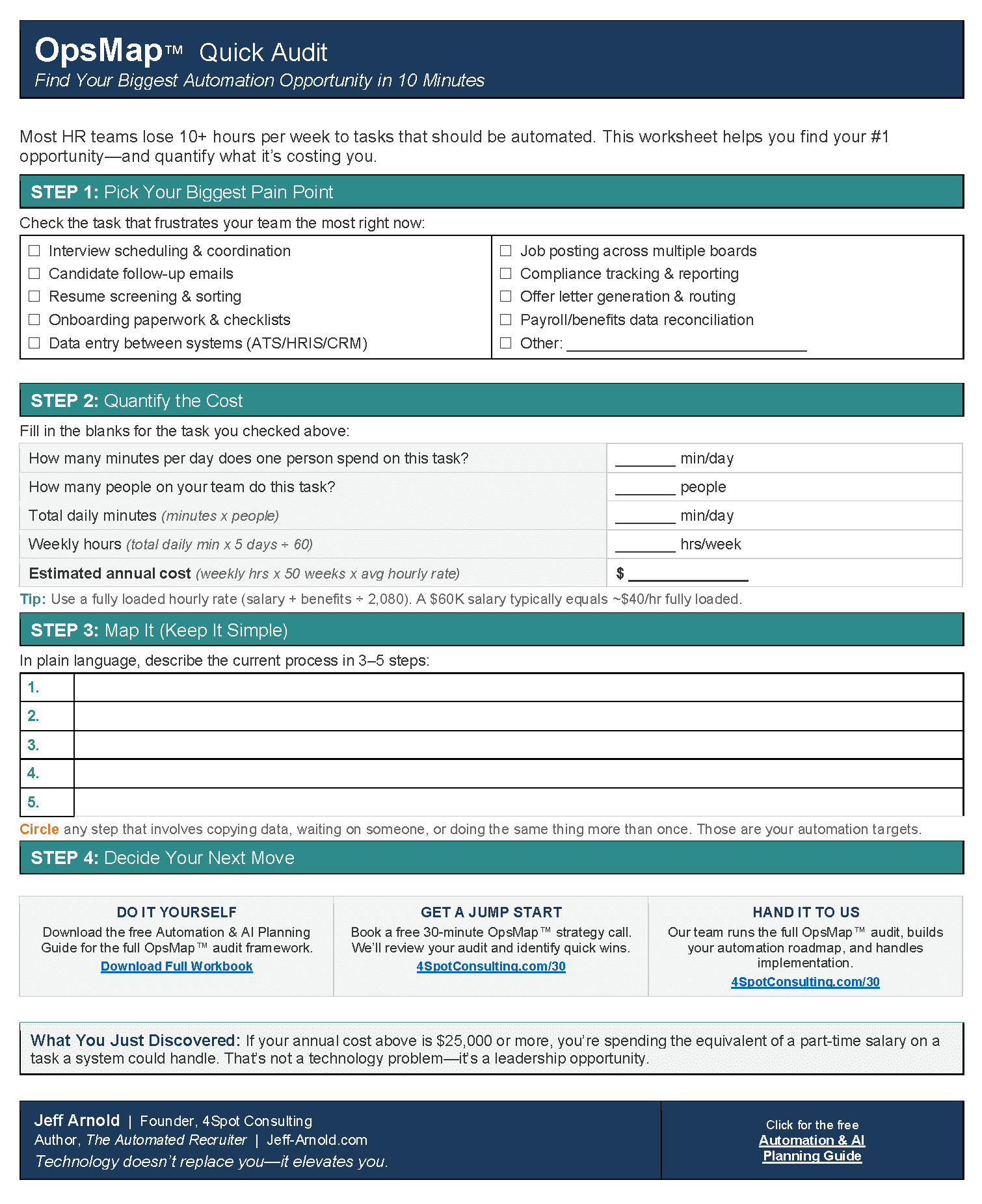
At 4Spot Consulting, we understand that true operational efficiency and strategic advantage come from a holistic approach. Our OpsMesh framework is meticulously designed to integrate and optimize business systems, and AI is the natural, powerful evolution of this strategy. We don’t just automate; we empower businesses to leverage intelligent automation that drives foresight and competitive edge. Through our OpsMap™ diagnostic, we meticulously audit your current HR processes, identifying not just where automation can save time and reduce errors, but critically, where AI can unlock profound predictive capabilities.
For instance, we can build robust systems using powerful integration tools like Make.com to seamlessly connect your applicant tracking system (ATS), HRIS, and even employee feedback platforms. This process creates a unified “single source of truth” for all HR data, eliminating silos and ensuring data consistency. Once your data is centralized and harmonized, we then layer in advanced AI capabilities – often leveraging specialized AI services – to provide real-time, actionable insights: predictive turnover scores, optimal recruitment channel analysis, or personalized career path recommendations. Our OpsBuild™ service translates these insights into actionable, automated workflows that feed directly into your HR operations. This ensures that every AI-driven insight leads to a tangible, beneficial outcome, rather than just another static report.
Imagine a system that automatically identifies skill gaps within your existing workforce and suggests relevant training modules or internal mentorship opportunities to close those gaps proactively. Or one that flags a high-performing employee showing subtle signs of disengagement, prompting a manager to intervene with a proactive, supportive conversation. This level of foresight and integrated, automated action is what transforms HR from an administrative function into a powerful strategic partner for sustained business growth and innovation.
Real-World Impact: Unleashing Efficiency and Insight
We’ve seen firsthand the transformative power of this integrated approach. For one HR tech client, we helped them save over 150 hours per month by automating their resume intake and parsing process using Make.com and AI enrichment, then syncing this intelligently processed data directly into their Keap CRM. This wasn’t merely about faster processing; it was about richer, more accurate data driving smarter, more strategic recruitment decisions. As their CEO put it, “We went from drowning in manual work to having a system that just works – and even tells us who’s likely to be a top performer, before we even speak to them.”
The Future is Intelligently Automated
The future of HR is not just automated; it’s intelligently automated. By moving beyond basic task automation to fully embrace AI’s predictive capabilities, businesses can cultivate a workforce that is not only efficient but also deeply engaged, resilient, and strategically aligned with overarching business objectives. This means better talent acquisition, higher retention rates, and a significant, measurable boost to overall operational effectiveness and profitability.
Ready to explore how AI can truly transform your HR operations from reactive to predictive? Our OpsMap™ is the strategic audit specifically designed to uncover these exact opportunities within your organization, helping you save 25% of your day and unlock unparalleled strategic advantage in talent management.
If you would like to read more, we recommend this article: The Future of Business Automation: Unlocking Efficiency and Growth


RELATED POST