Post: Stop the Silent Killer: Unifying Disconnected Data for Business Growth
The Silent Killer: How Disconnected Data Systems Cripple Business Growth
In the relentless pursuit of growth, businesses often invest heavily in new technologies, sales strategies, and marketing campaigns. Yet, beneath this dynamic exterior, a quiet saboteur often lurks: disconnected data systems. This isn’t just about a minor inconvenience; it’s a systemic problem that bleeds productivity, fuels human error, and ultimately suffocates scalability, leaving high-value employees mired in low-value work.
Consider the typical scenario: your HR team uses one system for applicant tracking, another for onboarding, and a third for payroll. Sales operates on a CRM, while marketing uses a separate platform for campaigns. Operations manages projects in yet another tool, and finance has its own suite for accounting. Each department functions in a silo, often creating its own version of the truth, leading to an ecosystem of fragmented information. The result? A business where critical insights are elusive, cross-departmental collaboration is a chore, and the potential for costly errors skyrockets.
The Hidden Costs of Data Fragmentation
The financial and operational repercussions of disconnected systems are profound. First, there’s the sheer inefficiency. When data isn’t shared seamlessly, employees spend an inordinate amount of time manually transferring information, reconciling discrepancies, or chasing down details from colleagues. This isn’t strategic work; it’s repetitive, soul-crushing drudgery that drains valuable employee hours – hours that could be spent on innovation, client engagement, or strategic planning. For a high-growth B2B company, this can easily equate to 25% or more of an employee’s day lost to preventable administrative tasks.
Beyond time, there’s the issue of data integrity. Manual data entry is inherently prone to human error. A misplaced decimal, a forgotten field, or an inconsistent naming convention can ripple through multiple systems, corrupting reports, misinforming decisions, and potentially leading to compliance issues or customer dissatisfaction. Imagine an incorrect client address causing a shipment delay, or inaccurate financial data leading to flawed budgeting. These aren’t hypothetical; they are daily realities for businesses grappling with data silos.
Eroding Customer Experience and Limiting Strategic Vision
Disconnected systems don’t just affect internal operations; they directly impact the customer experience. When sales, support, and marketing teams lack a unified view of a customer’s history, interactions become disjointed and impersonal. A customer might have to repeat their issue to multiple representatives, or receive marketing messages irrelevant to their current service status. This fragmented experience erodes trust and diminishes loyalty in an increasingly competitive market.
Furthermore, without a single source of truth, leadership struggles to gain a holistic view of the business. Strategic decisions become less informed, based on incomplete or conflicting data. Identifying bottlenecks, forecasting trends, or measuring true ROI across different initiatives becomes a complex, often impossible, task. The ability to pivot quickly or capitalize on emerging opportunities is severely hampered when the foundational data insights are missing.
Building Your “Single Source of Truth” with OpsMesh™
At 4Spot Consulting, we’ve witnessed firsthand how these challenges impede even the most ambitious companies. Our approach begins with the understanding that automation isn’t just about saving time; it’s about creating a cohesive, intelligent operational ecosystem. We leverage platforms like Make.com, Keap, and AI tools to bridge the gaps between disparate systems, constructing what we call an “OpsMesh™”—a strategic framework designed to weave together your operational data into a unified, reliable whole.
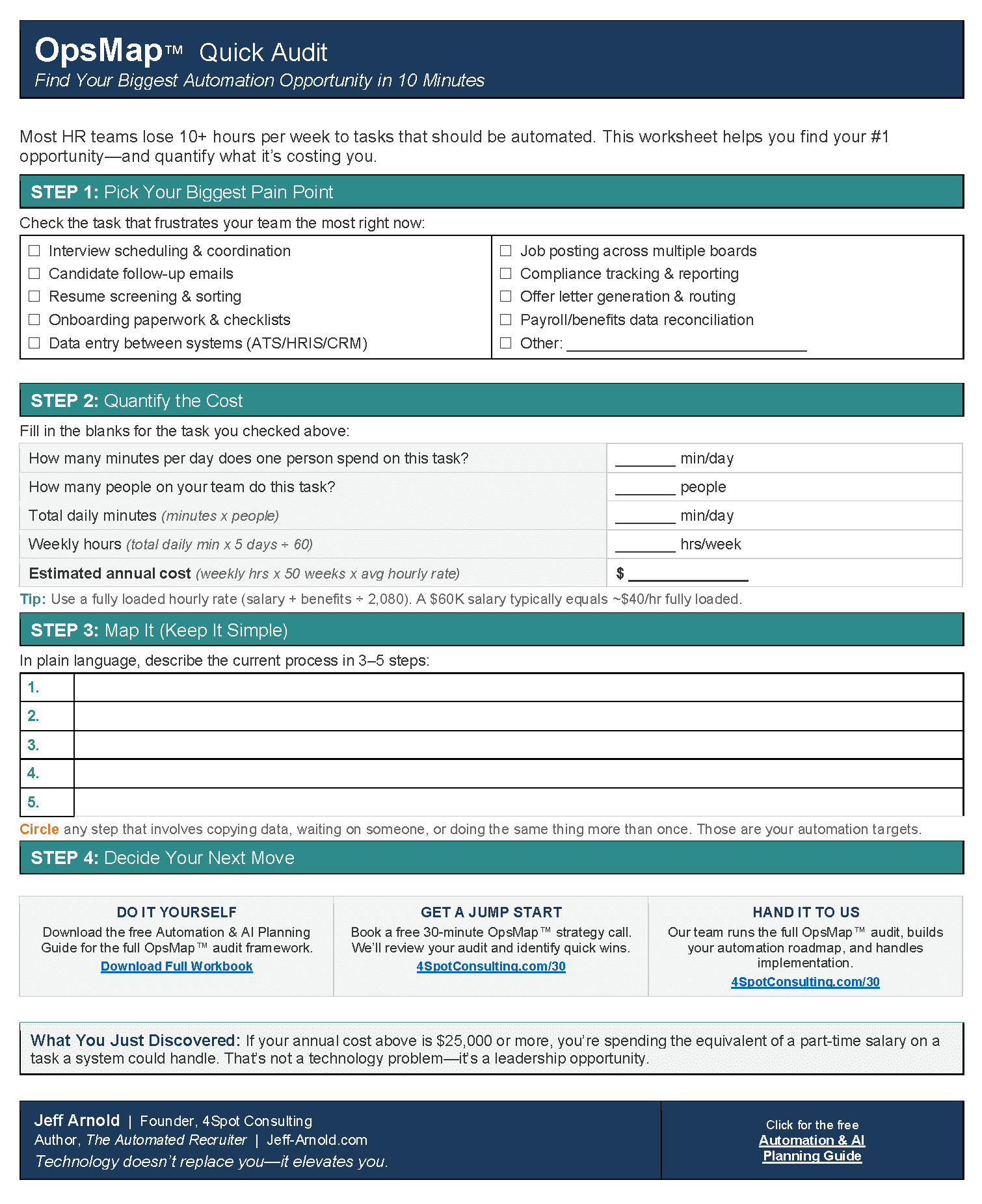
The journey starts with our OpsMap™ diagnostic. This isn’t a superficial review; it’s a deep dive into your existing workflows, data flows, and pain points. We meticulously identify where your systems are disconnected, where manual data transfer is rampant, and where the risk of human error is highest. Our goal is to uncover the inefficiencies costing your high-value employees precious time and your business significant resources.
Automating for Clarity and Scalability
Once we have a clear OpsMap™, our OpsBuild™ phase kicks in. Here, we design and implement robust automations that eliminate manual data entry, synchronize information across platforms, and create a centralized repository for critical business intelligence. For example, we’ve helped HR firms automate resume intake and parsing, feeding enriched data directly into their CRM like Keap, saving over 150 hours per month. For other clients, we’ve integrated sales data with project management and finance systems, providing a real-time, 360-degree view of every client engagement.
The result is a transformative shift: your high-value employees are liberated from low-value, repetitive tasks. They can dedicate their expertise to strategic initiatives, customer satisfaction, and core business growth. With a single source of truth, decision-making becomes faster, more accurate, and more proactive. Your business gains the agility and scalability it needs to thrive, free from the silent burden of disconnected data.
The time for patchwork solutions is over. To truly scale, innovate, and lead in your industry, you must address the foundational issue of data fragmentation. It’s not merely about integrating tools; it’s about strategically re-engineering your operational backbone to empower your team and drive unparalleled efficiency.
If you would like to read more, we recommend this article: Mastering Operational Efficiency: Your Guide to Automation and AI in Business

RELATED POST