Post: Reclaim 25% of Your Day: 7 AI Strategies for HR & Recruiting Efficiency
Leveraging AI for HR and Recruiting: 7 Essential Strategies to Save 25% of Your Day
In today’s competitive talent landscape, HR and recruiting professionals face unprecedented pressures: a relentless demand for skilled candidates, the imperative to maintain a positive candidate experience, and the constant need to optimize internal operations with limited resources. The old ways of manual resume screening, repetitive outreach, and fragmented data management are no longer sustainable. At 4Spot Consulting, we understand these challenges because we’ve lived them, and we know that simply working harder isn’t the answer. The real solution lies in working smarter, and that’s where Artificial Intelligence (AI) steps in as a game-changer. AI isn’t just a buzzword; it’s a powerful suite of tools ready to transform how you attract, assess, and onboard talent, fundamentally reshaping the HR function from a cost center into a strategic value driver. By integrating AI-powered automation, HR and recruiting teams can reclaim significant portions of their day, redirecting high-value employees from low-value tasks to initiatives that truly move the needle for their organizations. This article will explore seven practical, actionable strategies for leveraging AI to streamline operations, enhance decision-making, and ultimately save you a substantial 25% of your day, enabling you to focus on the human element that AI can never replace.
1. Intelligent Candidate Sourcing and Matching
One of the most time-consuming aspects of recruiting is identifying and engaging with qualified candidates. Traditional methods often rely on keyword searches that miss suitable profiles or deliver overwhelming volumes of irrelevant results. AI-powered sourcing tools revolutionize this process by going beyond keywords to understand intent, analyze resumes and job descriptions contextually, and even predict candidate fit based on skills, experience, and cultural indicators. These systems can scour vast databases, social media, and professional networks at lightning speed, surfacing candidates who might otherwise be overlooked. For instance, an AI engine can analyze a successful employee’s profile within your organization and then proactively search for external candidates with similar attributes, significantly reducing time-to-fill. Furthermore, AI can automate initial outreach, personalizing messages based on candidate profiles and even suggesting optimal times for contact. At 4Spot Consulting, we’ve implemented solutions using platforms like Make.com to connect various sourcing platforms with CRMs like Keap, allowing for seamless data flow and automated follow-up sequences. This integrated approach ensures that once a promising candidate is identified, the system immediately initiates engagement, freeing recruiters to focus on deeper interactions with genuinely interested and qualified individuals rather than manual search and initial vetting. The result is a dramatically more efficient sourcing funnel and access to a higher quality talent pool.
2. Automated Resume Screening and Parsing
The sheer volume of applications for a single role can be daunting, often leading to hundreds, if not thousands, of resumes to review. Manually sifting through these documents is a monumental task prone to human bias and oversight, costing recruiters valuable hours. AI-driven resume screening and parsing tools are designed to eliminate this bottleneck. These systems can quickly scan and extract key information—skills, experience, education, certifications—from diverse resume formats, standardizing the data for easy comparison and analysis. Beyond simple data extraction, advanced AI can rank candidates based on predefined criteria, identify red flags, and even flag potential top performers who might not perfectly match every single keyword but possess highly relevant transferable skills. Our experience with clients, such as an HR firm that saved over 150 hours per month, demonstrates the power of this automation. We leveraged Make.com to automate their resume intake, parsing the data with AI enrichment, and then syncing it directly into their Keap CRM. This not only dramatically speeds up the initial screening phase but also ensures that valuable candidate data is accurately captured and readily accessible for future roles, building a robust talent pipeline. By automating this crucial yet repetitive step, HR professionals regain substantial time, allowing them to engage earlier with the most promising candidates and focus on the qualitative aspects of selection.
3. AI-Powered Chatbots for Candidate Engagement
Candidates today expect immediate responses and personalized interactions throughout their application journey. However, HR teams are often stretched thin, unable to provide the instant gratification applicants desire, leading to drop-offs and a diminished candidate experience. AI-powered chatbots offer an elegant solution to this challenge. These sophisticated virtual assistants can be deployed on career pages, job boards, or even via messaging apps to provide 24/7 support. They can answer frequently asked questions about company culture, benefits, specific job requirements, and application status instantly. Furthermore, chatbots can conduct preliminary screenings, asking candidates a series of qualifying questions and even scheduling initial interviews, seamlessly integrating with HR calendars. Beyond efficiency, chatbots enhance the candidate experience by offering prompt, consistent, and unbiased information, reducing frustration and keeping candidates engaged. For example, using a tool like Bland AI, we can help implement conversational AI that guides candidates through FAQs or even initiates basic screening questions before handing off to a human recruiter. This not only frees up recruiters from fielding repetitive inquiries but also ensures that only genuinely interested and pre-qualified candidates move forward in the process. The impact is a more efficient, engaging, and scalable candidate journey, improving recruitment metrics across the board.
4. Predictive Analytics for Workforce Planning and Retention
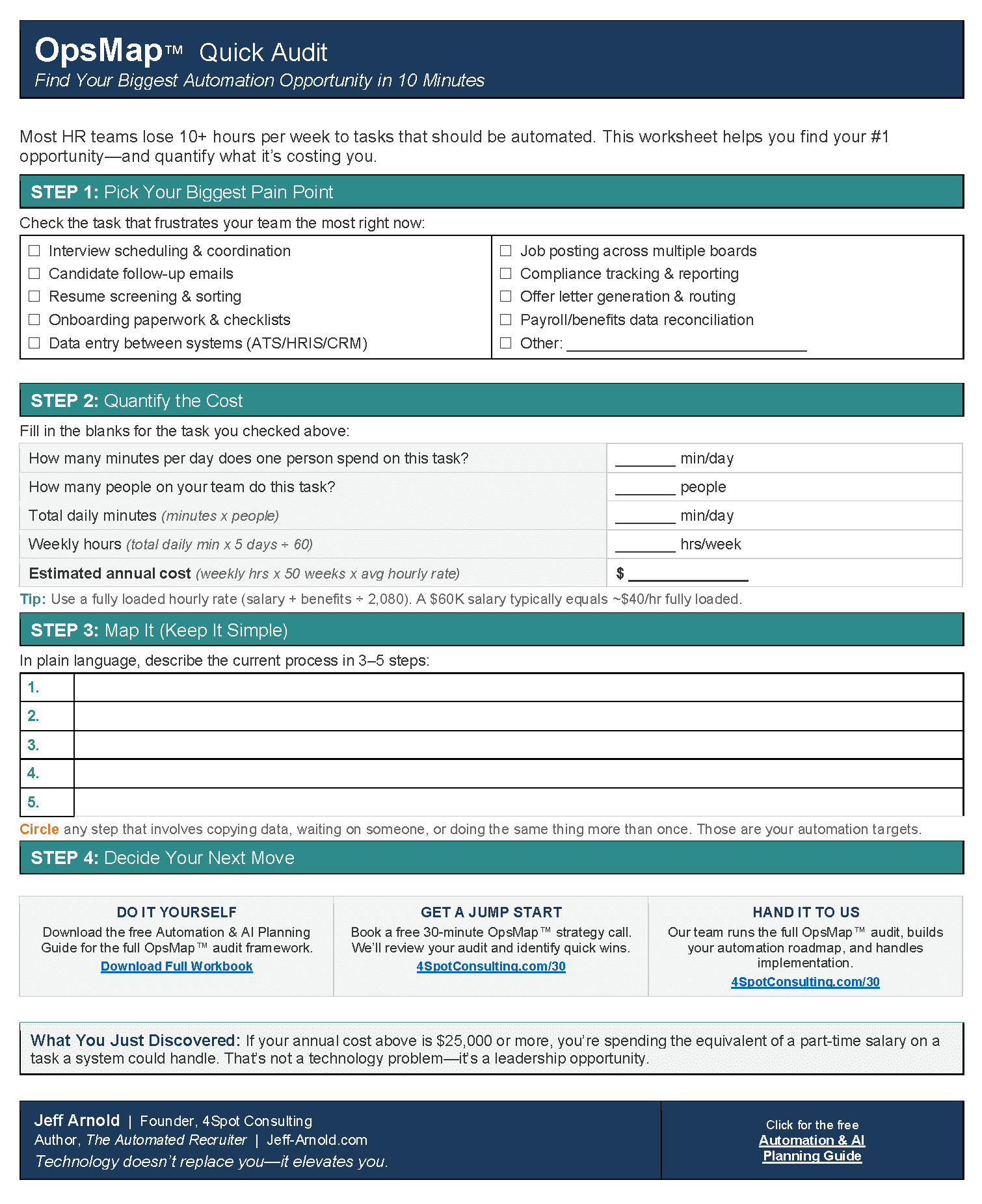
Effective HR isn’t just about reactive hiring; it’s about strategic foresight. AI brings powerful predictive capabilities to workforce planning and retention strategies, transforming HR from a reactive function into a proactive one. By analyzing vast datasets—including employee performance, tenure, engagement scores, compensation, industry trends, and even external market data—AI algorithms can identify patterns and predict future outcomes. For instance, AI can predict which employees are at a higher risk of attrition, allowing HR to intervene with targeted retention strategies before it’s too late. It can also forecast future talent needs based on business growth projections and skill gaps, enabling proactive recruitment and training initiatives. Our OpsMap™ diagnostic often uncovers opportunities to integrate existing HR data with AI tools to build these predictive models. This enables leaders to make data-driven decisions about everything from resource allocation and skill development to succession planning. Instead of relying on intuition, HR professionals can leverage concrete insights to optimize staffing levels, identify critical roles for development, and design impactful employee engagement programs. This strategic application of AI ensures that your organization is always prepared for future talent demands and that your most valuable assets—your employees—are retained and nurtured.
5. Automated Onboarding and Compliance Workflows
The onboarding process is critical for new hire success and retention, yet it’s often riddled with manual paperwork, repetitive data entry, and fragmented communications across departments. This not only creates a poor first impression for new employees but also consumes significant HR time. AI-powered automation can completely transform onboarding, making it seamless, personalized, and compliant. Imagine a system where, once an offer is accepted, AI automatically triggers a series of events: generating offer letters (via tools like PandaDoc), initiating background checks, provisioning IT equipment, enrolling the new hire in benefits, and setting up necessary system access. AI can also personalize the onboarding journey by delivering relevant content and training modules based on the employee’s role and department. Furthermore, AI helps ensure compliance by automatically tracking required forms, certifications, and training completion, sending reminders, and maintaining an auditable trail. At 4Spot Consulting, our OpsBuild framework frequently involves implementing such automated workflows, integrating various tools to create a “single source of truth” for employee data. This approach not only frees up HR teams from administrative burdens but also significantly improves the new hire experience, ensuring they feel welcomed, informed, and productive from day one, leading to faster assimilation and higher retention rates.
6. Enhancing Learning & Development with AI Personalization
Employee growth and skill development are paramount for organizational success and individual career progression. However, delivering relevant and engaging learning experiences to a diverse workforce can be a challenge. AI provides powerful tools for personalizing learning and development (L&D) programs, making them more effective and efficient. AI algorithms can analyze an employee’s current skills, career aspirations, performance data, and even learning preferences to recommend tailored courses, modules, and resources. Instead of a one-size-fits-all approach, each employee receives a customized learning path designed to bridge their specific skill gaps and support their professional goals. This also extends to identifying emerging skill needs within the organization and proactively suggesting training to develop the internal talent required for future roles. For instance, AI can detect trends in project requirements or client needs and then recommend relevant upskilling opportunities to specific teams. By integrating AI into L&D platforms, companies can foster a culture of continuous learning, improve employee engagement, and ensure their workforce remains agile and future-ready. This strategic application of AI not only boosts individual performance but also contributes directly to the organization’s overall competitiveness and adaptability in a rapidly changing market, all while reducing the administrative overhead typically associated with managing broad training programs.
7. Data-Driven Decision Making and HR Analytics
In the past, HR decisions were often based on intuition or anecdotal evidence. Today, AI empowers HR leaders with sophisticated analytics capabilities that provide deep insights into every aspect of the employee lifecycle. AI-driven HR analytics platforms can integrate data from various sources—applicant tracking systems, HRIS, performance management software, engagement surveys, and even external market data—to create comprehensive dashboards and reports. These platforms can identify correlations, uncover hidden trends, and predict outcomes that would be impossible for humans to discern from raw data. For example, AI can analyze compensation data across the industry to ensure competitive salaries, identify which recruiting channels yield the highest quality hires, or pinpoint specific training programs that have the greatest impact on performance. Our OpsMesh framework emphasizes creating a robust data infrastructure that feeds into these analytics. This means HR leaders can move beyond simply reporting on metrics to truly understanding the “why” behind their data, making informed, strategic decisions that drive business outcomes. By leveraging AI for data analysis, HR teams can justify investments, optimize their strategies, and demonstrate their value to the organization with concrete, data-backed evidence, moving from an administrative function to a strategic partner at the executive table.
The integration of AI into HR and recruiting is no longer a luxury but a strategic imperative for organizations looking to thrive in the modern business landscape. From intelligent sourcing and automated screening to predictive analytics and personalized learning, AI offers a comprehensive toolkit to optimize every facet of the talent lifecycle. By embracing these seven essential strategies, HR and recruiting professionals can significantly reduce manual burdens, enhance decision-making, improve the candidate and employee experience, and ultimately reclaim up to 25% of their day. This newfound efficiency allows high-value employees to focus on strategic initiatives, human connection, and fostering a thriving organizational culture—aspects that AI can augment but never replace. At 4Spot Consulting, we specialize in helping high-growth B2B companies like yours navigate this transformation, building custom AI and automation solutions that drive tangible ROI. Isn’t it time to transform your HR operations?
If you would like to read more, we recommend this article: The Ultimate Guide to HR & Recruiting Automation in the AI Era
RELATED POST