Post: Behind the Scenes of: How to Evaluate an HR Automation Consultant: A CHRO’s Buyer’s Guide
Evaluating an HR automation consultant comes down to three things: whether they diagnose before they prescribe, whether they build on your existing systems rather than replacing them, and whether they measure outcomes in business terms. This post walks through the exact process 4Spot runs on every CHRO engagement from first call through delivery.
Why Most CHRO Evaluation Frameworks Fall Short
The frameworks most CHROs apply to technology vendors fail when applied to automation consultants. Technology vendors sell features. Automation consultants sell transformation – and transformation requires a different kind of scrutiny.
The gap shows up fast. A feature-focused evaluation surfaces impressive demos and polished slides. A process-focused evaluation surfaces how a consultant thinks when the data is messy, the integrations are broken, and the stakeholders disagree on priorities. Those are the real conditions every engagement operates in.
4Spot built the OpsMesh™ framework to close that gap. It sequences evaluation and delivery around process clarity first, technology second. Before any automation gets built, the workflow has to be documented, tested, and agreed upon by everyone who touches it. That sequence – process before platform – is the single biggest differentiator between automation that sticks and automation that gets abandoned six months after go-live.
If you want to see where most HR teams discover they need outside help, the 10 signs you need to hire an HR automation consultant lays out the pattern clearly.
What the Discovery Phase Actually Looks Like
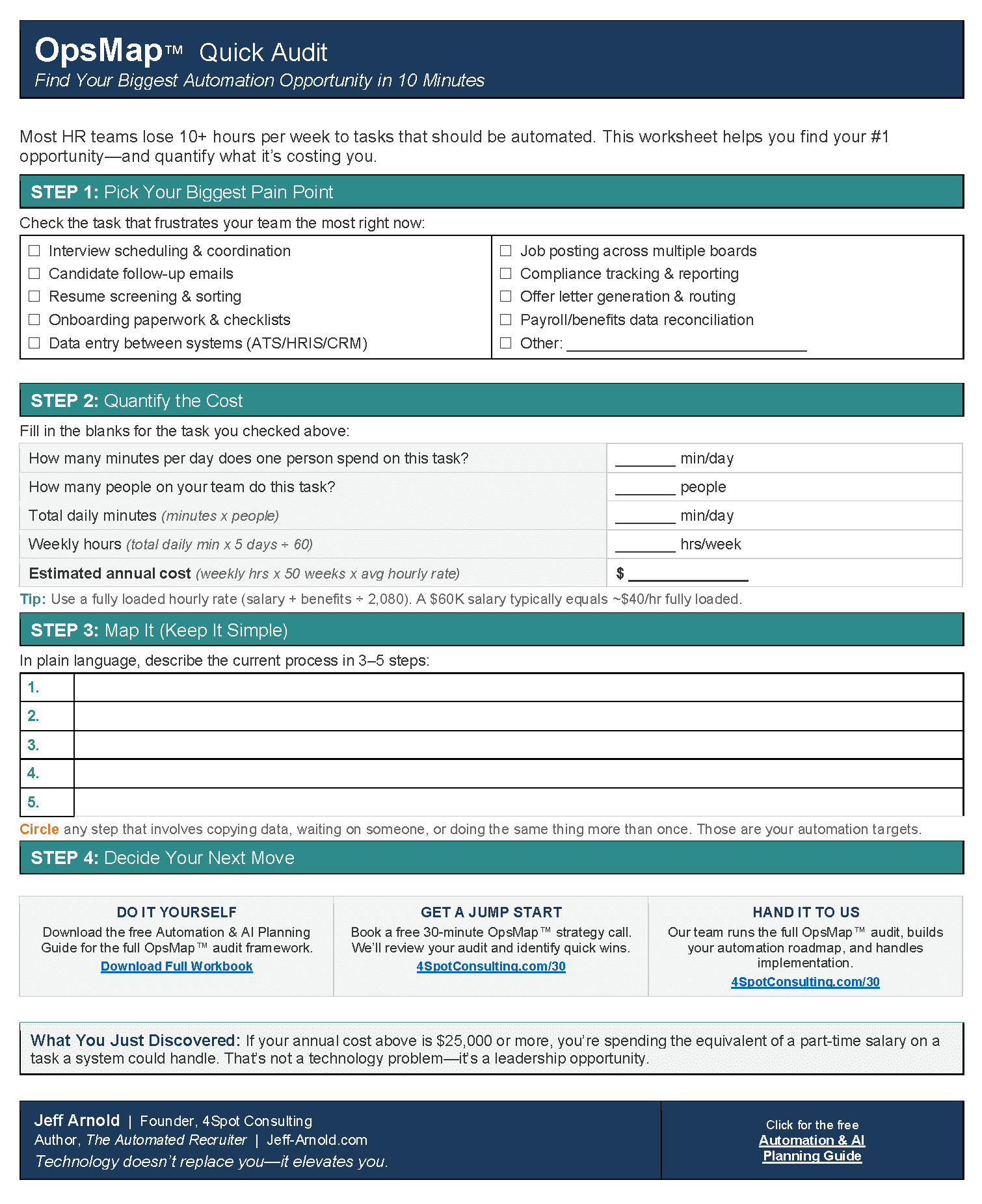
A qualified automation consultant starts with an OpsMap™ before recommending anything. The OpsMap is a structured discovery engagement that documents every workflow, identifies every manual handoff, and maps every system interaction your HR operation runs on. It produces a prioritized list of automation opportunities ranked by time savings, error reduction, and strategic impact.
What you are evaluating in this phase is the quality of the questions. Weak consultants ask what you want automated. Strong consultants ask what breaks, what is inconsistent, and what your team does when the system does not do what it is supposed to. The second set of questions surfaces the real problem. The first set just documents the symptoms.
Watch for consultants who skip straight to tool recommendations. If someone arrives at a first meeting with a preferred platform already in mind, they are selling a solution in search of a problem. The right consultant stays platform-agnostic until the process map is complete. Platform selection follows the map – it does not precede it.
The connection between process clarity and automation success is not optional. These real examples of why clean processes must come before HR automation show exactly what happens when teams skip discovery and try to automate broken workflows.
Scoping the Work: OpsSprint vs. OpsBuild
Automation engagements come in two shapes, and you need to know which one fits your situation before signing anything. Fixed-scope engagements work when the process is clean, the requirements are documented, and the integration points are stable. Flexible engagements work when you are still learning what you need, the process has exceptions your team has not mapped yet, or you are connecting systems that have never talked to each other before.
4Spot structures initial engagements as an OpsSprint™ or an OpsBuild™ depending on scope. An OpsSprint is a fast, focused build – typically a single workflow or integration delivered in a compressed timeline. An OpsBuild is a full-scope implementation that covers multiple workflows, custom integrations, and stakeholder training. OpsMap findings determine which path makes sense.
The mistake CHROs make is trying to scope a full implementation before discovery is complete. You cannot accurately scope what you do not fully understand. Any consultant who gives you a firm fixed-price quote before doing discovery is either guessing or planning to change-order their way to the real number later. Insist on discovery first.
Evaluating Technical Depth Without Being Technical
You do not need to be a developer to evaluate technical competence – you need the right proxy questions. Ones that separate surface-level automation knowledge from genuine systems expertise.
Ask how they handle errors. Automation that runs cleanly in a controlled environment breaks in production because of API timeouts, data format mismatches, and edge cases nobody anticipated. A consultant who describes their error handling strategy in plain language – retry logic, failure alerts, rollback procedures – has built real systems. A consultant who glosses over it has not.
Ask what happens when a connected system changes. SaaS platforms update their APIs, change field structures, and deprecate features without warning. A good automation practice builds monitoring into every workflow and has a maintenance protocol when upstream systems break things. OpsCare™ exists specifically for this reason – ongoing scenario health, dependency tracking, and proactive updates when a connected platform changes its behavior.
Ask for a reference from an engagement that hit obstacles. Every consultant has had a project that did not go exactly as planned. What matters is how they handled it – did they communicate early, adapt the scope, and deliver something functional, or did they disappear and blame the client’s data? That answer tells you more than any case study on their website.
Expert Take
The single most reliable signal in an HR automation evaluation is how a consultant responds when you describe a broken process. A sales-oriented consultant pivots to what their tool does. A delivery-oriented consultant asks three follow-up questions. The follow-up questions are the differentiator – they show diagnostic thinking, not feature mapping. If you get a prospective consultant into a working session before you sign, do it. One hour of real problem-solving tells you more than ten hours of structured demos.
Commercial Terms: What a Fair Engagement Looks Like
Automation consulting engagements should be structured around delivered outcomes, not hours billed. An hourly billing model misaligns incentives – it rewards complexity and penalizes efficiency. A milestone-based model puts both parties on the same side of the outcome.
Look for structured milestone payments tied to deliverable completion – OpsMap complete, first workflow live, training delivered, sign-off received. That structure keeps the engagement moving and gives you clear decision points to reassess scope if priorities shift mid-project.
Ongoing support must be explicitly scoped. Too many automation engagements end at go-live and leave HR teams holding workflows they do not fully understand, connected to systems they cannot troubleshoot. Ask what happens after delivery. A maintenance agreement, a monitoring protocol, and a clear escalation path for when something breaks are non-negotiable for any workflow running core HR operations.
The Six-Criteria Scorecard
A structured scorecard keeps the evaluation from drifting into subjective impressions. Score each criterion on a simple three-point scale and compare across candidates.
Process-first sequencing. Does the consultant insist on mapping the process before recommending tools? A yes here is non-negotiable. Any consultant who skips this step is a risk.
Platform fit vs. platform loyalty. Does the recommendation match your existing stack, or does it require replacing systems you already own? Consultants who push their preferred platform regardless of fit add switching costs and adoption risk to every engagement.
Error handling depth. Can they describe their approach to failures, edge cases, and upstream API changes in plain language? Technical depth shows here without requiring you to evaluate code.
Outcome definition clarity. Did they help you define what success looks like in measurable terms before scoping the work? Vague success criteria protect the consultant, not the client.
Reference quality. Are references from engagements similar in scope and complexity to yours? A reference from a small single-workflow project does not validate a large multi-system implementation.
Post-delivery support model. Do they have a structured maintenance offering, or does the engagement end at go-live? Automation without maintenance is a slow failure waiting to happen.
For the numbers that frame why each of these criteria matter at the business level, these 12 stats explain the CHRO buyer’s guide with hard data behind each point.
How 4Spot Runs a CHRO Engagement
Every 4Spot engagement starts with a structured intake call that covers the same ground as the evaluation criteria above – but from the other direction. We are evaluating fit as much as the CHRO is. Engagements that succeed share a few traits: HR leadership is aligned on the problem they are trying to solve, the process is documented well enough to build on, and there is an internal owner who will champion the implementation after we are done.
The OpsMap™ engagement is the entry point for any mid-size or complex HR operation. It produces a standalone deliverable – a documented process map, a prioritized automation backlog, and a recommended build sequence – that has value regardless of whether 4Spot handles the build. If you want an independent opinion before committing to a full engagement, the OpsMap is designed for exactly that.
The results speak for themselves. This engagement with Global Talent Solutions shows what a full OpsBuild delivers at scale, and this follow-on engagement shows how a focused OpsSprint reclaimed 100 hours on a specific workflow bottleneck. For a broader look at how other HR teams are using real examples to set evaluation benchmarks, these 10 real examples of the CHRO buyer’s guide evaluation are worth your time.
Frequently Asked Questions
What is the difference between an HR automation consultant and an HR technology vendor?
An HR technology vendor sells a platform. An HR automation consultant builds the workflows that connect your platforms and makes them work together as a system. Vendors have incentive to sell you their product. A platform-agnostic consultant has incentive to solve your problem with whatever tools fit best.
How long does a typical HR automation discovery take?
A structured discovery engagement for a mid-size HR operation runs two to three weeks. Larger operations with more complex workflows and more system integrations run longer. Discovery stretches when process documentation does not exist and needs to be built from observation rather than existing materials.
What HR systems does 4Spot work with?
4Spot builds automation across ATS platforms, HRIS systems, CRM tools, document management platforms, and payroll connectors. Make.com serves as the integration layer across most engagements. The full stack depends on what the client already owns – we build on existing infrastructure, not a replacement suite.
How do I know if my HR processes are ready for automation?
The readiness test is simple: write down the steps for your five highest-volume HR workflows. If you can document each step clearly enough that a new team member executes it without asking questions, your process is ready to automate. If documentation reveals exceptions, workarounds, and tribal knowledge at every step, process cleanup comes before automation – and a good consultant tells you that upfront. These 10 signs you need clean processes before automation show where most HR operations actually stand.
What should I look for in a consultant’s proposal?
A complete proposal includes milestone-based scope with defined deliverables at each stage, a named error handling protocol for every workflow they build, a named owner on the consultant side for the engagement, a post-delivery maintenance plan, and at least two references from engagements of similar complexity. A proposal missing these elements is incomplete – not a starting negotiation point.
How do CHROs typically measure success after go-live?
The strongest post-go-live metrics are time reclaimed per workflow, error rate before and after automation, and recruiter or HR generalist capacity redirected to strategic work. Consultants who cannot help you define these measurements before the build starts are not thinking about your outcomes – they are thinking about their deliverables.
Part of our complete guide: How to Evaluate an HR Automation Consultant: A CHRO’s Buyer’s Guide.