

Post: AI Parsing vs. Boolean Search: Choose Your ATS Strategy
Boolean search and AI parsing solve different problems inside your ATS – and choosing between them before fixing your workflow is the wrong sequence. Boolean delivers precision for specialized roles; AI parsing delivers recall for high-volume pipelines. Build the automation foundation first, then select the method that fits your actual hiring constraint.
At a Glance: Boolean Search vs. AI Parsing
| Factor | Boolean Search | AI Parsing |
|---|---|---|
| Matching logic | Deterministic (rules-based) | Probabilistic (NLP + ML) |
| Best for | Niche, specialized, low-volume roles | High-volume, unstructured pipelines |
| Skill synonym handling | Manual – must be coded into string | Automatic – inferred from context |
| Transparency / auditability | High – logic is explicit and documented | Lower – model decisions require interpretation |
| Bias risk | Recruiter assumptions embedded in query | Historical hiring bias embedded in training data |
| Setup complexity | Low (requires sourcer skill, not tech config) | Medium-High (requires data quality + model tuning) |
| Candidate recall | Narrow (misses synonyms, inferred skills) | Broad (surfaces contextually equivalent profiles) |
| Regulatory defensibility | Strong – logic is fully documentable | Requires model audit and disparate impact testing |
| Ideal volume | Any size; strongest below 50 apps/role | Strongest above 50-100 apps/role |
What Boolean Search Actually Does – and Where It Breaks Down
Boolean search is a deterministic, rules-based method for querying structured data. It excels at precision: the logic is yours, the output is predictable, and every exclusion is intentional and documented.
- Unambiguous for specialized roles: A query like “Quality Engineer AND (Six Sigma OR ISO 9001) NOT intern” surfaces exactly the population you defined – no interpretation layer between your intent and the result.
- Auditable by design: In regulated industries or organizations with EEOC reporting obligations, Boolean logic is fully documentable. You can show exactly why any candidate was or was not surfaced.
- Skill of the sourcer, not the system: Boolean quality is constrained by how well the recruiter understands the role. Weak strings produce weak results – the system does not compensate for gaps in query construction.
- Synonym blindness: A search for “Project Manager” misses candidates who list “Programme Manager,” “Delivery Lead,” or “Scrum Master” unless those terms are explicitly added. In high-volume pipelines, this silently excludes qualified candidates at scale.
- Maintenance burden: Role requirements evolve. Every time a new framework, tool, or title enters the market, your Boolean strings must be manually updated to stay current.
Bottom line: Boolean search is the right tool when precision matters more than recall – specialized roles, compliance-sensitive environments, and searches where every false positive costs significant recruiter time.
What AI Parsing Actually Does – and Where It Breaks Down
AI parsing uses natural language processing (NLP) and machine learning to extract, normalize, and contextually match candidate information from unstructured resume text. It surfaces candidates Boolean logic would miss – but introduces its own failure modes.
- Contextual skill inference: AI parsing identifies that “led cross-functional delivery teams” implies project management experience, even when “project manager” is never written. This dramatically increases candidate recall in high-volume pipelines.
- Structured data from unstructured input: Manual resume data entry introduces errors, rework, and compounding time cost across every req. AI parsing eliminates a substantial portion of that burden by normalizing resume data automatically at intake. For a breakdown of what strong parsing requires, see 10 must-have features for peak AI resume parser performance.
- Volume scalability: Knowledge workers spend a disproportionate share of their time on repetitive document-processing tasks. AI parsing automates exactly that category of work at the top of the recruiting funnel.
- Bias inheritance: Harvard Business Review research on algorithmic hiring is direct: AI systems trained on historical hiring decisions inherit the same biases those decisions contained – often in less visible form. An AI model that deprioritizes candidates from certain educational backgrounds or with non-linear career paths will do so consistently and at scale, making disparate impact harder to detect than it would be in an explicit Boolean string.
- Data quality dependency: AI parsing accuracy degrades sharply when intake data is inconsistent, fields are unmapped, or resumes arrive in non-standard formats. You cannot layer AI onto a chaotic intake process and expect clean results.
Bottom line: AI parsing is the right tool when recall matters more than precision – high-volume roles, broad talent pool searches, and situations where manual resume review is the primary bottleneck. It requires clean intake data and regular bias auditing to perform reliably.
Bias: The Factor Both Methods Handle Poorly Without Deliberate Intervention
Both Boolean search and AI parsing carry bias risk – just in different places. Neither method is inherently fairer than the other without active management.
Boolean search embeds bias at the query construction stage. When a recruiter writes “MBA required” into a Boolean string, candidates without that credential are excluded before any human reviews them – regardless of whether the MBA is genuinely predictive of job performance. SHRM and HBR research both confirm that sourcing criteria reflect historical patterns rather than validated job-relatedness.
AI parsing embeds bias at the model training stage. If the historical dataset used to train the model over-represents hires from certain schools, geographies, or career paths, the model will replicate that pattern at scale. Gartner has flagged AI hiring tool bias as a top governance risk in HR technology adoption, specifically because the bias is less visible and harder to attribute than explicit rule-based exclusions.
The practical implication: auditing cannot be optional for either method. For Boolean, audit your query strings against validated job requirements. For AI parsing, conduct regular disparate impact analysis on output populations. For a structured look at where parsing decisions go wrong, see 12 critical AI resume parsing mistakes HR can’t afford to make.
Expert Take
The bias problem in AI hiring is structurally different from the bias problem in Boolean search. Boolean bias is visible – you can read it in the query string. AI bias is statistical – it shows up in aggregate output patterns, not individual decisions. That difference changes how you audit: Boolean requires query review; AI requires disparate impact testing on output populations compared against the qualified applicant pool. Teams that skip the latter are not auditing AI – they are assuming it.
Performance: Speed, Accuracy, and Candidate Quality
Speed and accuracy trade off differently for each method depending on pipeline volume and role complexity.
McKinsey Global Institute research on workplace automation found that routine document-processing and data-extraction tasks are automatable with current technology, freeing meaningful recruiter capacity previously consumed by manual review. AI parsing addresses this category directly. At volume, it processes applications faster than any human-led Boolean review workflow.
However, Forrester research on automation ROI consistently distinguishes between speed improvements and quality improvements. Faster processing of a poorly defined candidate pool still produces low-quality shortlists. AI parsing at high speed with misconfigured matching criteria produces a high volume of irrelevant candidates – a worse outcome than a slower Boolean search that surfaces fewer but stronger matches.
The accuracy question ultimately reduces to role specificity. For roles with narrow, well-defined technical requirements, Boolean search precision outperforms AI parsing’s broader recall. For roles with varied entry paths, transferable skill sets, or high application volume, AI parsing consistently produces more qualified candidate pools for recruiter review. For a deeper look at what strong AI features inside an ATS actually require, see 12 essential AI features for your next-gen ATS.
Ease of Use and Operational Overhead
Boolean search requires no technology configuration beyond ATS access – but it demands sourcer expertise. Experienced Boolean practitioners build strings that are both precise and maintainable. Teams without that expertise consistently build strings that either return too many irrelevant results or exclude qualified candidates through overly narrow logic. There is no system-level guardrail to flag a poorly constructed query.
AI parsing requires significant upfront configuration investment – field mapping, data normalization, model tuning – but reduces per-search operational overhead once running. The risk is that teams underestimate the data quality prerequisites. Gartner’s HR technology adoption research identifies poor data governance as the primary reason AI recruiting tools underperform against vendor benchmarks.
Operationally, AI parsing demands an ongoing audit cadence that Boolean search does not. Model drift – where output quality changes over time as job markets and resume conventions evolve – is a real phenomenon. Without periodic retraining or recalibration, AI parsing accuracy degrades silently. For the key metrics that surface parser drift before it damages your pipeline, see 11 essential metrics for optimizing your resume parsing automation.
The Automation-First Sequencing Rule
The most important decision in the Boolean vs. AI parsing debate is not which method to choose – it is when to make the choice. Deploying either method on top of manual, inconsistent workflows produces unreliable results regardless of which tool you select.
The correct sequence: automate your intake, routing, communication, and data-capture workflows first. Once structured data flows reliably through your ATS, Boolean search strings produce consistent results because the underlying database is clean. AI parsing performs accurately because the training and matching data is normalized and complete.
Sourcing methodology is a judgment-layer decision – it belongs after the deterministic workflow automation is in place, not before. Teams that skip the automation foundation and deploy Boolean or AI parsing on top of chaotic intake workflows report the same outcome: the method works as designed, but the underlying data undermines every result it produces.
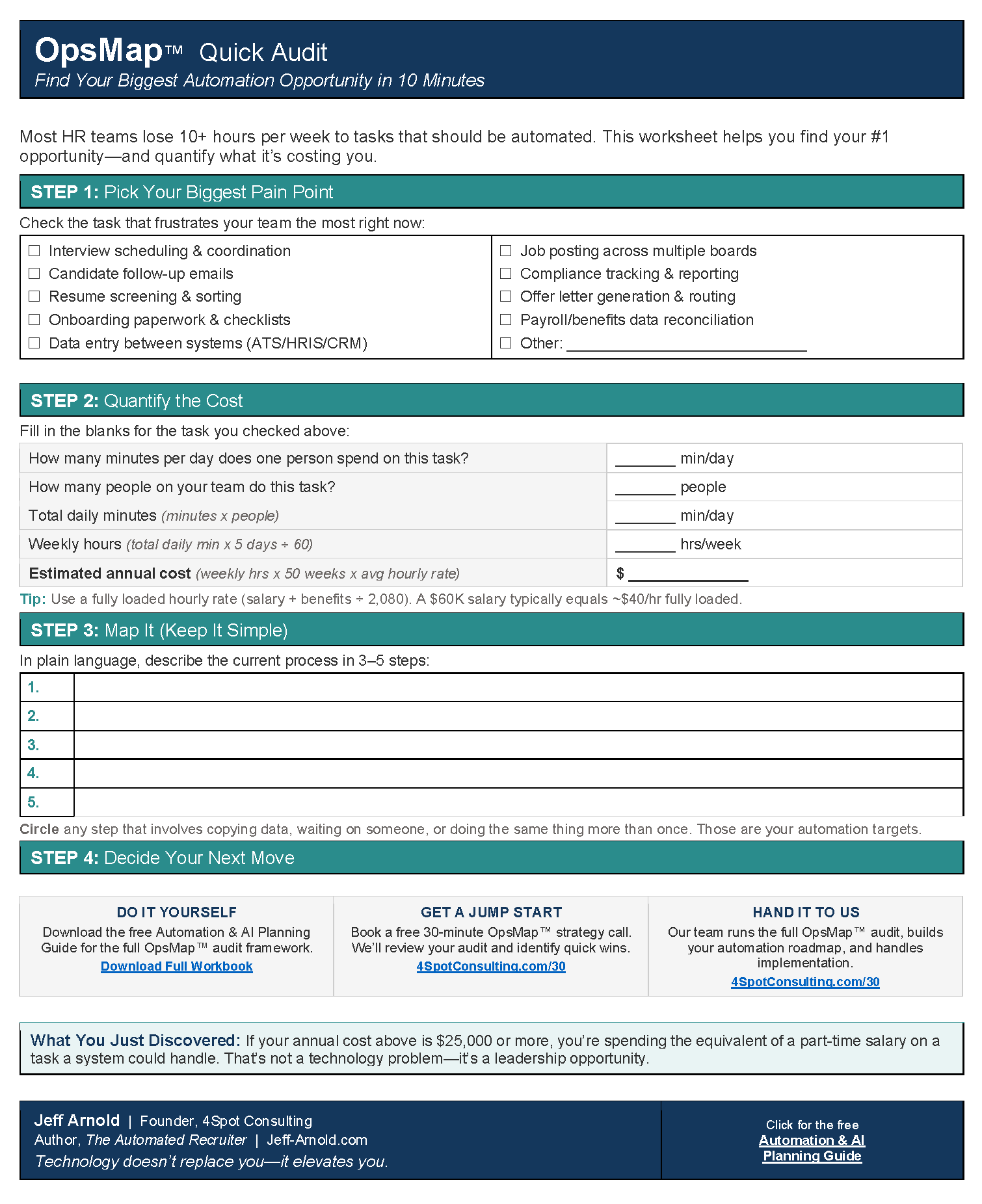
A TalentEdge OpsMap™ engagement identified nine workflow automation gaps before the team even addressed sourcing methodology. The savings came from fixing those gaps first – the sourcing tool debate was downstream of workflow problems that no amount of Boolean expertise or AI sophistication could solve. For the core ATS automation features that enable both methods to perform reliably, see 12 critical ATS automation features for next-gen talent acquisition.
Choose Boolean Search If… / Choose AI Parsing If…
Choose Boolean Search If:
- You are hiring for specialized, low-volume roles with narrow, well-defined technical requirements
- Your organization operates in a regulated industry where candidate selection logic must be fully documentable
- You have experienced sourcers who can build and maintain high-quality query strings
- Application volume per role is below 50-100 per opening, where manual review remains feasible
- False positives – advancing the wrong candidate – carry a higher cost than false negatives – missing a qualified candidate
Choose AI Parsing If:
- You are processing high application volumes (consistently above 50-100 applications per open role)
- Your roles attract candidates with varied career paths, non-standard titles, or transferable skill sets
- Manual resume review is the primary bottleneck in your time-to-hire metric
- Your ATS intake data is clean, structured, and consistently normalized (prerequisite, not optional)
- You have the governance infrastructure to conduct regular disparate impact audits on AI output
Use Both If:
- Your team fills a mix of specialized and high-volume roles
- You want Boolean precision for executive and niche searches alongside AI recall for high-volume pipelines
- Your automation layer is in place and feeding clean, structured data to both methods
For a complete look at what strong AI resume parsing requires before you commit to a vendor, see 11 non-negotiable features for a high-impact AI resume parser.
Frequently Asked Questions
What is the main difference between Boolean search and AI parsing in an ATS?
Boolean search uses explicit logical operators (AND, OR, NOT) to match candidates against exact keyword criteria. AI parsing uses natural language processing to infer meaning, recognize synonyms, and extract structured data from unstructured resume text. Boolean is precise and deterministic; AI parsing is contextual and probabilistic.
Which method finds more candidates – Boolean search or AI parsing?
AI parsing surfaces a larger candidate pool because it catches equivalent skills, varied job titles, and inferred experience that Boolean strings miss. Larger pools require stronger downstream filtering to avoid wasting recruiter time on weak matches.
Is Boolean search obsolete now that AI parsing exists?
No. Boolean search is the superior tool for highly specialized, low-volume roles where a false positive – interviewing the wrong candidate – is expensive. AI parsing and Boolean search serve different points in the hiring workflow, and the best ATS strategies use both.
How does AI parsing handle bias compared to Boolean search?
Both methods carry bias risk. Boolean search encodes recruiter assumptions directly into query logic – if a sourcer excludes certain terms, those candidates never surface. AI parsing reflects historical hiring bias embedded in training data, deprioritizing underrepresented groups at scale. Auditing both methods for disparate impact is non-negotiable.
Can a small recruiting team realistically use AI parsing?
Yes, but only if the ATS or an integrated automation layer handles the data normalization AI parsing depends on. Without clean, structured intake data, AI parsing accuracy degrades. Smaller teams should automate intake workflows before layering in AI features.
What volume threshold makes AI parsing worth the investment?
AI parsing delivers compounding ROI once a team regularly processes more than 50-100 applications per open role. Below that threshold, a skilled sourcer with Boolean strings achieves comparable quality with less configuration overhead.
How do I know if my ATS supports true AI parsing versus basic keyword matching?
True AI parsing extracts and normalizes skills, titles, and experience into structured fields even when candidates use non-standard language. Test by submitting a resume that uses a synonym or describes a skill without naming it – if the system surfaces the candidate for the relevant role, parsing is genuine.
Should automation be built before choosing between Boolean and AI parsing?
Automation should always come first. Building the automation spine – routing, communication, data capture – before deploying Boolean or AI parsing is the sequence that separates ROI from an expensive pilot that gets cancelled.
What recruiting roles benefit most from Boolean search in 2026?
Niche technical roles, compliance-sensitive positions, and any search where the organization needs an auditable, explainable candidate-selection rationale benefit most from Boolean search. Regulated industries prefer it precisely because the logic is transparent and documentable.
Does AI parsing replace the need for a skilled recruiter?
No. AI parsing shifts recruiter effort from manual resume review to result evaluation, bias auditing, and candidate engagement. The judgment layer – deciding who advances – still requires human expertise. Automation and AI expand recruiter capacity; they do not eliminate the need for experienced judgment.


RELATED POST


