Post: 9 Business Automation Benefits Every Operations Leader Should Know in 2026
Business automation delivers nine core benefits: reduced labor waste, lower error rates, stronger compliance, better data visibility, faster onboarding, improved security posture, ESG progress, scalable analytics, and measurable ROI. Organizations that implement automation systematically outperform those that automate reactively.
Most companies understand that automation saves time. Fewer understand where the time goes, which processes bleed money quietly, and what the compounding cost of inaction looks like over twelve months.
Jeff, who ran a Las Vegas mortgage branch in 2007, tracked a deceptively simple number: 10 minutes of wasted time per day per employee equals one full work week lost per year — per person. Multiply that across a team of twenty, and you’ve lost half a year of productive capacity before a single strategic initiative gets touched.
The nine benefits below aren’t theoretical. They’re drawn from the operational patterns we see repeatedly across HR, recruiting, and mid-market operations engagements. Each one maps to a real process failure — and a real fix.
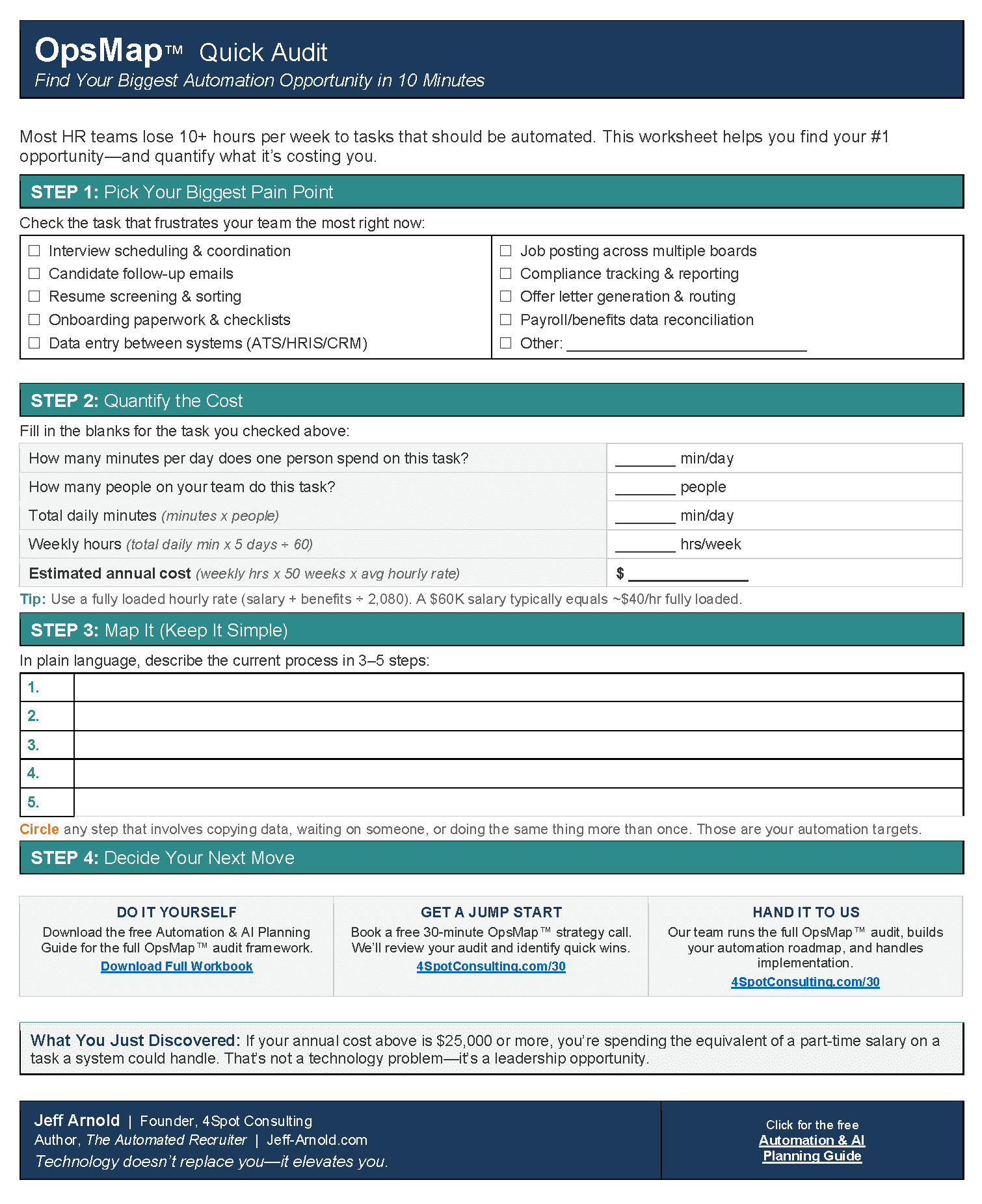
Before automating anything, a structured discovery step matters. Our OpsMap™ discovery process identifies which workflows are worth automating and which ones will cause problems if you automate them too early. You can also review 7 questions to ask before you automate anything to pressure-test your process map. For teams looking at the broader system, the OpsMesh™ framework explains how structured engagements connect discovery, build, and ongoing care.
| Benefit | Primary Impact | Who Feels It First |
|---|---|---|
| Labor waste reduction | Hours reclaimed per week | Operations, HR |
| Error rate reduction | Fewer costly corrections | Finance, HR |
| Compliance confidence | Audit trail, fewer violations | HR, Legal |
| Data visibility | Real-time reporting | Leadership |
| Faster onboarding | Time-to-productivity cut | HR, Hiring Managers |
| Security posture | Fewer breach exposure points | IT, Compliance |
| ESG progress | Reporting accuracy, carbon reduction | Leadership, Legal |
| Scalable analytics | Decisions based on current data | All departments |
| Measurable ROI | Documented financial return | CFO, CEO |
1. Labor Waste Reduction
The most immediate benefit of automation is time recovery. Manual tasks — data entry, status updates, file routing, report generation — consume hours that disappear into no one’s calendar and show up nowhere on a P&L until someone calculates the cost.
Nick, a recruiter at a small firm, was spending 15 hours a week on manual handoffs and proposal coordination. Across a three-person team, that was 150+ hours per month consumed by work that created no strategic value. Automating six manual handoffs returned that capacity to billable and client-facing work.
Sarah, an HR Director at a regional healthcare organization, reclaimed 12 hours per week after automating her onboarding workflow. Her 45-minute onboarding process dropped to under 4 minutes — without removing the human touchpoints that mattered for new hire experience.
Expert Take
Labor waste rarely looks like wasted labor. It looks like a competent person doing a task that a system should do — and no one flagging it because the person is competent and the task gets done. The cost is invisible until you add it up.
2. Error Rate Reduction
Manual processes introduce transcription errors, missed fields, and version mismatches. These aren’t failures of attention — they’re structural failures of process design. When humans touch data repeatedly, errors compound.
David, an HR Manager at a mid-market manufacturing firm, processed a payroll transcription error that moved an employee from a $103K salary to $130K. The $27K overpayment wasn’t caught until the employee had already resigned. The financial loss was recoverable. The reputational and morale damage was not.
That case study details exactly how the error happened and what HRIS configuration changes prevent it. The short version: required field validation and automated cross-checks eliminate the class of error entirely.
For teams weighing how to protect data integrity, HRIS required fields vs. manual data validation covers which approach actually holds under pressure.
3. Compliance Confidence
Compliance requires documentation, consistency, and audit trails — three things manual processes struggle to provide at scale. Automated workflows create a timestamped record of every action, every approval, and every exception without anyone needing to remember to log it.
For HR teams managing I-9 records, benefits enrollment, and onboarding documentation, auditing inherited I-9 records is a foundational compliance step that automation makes sustainable rather than a one-time scramble.
Teams that skip the compliance layer in their automation builds create a different class of risk: automated errors that scale faster than manual ones. HRIS configuration defaults are a common source of silent compliance exposure that automation can lock down permanently.
4. Data Visibility
Automation centralizes data flow. When processes run through structured workflows rather than email threads and shared spreadsheets, leadership gains access to real-time operational data that previously required someone to manually compile it.
This is the precondition for strategic decision-making. Leaders who are working from last month’s spreadsheet aren’t making current decisions — they’re making historical ones. Automated data pipelines close that gap.
Building a single source of truth is the practical outcome of data visibility work. It’s not a reporting project — it’s a process design project that automation makes executable.
Expert Take
Every manual handoff is a data gap. When a process lives in someone’s inbox, the data from that process lives there too — invisible to reporting, unavailable for analysis, and gone when that person leaves the organization.
5. Faster Onboarding
Onboarding is the highest-leverage HR process to automate because its speed directly affects time-to-productivity, new hire experience, and manager workload — simultaneously.
Sarah’s case is the clearest example: a 45-minute manual onboarding process rebuilt as an automated workflow completed in under 4 minutes, with hiring time cut by 60%. The human touchpoints remained. The paperwork routing, system provisioning, and document collection became automatic.
For teams still running manual onboarding, onboarding bottlenecks that automation eliminates covers the seven most common friction points and how to address them without a full system overhaul.
6. Security Posture
Manual processes create security exposure through inconsistent access provisioning, shared credentials, delayed offboarding, and documents stored outside controlled systems. Each of these is a breach vector that automation closes.
Automated offboarding workflows that trigger immediately on termination — revoking access across connected systems within minutes rather than days — eliminate one of the most common internal security risks in mid-market organizations.
The same logic applies to document handling. When sensitive employee records route automatically to governed storage rather than email attachments, the exposure surface shrinks materially.
7. ESG Progress
Environmental, Social, and Governance reporting requires accurate, auditable data across multiple operational dimensions. Manual reporting introduces inconsistencies that create liability when disclosures are scrutinized.
Automated data collection and aggregation for ESG metrics — energy usage, workforce composition, pay equity, supplier data — produces reporting that is defensible because it is systematic. The data trail exists whether or not anyone anticipated needing it.
For HR-adjacent ESG metrics, automated compensation and benefits reporting connects directly to pay equity analysis. The teams that have clean data win the audit. The teams that reconstruct it manually do not.
8. Scalable Analytics
Analytics built on manual data collection don’t scale. As the organization grows, the data collection burden grows proportionally — and the reporting lag grows with it. Automation decouples analytics capacity from headcount.
TalentEdge, a recruiting firm, achieved $312K in annual savings and a 207% ROI after standardizing their processes and automating their data flows. The savings weren’t from a single workflow — they came from compounding improvements across recruiting, onboarding, and client reporting that became visible only after the data pipeline was clean.
The TalentEdge case study details exactly how process standardization preceded the analytics gains — and why skipping standardization first produces analytics that mislead rather than inform.
9. Measurable ROI
The final benefit is the one that justifies the investment: documented, measurable return. Automation ROI comes from four sources — labor hours recovered, errors eliminated, compliance risk reduced, and capacity redirected to revenue-generating work.
Each of these is quantifiable. Labor hours have a fully-loaded cost. Errors have a correction cost and a downstream consequence cost. Compliance violations have a fine structure and a legal cost. Capacity redirected to revenue has a revenue multiplier.
For teams building the business case, OpsMap™ vs. skipping discovery shows what happens to ROI calculations when automation is deployed without a structured process audit first — and why the discovery step consistently pays for itself.
The OpsMesh™ framework structures these four ROI sources into a repeatable engagement model: OpsMap™ for discovery, OpsSprint™ for rapid deployment, OpsBuild™ for full workflow construction, and OpsCare™ for ongoing optimization. Each phase generates its own measurable return before the next begins.
Expert Take
ROI from automation is not a projection — it’s a calculation. Hours saved times loaded labor cost. Errors prevented times average correction cost. Compliance violations avoided times regulatory exposure. Run the numbers before you start, not after, and you’ll build toward a target instead of hoping for one.
Frequently Asked Questions
What is the fastest business automation benefit to realize?
Labor waste reduction is the fastest to measure. Within the first week of a new automated workflow, the hours previously spent on manual tasks are visibly recovered. Nick’s team saw 150+ hours per month returned after automating six handoffs — the impact showed up in the first billing cycle.
Which department benefits most from business automation?
HR and operations see the broadest benefit because they sit at the intersection of every other department’s data flows. When HR processes automate cleanly, the downstream effects reach finance, legal, IT, and leadership simultaneously.
How do you measure automation ROI before you build?
Calculate the fully-loaded cost of current manual labor for the targeted process, add the average cost of errors that process produces, and add any compliance exposure associated with inconsistent execution. That sum is your baseline. Automation ROI is the percentage of that baseline you recover.
What is the biggest risk when automating business processes?
Automating a broken process. Automation scales whatever behavior the process produces — including the errors. A structured discovery step like OpsMap™ identifies process failures before they get embedded into automated workflows.
Does business automation require technical staff to maintain?
Not when built correctly. Platforms like Make.com support non-technical teams in maintaining and extending workflows after the initial build. Non-technical HR teams have built and maintained their own automations using Make combined with AI assistance — without a developer on staff.
Additional Reading
- What Is OpsMap? The Discovery Step That Prevents Automation Mistakes
- What Is OpsMesh? The Framework That Structures Every 4Spot Engagement
- 7 Questions to Ask Before You Automate Anything (The OpsMap Checklist)
- OpsMap vs. Skipping Discovery: What Happens When You Automate Without a Map
- The $27K Overpayment: How One HRIS Data Entry Mistake Cost a Manufacturer a Year of Salary
- How Sarah Compressed a 45-Minute Onboarding Process to Under 4 Minutes
- How Nick Cut 6 Manual Handoffs From Proposal Generation With One Make Workflow
- How TalentEdge Saved $312K with HR Process Standardization
- HRIS Required Fields vs Manual Data Validation: Which Is Safer for Small HR Teams?
- How a Non-Technical HR Team Started Building Their Own Automations With Make + AI
- Drowning in Admin: How Solo and Small HR Teams Can Fix Broken HR Operations Without Burning Out
- 11 Warning Signs Your Inherited HR Operation Is Bleeding Money
- Manual Data Entry: The Silent Killer of Business Productivity & Profit
- The Invisible Drain: How Automation Unleashes Business Growth
- What Is Automation-First? Why You Should Automate Before You Add AI


RELATED POST