Post: How to Evaluate an HR Automation Consultant: A CHRO’s Buyer’s Guide
To evaluate an HR automation consultant, verify three things before you sign: they start with process documentation before platform selection; they prove live integrations in your actual tech stack; and they hand full operational ownership to your team at engagement close. Everything else is secondary.
Why So Many HR Automation Engagements Fail Before They Start
The most common failure point in HR automation consulting is scope that gets defined around a platform sale, not your actual operational gaps. A consultant who leads with “we recommend Make.com” or “you need a new ATS” before they have documented your current workflows is selling you a solution before they understand your problem. That sequence produces integrations that technically work but don’t move the metrics that matter.
CHROs at mid-market companies are particularly exposed to this. You have enough complexity to justify the engagement but not always the internal technical staff to push back when a consultant steers toward the tools they know best. The result is a two-year-old automation stack that handles 30% of what it was supposed to handle, with a vendor who has moved on and left your team holding documentation they can’t use.
The buyer’s guide below is built from the patterns that separate engagements that deliver from the ones that produce expensive shelfware. Use it before you issue an RFP – not after you’ve already picked a finalist.
For a closer look at internal automation mistakes that compound bad consulting choices, see 11 Common Mistakes HR Teams Make Automating Internally.
The Five Questions Every CHRO Must Ask Before Signing
Start every consultant evaluation with these five questions. The answers surface more about engagement quality than any case study deck or LinkedIn credential.
1. What does your discovery phase produce, and who owns it?
A credible consultant uses their discovery phase to map every current-state workflow that touches the automation scope – not to write a requirements document for software they already sell. The output of that phase should be yours: a documented process map, a gap analysis, and a prioritized build sequence. If the consultant can’t describe what they deliver at discovery close, or if they describe it as “internal planning,” walk away.
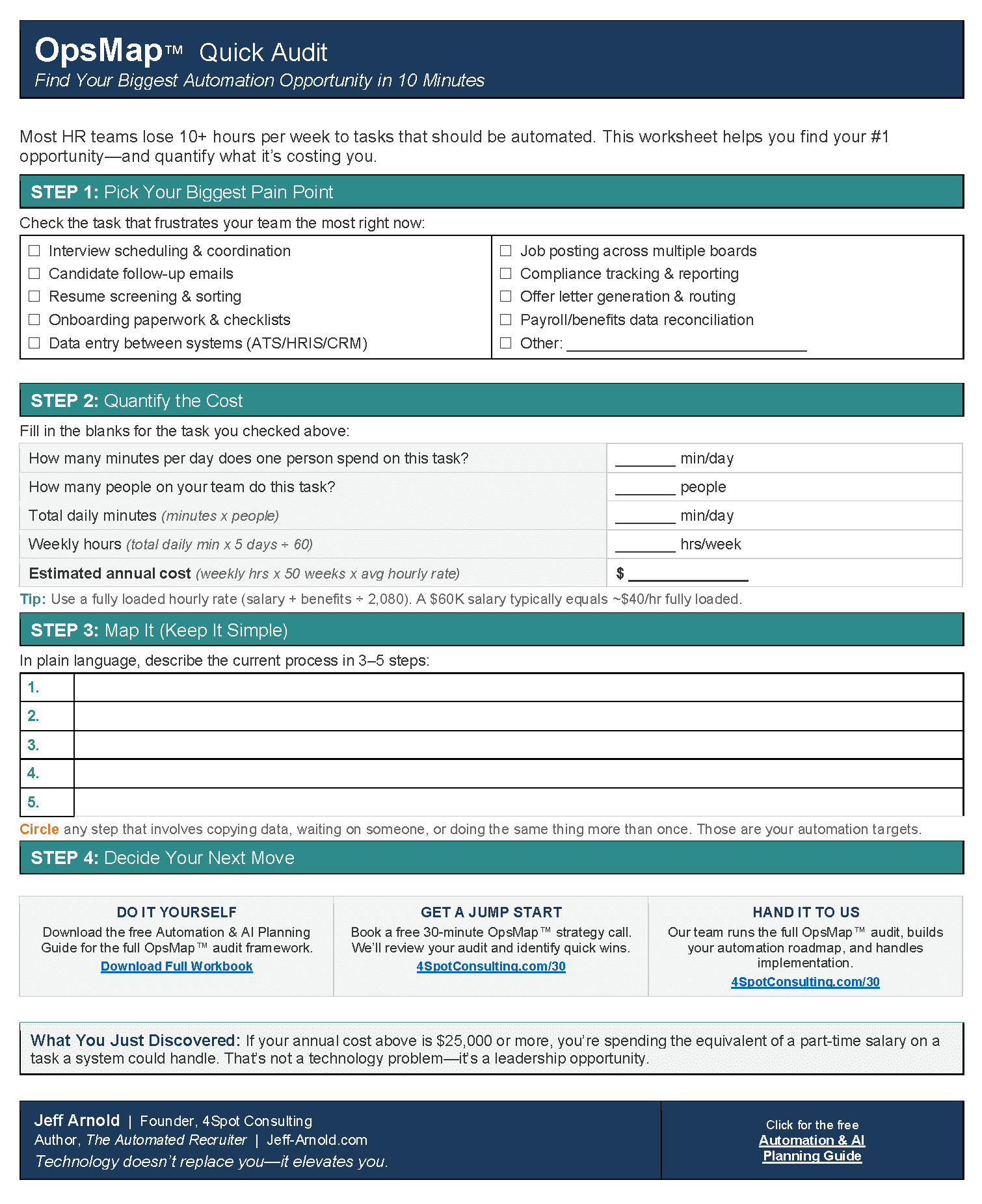
At 4Spot, we call this phase the OpsMap™. Clients leave it with a complete workflow inventory, a stack assessment, and a ranked list of automation targets sorted by impact-to-effort ratio. That document belongs to the client regardless of whether we build anything from it.
2. Can you show me a live integration in my exact stack?
Not a demo environment. Not a video walkthrough. A live integration – ideally in a system you use – that they’ve built and maintained for an active client. Any consultant worth hiring has reference integrations they can demonstrate. If they hedge on this, it tells you they are stronger at selling automation than running it.
3. What happens when something breaks at 11pm?
This question reveals the operational reality behind the pitch. Automation breaks. Webhooks time out, APIs change, and CRM field maps drift after a platform update. The question is not whether failures happen – it’s whether there is a documented error-handling protocol, an escalation path, and a human who picks up the phone. Get that SLA in writing before you sign.
4. How do you train my team to own and modify what you build?
An automation consultant who builds things only they can maintain has created a dependency, not a solution. Every scenario, integration, and workflow the consultant builds should come with a documentation package your team can follow, plus hands-on training that leaves at least two internal people capable of making routine modifications without outside help.
5. What is your stance on the platforms you recommend?
Platform-agnostic is a buzzword. Everyone has platforms they know better than others, and that’s fine. What you want is honesty about that bias and evidence that the recommended platform solves your specific problem – not just the consultant’s operational preference. Ask for the alternative they considered and why they rejected it. A consultant who can’t articulate that tradeoff has not actually done the analysis.
Red Flags That Disqualify a Consultant Fast
These patterns signal a bad fit before any contract language becomes relevant.
- They lead with a platform recommendation in the first meeting. No credible consultant recommends a platform before they’ve mapped your workflows. That sequence tells you they are a reseller first and a consultant second.
- Their case studies don’t include your industry or company size. HR automation for a 200-person staffing firm looks nothing like HR automation for a 5,000-person enterprise. The consultant should have proof of work in your operational tier.
- They can’t name what they won’t build. Good consultants have clear scope boundaries and will tell you what falls outside their model. Consultants who say yes to everything are usually figuring it out as they go.
- Their proposal is heavy on hours and light on deliverables. Time-and-materials billing without defined milestones benefits the consultant, not you. Tie payment to deliverable acceptance.
- They can’t produce client references who are two or more years post-engagement. Fresh references are easy. A client who has been running the consultant’s automation independently for two years is the proof point that matters.
- They resist involving your IT team. A consultant who pushes back on IT joining conversations about data access, permissions, or handoff documentation is signaling that their approach won’t survive an IT review. Surface that before the contract, not after.
For a structured set of evaluation questions to use alongside this red flag list, see 13 Essential Questions for HR Leaders Before Investing in Automation and 11 Essential Questions for Hiring the Right ATS Automation Consultant.
What Good Deliverables Actually Look Like
Deliverable quality is the fastest proxy for engagement quality. Here’s the minimum standard for each phase of a credible HR automation engagement.
Discovery Deliverables
At discovery close you should have: a complete current-state process map, a tool and integration inventory with documented data flows, a gap analysis that identifies both automation targets and process problems that automation won’t fix, and a prioritized build sequence with clear rationale. If you skip this phase or compress it to save budget, you will spend twice as much fixing assumptions during build.
Build Deliverables
Every automation built in your environment should be named clearly (not “HTTP Module 7”), documented in plain language, and equipped with error handling that surfaces failures before they cascade. Every outbound webhook or API call should log its source and destination so your team can trace any issue without digging through scenario history. Named modules, per-step error handlers, and documented logic blocks are not optional extras – they are what makes the work maintainable after the consultant leaves.
Expert Take
The single best predictor of engagement success is whether the consultant’s discovery deliverable stands alone without the consultant present. If you can hand that document to a different firm and they can build from it without clarification, you have a real discovery output. If the document only makes sense to the person who wrote it, you have a sales artifact dressed as a deliverable.
Handoff Deliverables
A complete handoff package includes scenario documentation your team can follow independently, training on how to modify routine elements, an escalation contact for the first 90 days, and a clear answer to: “What does your team need to know to run this without us?” A 45-minute walkthrough call and a folder of screenshots is not a handoff – it’s abandonment with a bow on it.
To see what a complete engagement handoff looks like in practice, see the Global Talent Solutions onboarding and invoicing automation case study.
The OpsMesh Framework: Process Before Platform
The OpsMesh™ framework at 4Spot starts from a principle most automation consultants skip: broken processes don’t get better when you automate them. They get faster and more expensive to fix.
Before 4Spot recommends a single integration or triggers a single scenario, we map the full workflow as it actually runs today – not as it’s supposed to run per the org chart. That distinction matters. HR operations in most organizations have manual workarounds, shadow processes, and informal handoffs that never appear in documented procedures but drive a significant share of actual volume. Automating without that map produces systems that handle the official workflow perfectly and fall apart on the real one.
The OpsMap™ discovery phase produces a live process inventory your team owns. The OpsSprint™ build phase produces named, documented, error-handled scenarios – not a black box only the consultant understands. The OpsCare™ maintenance layer covers scheduled audits, error monitoring, and modification support structured so your team handles more of it each quarter, not less.
That progression – map, build, hand off, maintain – is what separates an engagement that compounds over time from one that starts decaying the day the consultant stops billing.
For a full view of how the framework operates across a multi-system HR environment, see the 103K Annual Labor Hours case study and the 105,000 Hours Saved talent acquisition transformation.
Frequently Asked Questions
How long should an HR automation consulting engagement take?
Discovery for a mid-market HR operation runs four to six weeks when done thoroughly. Build timelines depend on scope, but a three-to-four-month initial engagement covering onboarding, offboarding, and core recruiting workflows is realistic for a company in the 200-to-1,000 employee range. Anything significantly faster is compressing discovery, not executing more efficiently.
What’s the difference between an automation consultant and an automation agency?
An agency delivers executions at volume. A consultant delivers a diagnosis first. The right model depends on whether you already know what needs to be built. If you don’t have a process map and a clear prioritization, an agency will build what you ask for – which is usually not what you need. Start with the diagnostic engagement, then move to execution.
Should the consultant own the automation accounts and credentials?
No. Full stop. Every account – Make.com, your CRM, your ATS, your HRIS – stays under your organization’s ownership from day one. A consultant who requires access through their own agency credentials creates a dependency that becomes a hostage situation when the relationship ends. Put account ownership in the contract language before you sign, not as an afterthought during offboarding.
How do I evaluate a consultant’s technical depth without being technical myself?
Ask them to walk you through a failure they’ve had to fix in a client environment and exactly what they changed to resolve it. That question surfaces operational experience that a polished pitch deck can’t fake. A consultant with real field experience has specific failure stories with specific resolutions. A consultant who lacks that experience will describe the failure vaguely and jump quickly past the resolution.
What is a realistic scope for a first automation engagement?
A first engagement should target one complete workflow end-to-end – not a surface-level integration of three platforms that only handles the happy path. Onboarding is a common starting point because it touches multiple systems, has a defined trigger, and produces measurable output. A complete onboarding automation that handles edge cases and failures teaches your team far more than three partial automations that technically connect but require manual intervention constantly.
How do I know if my processes are ready for automation?
A credible consultant will tell you when they’re not – and that answer is actually a positive signal. Processes that rely on informal judgment calls, undocumented exceptions, or tribal knowledge need to be documented and standardized before automation adds any value. A consultant who skips that step and automates anyway is accelerating your existing chaos. See Why Clean Processes Must Come Before Any HR Automation for what to address first.
Part of our complete guide: How to Evaluate an HR Automation Consultant: A CHRO’s Buyer’s Guide.