Post: HR Automation: Become a Strategic Partner, Not an Admin Burden
HR Automation: Frequently Asked Questions
HR automation is the single highest-leverage investment most HR teams are not yet making at scale. It removes the manual, rules-based work that consumes recruiters and HR directors — resume review, interview scheduling, compliance documentation, onboarding paperwork — and routes it into structured workflows that run without human intervention. What remains is the strategic, judgment-intensive work that HR professionals were hired to do.
This FAQ addresses the questions we hear most often from HR leaders evaluating automation for the first time and from teams that have started but stalled. For the foundational framework on where resume parsing fits into this picture, see the resume parsing automation pipeline that feeds clean data into every downstream HR workflow. The questions below pick up where that pillar leaves off.
Jump to a question:
- What does HR automation actually cover?
- How much time can HR teams realistically reclaim?
- What is the connection between HR automation and resume parsing?
- Will automation eliminate HR jobs?
- What errors does HR automation prevent?
- How do I know which HR processes to automate first?
- Is HR automation compliant with employment law and data privacy regulations?
- What is the difference between HR automation and HR artificial intelligence?
- How long does implementation take for a mid-size company?
- What metrics should I track to prove HR automation ROI to leadership?
What does HR automation actually cover — is it just onboarding and payroll?
HR automation covers every rules-based, repeatable process across the full employee lifecycle — not just onboarding and payroll.
The highest-impact categories include:
- Recruiting workflows: Resume parsing, candidate routing, interview scheduling, offer letter generation
- Onboarding: Document collection, account provisioning, training assignment, IT ticket creation
- Compliance: Policy acknowledgment tracking, mandatory training completion logging, audit documentation
- Records management: Employee record updates, role change processing, termination checklists
- Benefits administration: Enrollment reminders, eligibility verification, life-event processing
Payroll and onboarding receive the most attention because they are well-understood and have obvious failure modes. But recruiting workflow automation — specifically resume intake, parsing, and candidate routing — consistently delivers faster, more measurable ROI than any other starting point. An OpsMap™ diagnostic typically surfaces 6-12 distinct automatable workflows in HR departments that believe they have already optimized their operations.
Every HR leader I’ve worked with knows their team is spending too much time on work that a well-configured workflow could handle. The barrier isn’t technical — it’s the assumption that automating a process requires a massive IT project. In most cases, a single recruiting workflow (resume intake to ATS population) can be automated in weeks and reclaims more time than any other single initiative. The teams that move fastest pick one painful, high-volume process and fix it completely before touching anything else.
How much time can HR teams realistically reclaim through automation?
The realistic range is 6-15 hours per HR professional per week, depending on team size and process maturity.
McKinsey Global Institute research estimates that roughly 56% of typical HR tasks are automatable with current technology. In practice, interview scheduling alone — one of the most fragmented manual workflows — regularly consumes 10-12 hours per week for HR directors managing mid-volume hiring. Automating that single process reclaims the equivalent of one full workday per week without touching any other function.
Parseur’s Manual Data Entry Report benchmarks the cost of manual data handling at approximately $28,500 per employee per year when factoring in error correction, rework, and the opportunity cost of displaced strategic activity. For HR teams processing high volumes of candidate records, the math compounds quickly.
The important caveat: time reclaimed is only valuable if it is reinvested in higher-value work. Teams that automate scheduling but fill the reclaimed hours with other administrative tasks do not see the organizational impact that teams do when they redirect capacity toward workforce planning, retention analysis, or strategic talent development.
What is the connection between HR automation and resume parsing specifically?
Resume parsing is the front door of HR automation — and the quality of everything downstream depends on what happens at that entry point.
When candidate data arrives inconsistent, incomplete, or manually transcribed from a resume PDF into your ATS, every downstream workflow inherits that error. Automated routing fires on bad data. Scoring models rank on incomplete profiles. Compliance documentation references incorrect candidate information. The entire recruiting pipeline is only as clean as the first data capture.
Structured resume parsing creates normalized candidate records that feed automated routing, scoring, ATS population, and compliance documentation without human re-entry at each stage. That is why the resume parsing automation pipeline is the correct starting point for HR automation — not because it is the only thing that matters, but because every other workflow depends on the data quality it establishes.
For a structured evaluation of what your parsing system needs to do before you add AI on top of it, see the needs assessment for your resume parsing system.
Will automation eliminate HR jobs?
No — automation eliminates HR tasks, not HR roles.
Rules-based automation handles data entry, scheduling, document routing, and compliance tracking. It does not handle employee relations, workforce planning, culture work, compensation philosophy, or the judgment calls that define strategic HR. These functions require human presence, institutional knowledge, and relational intelligence that no workflow replaces.
McKinsey research consistently finds that automation augments knowledge workers by removing low-value volume work, which allows professionals to concentrate on higher-judgment functions. HR teams that automate well typically grow in organizational influence — moving from administrative service providers to strategic advisors to the business — rather than shrinking in headcount.
The risk is not job elimination. The risk is that HR teams that do not automate remain so burdened by administrative volume that they never get the chance to demonstrate their strategic value, while competitors that do automate shift that capacity into workforce intelligence and talent strategy that drives measurable business outcomes. For a broader view of this shift, see how AI transforms HR and recruiting for high-growth organizations.
What are the most common errors HR automation prevents?
The three most costly error categories automation eliminates are manual transcription mistakes, inconsistent compliance documentation, and missed SLA deadlines in candidate communication.
Transcription errors in compensation data are particularly damaging. A miskeyed salary figure propagates through payroll, equity calculations, and tax filings before anyone catches it — and by then the cost of correction extends well beyond the original error. These mistakes erode employee trust and create payroll liability that compounds over time.
Inconsistent compliance documentation creates audit exposure that accumulates silently. When policy acknowledgments, training completions, or hiring decision rationale are tracked manually across spreadsheets and email threads, gaps are inevitable. Automated documentation removes the dependency on individual diligence and produces audit-ready records by default.
Candidate communication delays cost organizations qualified applicants to faster-moving competitors. SHRM data indicates that top candidates are typically off the market within 10 days of beginning an active job search. Automated touchpoints — application confirmations, stage progression notifications, interview scheduling — keep candidates engaged during the evaluation window without HR staff manually managing each interaction.
How do I know which HR processes to automate first?
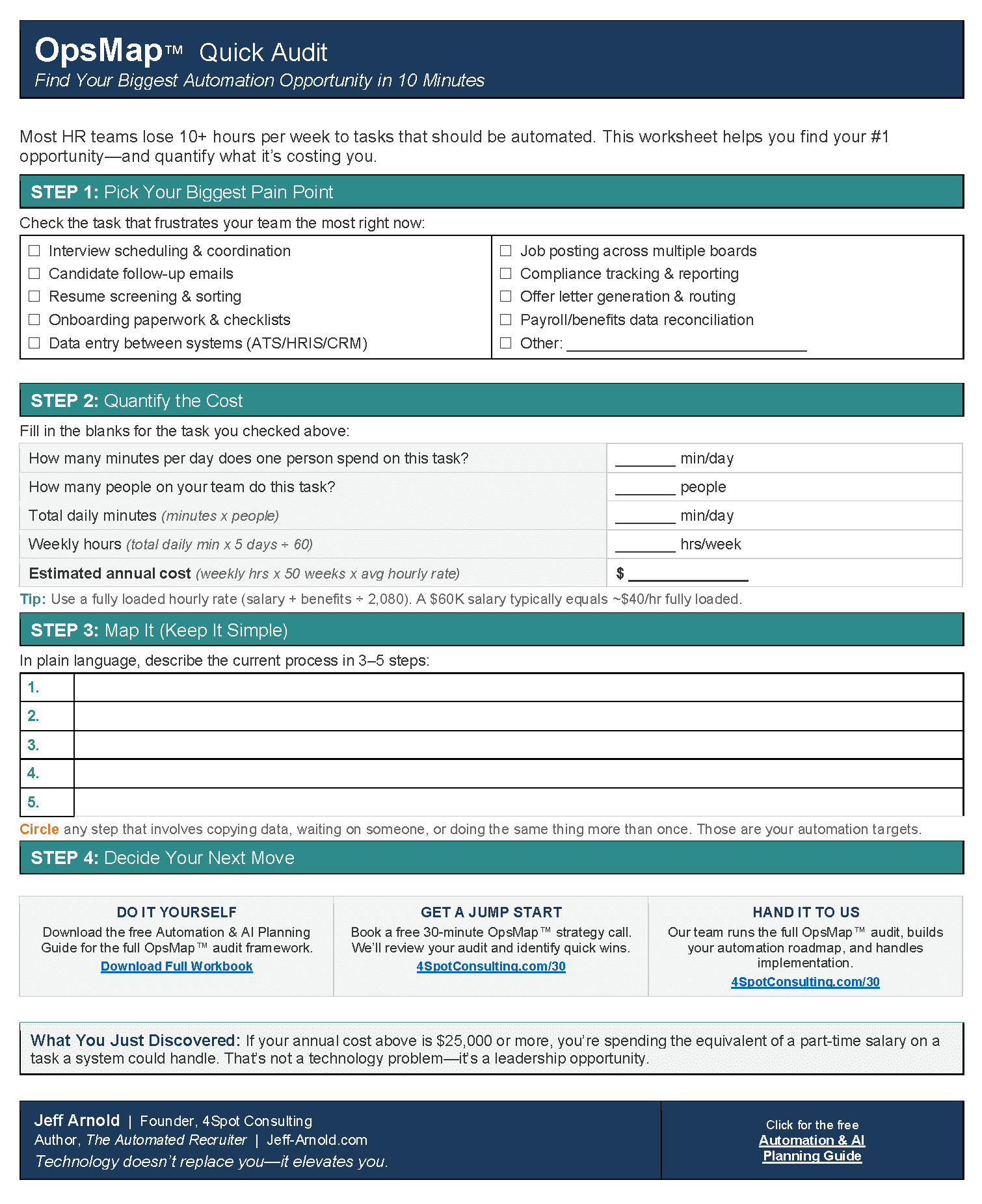
Start with a time-per-task audit. The correct prioritization methodology is straightforward:
- List every recurring HR activity
- Record time per instance and weekly frequency
- Multiply to get total weekly hours consumed per task
- Rank by that total — your top five are your automation candidates
The tasks at the top of that list are almost always in recruiting (resume review, interview scheduling) and onboarding (document collection, account provisioning) — not because other functions are unimportant, but because these run at higher frequency and involve more manual handoffs than any other HR function.
A structured assessment — like an OpsMap™ diagnostic — formalizes this process and identifies not just time sinks but also error-prone handoffs and compliance gaps that automation resolves simultaneously. Most teams discover their highest-ROI opportunity in recruiting workflows before they ever reach payroll or benefits.
For a structured framework on evaluating your automation priorities and building a business case, the strategic ROI case for automated resume screening walks through the calculation methodology in detail.
The sequencing error we see most often is HR teams purchasing AI-powered screening tools before their data infrastructure is solid. The AI receives inconsistent inputs — resumes in five different formats, candidate fields mapped differently across job boards, ATS records with missing or duplicated entries — and produces unreliable outputs that erode trust in the technology. Every engagement where we’ve reversed that sequence, building the structured automation pipeline first and layering AI only at genuine ambiguity points, has produced sustained performance. The automation spine is not optional prep work; it is the foundation the AI depends on.
Is HR automation compliant with employment law and data privacy regulations?
Properly configured HR automation is compliant — and often more consistently compliant than manual processes.
The critical design requirements are:
- Data minimization: Collect only what is legally permissible at each hiring stage
- Access controls: Limit who can view sensitive candidate and employee records, with role-based permissions enforced by the system rather than by individual discipline
- Audit logging: Maintain timestamped records of every automated action, especially in the screening and routing stages where adverse impact scrutiny applies
- Documented decision logic: Automated screening criteria must be reviewable and defensible under EEOC and OFCCP standards
GDPR, CCPA, EEOC, and OFCCP requirements all have specific implications for automated hiring workflows. Building compliance requirements into the automation design from the start is far simpler than retrofitting them after deployment. For a detailed treatment of the data governance dimension, see the satellite on data governance for automated resume extraction.
Note: This content is informational and does not constitute legal advice. Consult employment counsel for jurisdiction-specific requirements.
What is the difference between HR automation and HR artificial intelligence?
HR automation and HR artificial intelligence are not the same thing — and conflating them is one of the most common reasons HR technology investments underperform.
HR automation executes defined rules on structured data. If a candidate meets these criteria, route them to this stage, send this email, update this field. The logic is explicit, deterministic, and auditable. Any competent reviewer can inspect an automated workflow and understand exactly what it does and why.
HR artificial intelligence applies machine learning or language models at decision points where explicit rules break down — evaluating a resume that does not fit a standard template, predicting which candidates are likely to accept an offer, or surfacing non-obvious matches from a historical talent database. AI outputs are probabilistic rather than deterministic, which means they require human review at the decision point and ongoing performance monitoring to catch drift.
The correct deployment sequence is automation first, AI second. AI tools underperform and produce unreliable outputs when the underlying data they analyze is inconsistent, incomplete, or manually curated — all problems that structured automation solves at the foundation. This sequencing principle is the core argument of the parent pillar on resume parsing automations and applies equally across every HR function.
How long does it take to implement HR automation for a mid-size company?
A focused initial deployment targeting one or two high-impact workflows typically reaches live operation in 4-8 weeks for a mid-size organization.
Full-lifecycle HR automation — covering recruiting, onboarding, compliance, and records management — is a 3-6 month program, with each workflow module going live incrementally rather than all at once. The incremental approach serves two purposes: it generates ROI data early enough to validate continued investment, and it limits the change-management surface area that HR staff must adapt to at any given moment.
Teams that attempt big-bang implementations across all functions simultaneously consistently experience longer timelines and higher change-management friction than teams that sequence deployments by ROI priority. The typical sequencing that produces the fastest path to sustained ROI: resume parsing and routing first, interview scheduling second, onboarding documentation third, compliance tracking fourth.
For benchmarks on what a well-structured implementation looks like in terms of accuracy milestones and performance gates, the guide on how to benchmark and improve resume parsing accuracy provides a useful quarterly measurement framework.
What metrics should I track to prove HR automation ROI to leadership?
The metrics that resonate with executive leadership fall into three categories: time recovered, hiring speed, and error reduction.
Time recovered:
- Hours per week reclaimed per HR staff member
- Percentage of previously manual tasks now handled without human touchpoints
Hiring speed:
- Time-to-fill (requisition open to offer accepted)
- Time-to-hire (application received to offer accepted)
- Interview scheduling cycle time (request to confirmed appointment)
Error reduction:
- Payroll discrepancy rate
- Compliance audit findings related to HR documentation
- Offer letter revision cycles
Cost-per-hire improvements and candidate experience scores — offer acceptance rate, application completion rate, candidate NPS — provide secondary validation that the process improvements are producing quality outcomes, not just faster mediocre ones.
Establishing baseline measurements before automation launches is non-negotiable. Without a pre-automation benchmark, you cannot calculate the delta that proves ROI to finance or justify the next phase of investment. For a comprehensive list of the automation metrics that matter most at each stage of the recruiting funnel, see the guide on essential metrics for tracking resume parsing and HR automation ROI.
HR teams tend to frame automation ROI around time savings and hiring speed — both legitimate. But the compliance dividend is consistently undervalued at the outset and deeply appreciated once teams experience their first clean audit. Automated documentation of policy acknowledgment, training completion, and decision rationale in hiring workflows removes the frantic pre-audit scramble that consumes enormous HR bandwidth. One OpsMap™ engagement surfaced a client’s manual training-completion tracking as their single highest-risk compliance gap — a workflow that was fully automatable in under a week and had been creating audit exposure for years.
The Strategic Case in One Sentence
HR automation does not make HR less human — it removes the administrative volume that prevents HR from being fully human where it matters.
The teams that move fastest to strategic influence are the ones that stop defending their bandwidth and start reclaiming it, one automated workflow at a time. The data pipeline that makes all of it possible starts with resume parsing. For everything you need to build that foundation correctly, the resume parsing automation pillar is the right place to start.
For a closer look at how automation supports equitable hiring outcomes alongside efficiency gains, see how automated resume parsing supports more diverse hiring outcomes.