

Post: 5 Resume Parsing Automations That Save Hours and Speed Up Hiring
Resume parsing automation extracts structured data from unstructured resume documents and routes it into your recruiting systems without human intervention. The five highest-return automations are structured field extraction, deduplication, ATS population and routing, candidate communication triggers, and skills normalization. Built in the right sequence with logging baked in, these five automations reclaim the majority of recruiter hours spent on administrative work every week.
What Resume Parsing Automation Actually Is
Resume parsing automation is the discipline of building a structured, reliable pipeline that extracts data from unstructured resume documents and routes it — consistently, completely, and without human intervention — into the systems your recruiting team depends on. It is not AI. It is not a feature inside your ATS vendor’s premium tier. It is not a chatbot that screens candidates. It is engineering applied to a specific class of repetitive, low-judgment work that currently consumes a measurable percentage of your team’s available hours every week.
The distinction matters because the market conflates the two. Vendors pitch AI-powered resume parsing as a unified concept, which obscures the reality that the automation and the AI are separate layers with separate dependencies. The automation layer handles extraction, transformation, routing, and population — tasks that have correct and incorrect outputs, which can be validated deterministically. The AI layer handles judgment — tasks where the correct output is contextual and a rule-based system would require too many exceptions to be maintainable.
What resume parsing automation is not: it is not a replacement for recruiter judgment at the evaluation stage. It does not decide who gets hired. It does not read between the lines of a candidate’s career narrative. Those are human functions, and the well-designed automation stack preserves them by eliminating the administrative burden that prevents recruiters from exercising judgment at all.
Knowledge workers spend a significant share of their week on work about work — status updates, file handling, data transfer, manual entry — rather than the skilled work they were hired to do. In recruiting, that work-about-work is dominated by resume-related administration. Automation eliminates that class of work at the source. Learn how automated resume parsing drives employer brand outcomes beyond efficiency gains.
Five Terms You Need to Know Before You Build
Five terms appear in every vendor conversation and every implementation decision. Knowing what they actually do in the pipeline — not what the marketing copy says they do — is the prerequisite for making good build decisions.
Field extraction is the process of identifying and pulling discrete data elements from an unstructured document: name, email, phone, work history, education, certifications, skills.
Data normalization is the process of converting extracted values into a consistent format. “Sr. Software Engineer,” “Senior Software Eng.,” and “Software Engineer III” refer to the same role family but will not match in a keyword search without normalization.
Deduplication is the process of identifying and resolving candidate records that represent the same person.
Routing logic is the set of rules that determines where a parsed candidate record goes after extraction.
Audit trail is the log of every transformation the automation performs. An audit trail is not optional. Review the governance framework for data quality in automated resume extraction.
Why Most Implementations Fail
The primary failure mode is sequence: organizations deploy AI before building the structured data pipeline the AI requires. The result is AI operating on inconsistent, incomplete, and often corrupt input — producing unreliable output and generating a growing organizational belief that the technology does not work for them. The technology is not the problem. The missing structure is.
Gartner research on HR technology adoption consistently identifies data quality as the top barrier to AI value realization in talent acquisition.
The second failure mode is automation built without logging. A parsing workflow that runs without producing an audit trail is a black box. When it fails — and it will fail — there is no record of what it did or why.
The third failure mode is building in the wrong order. Organizations frequently automate the visible parts of recruiting before automating the foundational data infrastructure those tools depend on. The warning signs that recruiting operations are bleeding top candidates trace back to exactly this sequencing error.
The 5 Highest-ROI Resume Parsing Automations
Rank automation opportunities by hours recovered per week and measurable error reduction — not by feature count or vendor capability. The five automations below consistently produce the highest return across organizations of different sizes and ATS configurations.
1. Structured Field Extraction
Structured field extraction is the foundation every other automation depends on. At 30 to 50 resumes per week, manual entry consumes roughly 15 hours of recruiter time. Automated extraction reclaims that time immediately. See how field extraction transforms your ATS into a strategic hiring engine.
2. Duplicate Detection and Deduplication
Duplicate detection eliminates a problem that compounds over time. Every ATS with more than six months of active use accumulates duplicate candidate records. The specific logic sequence for effective deduplication is detailed here.
3. ATS Population and Routing Logic
Once fields are extracted and validated, routing logic determines where the record goes. This is pure deterministic automation — no AI required, no edge-case ambiguity, no judgment calls. The rules are explicit, the outputs are verifiable, and the system runs without human oversight.
4. Candidate Communication Triggers
Application acknowledgment, status updates, and interview scheduling triggers fire automatically from state changes in the ATS. SHRM research identifies communication delays as the primary driver of candidate withdrawal — an entirely preventable failure mode. Learn how automated communication reduces candidate ghosting.
5. Skills Normalization
Skills normalization maps extracted free-text skill descriptions to a controlled vocabulary, making your candidate database searchable, filterable, and usable for skills-gap analysis. This is also the point where AI delivers measurable value — because the input is structured enough for the AI to work with reliably. Review the ROI measurement framework for each of these five automations.
Expert Take
When we mapped one recruiter’s workflow at a small staffing firm, he was spending 15 hours per week on PDF resume file handling and manual data entry — 30 to 50 resumes per week, each requiring him to open the file, read it, and type the candidate’s information into the ATS field by field. The first automation we built wasn’t sophisticated. It was a structured extraction pipeline that pulled name, contact information, work history, education, and skills from incoming PDF resumes and populated the ATS fields automatically. That single automation reclaimed 150-plus hours per month across his three-person team. No AI. No machine learning. Just reliable, consistent extraction — the foundation everything else is built on.
Where AI Belongs Inside the Pipeline
AI earns its place inside the automation pipeline at three specific judgment points where deterministic rules fail. Outside those three points, reliable rule-based automation is faster, cheaper, more auditable, and less prone to producing wrong answers confidently.
Fuzzy-match deduplication: when two candidate records share a name but different email addresses, a deterministic rule cannot reliably merge or separate them. AI makes a defensible judgment; rule-based logic either fails or flags every ambiguous pair for manual review.
Free-text interpretation: non-standard resume formats do not conform to positional logic. AI-assisted extraction interprets the document semantically rather than relying on document structure that isn’t consistent.
Ambiguous record resolution: when field extraction produces conflicting values, an AI resolution layer makes a defensible judgment, logs its reasoning, and routes the record appropriately. A rule-based system either fails silently or flags the record without resolving it.
Everything outside these three points is better handled by rule-based automation. The judgment-layer model and what to look for in a parser that applies it correctly is detailed here.
Expert Take
AI in resume parsing is useful, but only at three specific points — fuzzy-match deduplication, free-text interpretation, and ambiguous record resolution. Everything outside those points is better handled by reliable, auditable, rule-based automation. AI deployed everywhere else is an expensive way to introduce new failure modes into a process that should be predictable and auditable. The vendors who tell you differently are selling you a feature, not a solution.
Three Non-Negotiable Operational Principles
Three principles apply to every production-grade resume parsing automation build. A build that skips any of them is not a solution — it is a liability that hasn’t failed yet.
Back Up Before You Migrate
Before any automation touches existing candidate records, a complete backup of the current database state must exist. The backup-first protocol for candidate database migration is here.
Log Every Transformation
Every change the automation makes to a candidate record must be captured in a log: what field changed, what the value was before, what the value is after, and when the change occurred. EEOC, GDPR, and state-level AI hiring regulations all require that automated decisions be explainable and auditable. Review the logging schema and governance framework.
Wire a Sent-To/Sent-From Audit Trail Between Systems
Every data exchange between your parsing pipeline and a downstream system must produce a record of what was sent, when it was sent, and what confirmation was received. Without it, you discover silent failures when a hiring manager asks why a candidate isn’t in their queue — not when the automation ran.
How to Pick Your First Automation Candidate
Apply a two-part filter. Does the task happen at least once or twice per day? Does it require zero human judgment to complete correctly? If both answers are yes, the task is an OpsSprint™ candidate — a quick-win automation that demonstrates value before full build commitment and builds organizational confidence in the automation program.
Three tasks pass this filter immediately for most recruiting operations: moving received resumes from an email inbox into the ATS; populating standard fields from structured resume submissions; sending application acknowledgment emails.
Tasks that fail the filter include any step that requires reading a resume to evaluate candidate quality, any routing decision that depends on context not captured in the structured data, and any communication requiring personalization beyond a template.
The OpsSprint™ model — a focused, time-boxed build targeting a single high-frequency, zero-judgment task — is the correct entry point. See how the OpsSprint™ entry point scales into a full recruiting automation program.
The 8-Step Implementation Sequence
Every production-grade resume parsing automation implementation follows the same structural sequence. Deviating from the sequence to save time at one stage creates compounding problems at every subsequent stage.
Step 1: Back up the current state. Export and store a complete copy of your existing candidate database before touching anything.
Step 2: Audit the current data landscape. Identify what fields exist in your ATS, which are populated consistently, which are populated inconsistently, and which are systematically empty.
Step 3: Map source-to-target fields. For every field your extraction pipeline will populate, document the source location in the resume document, the target field in the ATS, the expected data type and format, and the validation rule that confirms a successful extraction. The field-mapping methodology is detailed here.
Step 4: Clean before you migrate. Normalize existing ATS data before the new extraction pipeline begins populating it. Migration amplifies existing inconsistencies — it does not fix them.
Step 5: Build with logging baked in. Build the audit log as part of the initial build, not as an addition after the pipeline is functional.
Step 6: Pilot on representative records. Run the pipeline on a sample of 50 to 100 records covering the full range of resume formats your organization receives. Review extraction output against source documents manually. Identify failure modes and fix them before the full run.
Step 7: Execute the full run and validate. Run the full pipeline and validate output against the field map and validation rules. Flag records that fail validation for manual review.
Step 8: Wire the ongoing sync with a complete audit trail. Configure the sent-to/sent-from audit trail between every system in the pipeline before declaring the build complete. The ongoing monitoring framework for resume parsing accuracy is here.
Building the Business Case
The business case structure depends on your audience. Lead with hours recovered for the HR director. Pivot to error costs avoided for the CFO. Close with both, tied to three baseline metrics you can measure before the build and track after it.
The HR director case: document current hours per role per week spent on resume-related administration. Multiply by the fully-loaded cost of recruiter time. That is the annual cost of the manual process. The automation recovers the majority of that time — conservatively 70 to 80 percent, based on research findings on time consumption in manual document processing workflows.
The CFO case: the 1-10-100 rule provides the error-cost framework as a ratio. A data error caught at the point of entry costs a fraction of one unit to fix. The same error cleaned later in the process costs an order of magnitude more. The downstream consequence — a payroll discrepancy, a duplicate outreach to a candidate, a compliance flag — multiplies that cost by another order of magnitude. The automation that prevents that error category costs a fraction of one incident to deploy and maintain.
The three baseline metrics to track: hours per role per week on resume administration (before and after), data errors caught per quarter in QA review (before and after), and time-to-fill delta (before and after). See the full ROI measurement framework and financial model template.
Expert Take
One HR manager at a mid-market manufacturing company had his team manually transcribing offer data from the ATS into the HRIS. One transcription error turned a six-figure annual salary offer into a substantially higher payroll entry. Nobody caught it until the employee’s first paycheck. The employee had already relocated. The cost to resolve — overpayment recovery, legal review, replacement recruiting when the employee resigned — ran to multiples of the original discrepancy. The automation that would have prevented it costs a fraction of that total. The 1-10-100 rule puts a formal framework on what he learned the hard way: catching the error at entry costs almost nothing; cleaning it later costs an order of magnitude more; fixing the downstream consequence costs a hundred times the original fix.
Answering the Three Common Objections
Three objections come up in every conversation. Each has a defensible answer that doesn’t require minimizing the concern.
“My team won’t adopt it.”
Adoption-by-design means there is nothing to adopt. A well-built resume parsing automation runs on the back end of the existing workflow. Resumes arrive; fields get populated; the ATS record exists. The only adoption required is trust in the output quality, which the audit trail and pilot validation process establish before the full build goes live. The change management dimension of HR automation is addressed here.
“We can’t afford it.”
The OpsMap™ carries a guarantee: if it does not identify at least five times its cost in projected annual savings, the fee adjusts to maintain that ratio. The OpsMap™ is the audit stage — the investment before the build commitment — which means the decision to proceed is made with a clear ROI projection in hand, not on faith.
“AI will replace my recruiting team.”
The automation stack described here does not replace recruiters. It removes the administrative work that prevents recruiters from doing the work that requires human judgment. Deloitte research on HR transformation consistently finds that automation of administrative tasks increases recruiter output per headcount without reducing headcount. The top AI recruitment misconceptions — including the replacement concern — are addressed with operational evidence here.
How This Works in Practice
A successful engagement follows a defined sequence: OpsMap™ audit first, OpsBuild™ implementation second, OpsCare™ ongoing monitoring third. Each stage has defined inputs, outputs, and success criteria. None are skipped.
The OpsMap™ produces a prioritized automation roadmap — the resume parsing automation opportunities ranked by ROI, with timelines, dependencies, system requirements, and a management buy-in plan. For a 12-recruiter firm processing high resume volume, an OpsMap™ identifies between seven and twelve discrete automation opportunities, with a clear sequence for building each one.
The OpsBuild™ implementation follows the eight-step sequence described above, with the three non-negotiable operational principles — backup, logging, audit trail — present in every build component. A resume parsing OpsBuild™ for a mid-market recruiting operation runs eight to twelve weeks for the foundational five automations.
OpsCare™ is the ongoing monitoring and maintenance layer. Parsing pipelines degrade over time as resume formats evolve, ATS configurations change, and candidate data volumes shift. OpsCare™ includes regular accuracy audits plus proactive monitoring of the sent-to/sent-from audit trails and field validation logs. The audit protocol and ongoing monitoring framework are here.
The Contrarian View the Vendors Won’t Give You
The industry is selling AI as the solution to a problem that automation solves better. Most of what vendors call AI-powered resume parsing is rule-based extraction with a few machine learning features applied to edge cases, wrapped in marketing copy that leads with artificial intelligence. The honest characterization: automation with AI at specific judgment points. That is the correct architecture. The marketing framing inverts it.
The inversion matters because it shapes buying decisions. When HR leaders believe they are buying AI, they evaluate the purchase on AI criteria: capability demos, accuracy claims, benchmark scores on curated test sets. When they are actually buying automation infrastructure, the correct evaluation criteria are reliability, auditability, maintainability, and API quality. A parsing tool that scores well on a benchmark test but lacks a structured audit log is worse for production use than a tool with a lower benchmark score that produces a complete transformation record for every record it touches.
Harvard Business Review research on AI adoption in enterprise contexts identifies the gap between demo performance and production performance as the primary driver of AI disappointment across industries. The demo runs on clean, representative data. The production environment runs on the actual messy, inconsistent data that accumulated over years of manual entry. The automation spine — field extraction, normalization, deduplication, and routing — is what converts production data into the clean, structured input that makes AI perform at demo quality.
The contrarian thesis is not that AI is bad. The contrarian thesis is that AI without the automation spine is a feature deployed on a broken foundation. Build the spine first. The case for AI resume parsing as a component of a structured automation system is made here.
Expert Take
Every month I talk to HR leaders who tried AI-powered resume screening and concluded the technology doesn’t work. In almost every case, the real problem is sequence. They deployed AI on top of a manual, inconsistent data process. The AI had nothing reliable to work with, so it produced unreliable output. The fix isn’t a better AI tool. The fix is building the structured automation pipeline first — field extraction, normalization, deduplication, routing — so the AI has clean, consistent data to operate on. That’s not a controversial position. It’s engineering reality that the vendor pitch cycle skips because building the pipeline isn’t as exciting to demo as the AI scoring dashboard.
Where to Start
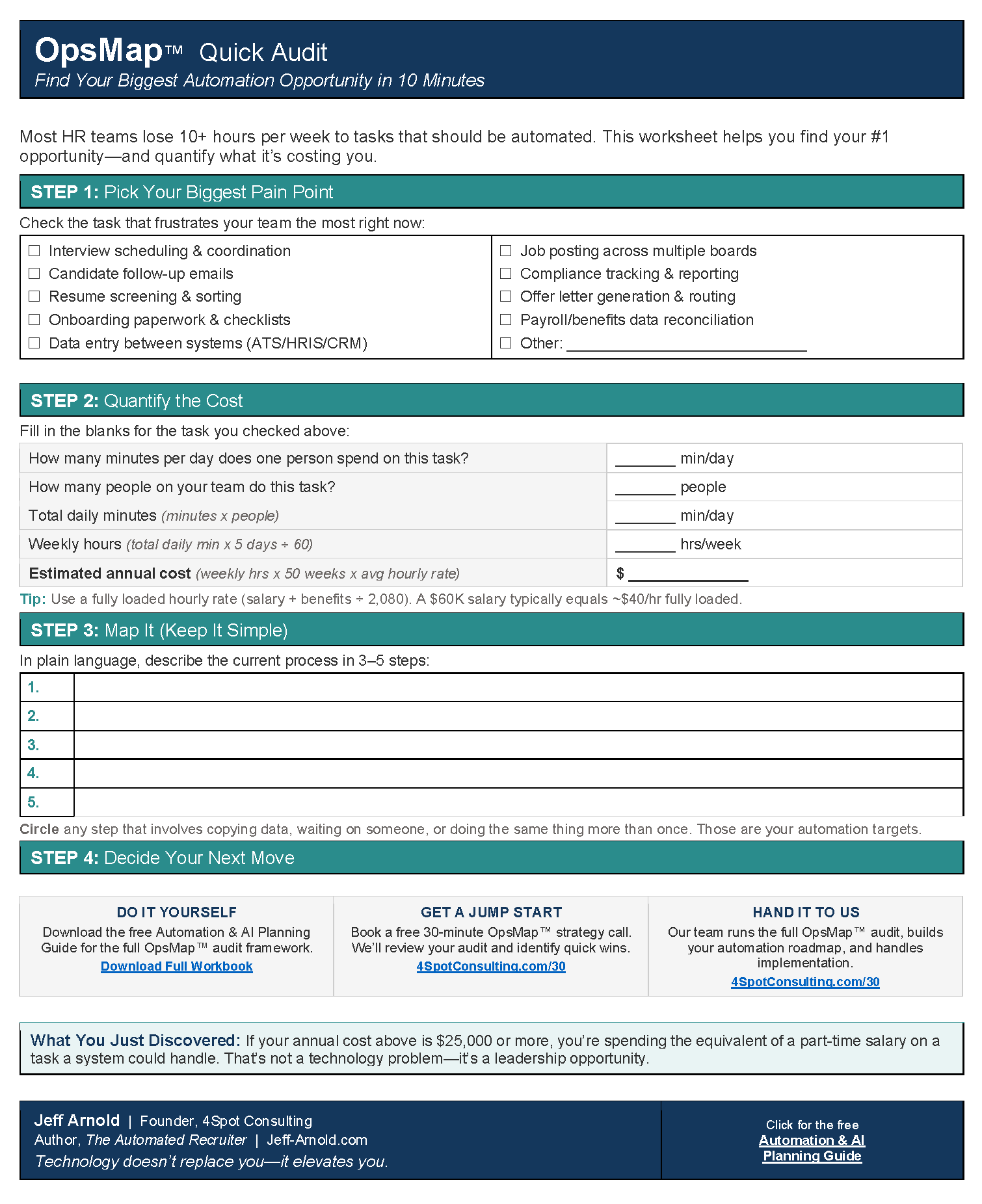
The OpsMap™ is the correct entry point. Not a platform trial. Not a proof-of-concept build. Not a vendor demo. The OpsMap™ is a structured audit of your current recruiting workflow that identifies the highest-ROI automation opportunities — ranked, with timelines, dependencies, system requirements, and a management buy-in plan — before a single line of automation is built.
The OpsMap™ answers three questions every successful build requires before it starts. First: which automation delivers the most return for the least implementation complexity, given your specific ATS configuration and resume volume? Second: what is the correct sequence — which automation creates the data foundation the next automation depends on? Third: what does the ROI projection look like with enough specificity for a CFO to sign off without a follow-up meeting?
The OpsMap™ guarantee: if it does not identify at least five times its cost in projected annual savings, the fee adjusts to maintain that ratio. That guarantee exists because the audit methodology is designed to surface real opportunities from real workflows, not to produce a proposal that justifies a predetermined build scope.
After the OpsMap™, the OpsBuild™ implements the roadmap. After the OpsBuild™, the OpsCare™ keeps the pipeline performing at production quality as volumes, formats, and systems evolve. The OpsMesh™ methodology — OpsMap™, OpsSprint™, OpsBuild™, and OpsCare™ working together — ensures every automation component, every data flow, and every system integration produces the compounding returns that justify the investment at the organizational level.
For organizations not yet ready for the full OpsMap™ engagement: start with the two-part filter. Identify the task in your current resume processing workflow that happens at least once per day and requires zero human judgment. That task is your OpsSprint™ candidate. Build it, measure it, and use the measurement to build the internal case for the full program. Understand the common mistakes HR teams make when automating internally and why clean processes must come before any HR automation to position the resume parsing program correctly. For the compliance and security dimensions, the essential questions HR leaders must answer before investing in automation provides the frameworks your build must incorporate before go-live.
Related Resources
- 11 Essential Metrics for Optimizing Your Resume Parsing Automation
- 12 Critical AI Resume Parsing Mistakes HR Can’t Afford to Make
- 12 Red Flags When Selecting the Right AI Resume Parser Vendor
- 10 Must-Have Features for Peak AI Resume Parser Performance
- 11 Non-Negotiable Features for a High-Impact AI Resume Parser
- 10 Ways Automated Resume Parsing Elevates Your Employer Brand
- 12 AI Recruitment Misconceptions Debunked
- 13 Automation Strategies to Empower HR and Eliminate Manual ATS Entry
- 10 HR Data Governance Mistakes to Avoid for Strategic Success
- 12 Automated Strategies to Combat Candidate Ghosting and Optimize Recruiting Efficiency


RELATED POST

