Post: From Problem to Solution: How to Evaluate an HR Automation Consultant: A CHRO’s Buyer’s Guide
The right HR automation consultant maps your broken processes before writing a single line of code, demonstrates live connections to your systems before you sign, and ties every deliverable to a measurable HR outcome – not a feature list. This guide gives CHROs the exact questions, gates, and red flags to use during evaluation.
Why Most HR Automation Engagements Fail Before They Start
Most HR automation projects fail at the vendor selection stage, not the implementation stage. HR leaders buy a consultant’s demo environment instead of testing their real-world methodology. The result is a signed contract with a firm that builds impressive slide decks and then struggles with your actual HRIS, your actual workflows, and your actual team’s capacity to absorb change.
The market is crowded with generalist automation shops that added “HR” to their website when the category heated up. Separating those firms from consultants who understand HR operations requires a structured evaluation – one that goes beyond references and proposal decks.
For a look at what the warning signs look like once a project is already underway, see 11 Warning Signs Your Inherited HR Operation Is Bleeding Money.
What a Process-First Consultant Actually Delivers
A process-first consultant delivers workflow documentation before automation architecture, and that distinction separates real practitioners from tool vendors who default to platform recommendations before understanding your problem.
The sequence matters. Map the current state. Identify failure points. Define the improved future state. Then – and only then – select the tools that close the gap. Consultants who lead with their favorite platform are working backwards. They fit your problem to their answer instead of building an answer to your problem.
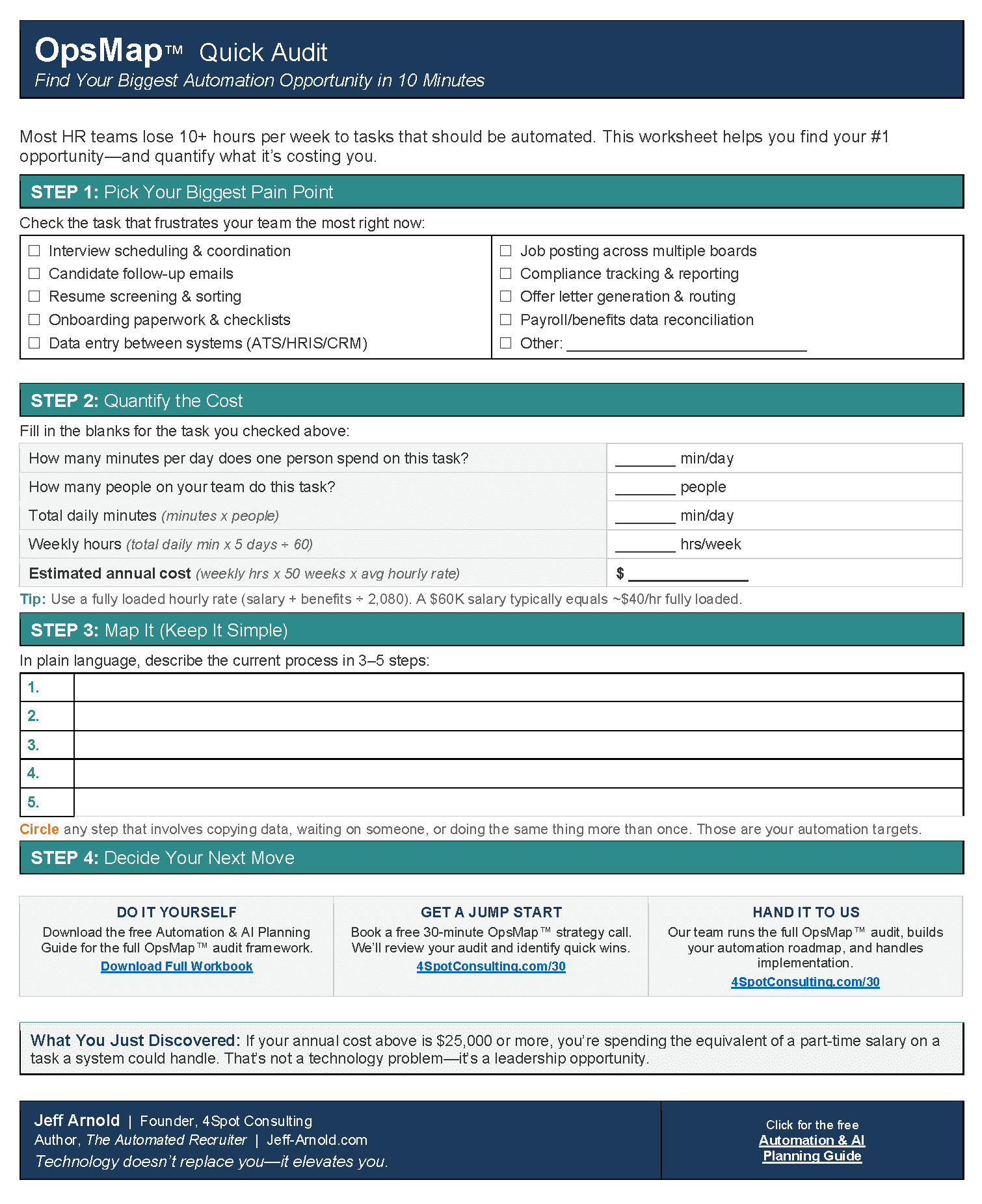
4Spot Consulting’s OpsMesh™ framework starts every engagement with an OpsMap™ diagnostic. The OpsMap captures every handoff, system dependency, and manual touchpoint in your HR workflow before a single automation is scoped. The diagnostic output becomes the project charter – stakeholders see exactly what is being automated, why, and what success looks like.
This approach is why engagements like the Global Talent Solutions project produced verified, measurable outcomes – not just delivered automations. Read the full breakdown at $1.2 Million Saved: 4Spot Consulting’s AI Automation Transformation for Global Talent Solutions.
Expert Take
The single most reliable signal that a consultant is process-first: they ask to shadow your team in their actual workflow during the first week. Not to audit them – to understand the gap between how the process was designed and how people actually execute it day to day. That gap is where automation either succeeds or gets abandoned six months after launch.
Five Questions Every CHRO Must Ask Before Signing
These five questions separate genuine HR automation consultants from generalists who will learn on your budget.
1. How do you handle a process that is broken before you automate it?
The right answer names a specific diagnostic step that runs before any tool selection. If the consultant jumps to platform recommendations, stop the conversation. Require a consultant who treats process cleanup as a prerequisite, not an add-on. See 10 Signs You Need: Why Clean Processes Must Come Before Any HR Automation for the framework that drives this question.
2. What does your onboarding automation architecture look like for a company our size?
You are not asking for a template – you are watching how they think. Strong consultants ask clarifying questions about your HRIS, your headcount volume, and your current failure points before sketching anything. Weak consultants show you a slide they already had.
3. Can you demonstrate a live connection to our systems before we sign?
API credentials and sandbox environments exist. A consultant who cannot show a live integration during the sales process is selling theoretical capability. Require a proof-of-connection call against your actual tech stack before any contract is executed.
4. How do you measure success, and who owns that measurement?
The answer should name specific HR metrics – time-to-hire, onboarding completion rate, HR ticket volume, manual hours eliminated – with a clear owner on both sides. Vague answers about “transformation” and “efficiency gains” are not metrics. They are marketing language.
5. What happens when something breaks after go-live?
Every automation breaks eventually. The question is whether the consultant has a documented support model with defined response times, or whether post-launch support is an informal conversation about scheduling another engagement. Get the support model in writing before signing.
Red Flags That Kill Projects Before They Start
Red flags in HR automation consulting appear during the sales process – not after the contract is signed – if you know what to watch for.
- Platform evangelism before problem definition. If the consultant’s first slide is about their preferred tool, they are selling software adoption, not business outcomes.
- References that are not in HR. Automation consulting for marketing operations and automation consulting for HR operations are different disciplines. Verify that references come from HR or talent acquisition leaders specifically.
- No clear ownership of change management. Automations that HR teams do not adopt are failed automations. Ask who owns adoption and training – if it is not in scope, it needs to be.
- Vague scoping language in the proposal. “Automate your onboarding process” is not a deliverable. “Trigger a new-hire document packet via your HRIS, route countersignatures through PandaDoc, and log completion back to Keap within 24 hours of start date” is a deliverable.
- No process documentation as a standalone deliverable. If the engagement ends and you own only the automations – not the documented logic behind them – you are dependent on that consultant indefinitely. Require that documentation is a named, contractual deliverable.
For a deeper look at the mistakes HR teams make when they try to handle automation internally, see 11 Common Mistakes HR Teams Make Automating Internally.
How to Structure the Evaluation Process
Structure the evaluation in three gates, each designed to eliminate consultants who are not ready to perform at the next level.
Gate 1: Written Methodology Review
Request a written description of their engagement methodology – not a proposal, a methodology document. It should name specific phases, deliverables at each phase, and how they handle scope changes. A firm that cannot produce a methodology document does not have a repeatable process.
Gate 2: Live Process Mapping Session
Invite finalists to run a 90-minute live process mapping session against one real HR workflow you are willing to share. Give every finalist the same workflow. Compare how they diagnose it, what questions they ask, and what they recommend before they know what tools you already own.
Gate 3: Technical Proof-of-Connection
Require each finalist to demonstrate a live API connection to at least one of your HR systems during a structured technical review. This is a live test, not a presentation. Consultants who cannot connect in a demo environment are not ready to connect in your production environment.
For the questions that drive Gate 1 and Gate 2, see 13 Essential Questions for HR Leaders Before Investing in Automation and 10 Critical Questions for Choosing Your HR Automation Platform.
The 4Spot Consulting Approach in Practice
4Spot Consulting’s engagement model was built for HR leaders who have been burned by generalist automation shops.
Every new engagement starts with an OpsMap™ diagnostic that produces documented current-state workflows before any automation is scoped. From there, the OpsSprint™ phase delivers the first working automations in a defined window – not a roadmap for future work. The OpsBuild™ phase scales what works and retires what does not. OpsCare™ provides a post-launch support model with documented response expectations, not informal availability.
The OpsMesh™ connective layer ties every phase together and gives HR leadership visibility into what is running, what is queued, and what the measured outcomes are at any point in the engagement.
You can see what this looks like as a verified outcome in the Global Talent Solutions engagement, which reclaimed significant operational capacity across onboarding and invoicing workflows: 100 Hours Reclaimed: 4Spot Consulting Streamlines Onboarding and Invoicing for Global Talent Solutions.
Frequently Asked Questions
What is the most important thing to verify before hiring an HR automation consultant?
Verify that the consultant runs a process diagnostic before proposing any tools. A consultant who leads with platform recommendations is solving for their own expertise, not your problem. The diagnostic deliverable – a documented current-state workflow with named failure points – should be a contractual milestone, not a conversation topic.
How long should an HR automation evaluation take?
A structured three-gate evaluation runs three to four weeks. That timeline gives you enough room to run a live process mapping session and a technical proof-of-connection with finalists without letting the process drag into an extended RFP cycle that burns your team’s time.
Do small HR teams benefit from automation consulting?
Small HR teams benefit most from automation consulting because they have the least capacity to absorb manual work. The evaluation criteria are identical – process-first methodology, documented deliverables, defined support model. The scope of the initial engagement narrows to the two or three workflows with the highest manual burden, but the evaluation rigor stays constant.
What deliverables should any HR automation engagement include?
Require four categories: documented current-state workflows before automation begins, a defined scope statement for every automation built, completed automations with internal documentation of the logic, and a post-launch support model in writing. Verbal commitments on any of these four are not commitments.
How does 4Spot Consulting differ from a generalist automation agency?
4Spot Consulting works exclusively within HR and recruiting operations, which means our diagnostic methodology, our integration patterns, and our support model are built around the specific failure modes of HR workflows – not adapted from a general-purpose playbook. See 10 Real Examples of How to Evaluate an HR Automation Consultant to compare approaches against documented real-world cases.
Part of our complete guide: How to Evaluate an HR Automation Consultant: A CHRO’s Buyer’s Guide.