Post: Global Talent Solutions’ SaaS Operational Success: Six-Figure Savings with 4Spot Consulting

By Published On: February 5, 2026

Global Talent Solutions partnered with 4Spot Consulting to dismantle the manual bottlenecks strangling their growth. Using the OpsMesh™ framework — anchored in Make.com automation — 4Spot connected their siloed CRM, ATS, and document systems into one integrated operational engine, delivering six-figure annual savings and a 30% reduction in client onboarding time.

About Global Talent Solutions

Global Talent Solutions (GTS) is a rapidly scaling talent acquisition platform serving large enterprises across global markets. Their client roster spans mid-market organizations to Fortune 500s, with high daily volumes of candidate applications, executed contracts, performance data, and workforce records moving through their systems.

Their technology stack was extensive: a proprietary ATS, Keap CRM, multiple HRIS platforms, PandaDoc for document execution, and accounting software. Each system performed its function well. None of them talked to each other — and the manual labor filling those gaps was becoming an operational liability as GTS scaled.

The Operational Challenge

GTS was growing fast enough to expose every seam in their operations. The problems weren’t isolated — they were systemic and compounding:

  • Manual data re-entry across every system: A signed contract in PandaDoc triggered a cascade of manual input into the CRM, project management platform, and accounting software. Every handoff introduced delay and error.
  • Client onboarding measured in days, not hours: New enterprise clients waited up to a full week to be fully onboarded. The process depended on email coordination, manual record creation, and manual access provisioning — none of it automated.
  • Administrative overhead scaling with headcount: A growing share of the operational budget funded staff performing repetitive, low-value tasks. The model required proportionally more people for every new client added.
  • No real-time operational picture: Leadership had no live view of client status, candidate pipelines, or project health. Reports were stale. Decisions were reactive.
  • Scalability ceiling: The manual-entry foundation meant every new enterprise client cost more to onboard than the last. That math compounds against you.
  • High-value staff buried in admin: Account managers and project coordinators spent an estimated 20–30% of their week on data entry and coordination instead of client strategy.

GTS recognized that the answer wasn’t more coordinators — it was rebuilding how work moved through their systems.

How 4Spot Consulting Designed the Solution

4Spot engaged GTS under the OpsMesh™ framework — our methodology for connecting disconnected systems into a single, self-executing operational mesh. The goal wasn’t to replace the tools GTS already owned. It was to make those tools work together intelligently, with Make.com as the orchestration layer.

OpsMap: Strategic Workflow Audit

The OpsMap™ phase opened with stakeholder interviews across sales, operations, HR, and finance. Every data flow, system handoff, and manual step was documented. The output: a prioritized automation roadmap with clear ROI targets — not a wish list, a blueprint with sequenced delivery.

OpsBuild: Integrated Automation with Make.com and AI

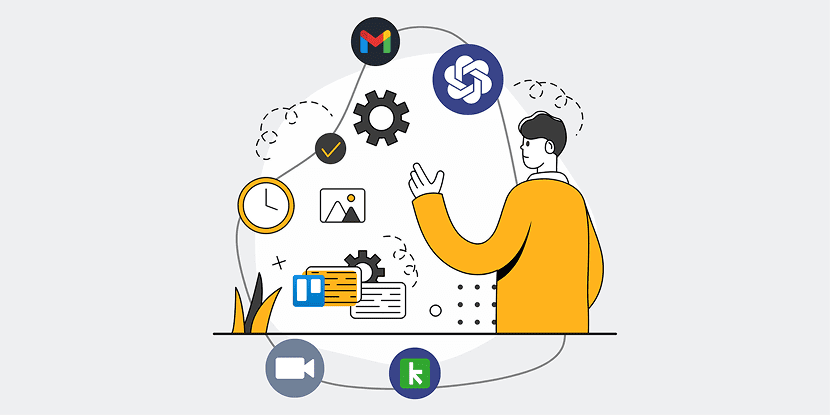
OpsBuild™ delivered the automation infrastructure. Make.com served as the central orchestration layer connecting every system in GTS’s stack:

  • Bi-directional CRM sync: GTS’s ATS, Keap CRM, and project management platform now exchange data automatically. A record created or updated in one system propagates to all others without manual entry.
  • Automated client onboarding: When a contract executes in PandaDoc, Make.com fires a sequence — CRM record created or updated, project workspace provisioned, welcome communications sent, account team notified, kick-off meeting scheduled. No human touches it.
  • AI-powered document and data processing: Incoming resumes, client documents, and support tickets route through AI extraction. Key fields are parsed and pushed to CRM and ATS records automatically, eliminating transcription errors and document-handling delays.
  • Automated billing and reporting: Invoices generate automatically from service milestones and subscription events. Leadership dashboards pull live from connected systems — revenue recognition and client status are always current.
  • Proactive alert system: Expiring contracts, stalled onboarding sequences, and renewal windows trigger automated notifications. Teams act before issues escalate.

OpsCare: Ongoing Optimization and Support

OpsCare™ covered staff training, process documentation, and ongoing monitoring post-launch. Automation that isn’t adopted doesn’t deliver ROI — so 4Spot built the enablement layer alongside the technical layer to ensure GTS extracted full value from day one and continuously improved from there.

Implementation Phases

The engagement ran in structured phases to protect live operations while delivering each automation layer:

  1. OpsMap™ — 4 weeks: Stakeholder interviews, current-state workflow documentation, automation roadmap, and prioritization by impact and complexity.
  2. OpsBuild™ Phase 1 — 8 weeks: Core client onboarding automation. Make.com setup, PandaDoc integration, Keap CRM ingestion sequences, automated client communications, and pilot testing with a live client cohort.
  3. OpsBuild™ Phase 2 — 10 weeks: AI-enhanced talent workflows. Resume parsing automation, candidate data routing from multiple intake sources into ATS and CRM, automated initial screening prompts, and real-time talent pipeline dashboards.
  4. OpsBuild™ Phase 3 — 6 weeks: Financial and advanced operations integration. Automated invoicing and reconciliation, advanced reporting across all connected systems, and iterative optimization of Phase 1–2 automations based on live performance data.
  5. OpsCare™ — Ongoing: Team training across sales, operations, HR, and finance. Documentation, troubleshooting guides, and continuous monitoring with iterative improvements as GTS’s business needs evolved.

The Results

The automation infrastructure delivered sustained, measurable improvements across GTS’s entire operation — not just isolated time savings in one department:

  • Six-figure annual operational savings: Eliminating manual data entry and repetitive administrative tasks freed thousands of staff hours annually. GTS redirected those resources to product development and client strategy. The full scope of the financial impact across the GTS engagement is documented in 4Spot’s GTS transformation overview.
  • 30% reduction in client onboarding time: The previously week-long onboarding process dropped by 30%, accelerating time-to-value for new enterprise clients and freeing implementation teams for higher-value client work.
  • 40% decrease in manual data entry: Across all integrated departments, automated data flows eliminated the bulk of manual record creation and updates — directly lifting employee productivity.
  • 90% drop in data entry errors: Automated transfers and AI-powered extraction removed the human error layer from data handling. Records became cleaner, reports more reliable, and rework cycles near-eliminated.
  • Scalable capacity without proportional headcount: GTS expanded their client base significantly within 12 months of go-live without adding administrative staff. The automated infrastructure absorbed increased volume with minimal additional operational strain. See also: 100 hours reclaimed through onboarding and invoicing automation.
  • Real-time operational visibility: Leadership works from live dashboards instead of stale reports. Client status, project health, and financial metrics update automatically as events occur across connected systems.
  • Reclaimed strategic capacity: Account managers and project coordinators reported collectively recovering more than 150 hours per month previously consumed by administrative work — time now applied to client engagement and revenue-generating activity.

Expert Take

The defining pattern in GTS’s transformation isn’t the automation volume — it’s the sequencing. Most scaling SaaS operations want to start building automations immediately, and that instinct is understandable. But bypassing the audit phase means building fast in the wrong direction. The OpsMap phase converts a list of frustrations into a prioritized ROI roadmap. When OpsBuild follows that blueprint, every automation investment lands in a high-leverage spot. That’s why GTS’s results compounded rather than showing up as scattered time savings across a few isolated workflows.

Key Takeaways for Scaling SaaS and B2B Operators

The GTS engagement surfaces principles that apply directly to any B2B or SaaS company approaching the same operational ceiling:

  • Automation is not optional at scale. Manual processes cap your growth ceiling. Every enterprise client added to a manual-entry foundation costs more to serve than the last — and that compounding math eventually breaks your model.
  • Integration beats replacement. GTS didn’t rip out existing tools. They connected them. The OpsMesh™ approach — with Make.com as the orchestration layer — unlocked value already sitting in their stack. See 10 essential Make.com integrations that unlock cheaper, more powerful automation for examples of what that looks like in practice.
  • AI amplifies automation. AI-powered document processing handled the mechanical extraction work so people could apply judgment where it actually matters — client relationships, strategy, and edge cases.
  • Audit first, build second. OpsMap™ before OpsBuild™ is not bureaucracy — it’s the difference between automation that solves the right problem and automation that just makes the wrong process run faster. For additional context on when your team is ready for this move, see 11 signs your HR team is ready for Make.com automation.
  • ROI is measurable and significant. The investment in a structured automation engagement pays back in reduced administrative overhead, faster client delivery, and the capacity to grow without proportional hiring.

“Before 4Spot Consulting, our growth was creating as many problems as it was solving. Our teams were buried in manual data entry and our onboarding was a bottleneck. 4Spot didn’t give us a band-aid — they rebuilt how we operate. The savings are significant, but the real win is the agility. We went from constantly reacting to proactively driving the business forward.”

— CEO, Global Talent Solutions

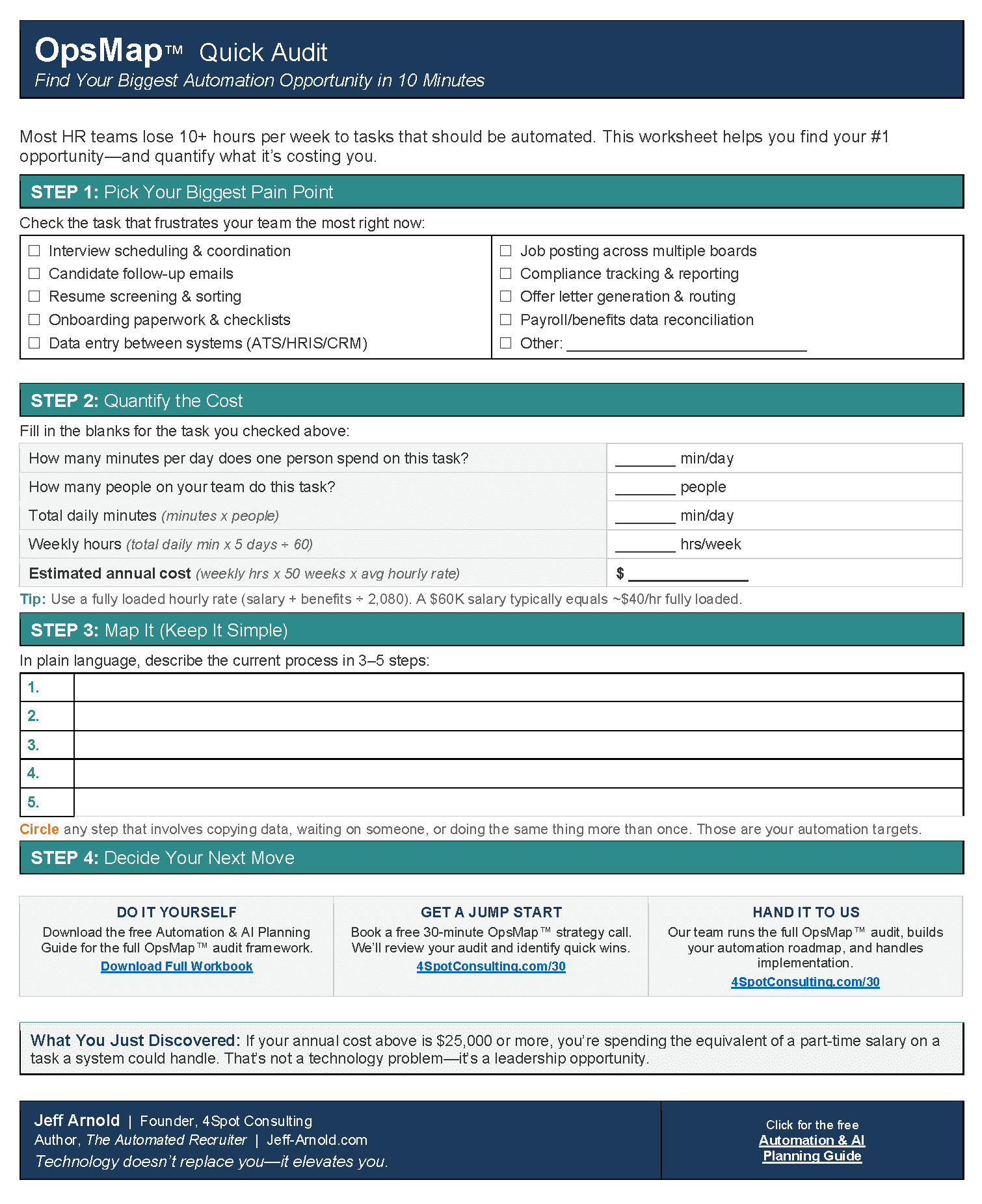
Free OpsMap™️ Quick Audit

One page. Five minutes. Pinpoint where your business is leaking time to broken processes.

Free Recruiting Workbook

Stop drowning in admin. Build a recruiting engine that runs while you sleep.