Post: Lessons From: How to Evaluate an HR Automation Consultant: A CHRO’s Buyer’s Guide
When a CHRO evaluates an HR automation consultant, the process reveals as much about the consultant as it does about the CHRO’s own readiness. The right consultant asks hard questions first, builds only what the process warrants, and delivers documented systems your team owns – not a vendor dependency you manage forever.
What the Evaluation Process Actually Teaches You
The evaluation process is diagnostic on both sides of the table.
Most CHROs enter a consultant search looking for capability – can this person build what we need? That’s the wrong first question. The more revealing question is: does this consultant push back on your assumptions before they write a single scenario?
A consultant who immediately scopes automation without asking how your current process runs, who owns it, and where it breaks down is selling you a solution before they understand the problem. That’s a red flag, not a qualification.
Watch how a consultant handles the first 20 minutes. Do they ask about your HR team’s current tools? Do they want to see your existing workflows before suggesting what to automate? Do they push back when you describe a process that has no business being automated yet?
If the answer to those questions is no, you’re looking at a vendor – not a partner.
Before going deeper on evaluation criteria, it helps to understand why clean processes must come before any HR automation. Automating a broken process doesn’t fix it – it breaks it faster and at scale.
Credentials That Separate Practitioners From Presenters
Platform certifications are a floor, not a ceiling.
Any reputable HR automation consultant holds platform credentials – Make.com, Keap, or whatever stack they build on. But certifications prove someone can configure a tool. They don’t prove someone can diagnose a people process, run a structured discovery session, or know when NOT to automate.
The credentials that actually matter in this evaluation:
- Process documentation before build. Can they show you a process map for a prior engagement before the automation was built? If they jump straight to scenario screenshots, they built solutions without mapping problems first.
- Platform independence. A practitioner recommends the right tool for your stack. A presenter recommends the tool they know best and get paid to deploy.
- Documented handoffs. Ask to see an actual deliverable from a prior engagement. Not a slide deck – the actual system documentation your team would inherit.
- Error-handling philosophy. Ask how they handle automation failures at 2 AM when no one is watching. Their answer separates builders from theorists.
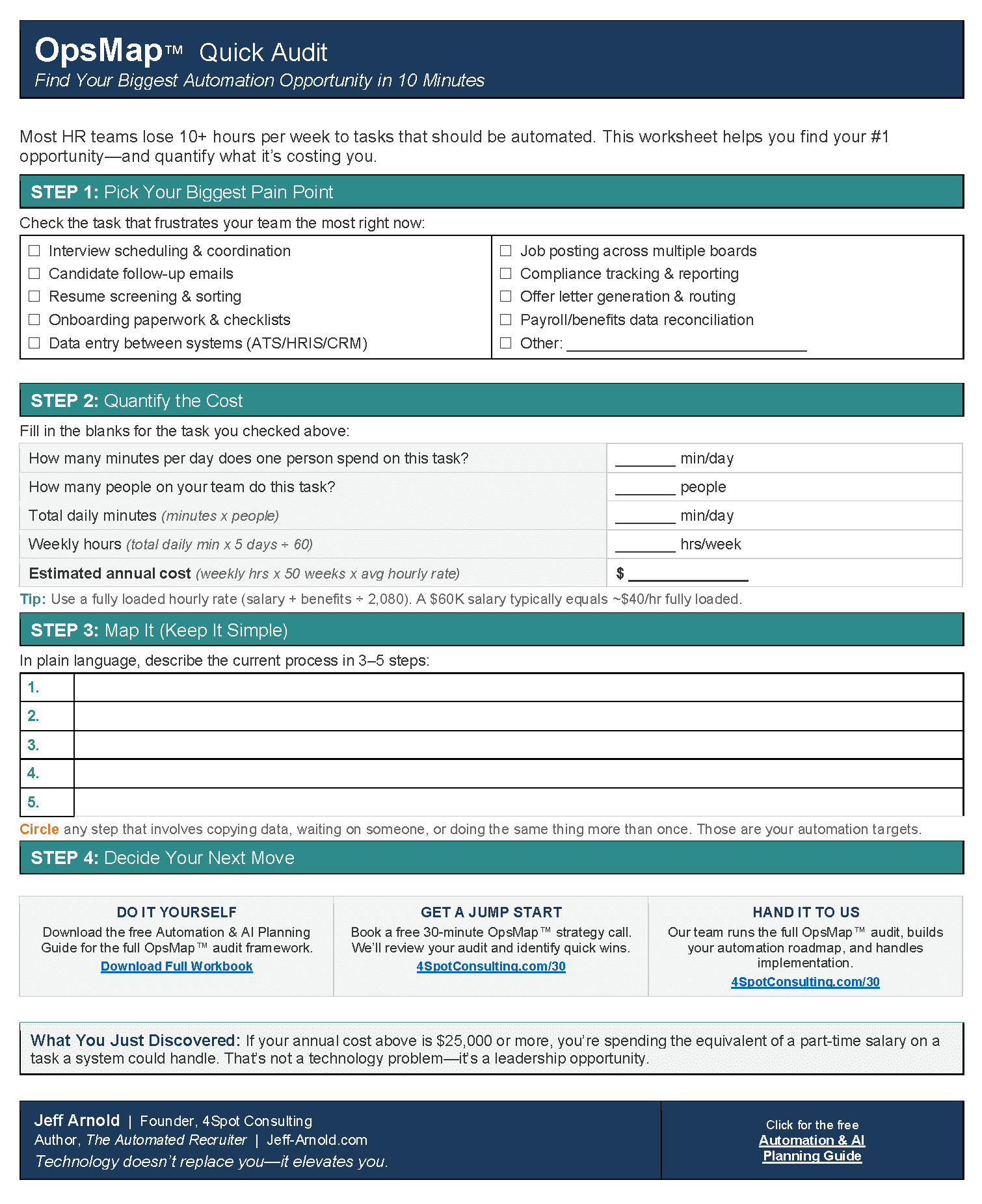
At 4Spot, our engagement model starts with an OpsMap™ – a full diagnostic of your current HR workflows, tool stack, and automation readiness before a single scenario gets built. That sequencing isn’t a formality. It’s what separates work that sticks from work that gets rebuilt six months later.
The essential questions for hiring the right ATS automation consultant covers this credential layer in more depth, including what to ask to distinguish platform knowledge from process expertise.
How to Structure a Real Discovery Call
A good discovery call has more silence than selling.
When you get on a call with a prospective HR automation consultant, the balance of talking tells you everything. If the consultant talks for the first 40 minutes about their methodology, their platform expertise, and their previous work without asking you a single diagnostic question – you’re in a sales call, not a discovery call.
Structure the call to force diagnostic behavior from the consultant. Give them a real scenario to react to. Describe a process that’s partially broken and watch how they respond. A practitioner asks clarifying questions. A presenter describes how they’d automate it.
Specific questions worth asking on a discovery call:
- “What’s the first thing you’d want to see before recommending what to automate?”
- “Tell me about an engagement where you told a client NOT to automate something.”
- “How do you handle a situation where the tool your client already owns isn’t the right tool for the job?”
- “What does your documentation handoff look like at the end of a project?”
Those four questions surface process maturity faster than any RFP. The 13 essential questions for HR leaders before investing in automation extends this list into due-diligence territory – useful reading before you finalize your evaluation scorecard.
Red Flags That Surface Before the Proposal
The warning signs appear in the sales process, not the contract.
Most CHROs treat the contract as the protection layer. It isn’t. By the time you’re reading contract language, you’ve already decided to trust this consultant. The real due diligence happens in the conversations before the proposal arrives.
Red flags to watch for before you receive a proposal:
- No process-first framing. If the consultant pitches “we’ll automate your onboarding” before asking how your onboarding actually works, they’re guessing.
- Vague handoff language. “We’ll train your team” is not a handoff. Ask what format that training takes, what documentation they leave behind, and who owns the system after launch.
- Platform lock-in posture. A consultant who builds on only one platform builds for their convenience, not yours.
- No failure-state examples. Ask directly: “What does a failed automation look like, and what’s your process for catching it?” Anyone who hasn’t thought about this in detail hasn’t built production-grade systems.
- Scope that inflates before discovery ends. If the proposal scope keeps expanding before they’ve finished learning your process, they’re estimating revenue, not requirements.
The mistakes HR teams make when automating internally covers why these same red flags surface when you try to do this work without outside expertise. The failure modes are identical whether the builder is internal or external.
Expert Take
The best automation consultants are process architects first and builders second. When an HR leader tells me they want to automate recruiting, my first question is always: walk me through what happens when a candidate doesn’t respond after an interview. If the process for that scenario lives in someone’s inbox, the automation problem is actually a process design problem. Build first, and you’ll rebuild three months later.
The Right Engagement Model for HR Automation Work
Engagement structure determines whether your investment compounds or expires.
A fixed-scope, deliver-and-exit model works for simple one-off builds. It doesn’t work for HR automation, where the process evolves, the team turns over, and the tool stack changes. If your consultant’s contract ends at launch, your investment starts depreciating the day they leave.
The engagement model that produces durable results has three phases:
- Diagnosis before build. Map the process, identify the automation candidates, and set clear criteria for what success looks like. This is the OpsMap™ work – and skipping it is the most expensive shortcut in HR automation.
- Build with documentation baked in. Every scenario, every trigger, every integration gets documented as it’s built – not summarized afterward. If the documentation is an afterthought, your team inherits a black box.
- Operational continuity post-launch. Systems break, teams change, integrations update. A consultant who walks away at launch leaves you holding a machine with no manual.
At 4Spot, the engagement model sequences through OpsSprint™ for rapid scoped builds, OpsBuild™ for full system development, and OpsCare™ for ongoing maintenance and iteration – all connected through the OpsMesh™ integration layer that keeps your HR stack talking to itself after we leave. Each phase sets up the next, and cutting any one of them creates a gap your team will feel within 90 days.
For a real-world example of what this sequencing produces, the Global Talent Solutions transformation case study walks through what happens when the full engagement model runs end-to-end. The results are a function of the process – not just the technology.
The real examples from the CHRO buyer’s guide also shows how different organizations applied this evaluation framework in practice – including what they got wrong the first time.
Frequently Asked Questions
What’s the difference between an HR automation consultant and an HR tech implementation partner?
An HR automation consultant diagnoses your process gaps and builds custom workflows to close them. An HR tech implementation partner configures a vendor’s product according to spec. An implementation partner deploys what the vendor supports; an automation consultant builds what your process requires, regardless of which platform it runs on.
How long should a proper HR automation discovery take before any build starts?
Discovery for a meaningful HR automation engagement runs one to three weeks, depending on the scope of workflows involved. Any consultant who skips structured discovery and moves straight to build is estimating without data. You’ll pay for that shortcut in rework.
Should HR automation consultants be neutral on platform selection?
A strong consultant recommends the platform that fits your existing stack, your team’s capability, and your budget – not the platform they know best or get referral fees to deploy. Platform neutrality is a qualifying criterion, not a bonus. Ask directly: “What would make you recommend a different platform than the one you typically use?”
What documentation should an HR automation consultant deliver at project close?
At minimum, you need: a scenario-level process map for every automation built, a written runbook for each workflow, credentials and access documentation, and a record of all error handlers and edge cases. If the handoff is a video walkthrough and a Slack thread, the system lives in the consultant’s head – not yours.
How do you evaluate a consultant’s error-handling competency?
Ask for an example of an automation they built that broke in production, then walk through how they caught it, fixed it, and hardened it against recurrence. A practitioner with real production experience has these stories. Someone who has only worked in test environments doesn’t.
Part of our complete guide: How to Evaluate an HR Automation Consultant: A CHRO’s Buyer’s Guide.