

Post: N8n vs Make.com (2026): Which Scales Better for Enterprise Recruiting?
N8n vs Make.com (2026): Which Scales Better for Enterprise Recruiting?
Enterprise recruiting teams do not have a feature problem — they have a scale and operability problem. High application volumes, multi-stage workflows, fragmented ATS and HRIS systems, and compliance obligations combine to expose every weakness in an automation platform fast. This satellite drills into the scalability dimension of the broader N8n vs Make.com for HR: Control, Cost, and Compliance decision — specifically: which platform keeps growing with your recruiting operation without becoming a liability?
The answer depends less on raw platform capability than on three variables your vendor will never ask about: your team’s technical composition, your data-residency obligations, and how fast you need to change automations when hiring priorities shift.
Quick Comparison: N8n vs Make.com for Enterprise Recruiting
| Factor | N8n | Make.com™ |
|---|---|---|
| Deployment model | Self-hosted or n8n Cloud | Cloud-hosted (SaaS) |
| Pre-built ATS/HRIS connectors | Moderate (community-maintained) | Extensive (vendor-maintained) |
| Non-technical user access | Limited — developer-centric UI | Strong — visual flow builder |
| Data residency control | Full (self-hosted) | Vendor DPA required |
| Custom code / logic | Native code nodes (JS, Python) | Limited — visual-first |
| Error handling for non-devs | Moderate — logs require dev interpretation | Strong — built-in scenario history and alerts |
| Licensing model | Open-source + cloud tier | Subscription (operations-based) |
| TCO at enterprise scale | Higher when DevOps labor included | Predictable subscription + lower labor |
| Best for | Dev-resourced teams, custom logic, data sovereignty | Cross-functional teams, fast iteration, broad integrations |
Scalability Factor 1 — Integration Breadth
Make.com™ wins on integration breadth for enterprise recruiting. Its vendor-maintained connector library covers the major ATS platforms, HRIS systems, communication tools, and CRMs that enterprise recruiting stacks rely on — and those connectors are updated by the platform when APIs change, not by your team.
N8n’s integration ecosystem is genuine and growing, but many connectors are community-maintained. In enterprise environments, a community connector that breaks during an API deprecation cycle is a production incident your DevOps team inherits. Gartner research consistently identifies integration maintenance as one of the top hidden costs in enterprise automation programs. At recruiting scale — where candidate data is moving between ATS, HRIS, background check vendors, and offer management systems simultaneously — connector reliability is not a minor consideration.
Mini-verdict: Make.com™ for teams running standard recruiting tech stacks. N8n for teams with highly proprietary internal systems that require custom HTTP integrations regardless of platform.
Scalability Factor 2 — Team Operability and Change Latency
The most underrated scalability variable in enterprise recruiting automation is how fast your team can change a workflow when hiring priorities shift. During peak hiring periods, recruiting workflows change constantly — new screening criteria, updated offer templates, revised approval chains. The platform that lets your HR ops team make those changes without entering a developer backlog is the platform that scales.
Make.com™’s visual scenario builder is accessible to technically capable non-developers — operations managers, senior HR administrators, and recruiting coordinators can modify, clone, and troubleshoot scenarios with training. N8n’s node editor requires a comfort level with data structures and workflow logic that most HR professionals do not have and should not be expected to develop.
Research from APQC on HR process benchmarking consistently shows that internal change latency — the lag between identifying a needed process change and deploying it — is a primary driver of recruiting efficiency loss in large organizations. Reducing that latency is where Make.com™ compounds its scalability advantage over time.
For a detailed look at automating candidate screening at scale, including how routing logic complexity affects team operability, see our dedicated satellite.
Mini-verdict: Make.com™ by a clear margin for cross-functional team operability. N8n only if you have a dedicated automation engineer embedded in your recruiting operations function.
Scalability Factor 3 — Data Residency and Compliance Architecture
N8n’s self-hosted model is the decisive winner for organizations with strict data-residency requirements. When candidate data must remain within a specific jurisdiction or on company-controlled infrastructure — common in healthcare recruiting, federal contracting, and multinational organizations subject to GDPR or state privacy laws — self-hosted n8n keeps that data entirely within your environment. No vendor data processing agreement bridges the gap; the data simply never leaves your infrastructure.
Make.com™ cloud processes data on vendor infrastructure. It is audit-ready and enterprise-capable, but compliance teams must execute and maintain a data processing agreement, and data flows through Make’s servers during scenario execution. For most enterprise recruiting teams this is fully manageable. For organizations in regulated industries or jurisdictions with strict data-transfer restrictions, it requires deliberate legal review.
As the parent pillar on N8n vs Make.com for HR compliance and architecture establishes: data architecture is a precondition of platform selection, not an afterthought. Get this decision right before evaluating features.
Mini-verdict: N8n (self-hosted) for data-sovereignty requirements. Make.com™ with a properly executed DPA for most enterprise recruiting environments.
Scalability Factor 4 — Total Cost of Ownership
N8n’s open-source license is genuinely zero cost for self-hosted deployments. That is where the straightforward cost story ends. Enterprise-scale self-hosting requires cloud infrastructure provisioning, security hardening, uptime monitoring, backup management, version upgrades, and incident response — all of which require DevOps labor. Parseur’s analysis of manual operational overhead finds that hidden labor costs routinely dwarf software licensing costs in operational technology decisions; automation platforms are no exception.
At enterprise scale, the TCO comparison often inverts the intuition that open-source equals cheaper. Make.com™’s operations-based subscription model is predictable and includes platform maintenance, uptime SLAs, and connector updates as part of the subscription. When the fully loaded cost of DevOps labor for self-hosted n8n is included, Make.com™’s TCO is frequently lower for teams without an existing infrastructure function.
N8n Cloud narrows the maintenance gap but also narrows the cost gap. Teams evaluating n8n Cloud vs Make.com™ should model current pricing tiers directly from each vendor — the delta is often smaller than expected once infrastructure labor is removed from the n8n column.
See our detailed analysis of the true cost of HR automation ownership for a full TCO framework across both platforms.
Mini-verdict: Make.com™ for predictable TCO at enterprise scale unless you have existing DevOps capacity already allocated to the automation function. N8n self-hosted only when infrastructure cost is genuinely lower than the subscription alternative after labor is included.
Scalability Factor 5 — Error Handling and Production Reliability
Enterprise recruiting workflows fail. Webhooks time out. API rate limits are hit. Candidate records fail validation. What separates a scalable automation program from a fragile one is how quickly failures are detected, diagnosed, and resolved — and by whom.
Make.com™’s built-in error handling infrastructure — scenario history, execution logs, error-route modules, and email/Slack alerting — is designed to be operated by non-developers. A recruiting operations manager can identify that a candidate routing scenario failed, see which record caused the failure, and re-run or manually route that candidate without engineering involvement. That operational independence is a compounding scalability advantage across a high-volume hiring cycle.
N8n provides comparable logging capability, but the diagnostic interface is more technical. Complex failures in workflows with custom code nodes typically require a developer to interpret. At enterprise scale, where production incidents may affect hundreds of candidate records simultaneously, the time-to-resolution difference is material.
For a full treatment of resilient HR workflow design and error handling across both platforms, see our dedicated comparison.
Mini-verdict: Make.com™ for self-sufficient error recovery. N8n where a developer is embedded in the operating model and can own production reliability.
Real-World Scale: What High-Volume Recruiting Looks Like
Consider what happens when a 45-person recruiting firm processes thousands of candidate applications across a dozen active clients simultaneously. The automation platform is not just routing resumes — it is managing screening triggers, updating ATS records, dispatching interview invitations, tracking response windows, escalating stalled candidates, and generating offer documents. Each of those workflows has failure modes. Each failure mode has a resolution path. The platform that lets the recruiting team own that resolution path — rather than escalating every incident to an engineer — is the platform that scales with the business.
This is the dynamic we observed when working through an OpsMap™ engagement with a firm of exactly that profile. Nine automation opportunities were identified. Seven were deployed on Make.com™ because the recruiting team could own and iterate those workflows directly. Two required custom data transforms that justified a more code-intensive approach. That hybrid result — not a binary platform choice — is what enterprise scalability actually looks like in practice.
For a detailed look at how automation scaled candidate intake 200% for a staffing firm, the case study illustrates what high-volume recruiting automation demands of any platform.
Scalability Factor 6 — Offer Letter and Downstream Workflow Automation
Recruiting automation does not end at screening. Offer letter generation, approval routing, background check triggers, and onboarding handoffs are where enterprise recruiting workflows become genuinely complex — and where platform scalability is tested by integration depth rather than throughput.
Make.com™’s pre-built connectors to document generation tools, e-signature platforms, and HRIS systems make end-of-funnel automation faster to deploy and easier to maintain. Offer letter logic — conditional compensation tiers, role-specific document templates, multi-approver routing — is achievable in Make.com™’s visual builder without code. N8n can execute the same logic, but the implementation is more code-intensive and the maintenance burden falls on a developer.
For teams evaluating this specific workflow, our satellite on automating offer letter generation provides a direct platform comparison with implementation detail.
Mini-verdict: Make.com™ for end-to-end offer and onboarding workflow automation without developer dependency. N8n where existing custom document infrastructure requires deep code integration.
Decision Matrix: Choose N8n If… / Choose Make.com™ If…
Choose N8n If:
- Your organization has dedicated automation engineers embedded in the recruiting operations function
- Data-residency requirements mandate self-hosted infrastructure and disqualify cloud-processed data flows
- Your recruiting workflows involve proprietary internal systems with no pre-built connector support
- You have existing DevOps infrastructure that absorbs self-hosting cost without incremental labor
- Custom code logic (Python, JavaScript) is essential to your screening or scoring models
Choose Make.com™ If:
- Your recruiting team needs to build, modify, and monitor automations without a developer queue
- Your ATS, HRIS, and communication tools are covered by Make.com™’s pre-built connector library
- Speed of deployment and iteration matters more than bespoke code-level control
- Predictable, subscription-based TCO is preferable to variable infrastructure and labor costs
- Cross-functional team access — recruiters, HR ops, and operations managers — is a design requirement
- You are automating standard enterprise recruiting workflows: screening, scheduling, offer generation, and onboarding handoffs
The Platform Choice That Doesn’t Matter Without This First
McKinsey research on digital transformation consistently finds that technology platform selection accounts for a fraction of automation program outcomes — process design, change management, and team capability account for the majority. An enterprise recruiting team that automates a broken candidate routing process at scale produces broken results faster. Platform choice amplifies the quality of the underlying process design; it does not substitute for it.
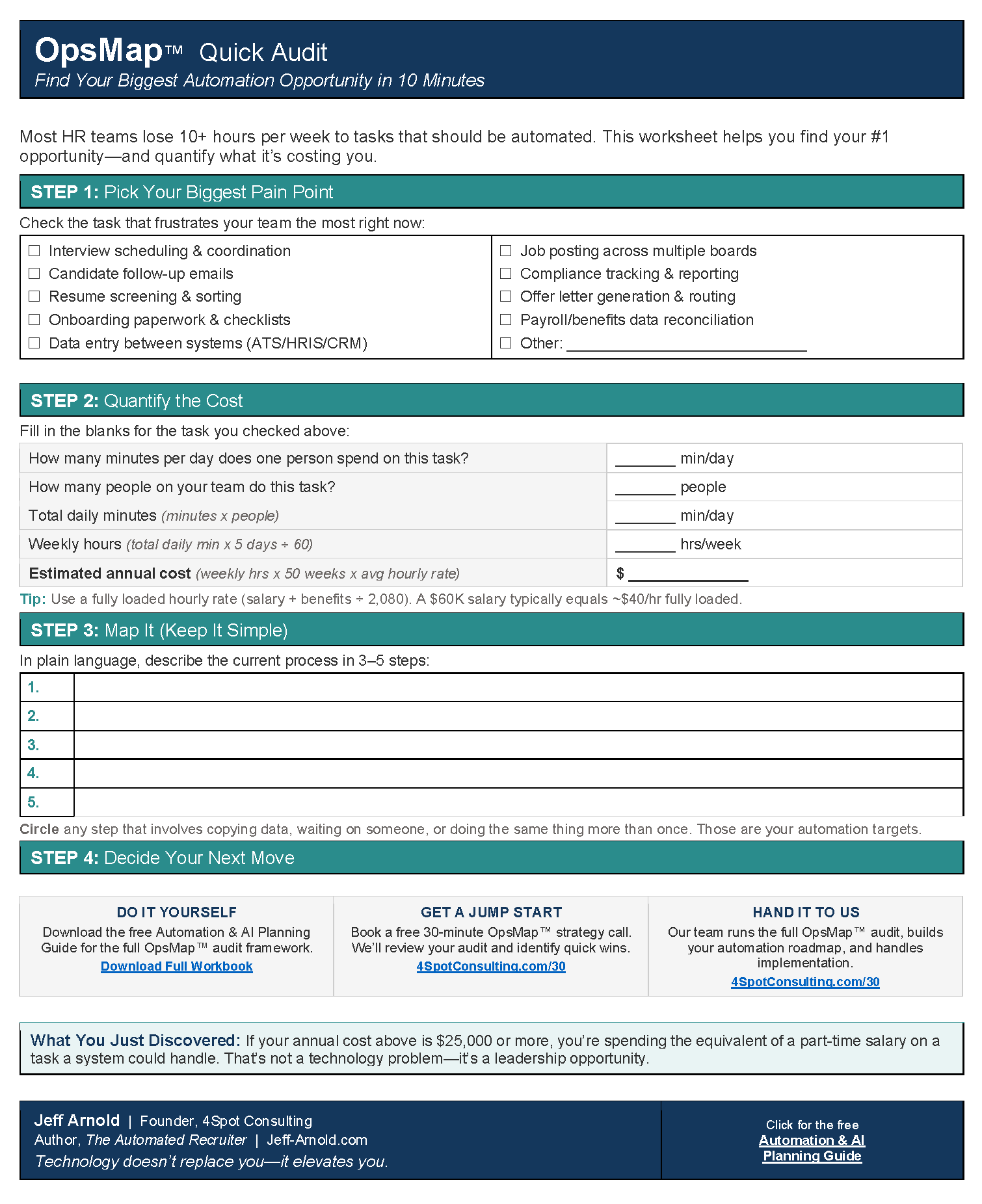
Before committing to either n8n or Make.com™, map your recruiting workflows end-to-end. Identify where errors actually occur, where candidate data actually lives, and which team members actually need to operate the automation in production. That mapping — not a feature comparison — determines which platform scales with your recruiting operation.
The broader parent pillar on n8n vs Make.com for HR compliance and architecture is the right starting point for that process. Scalability is the output of getting architecture, compliance, and team design right first.


RELATED POST


