Post: HR Data Management & Security Glossary for Automation

By Published On: January 10, 2026

HR Data Management & Security Glossary for Automation

Automated HR workflows move sensitive data—candidate PII, offer figures, background check results, payroll records—across systems at machine speed. That speed is the value proposition. It is also the risk. Every term in this glossary represents a control, a constraint, or a compliance obligation that governs how that data flows. HR leaders who command this vocabulary build automation that scales cleanly. Those who skip it build automation that auditors dismantle. This reference is designed for HR directors, COOs, and automation practitioners who need authoritative definitions, not vendor marketing copy.

For the strategic context behind these concepts—why automation architecture must be built before AI is layered on—read the HR automation consultant who sequences workflows correctly in the parent pillar.


Core Data Management Terms

Data Governance

Data governance is the organizational framework of policies, roles, standards, and processes that defines how data is created, stored, used, and retired across enterprise systems. In HR automation, it is the authority structure that answers four questions for every data field: Who owns it? Who can access it? How long does it live? What happens when it’s wrong?

Gartner defines data governance as the specification of decision rights and an accountability framework for ensuring appropriate behavior in the valuation, creation, consumption, and control of data and analytics. For automated HR environments, that accountability framework must extend to every integration point—ATS, HRIS, payroll, background screening, and any AI layer sitting above them.

Without a documented data governance map, automation creates data sprawl: the same candidate record stored in five systems with five divergent values, none of them authoritative. McKinsey Global Institute research on data-driven enterprises identifies data governance gaps as a primary barrier to scaling operational automation. The policy work is not optional overhead—it is the prerequisite that makes automation reliable.

Data Privacy

Data privacy is the set of principles, rights, and obligations governing how personal information is collected, processed, shared, and controlled. It is concerned primarily with the individual’s rights: the right to know what data is held, the right to correct it, the right to restrict its use, and in some jurisdictions, the right to have it deleted.

In HR and recruiting, data privacy intersects automation at every stage: the resume parsing step that extracts PII, the automated offer letter that populates salary data, the onboarding workflow that distributes personal information to benefits systems. Each handoff requires a documented lawful basis for processing—not an assumption that the data transfer is fine because it’s internal.

SHRM guidance on HR data privacy consistently identifies consent management and data subject request fulfillment as the two areas where HR teams are least prepared when regulators audit. Automation can solve both—if the workflow is designed with privacy as a first-class requirement, not a retrofit.

Data Security

Data security is the discipline of protecting data from unauthorized access, corruption, or destruction throughout its lifecycle—at rest, in transit, and in use. It encompasses technical controls (encryption, access management, monitoring), physical controls (data center security, device management), and administrative controls (policies, training, incident response).

For HR systems, the data security stakes are high. ATS platforms hold candidate SSNs, background check results, and salary history. HRIS platforms hold tax documents, health benefit elections, and performance records. Payroll platforms hold bank routing numbers. Any automation platform acting as an integration hub between these systems becomes a high-value target if its access credentials are over-privileged or unmonitored.

Parseur’s Manual Data Entry Report documents that organizations with fragmented HR data management—data living in spreadsheets, email threads, and disconnected portals—spend an estimated $28,500 per employee per year on the costs of manual data handling and associated error correction. Automated, secured data pipelines eliminate that spend while simultaneously reducing the breach surface that comes with dispersed, uncontrolled data storage.

Personally Identifiable Information (PII)

PII is any data that can be used to identify a specific individual, either on its own or in combination with other data. In HR contexts, PII includes name, address, Social Security number, date of birth, email address, phone number, financial account data, biometric identifiers, and in some regulatory frameworks, IP addresses and device identifiers.

Automated HR workflows handle PII constantly. A single onboarding automation sequence may touch a candidate’s name, SSN, bank account for direct deposit, and health insurance election data within minutes of a signed offer. Each field requires the same data classification, access controls, and audit logging as the most sensitive field in the set—not a tiered approach that leaves supporting data fields unprotected.

Data Minimization

Data minimization is the principle that an organization should collect and process only the personal data strictly necessary for a defined, documented purpose. It is a core requirement under GDPR (Article 5) and a foundational design principle for compliant HR automation.

In practice, data minimization requires workflow designers to audit every field passed between systems and ask: Does this downstream system actually need this field to perform its function? If a background check platform receives a candidate’s full address when it only requires a zip code for jurisdiction routing, that is a data minimization violation—and an unnecessary expansion of breach exposure. Reduce the data footprint. Build workflows that pass only what is required.

Data Retention and Disposal

Data retention policy defines how long each category of data is stored before it must be archived or deleted. Data disposal defines how deletion is executed—ensuring that records are not merely hidden but permanently and verifiably destroyed.

Automated HR workflows must enforce retention schedules programmatically. A candidate who applied, was not selected, and invokes their right to erasure under GDPR cannot be manually chased across six systems by an HR coordinator. The deletion must cascade automatically across every system that received that candidate’s data—ATS, screening platform, calendar tool, email archive, and any reporting database. Automation makes compliant deletion scalable. Manual deletion makes it impossible.


Regulatory Frameworks

GDPR (General Data Protection Regulation)

GDPR is the European Union’s comprehensive data protection regulation, effective May 2018, that governs the collection, processing, and storage of personal data belonging to EU residents. It applies to any organization that processes EU residents’ data—regardless of where the organization is based.

For HR automation, GDPR creates five non-negotiable requirements: (1) lawful basis for every data processing activity, (2) explicit, documented consent where consent is the chosen basis, (3) data subject rights fulfillment (access, erasure, portability, restriction) within 30-day response windows, (4) data processing agreements with every third-party vendor that touches personal data, and (5) breach notification to supervisory authorities within 72 hours of discovery.

Automation makes GDPR compliance achievable at scale. A data subject access request that would take an HR team three days to fulfill manually—locating the candidate’s records across ATS, email, calendar, screening platform, and HRIS—can be automated to compile and deliver within hours. The workflow must be designed for it. It will not happen by accident.

CCPA (California Consumer Privacy Act)

CCPA is California’s landmark consumer data privacy law, effective January 2020, that grants California residents rights over their personal information held by businesses meeting defined revenue or data-processing thresholds. Subsequent amendments under the California Privacy Rights Act (CPRA) extended and strengthened these protections.

For HR teams, CCPA applies to California-based employees and job applicants. It requires businesses to disclose what categories of personal data are collected and for what purposes, honor opt-out requests for data sale (relevant when candidate data is shared with third-party screening vendors), and respond to deletion requests within 45 days. Automated workflows that route California candidate data must be tagged with California-specific handling rules to ensure CCPA obligations are triggered at the right points in the pipeline.

HIPAA (Health Insurance Portability and Accountability Act)

HIPAA is the U.S. federal law governing the protection of individually identifiable health information (Protected Health Information, or PHI). For HR teams, HIPAA is most relevant in the administration of employee health benefits, leave management under FMLA, and occupational health records.

Automated HR workflows that touch health data—benefits enrollment, medical leave requests, return-to-work documentation—must be architected with HIPAA-compliant data handling: PHI fields separated from general employee records, access restricted to HR and benefits personnel with documented need, and any third-party platform receiving PHI operating under a Business Associate Agreement (BAA).


Security Architecture Terms

Encryption at Rest and in Transit

Encryption is the process of encoding data so that only authorized parties with the correct decryption key can read it. Encryption at rest protects stored data—database records, file archives, backups—from unauthorized access if storage media is compromised. Encryption in transit protects data moving between systems from interception during transmission.

Both must be active simultaneously in any HR automation stack. When an automation platform pulls a candidate’s offer details from an ATS and pushes them to an HRIS, that data traverses network infrastructure. If the connection is not encrypted in transit (minimum TLS 1.2, preferably TLS 1.3), that transmission is readable to anyone with access to the intervening network path. Encryption at rest and in transit is the floor, not the ceiling, of HR data security.

For deeper context on how data security errors in HR automation create compounding costs, see the analysis of hidden costs of manual HR data processes.

Role-Based Access Control (RBAC)

RBAC is an access control model that restricts system access based on a user’s defined organizational role rather than assigning permissions individually. In HR automation, RBAC extends beyond human users to include service accounts and API credentials used by automated workflows.

The principle is least privilege: every actor—human or automated—receives only the permissions required to perform its specific function. An automation workflow that routes interview scheduling confirmations does not need write access to payroll records. An HRIS integration that syncs job titles does not need access to health benefit elections. Scoping API credentials to least privilege per workflow is the single highest-impact RBAC action in an HR automation environment.

Zero-Trust Architecture

Zero-trust is a security model built on the assumption that no user, device, or system—inside or outside the corporate network—is inherently trustworthy. Every access request is verified before data is granted, regardless of network location. The principle is: never trust, always verify.

For HR automation, zero-trust means automation workflows authenticate at every integration point using short-lived, scoped credentials rather than long-lived API keys with broad permissions. It means access logs are generated for every data read and write. It means anomalous access patterns—an automation suddenly pulling ten times its normal record volume—trigger alerts rather than execute silently. Zero-trust architecture dramatically reduces the blast radius of a compromised automation credential.

Multi-Factor Authentication (MFA)

MFA is an authentication method that requires two or more verification factors before granting access to a system—something you know (password), something you have (authenticator app), or something you are (biometric). In HR technology, MFA is the baseline access control for any system handling PII, financial data, or health records.

HR automation platforms and the HR tech systems they connect to must enforce MFA for all human users and, where supported, for service account access. A single-factor credential protecting an HRIS integration is a single point of failure in an otherwise sophisticated automation architecture.

Audit Trail and Activity Logging

An audit trail is a sequential, tamper-evident log of every action taken on a data record—who accessed it, what operation was performed, what changed, and when. Activity logging is the real-time generation of these records. Together, they are the evidentiary foundation of compliance in automated HR environments.

Regulators auditing GDPR compliance or reviewing a breach investigation will request audit logs as the first evidence of control. Automation platforms that do not generate granular activity logs—or that overwrite logs after a short retention window—leave organizations unable to demonstrate compliance even when controls were functioning correctly. Audit trails must be immutable, retained for the duration required by applicable regulations, and accessible to compliance personnel without requiring engineering involvement.

The importance of audit trails is directly related to the AI compliance automation and risk reduction workflows that depend on them for evidence.


Data Handling Operational Terms

Data Processing Agreement (DPA)

A DPA is a legally binding contract between a data controller (the organization that determines the purpose of data processing) and a data processor (a third-party vendor that processes data on the controller’s behalf). GDPR Article 28 mandates DPAs with every vendor that processes EU personal data.

In an HR automation stack, DPAs are required with: the automation platform itself, the ATS vendor, the HRIS vendor, background screening providers, any AI screening or assessment tool, and cloud storage providers used by any of the above. HR teams that have deployed automation without auditing DPA coverage have legal gaps that a single regulatory inquiry will expose.

Data Controller vs. Data Processor

A data controller is the entity that determines the purposes and means of processing personal data. A data processor is an entity that processes personal data on behalf of the controller, under the controller’s instructions. The distinction matters because controllers bear primary GDPR liability; processors bear liability for failures to follow controller instructions or for unauthorized sub-processing.

In HR automation: your organization is typically the data controller. Your ATS vendor, HRIS vendor, and automation platform are data processors. If your automation platform uses a sub-processor (e.g., a cloud infrastructure provider), that sub-processing relationship must also be documented and disclosed. Understanding this chain is essential for assigning liability and negotiating vendor contracts.

Breach Notification Protocol

A breach notification protocol is the defined, documented process for identifying a personal data breach, containing it, assessing its scope, and notifying regulators and affected individuals within legally mandated timeframes. Under GDPR, the supervisory authority notification window is 72 hours from the point of discovery. Some state laws impose shorter windows.

In automated HR environments, breach detection must itself be automated. A misconfigured webhook silently exfiltrating candidate records will not be discovered by a routine Monday morning report. Anomaly-detection workflows—monitoring API call volumes, data export sizes, and off-hours access events—must be built as a layer of the automation architecture, not added after a breach surfaces. Pre-built notification workflows ensure that when a breach is detected, the response begins in minutes, not days.

Data Classification

Data classification is the process of organizing data into categories based on its sensitivity and the business impact of its unauthorized disclosure. Common classification tiers include Public, Internal, Confidential, and Restricted. Classification drives access controls, encryption requirements, retention policies, and breach notification obligations.

In HR, classification is non-trivial because data sensitivity varies within the same record. An employee’s job title (Internal) lives in the same HRIS record as their SSN (Restricted) and their performance rating (Confidential). Automated workflows must be designed to handle each field according to its classification—not treat the entire record as its most permissive field’s classification.

API Security

API security is the set of controls protecting the application programming interfaces through which automated systems communicate. In HR automation, APIs are the connective tissue between every platform—ATS, HRIS, payroll, screening, scheduling, and communication tools. Every API endpoint is a potential attack surface.

Core API security controls include: authentication (OAuth 2.0 or API keys with enforced rotation schedules), authorization (scoped permissions per endpoint), rate limiting (preventing high-volume data extraction), input validation (preventing injection attacks), and TLS encryption for all API traffic. Automation platforms making hundreds of API calls per day against HR systems must operate within these controls—not around them for convenience of setup.


Related Concepts and Further Reading

The terms above define the security and compliance perimeter that every HR automation workflow operates within. For the technology vocabulary that describes what those workflows actually do—ATS, HRIS, webhooks, triggers, and actions—see the companion reference on HR tech acronyms and automation terminology. For the broader automation concepts including AI-specific terminology, the HR automation and AI concepts defined glossary provides the complementary vocabulary set.

Understanding how these data governance principles apply to specific workflows—such as automating new hire data from ATS to HRIS—closes the gap between abstract policy and operational implementation. The data fields passed in that automation, the access credentials used, and the audit logs generated are all governed by the terms defined in this glossary.

Jeff’s Take: Governance Before Automation, Always

Every HR automation engagement I’ve walked into that had a data problem shared one root cause: the team built the workflows first and retrofitted the governance later. That approach doesn’t work. Data governance policies—who owns each field, how long it lives, who can read it—must be defined before the first automation trigger fires. When you wire an ATS to an HRIS without a data governance map, you don’t just risk a compliance violation. You guarantee data drift: fields that start clean, diverge silently, and cost more to reconcile than the automation ever saved. Build the map first. Automate second.

In Practice: The RBAC Audit Nobody Runs Until It’s Too Late

In most HR tech stacks I audit, the automation platform has been granted admin-level API access to the HRIS—because it was the easiest setup option. That one decision means every automation running through that platform can read, write, or delete any record in the system. RBAC solves this by scoping API credentials to only the objects and actions each workflow actually needs. Audit your automation platform’s API permissions quarterly. If the credential can do more than the workflow requires, it’s an unnecessary attack surface. Reduce it.

What We’ve Seen: Breach Notification Gaps in Automated Environments

Organizations with mature automation stacks often have a counterintuitive blind spot: because data moves so fast between systems, breach detection lags. A misconfigured webhook can exfiltrate thousands of candidate records before any human notices. The fix is an automated anomaly-detection layer—monitoring API call volumes, unusual export patterns, and off-hours data access—that triggers an alert workflow before a breach becomes a notification obligation. The 72-hour GDPR clock doesn’t pause while you investigate manually.


Closing: Data Security Is the Foundation, Not the Finish Line

The terms in this glossary are not aspirational. They are the operational vocabulary of every HR automation deployment that survives regulatory scrutiny, scales without security incidents, and earns the trust of candidates and employees whose data it handles. Mastery of this language is the prerequisite to deploying automation responsibly—and to evaluating whether your current stack meets the bar.

For the strategic view of how compliance, automation architecture, and AI deployment sequence together in a high-performing HR function, return to the parent resource on building HR automation that works at scale. For an honest accounting of what happens when security and compliance are treated as afterthoughts, the perspective in HR automation myths and data handling realities addresses the misconceptions that produce avoidable risk. And when you’re ready to calculate whether your current HR automation investment is delivering measurable return, the framework for calculating the ROI of HR automation investments provides the quantification methodology.

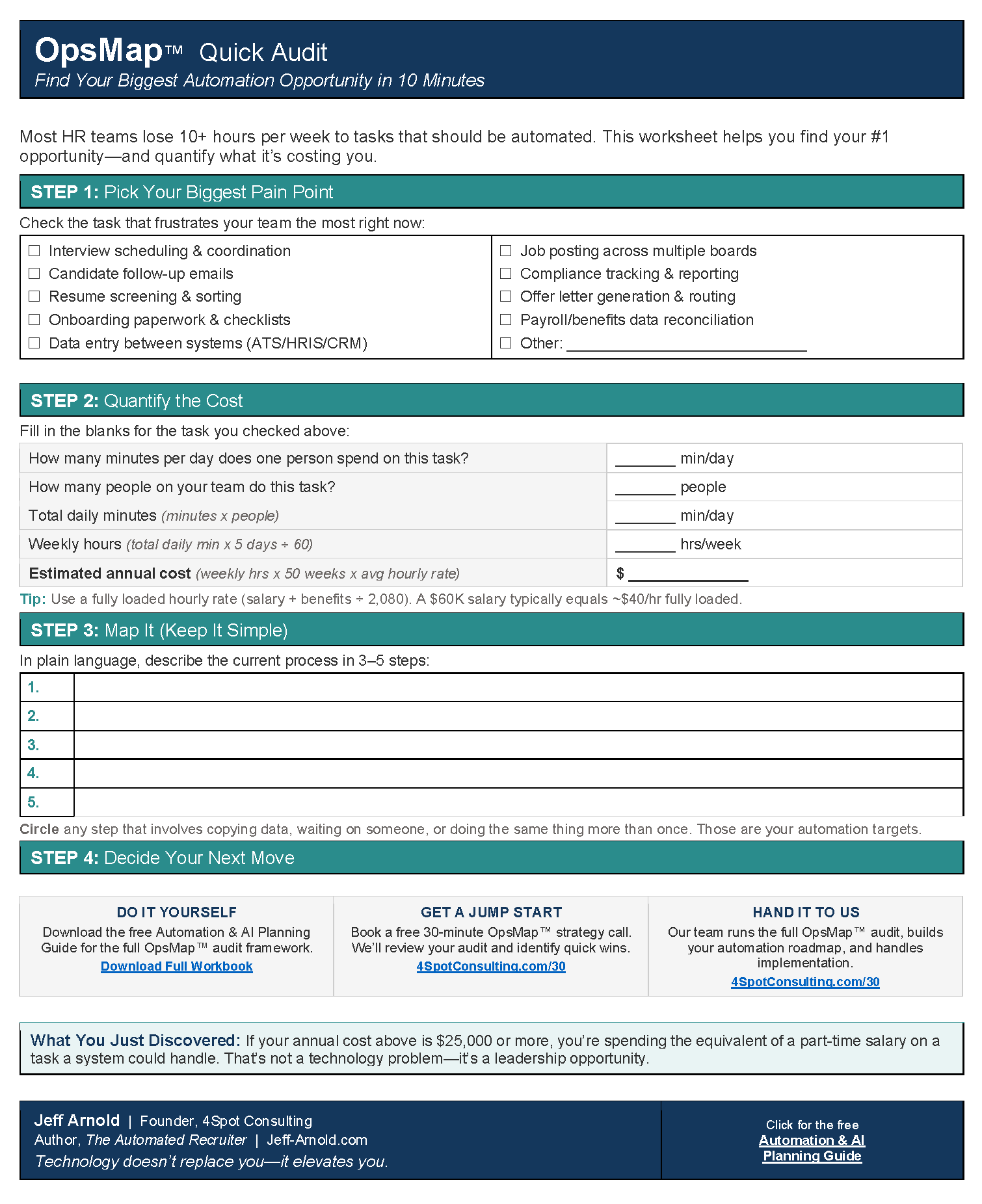
Free OpsMap™️ Quick Audit

One page. Five minutes. Pinpoint where your business is leaking time to broken processes.

Free Recruiting Workbook

Stop drowning in admin. Build a recruiting engine that runs while you sleep.