

Post: 13 Keap CRM Features You Must Use to Automate Growth
Most Keap users run the platform at a fraction of its actual capacity – basic email sequences, a contact list, and not much else. The 13 features covered here are the ones that separate businesses stuck in manual workflows from those running automated, scalable operations. Implement all 13 and Keap becomes a true growth engine.
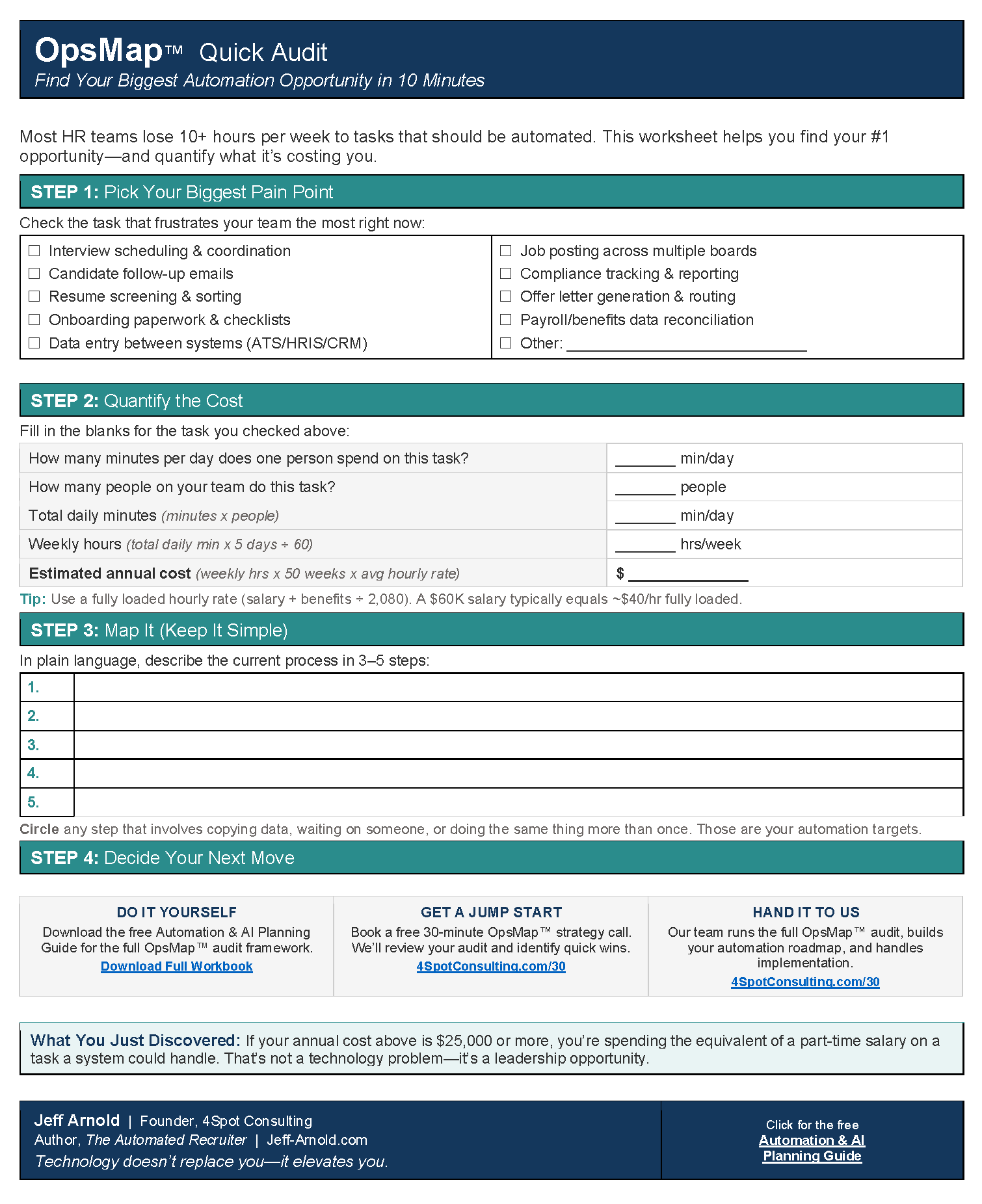
At 4Spot Consulting, our approach – built around frameworks like OpsMesh™, OpsMap™, and OpsBuild™ – is not about adding technology for its own sake. It is about aligning Keap’s full capability with your specific business goals: automating recruitment workflows, optimizing sales pipelines, and eliminating the manual busywork that stalls growth. Here are the 13 features most teams leave on the table.
1. Advanced Campaign Builder Logic and Goal Setting
Keap’s Campaign Builder goes far beyond basic email sequences – it supports conditional pathways that branch in real time based on contact behavior. Did the contact open the email? Click a specific link? Hit a lead score threshold? Each of those triggers a different path, creating a personalized journey that runs without manual oversight.
Decision diamonds and advanced goals let you move contacts between campaigns, apply tags, update fields, and fire API goals that connect to external systems. For recruiting, this means a candidate who views a job post, downloads a benefits guide, and hits an engagement threshold automatically advances from “Interested” to “Interview Scheduled” with zero manual handoffs.
Start by mapping your customer or candidate journey on paper – every branch and decision point. Then build that map inside Campaign Builder using decision diamonds and goal steps. The visual representation makes gaps in your follow-up logic impossible to miss.
Expert Take
The businesses that get the most from Keap’s Campaign Builder think in flowcharts before they think in features. Most automation failures trace back to missing decision logic, not missing tools. Map the journey first, build second.
2. Dynamic Lead Scoring Automation
Keap’s lead scoring becomes a genuine prioritization engine when you move beyond explicit data – job title, company size – and start tracking implicit behavior signals. A contact who visits your pricing page three times, downloads a specific whitepaper, and attends a webinar is telling you something. Keap lets you assign point values to each of those actions automatically.
Scores adjust in real time. When a contact crosses a threshold, Keap fires a task for your sales rep, adds them to a high-priority campaign, or sends an internal alert – all without anyone watching a dashboard. For recruiting, a candidate accumulates points for visiting your careers page, downloading a benefits guide, and interacting with a recruiter. When they hit your defined threshold, the recruiter gets notified immediately.
Define your ideal prospect or candidate behaviors, assign point values (positive and negative for disengagement signals), and wire each threshold to a specific downstream action. A lead score sitting in Keap that triggers nothing is a score that is not working.
3. Granular CRM Tags and Segments
Tags are how Keap knows who to talk to and what to say – but “tag soup” is real, and it kills segmentation accuracy. Businesses getting this right build a taxonomy before they build campaigns: tags that capture interests, product ownership, interaction history, lead source, and stage in the sales or recruiting process.
In HR, that looks like “Candidate: Software Engineer,” “Candidate: Interviewed-Stage 2,” “Client: HR Consulting,” or “Lead: Talent Acquisition Software.” Those specific tags, combined with Keap’s segment builder, let you send hyper-relevant messages to exactly the right people – and prevent clients from receiving candidate-facing content or vice versa.
Establish a naming convention before you create a single tag and enforce it without exceptions. Use campaign automation to apply and remove tags dynamically based on contact actions. Audit quarterly and remove any tag that has not driven a segmentation or campaign action in the past 90 days. See 11 Dynamic Tagging Mistakes to Avoid for Flawless Keap Campaigns for a full breakdown of what goes wrong when this is built without a plan.
4. Custom Sales Pipeline Management
Keap’s default pipeline stages were built for a generic sales process – not yours. Every stage transition in your actual process is an automation opportunity: a lead moving from “Proposal Sent” to “Negotiation” triggers a two-day follow-up task for the rep, updates the contact record, and alerts the manager if the deal stalls for more than a defined period.
For recruiting, the same logic applies from “Application Received” through “Offer Extended” to “Hired.” Each stage transition fires automated communications to the candidate and internal task assignments to the recruiter – no one has to remember, because the system handles it. Every stage that does not trigger at least one automated action is a manual step waiting to be dropped.
Sit down with your sales or recruiting team and map your actual process, not an idealized version of it. Customize pipeline stages to match that reality, then embed automation into each transition. Build the escalation rules too – if a deal or candidate sits in a stage past a set number of days, someone should know.
5. Integrated Order Forms and E-Commerce
Keap’s native order forms keep purchase data inside your CRM automatically, eliminating the sync gap that external platforms create. When a client completes a purchase through a Keap order form, the transaction is immediately logged on their contact record – and the post-purchase automation fires before they close the confirmation tab.
That automation runs the full onboarding sequence: tag applied, welcome email sent, service delivery task created, client added to the appropriate nurture campaign. No third-party connector required, no manual handoff. The entire post-purchase experience runs off a single form submission. A generic “thank you for purchasing” email is a waste of what Keap can do here.
Identify the services you can route through Keap order forms – retainers, audits, event registrations, digital products. Configure each form to capture the data your downstream campaigns need, then build post-purchase sequences that are specific to each product purchased. The more specific the sequence, the better the client experience.
6. Proactive Task Automation and Follow-Up Sequences
Manual follow-up is inconsistent by design – it depends on human memory, which fails under volume. Keap’s task automation removes the memory requirement entirely by creating, routing, and escalating follow-up tasks based on contact behavior and time triggers, not on whether someone remembered to add a to-do.
When a prospect downloads a lead magnet, a call task is assigned to the rep with a 24-hour deadline. If the task is not marked complete, Keap creates a follow-up task and notifies the manager. Nothing falls through because the system is watching. In recruiting, this same architecture handles interview scheduling reminders, reference check tasks, and candidate feedback requests on a consistent timeline regardless of recruiter workload.
Audit every point in your sales, recruiting, and service delivery process where a human is currently holding a to-do in their head. Replace each one with an automated task inside Keap, with a deadline and an owner. If it requires someone to remember it, it is a candidate for automation.
7. Advanced Web Forms and Landing Pages
Basic Keap forms collect a name and an email address. Advanced forms collect the data that determines which campaign the contact enters, which rep gets assigned, and what message they receive first. The difference is what you ask and how you structure the conditional logic behind each answer.
A job application form that includes desired start date, work authorization, and specific skill sets routes candidates to the right recruiter automatically. A service inquiry form that captures budget range and timeline puts qualified prospects in a fast-track campaign before anyone picks up the phone. Keap’s conditional field logic shows or hides form fields based on previous answers, keeping the form short while collecting complete qualification data.
Redesign your forms to collect qualification data, not just contact data. Every field should map to either a segmentation tag, a campaign trigger, or a routing decision. If a field does not drive an action downstream, remove it.
Expert Take
Most form audits find at least three fields that have no downstream effect – they collect data nobody looks at and nobody acts on. Every field on a Keap form is an implicit promise that something happens with that answer. If it does not, the form is doing less work than it looks like it is.
8. Strategic Internal Notifications and Alerts
Keap’s internal notification system keeps your team informed at the exact moment they need to act – not when they happen to check a dashboard. A high-value prospect crosses a lead score threshold at 2 p.m.; the rep gets a text and has context to call before 3 p.m. That is the difference between Keap as a record system and Keap as a live operations layer.
Configure alerts for the moments that actually matter: a contract approaching renewal, a candidate advancing to the final interview stage, a deal stuck in the same pipeline stage past a defined number of days, a specific product purchased. Route each alert to the right person via email or SMS – not a general inbox nobody monitors in real time.
Map your customer and candidate journey and identify every point where someone on your team should be acting within a defined window. Turn each of those points into an automated internal alert. If your team is discovering important events by logging into Keap and looking around, the notification system is not configured.
9. API Integrations via Make.com
Make.com is what turns Keap from a powerful CRM into the operational hub of your entire tech stack. Native Keap integrations cover common tools, but Make.com connects Keap to virtually any platform – an ATS, a project management system, an accounting tool – without custom development.
This is the architecture at the center of OpsMesh™: Keap as the CRM layer, Make.com as the integration fabric, with PandaDoc, Unipile, and other tools connected through automated scenarios that eliminate manual data entry and keep every system in sync. When a deal closes in Keap, the project management record updates, the contract generates in PandaDoc, and the accounting entry is created – in one automated flow with no one copying data between screens. See 10 Essential Make.com Integrations to Unlock Cheaper, More Powerful Business Automation for the integrations that produce the most immediate operational impact.
Audit your current tech stack for data silos: places where someone manually copies information from one system into another. Every one of those is a Make.com scenario waiting to be built. Start with the highest-frequency manual transfers and eliminate them first.
10. Custom Fields and Custom Objects
Keap’s standard contact fields cover the basics. Your business has data points that do not fit any of those fields – and forcing unique data into generic fields creates confusion that compounds over time. Custom fields solve this directly: “Contract Renewal Date,” “Recruitment Niche,” “Last Service Provided,” “Employee Start Date” – each one a field that drives campaign logic, segmentation, or reporting.
Custom objects, available in higher-tier Keap plans, take this further by creating entirely new record types – Projects, Jobs, Training Courses – that link directly to contacts and companies. This is what makes Keap a genuine single source of truth rather than a contact list with extra steps. When your custom structure is built correctly, every piece of data that matters to your business lives in one place and drives automation.
Start by auditing every spreadsheet your team maintains outside of Keap. Every column in those spreadsheets is a candidate for a custom field or object. Build the structure first, migrate the data second, then wire the fields into your campaign logic and reports.
11. Advanced Reporting and Analytics
Default Keap reports tell you what happened. Custom reports tell you what is working. The difference between teams that optimize and teams that guess is how they use reporting – and most teams stop at open rates when Keap is capable of tracking the full path from first touch to closed deal or placed candidate.
Build reports that answer the questions driving real decisions: which lead sources convert at the highest rate, where in the pipeline deals stall, at which stage candidates drop out, which campaign sequences produce the most meetings. Keap’s filtering, sorting, and grouping tools – combined with the custom fields built in the previous step – let you report on any data point relevant to your business. Segmenting by lead source alone changes how most teams allocate their outbound effort.
Define your critical KPIs for sales, recruiting, and operations before you build a single report. Every report should answer a specific business question. If you cannot state what decision the report informs, it is a report that will not get used.
12. SMS Marketing Automation
SMS gets opened – that is the baseline fact driving its value inside Keap. Time-sensitive messages delivered via SMS reach contacts when a crowded inbox does not. Appointment reminders, interview confirmations, urgent status updates, and time-critical follow-ups all work in SMS in a way they simply do not in email.
Keap’s SMS automation fires based on campaign triggers, lead scores, or date-based rules. A candidate confirms an interview; they receive an automated SMS reminder 24 hours before and again 2 hours before. A prospect’s lead score crosses a threshold; they receive a brief, direct message the same afternoon. The logic is identical to any other Keap automation – the delivery channel is faster and harder to ignore.
Get explicit consent before adding any contact to an SMS sequence – Keap’s opt-in tools handle this inside the form or campaign. Use SMS for short, actionable messages where timing changes the outcome. Do not move bulk marketing content to SMS; that burns the channel fast. Identify the specific, high-value touchpoints where immediacy matters and automate those first.
13. Data Backup and CRM Continuity
Keap is a cloud platform, not a backup strategy. Accidental deletions, a rogue integration that corrupts records, or an internal error can remove data you need – and Keap’s native restore tools have limits. An independent, automated backup of your Keap data is not optional for any business where the CRM is the system of record.
The right approach is to automate the backup rather than rely on periodic manual exports. Make.com scenarios pull and store your Keap data – contacts, custom fields, notes, tags, transaction records – to a secure cloud location on a daily or weekly schedule. This gives you a restore path that does not depend on Keap’s own infrastructure and puts you in control of your own continuity. See 12 Essential Strategies for Unwavering Keap CRM Business Continuity for a full implementation guide.
Do not wait for a data loss event to implement this. Set up an automated export of your critical Keap data to a cloud storage destination this week. The setup time is minimal relative to the recovery time required if you do not have it.
Expert Take
The businesses that learn the hard way about Keap data backup assumed “cloud” meant “safe.” Cloud means hosted, not backed up. Your CRM holds your most valuable business asset – relationships, history, transactions. Treat its backup with the same discipline you apply to anything else you cannot afford to lose.
Keap’s full capability is not a feature list – it is an operating architecture. The 13 features above work together: lead scoring triggers campaign logic, campaign logic applies tags, tags drive segmentation, segmentation feeds reporting, reporting informs your next campaign build. Implement them as a connected system, not a checklist, and the platform delivers on its actual potential.
Ready to identify exactly which of these 13 you are underutilizing and build a prioritized implementation plan? Book your OpsMap™ call with 4Spot Consulting and get a roadmap built on your specific business, not a generic playbook.
If you would like to read more, we recommend this article: Keap CRM Data Protection: 10 Essential Strategies for HR Recruiting


RELATED POST


