

Post: Top 10 Interview Scheduling Tools for Automated Recruiting
Interview scheduling is the highest-volume, lowest-judgment task in most recruiting operations — and most teams still run it on email threads and shared calendars. The tools that eliminate this overhead work only when availability rules are documented first. This guide explains the correct build sequence, the highest-ROI automations to deploy, and how to make the business case.
This pillar does not list ten scheduling tools and tell you which one to buy. It explains why most scheduling automation deployments underperform, what the correct sequencing looks like, and how to build a workflow that compounds efficiency gains instead of automating the chaos you already have. If you want to understand why clean processes must come before any HR automation before you invest in replacing manual scheduling, this is the right starting point.
What Is Interview Scheduling for Automated Recruiting, Really — and What Isn’t It?
Interview scheduling automation is the discipline of building structured, reliable workflows for the repetitive, low-judgment coordination work that consumes a disproportionate share of every recruiter’s day. It is not AI. It is not a platform purchase. It is the operational practice of replacing manual calendar coordination with rules-based systems that execute consistently, log every action, and integrate cleanly with your ATS and communication tools.
The confusion between automation and AI is the first place most organizations go wrong. Automation handles deterministic work: send a self-scheduling link when a candidate reaches stage three, confirm the slot in the ATS, trigger a reminder 24 hours before, fire a no-show recovery sequence if the candidate doesn’t appear. These are rules. They execute the same way every time. No judgment required.
What interview scheduling automation is not: a replacement for recruiter relationships, a fix for broken candidate pipelines, or a solution to the underlying problem of unqualified applicant volume. Automation operates on the process layer, not the sourcing or assessment layer. Teams that expect their scheduling tool to improve quality of hire are misreading what the tool does.
It is also not AI-powered scheduling in the marketing sense. Most platforms that carry that label have automated calendar logic with one or two machine-learning features — usually a smart-slot suggestion engine or a natural-language parser on the booking link. Those features are useful, but they are not AI in the transformative sense. Recognizing the distinction protects you from buying capabilities you don’t need while the foundational workflow remains unbuilt.
The operational definition that drives every decision in this pillar: interview scheduling automation is the process of converting every recurring, judgment-free scheduling task into a workflow that runs without a human in the loop — and auditing the output so you know when it breaks.
What Are the Core Concepts You Need to Know About Interview Scheduling Automation?
Six terms appear in every scheduling automation conversation. Each is defined here on operational grounds — what it actually does in the pipeline — not on marketing grounds.
Self-scheduling link. A candidate-facing booking interface that displays pre-approved interviewer availability and lets the candidate claim a slot without recruiter involvement. The slot is confirmed in real time, the ATS record is updated, and confirmation communications fire automatically. This is the single highest-ROI automation in most recruiting stacks.
Interviewer availability pool. A structured definition of which interviewers are available for which role types, at what cadence, and with what buffer requirements between sessions. Without a documented availability pool, self-scheduling links serve unmanaged calendar access — which creates interviewer fatigue and double-booking.
Confirmation-to-ATS sync. The automated write-back of a confirmed interview slot into the candidate’s ATS record. This eliminates the manual transcription step where errors enter the system. A single miskeyed field in a manual update can cascade into an offer letter discrepancy, a payroll correction, or a compliance problem — all of which cost far more to fix than to prevent. Sync quality depends entirely on API reliability between your scheduling tool and your ATS.
No-show recovery sequence. An automated series of communications triggered when a candidate fails to appear for a scheduled interview. The sequence fires a same-day rescheduling offer, a 48-hour follow-up, and a stage-disposition update in the ATS if no response is received. See the full playbook for automated strategies to combat candidate ghosting and optimize recruiting efficiency.
Audit trail. A log of every automated action the system takes — what changed, when, the before-state, and the after-state. Production-grade scheduling automation is not complete without an audit trail. It is the mechanism that lets you diagnose failures, satisfy compliance requirements, and demonstrate to your CHRO that the system is behaving as designed.
Automation spine. The complete set of structured workflows that execute scheduling end-to-end without human intervention: self-scheduling, confirmation, reminder, no-show recovery, ATS sync, and data logging. The automation spine is what AI features are layered on top of — not a replacement for. Learn the critical ATS automation features that build this spine correctly.
Why Is Interview Scheduling Automation Failing in Most Organizations?
The failure mode is consistent: organizations deploy a scheduling tool — one with prominent AI features — before building the availability rules, interviewer pool definitions, and confirmation workflow logic that the tool needs to operate on. The tool runs on chaos. It produces inconsistent output. The team loses confidence. The tool gets underused or cancelled. The organization concludes that automation doesn’t work for them.
The technology is not the problem. The missing structure is.
UC Irvine researcher Gloria Mark’s work demonstrates that it takes an average of 23 minutes to regain deep concentration after an interruption. Manual scheduling generates a continuous stream of interruptions — availability check emails, confirmation threads, rescheduling requests — that compound across the day. Microsoft’s Work Trend Index data shows that coordination overhead is among the leading causes of reduced productivity for information workers. In recruiting, that overhead is heavily concentrated in scheduling.
The structural gaps that cause scheduling automation to fail fall into three categories. First, undefined availability rules: the organization has never documented which interviewers are available for which role types, what buffer is required between sessions, or how panel composition should be determined. Without these rules written down and wired into the system, the scheduling tool cannot make reliable decisions.
Second, disconnected systems: the scheduling tool, ATS, and calendar platform are not integrated. Confirmed slots require manual ATS updates. Confirmation emails are sent from a different system than the one tracking candidate stage. The automation covers only one step in the chain, so humans fill in the gaps manually — defeating the purpose.
Third, no fallback logic: the automation has no defined behavior when a rule fails, a slot goes unfilled, or an interviewer cancels. Without fallback, the system goes silent and the recruiter discovers the failure when the candidate no-shows or calls to ask why nobody confirmed.
Gartner research on HR technology adoption consistently identifies process definition — not tool selection — as the primary determinant of implementation success. Tools succeed when they execute a defined process. They fail when they are expected to define the process themselves. See the complete breakdown of the most common HR automation mistakes and how to avoid them.
What Is the Contrarian Take on Interview Scheduling Automation the Industry Is Getting Wrong?
The industry is selling AI as the solution to a structure problem. That sequence is backwards, and it is producing a predictable outcome: expensive tools that underperform, teams that distrust automation, and a growing body of cautionary tales that slow adoption for everyone.
Expert Take
Most of what vendors label ‘AI-powered scheduling’ is calendar automation with a machine-learning model bolted onto one feature — usually a smart-suggest or language-parsing layer on the booking link. That’s not a criticism; those features are genuinely useful at the right moment in the pipeline. The problem is the marketing implies that AI is the engine, when automation is. If the automation spine — self-scheduling, confirmation sequences, ATS sync, no-show recovery — isn’t built and tested first, the AI layer has no reliable inputs to work from. Build the engine first. Then wire in the intelligence.
The honest diagnosis: most recruiting organizations do not have a scheduling AI problem. They have a scheduling process problem. Availability rules are undocumented. Interviewer pools are informal. Confirmation workflows are ad hoc. No-show recovery is inconsistent. These are process failures that no AI feature resolves — and deploying AI on top of them produces confident wrong answers instead of chaotic manual ones.
The contrarian sequence that works: define and document every scheduling rule first. Build the automation spine second. Pilot on a single role type, measure performance over four to six weeks, and tighten the rules based on what breaks. Only after the automation spine is stable and producing consistent output does AI earn a place in the stack — at the judgment points where deterministic rules genuinely fail.
Harvard Business Review’s coverage of process automation consistently reinforces a principle that applies directly here: the organizations that achieve compounding efficiency gains from automation are those that discipline themselves to build structure before speed. The temptation to deploy the most capable-sounding tool first is the pattern that produces the most expensive failures.
This is also the argument that these signs your HR team is ready for automation makes operational — readiness is a structural condition, not a capability condition.
Where Does AI Actually Belong in Interview Scheduling for Automated Recruiting?
AI belongs at the judgment points — the specific moments in the scheduling pipeline where a deterministic rule cannot produce a reliable answer because the input is ambiguous or multi-variable. Everywhere else, reliable automation is the right tool.
The three judgment points in interview scheduling where AI earns its place:
Ambiguous availability interpretation. When a candidate replies to a self-scheduling prompt with free text — “I’m free most mornings next week except Tuesday and I prefer not to do calls before 9” — a deterministic rule cannot parse that reliably. A natural-language processing layer can extract structured availability constraints from unstructured text and translate them into calendar parameters. This is AI doing a job automation cannot.
Time-zone resolution in global hiring. Panel interviews that span multiple countries involve time-zone arithmetic that scales in complexity with the number of participants. An AI-assisted scheduling layer that accounts for local business hours, daylight-saving transitions, and participant-specific calendar constraints reduces the coordination burden that otherwise falls on the recruiter. See essential questions for HR leaders before investing in automation to evaluate whether your team is ready for this layer.
Smart slot optimization for high-volume roles. When a role generates 50 to 200 scheduled interviews over a two-week window, AI-assisted slot utilization analysis — predicting no-show probability by time of day, day of week, and candidate profile attributes — can increase show rates meaningfully. For the strategic context behind this decision, see signs you need an AI roadmap for HR built the right way.
The operational rule is simple: if a deterministic rule can handle the task reliably, write the rule. If the input is too variable for a rule to cover reliably, that is the judgment point where AI belongs. Using AI to execute tasks that rules could handle introduces unnecessary complexity and failure modes. Using it at genuine judgment points unlocks capability that automation alone cannot provide.
Expert Take
Every recruiting team I audit has the same instinct: find the best AI scheduling tool, deploy it, and expect results. The problem is the ‘deploy it’ step skips straight over the part where you define what ‘it’ is supposed to do. Availability rules. Interviewer pools. Escalation logic when a slot goes unfilled. Buffer time between back-to-back panels. None of that exists in most teams’ documentation — because it’s always lived in someone’s head. AI has nothing to work with when the rules aren’t written down. Automation that runs on unwritten rules isn’t automation — it’s hope.
What Operational Principles Must Every Interview Scheduling Automation Build Include?
Three principles are non-negotiable in every production-grade scheduling automation build. A system that skips any of them is not a solution — it is a liability dressed as one.
Principle 1: Back up before you change anything. Before wiring a scheduling automation to your ATS or calendar system, export a full snapshot of the current data state. This applies even when the automation is read-only from the calendar’s perspective. Integration bugs can corrupt records in both directions. The backup is your recovery option when something unexpected happens — and something unexpected always happens in the first 30 days of a new integration.
Principle 2: Log what the automation does. Every automated action must write a log entry that captures: what action was taken, what record was affected, the timestamp, the before-state of the record, and the after-state. This is not optional instrumentation — it is the mechanism that lets you diagnose failures before they become candidate experience events or compliance problems. An audit trail also protects you when a hiring manager claims a scheduled interview was never confirmed: the log is the record of truth.
Principle 3: Wire a sent-to/sent-from audit trail between systems. When your scheduling automation sends a confirmation to a candidate, that send event must be logged in both the scheduling platform and the ATS. When the ATS receives the confirmed slot, it must record the source. This bi-directional handshake is what separates a connected system from two systems running in parallel. It is the foundation for the ATS automation features that make scaling possible.
APQC’s process management benchmarks consistently identify audit and logging infrastructure as the differentiator between automation deployments that scale and those that produce unmanageable exceptions. The principle applies directly to scheduling: teams that build logging from day one spend a fraction of the diagnostic time that teams who add it retroactively face.
A fourth principle applies specifically to multi-stage interview automation: define fallback behavior explicitly. What happens when no interviewer in the pool has availability within the booking window? What happens when a candidate’s selected slot is claimed by another candidate in the seconds between selection and confirmation? Fallback logic is not edge-case planning — it is the gap between a system that works 95% of the time and one that works reliably.
How Do You Identify Your First Interview Scheduling Automation Candidate?
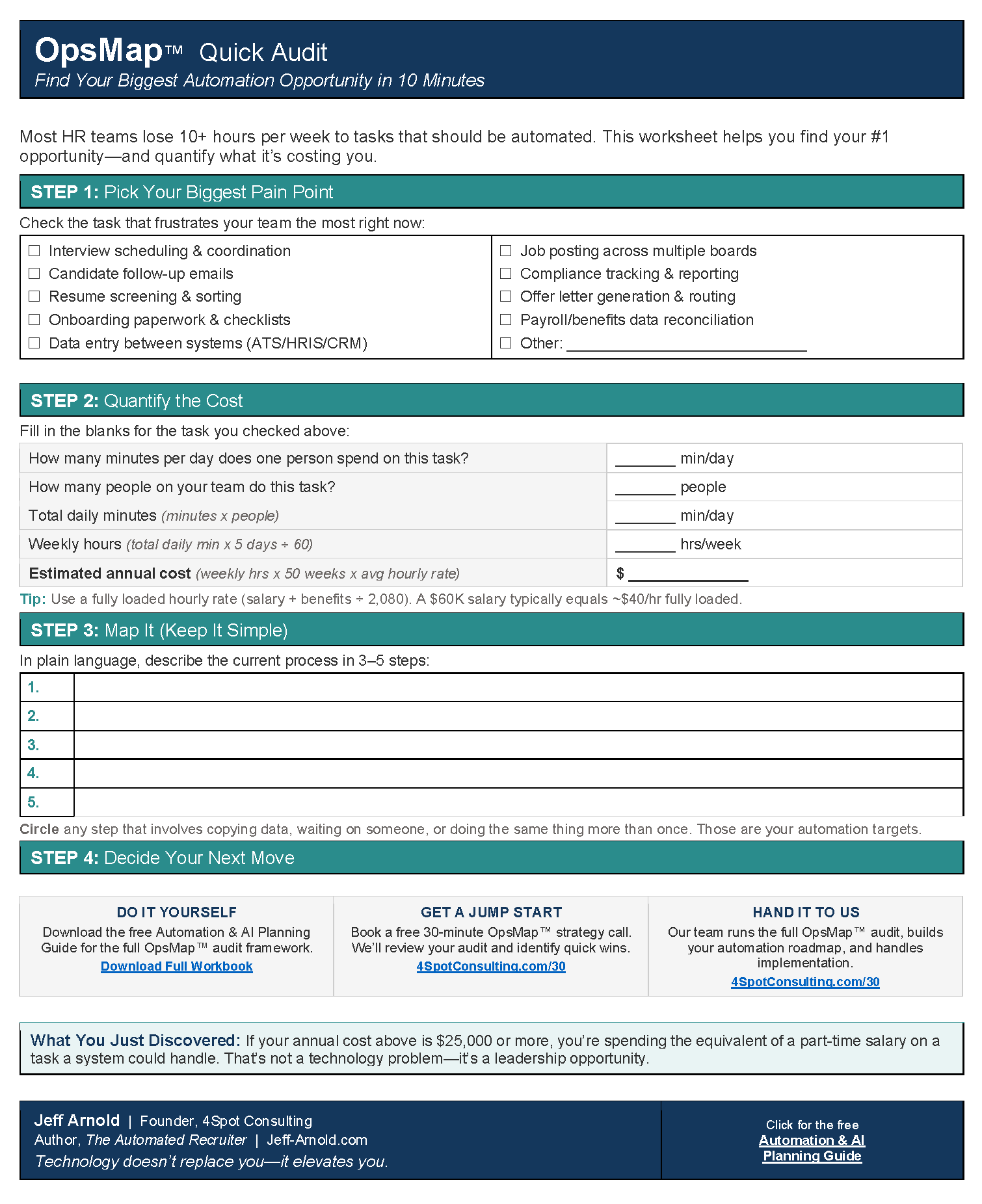
Apply a two-part filter to every scheduling task in your current workflow. Does the task happen at least once per day? Does it require zero human judgment? If yes to both, it is an OpsSprint™ candidate — a quick-win automation that proves value in one to two weeks before you commit to a full OpsBuild™.
In virtually every recruiting operation we audit through the OpsMap™ process, the same task clears both filters first: sending a self-scheduling link when a candidate is moved to the phone screen stage. This task happens multiple times per day at any active organization, it requires no judgment (the trigger is a stage change in the ATS, the action is a templated link send), and the downstream effect — the candidate self-books without recruiter involvement — recovers the largest single block of manual scheduling time in the stack.
The second task that clears both filters in most organizations: the 24-hour interview reminder. Same logic — deterministic trigger, no judgment required, fires automatically, materially reduces no-show rates. Forrester research on communication automation demonstrates that timely, relevant automated messages outperform manually-sent equivalents on both open rate and action rate — the automated reminder is more effective, not just more efficient.
Tasks that fail the filter — and should not be automated first — include: deciding which interviewer is best suited to assess a specific candidate’s background (judgment required), determining whether a candidate’s scheduling delay indicates declining interest (judgment required), and managing interviewer conflicts between a scheduled panel and a last-minute executive request (judgment and relationship required).
The OpsSprint model works because it produces a working automation in the timeline where stakeholder attention is highest. A two-week sprint that delivers a measurable outcome — recruiter hours recovered, confirmed by the HR director — creates the organizational momentum that a multi-month proposal cannot. See the framework at the essential metrics for measuring automation ROI in talent acquisition.
What Are the Highest-ROI Interview Scheduling Automation Tactics to Prioritize First?
Rank automation opportunities by hours recovered per week and error events avoided per quarter — not by feature sophistication or vendor capability score. The tactics that move the business case are the ones a CFO signs off on without a follow-up meeting.
Tactic 1: Self-scheduling link deployment at phone screen stage. This single workflow — triggered by an ATS stage change, delivering a candidate-facing booking link tied to a documented interviewer availability pool — eliminates the largest block of manual scheduling coordination in most stacks. Quantify your own version by tracking baseline hours per recruiter before and after deployment. Use the essential metrics for AI talent acquisition ROI to structure that measurement.
Tactic 2: Automated 24-hour and 1-hour reminders. No-show rates drop measurably with structured reminder sequences. For high-volume roles, this directly reduces the cost of wasted interviewer time — which is the cost CFOs respond to most clearly. Every no-show at a panel interview wastes three to five people’s blocked time simultaneously.
Tactic 3: Confirmation-to-ATS sync. Eliminate the manual step of updating the ATS after a slot is confirmed. This is both an efficiency gain and an error-prevention measure. Transcription errors between scheduling and ATS systems cascade into downstream payroll and compliance corrections that dwarf the original mistake. The integration layer that prevents this also creates the audit trail Principle 3 requires.
Tactic 4: No-show recovery sequence. An automated same-day rescheduling offer, followed by a 48-hour follow-up, followed by an ATS stage update if no response is received. This recovers candidates who no-showed due to a genuine conflict, creates a documented disposition trail for those who don’t respond, and removes the task from the recruiter’s follow-up queue entirely. Full detail at automated strategies to combat candidate ghosting and no-shows.
Tactic 5: Panel interview coordination automation. Multi-interviewer scheduling is the highest-complexity manual task in the scheduling stack. Automating the interviewer availability poll, slot selection, and individual confirmation dispatch reduces coordination time by the most meaningful margin of any single workflow. This is also the task where AI-assisted scheduling earns the most legitimate value — when panel size and availability constraints exceed what deterministic rules can resolve cleanly. See the detailed ATS requirements at critical ATS automation features for next-generation talent acquisition.
How Do You Make the Business Case for Interview Scheduling Automation?
Structure the business case in three layers, delivered in the order that matches your audience: hours recovered for the HR audience, dollar impact and errors avoided for the CFO audience, and both together for the CHRO or VP of Talent who needs to carry the approval upward.
Layer 1 — Hours recovered. Establish the current baseline: how many hours per week does each recruiter spend on scheduling-related tasks? Include availability polling, calendar cross-referencing, confirmation emails, reminder follow-ups, rescheduling coordination, and no-show management. Multiply by the number of recruiters. Multiply by the weeks in a year. You will produce a number large enough to make the room uncomfortable — which is the correct starting point for a business case.
Layer 2 — Dollar impact. Convert hours to dollars using fully-loaded recruiter cost. Add the error-avoidance component: every ATS-to-calendar transcription error that produces a downstream payroll, offer-letter, or compliance correction carries a correction cost that dwarfs the original error. The 1-10-100 rule from Labovitz and Chang captures the compounding cost structure: verify data at entry for the smallest cost, clean it later for ten times that cost, and fix the downstream consequence of corrupt data for one hundred times the original. Apply that ratio to your current scheduling error rate and the number becomes significant.
Layer 3 — Time-to-fill delta. Scheduling lag — the days between a candidate clearing a phone screen and their first panel interview — is one of the most controllable components of time-to-fill. SHRM data on the cost of unfilled positions makes this calculation straightforward: every day the role remains open has a quantifiable business cost. Reducing scheduling lag by four to seven days through automation translates directly to a business-value number. For a complete walkthrough of the CFO conversation, see the essential metrics for automation ROI in talent acquisition.
Expert Take
One HR director we audited was spending 12 hours per week coordinating interview schedules — polling interviewer availability by email, manually cross-referencing calendars, sending confirmation links, and following up on no-shows. That is more than 600 hours per year. At a fully-loaded HR director rate, the compounding cost of that coordination becomes significant fast. After implementing a structured self-scheduling workflow with automated reminders and a no-show recovery sequence, she reclaimed 6 hours per week. The remaining 6 hours shifted from coordination to candidate relationship work — the kind that actually moves hiring decisions.
What Are the Common Objections to Interview Scheduling Automation and How Should You Think About Them?
Three objections surface in every implementation conversation. Each has a defensible answer that doesn’t require over-promising.
Objection 1: “My team won’t adopt it.” Adoption-by-design means there is nothing to adopt. When scheduling automation is built correctly — triggered by an ATS stage change, requiring zero recruiter action to fire — the recruiter does not adopt the tool. The tool executes. The recruiter’s experience is that a task they used to do manually stopped requiring their involvement. That is the only adoption model that works reliably in HR, where change fatigue is a real operational constraint. Deloitte’s Global Human Capital Trends research identifies process design as the primary lever for technology adoption — not training, not incentives.
Objection 2: “We can’t afford it.” The OpsMap™ addresses this at the audit stage, before any spend commitment on implementation. Because the OpsMap™ carries a 5x guarantee — if the audit does not identify at least five times its cost in projected annual savings, the fee adjusts to maintain that ratio — the risk-exposure argument for not starting disappears. The audit produces a CFO-ready business case with timelines and dependencies. If the numbers don’t work, you know before you build anything.
Objection 3: “AI will replace my recruiting team.” Scheduling automation does not replace judgment. It eliminates the coordination tasks that prevent judgment from being applied to the work that requires it. Recruiters who shift out of scheduling coordination move into candidate relationship development and pipeline strategy — work that requires a human. The automation does not reduce headcount. It reallocates human capacity to higher-value activity. See the warning signs of an operation losing capacity to low-value work at warning signs your HR operation is bleeding money.
A fourth objection surfaces specifically in healthcare, finance, and government recruiting: “Our compliance requirements make automation risky.” The answer is that documented, logged, audited automation is substantially more compliant than undocumented manual processes. The audit trail that Principle 2 requires is also the compliance documentation your counsel needs. Manual processes that live in email threads are the compliance liability — not the automation.
How Do You Implement Interview Scheduling Automation Step by Step?
Every scheduling automation implementation that holds up in production follows the same structural sequence. Compress or skip any step and the failure mode is predictable.
Step 1: Back up. Export your current ATS candidate data, your calendar system’s event records, and your active job requisitions. Store the backup in a location that is not the system you are integrating. This is non-negotiable.
Step 2: Audit the current workflow. Document every scheduling task currently performed manually. For each task, record: trigger event, actions taken, systems touched, time required, and frequency per week. This produces your automation target list and your baseline metrics.
Step 3: Document availability rules. Define which interviewers are in which pools, what buffer is required between sessions, how many slots per interviewer per week are authorized, and what the escalation path is when the pool has no availability. This documentation is the foundation the automation operates on.
Step 4: Map source-to-target fields. Identify every data point the scheduling automation will read from and write to in your ATS, calendar, and communication systems. Confirm the field names match. Confirm the data types are compatible. Confirm the API connections support write-back, not just read. This is where most DIY implementations encounter their first week of delays.
Step 5: Build with logging baked in. Wire the audit trail before you test anything. Every test run must produce a log entry. This ensures the logging infrastructure is validated before go-live.
Step 6: Pilot on representative records. Run the automation on five to ten real candidates in a controlled test. Validate that ATS updates are accurate, confirmation emails render correctly, calendar invites include the right participants and video links, and the log captures the full action record.
Step 7: Execute the full run and monitor. Go live for a defined role type or team. Check the audit trail daily for the first two weeks. Measure against your baseline metrics at 30, 60, and 90 days. Use these critical questions for your HR automation platform to evaluate whether your tooling is producing the output the framework requires.
What Does a Successful Interview Scheduling Automation Engagement Look Like in Practice?
A successful engagement follows a defined arc: OpsMap™ audit, OpsSprint™ quick win, OpsBuild™ full implementation, OpsCare™ ongoing optimization. Each phase has clear deliverables and measurable outcomes.
Expert Take
We see this pattern consistently in OpsMap audits: an organization purchased an AI-powered scheduling platform 6 to 18 months ago, usage is low, the team reports that it doesn’t really work for them, and the vendor is on the verge of being cancelled. In every case, the root cause is the same — the team tried to use AI to define the workflow instead of using it to execute a defined workflow. The platform isn’t broken. The structure underneath it was never built. An OpsSprint that runs one to two weeks to document and wire the availability rules is usually all that’s needed to unlock the tool they already paid for.
The OpsMap phase — two to three weeks — produces four deliverables: a current-state workflow map, an automation opportunity inventory ranked by ROI, a dependency map showing which automations require which prerequisites, and a management buy-in document that translates the opportunity inventory into CFO language. The OpsMap 5x guarantee applies to this phase.
The OpsSprint phase — one to two weeks — deploys the single highest-ROI automation identified in the OpsMap. For most recruiting operations, this is the self-scheduling link at phone screen stage. The sprint produces a live automation, a validated log infrastructure, and a 30-day measurement plan.
The OpsBuild™ phase — six to twelve weeks depending on stack complexity — implements the full automation spine: self-scheduling across all active stages, confirmation-to-ATS sync, multi-stage reminder sequences, no-show recovery, panel coordination automation, and analytics instrumentation. One mid-size recruiting firm we worked with followed this exact sequence and identified nine automation opportunities through the OpsMap. The resulting OpsBuild delivered measurable annual savings within 12 months — with scheduling automation as the first and highest-impact implementation.
The OpsCare™ phase — ongoing — handles exception management, rule updates as hiring patterns change, and the integration maintenance that keeps the automation spine connected as vendor APIs evolve. Automation that is not maintained degrades. OpsCare is the operational layer that protects the investment made in OpsBuild.
For the specific mechanics of high-volume implementations, see the stats that explain why clean processes must precede automation at scale. For smaller HR teams weighing the make-vs-buy decision, see warning signs your inherited HR operation is bleeding money before committing to a build.
What Are the Next Steps to Move From Reading to Building Interview Scheduling Automation?
The gap between understanding the argument and running the first automation is a sequence of concrete steps, not a technology decision. The technology decision is the last step — after the rules are documented, the baseline metrics are measured, and the highest-ROI opportunity is identified.
Start here: measure your current scheduling time. Count the hours per recruiter per week that go to availability polling, calendar coordination, confirmation emails, reminder follow-ups, rescheduling, and no-show management. Total them across the team. That number is your baseline, your business case starting point, and your ROI denominator. Without it, every subsequent decision is untethered.
Second: document your availability rules. Before you evaluate a single scheduling tool, write down which interviewers are authorized for which role types, what scheduling windows are available, how much buffer is required between sessions, and what happens when the pool has no availability. This documentation is the substrate the automation runs on. A scheduling tool deployed without this documentation is a self-scheduling link pointed at an undefined calendar.
Third: book an OpsMap™. The audit takes two to three weeks and produces a ranked automation opportunity inventory, a dependency map, and a management buy-in document. It identifies where scheduling automation delivers the most measurable impact in your specific operation — not the generic playbook, but your actual workflow mapped against your actual systems. The 5x guarantee means the ROI of the audit is protected before you commit to building anything.
The offer ladder from here: OpsMap identifies and prioritizes. OpsSprint™ delivers the first quick win. OpsBuild™ implements the full spine. OpsCare™ maintains and evolves it. Each phase has a defined entry point, a defined deliverable, and a defined measurement framework.
For teams that want to understand the integration layer before committing to a build, start with essential questions for HR leaders before investing in automation and real examples of why clean processes must come before automation. For teams budgeting for the first time, these critical questions for choosing an HR automation platform walk through the cost and capability structure. For smaller HR teams, these signs your HR team is ready for automation applies the readiness framework to your specific constraints.
The sequence is the strategy: structure first, automation second, AI third. Teams that respect that order see compounding efficiency gains. Teams that reverse it automate the chaos and wonder why the tool doesn’t work. The OpsMap is designed to put you on the right side of that line before you build a single workflow.


RELATED POST

