

Post: 9 Essential Make.com™ Modules for HR Automation in 2026
9 Essential Make.com™ Modules for HR Automation in 2026
HR teams don’t have a strategy problem. They have a repetition problem. Applications arrive, someone copies them into a spreadsheet. A new hire signs an offer, someone manually creates their HRIS profile. A time-off request lands in an inbox, someone forwards it to a manager and follows up three days later. Every one of those handoffs is a candidate-experience failure and a recruiter-hour lost.
The fix isn’t a new HRIS platform or a six-figure AI implementation. It’s a structured automation spine built from the right modules in the right order. This listicle ranks the 9 Make.com™ modules that deliver the highest operational impact for HR teams — based on where manual effort is heaviest and where errors carry the most downstream cost. For the full strategic framework behind these modules, start with the strategic HR automation blueprint that governs how 4Spot Consulting sequences every client build.
McKinsey research estimates that knowledge workers spend 28% of their workweek managing email alone — a figure that balloons when manual data-moving tasks are added. Asana’s Anatomy of Work Index found that employees spend 60% of their time on “work about work” rather than skilled tasks. These modules exist to close that gap.
How These Modules Are Ranked
Each module is scored on three criteria: (1) frequency of use across HR automation stacks, (2) time recovered per week when deployed correctly, and (3) error-reduction impact on downstream workflows. Modules that appear in every production HR scenario rank highest. Modules that are powerful but narrower in application rank lower — not because they matter less, but because they serve fewer teams out of the gate.
1. Webhooks — Instant Trigger, Zero Polling Delay
The Webhook module is the front door of every real-time HR workflow. It fires the instant an upstream event occurs — no scheduled syncs, no manual checks.
- What it does: Listens for an HTTP POST from any external system (ATS, career page, form tool, document platform) and immediately passes the payload into your Make.com™ scenario.
- HR use cases: New application submitted → trigger ATS record + candidate confirmation email simultaneously. Offer letter e-signed → trigger HRIS profile creation + IT provisioning request + onboarding document send.
- Why it ranks #1: Every other module on this list needs something to trigger it. Webhooks are that trigger for any system that doesn’t have a native Make.com™ connector with a “watch” module.
- Time recovered: Eliminating the manual “check for new applications” loop typically recovers 45–90 minutes per recruiter per day in high-volume hiring periods.
- Risk if skipped: Timed polling introduces delays of 5–15 minutes per event. In candidate experience terms, that’s the difference between an instant acknowledgment and a form submission that feels broken.
Verdict: Non-negotiable. If your HR automation stack has only one module, it’s this one — wired to your highest-volume inbound event.
2. Router — Parallel Paths From a Single Trigger
The Router module splits one data stream into multiple simultaneous execution paths. It is the difference between a linear scenario and a production-grade HR workflow.
- What it does: Takes a single incoming bundle (e.g., a new application webhook payload) and routes it down 2–5 parallel branches, each with its own filters and downstream modules.
- HR use cases: New application → Branch 1: send candidate confirmation. Branch 2: create ATS record. Branch 3: alert hiring manager in Slack. Branch 4: write to compliance log spreadsheet.
- Why it ranks #2: Without a Router, teams build four separate scenarios for four parallel actions — quadrupling maintenance overhead. One Router consolidates all four into a single scenario with one update point.
- Common mistake: New users confuse Routers with Filters. A Filter blocks or passes one path. A Router creates multiple paths. Use both together: Router to split, Filter on each branch to qualify.
- Time recovered: Scenario consolidation saves 2–4 hours per month of scenario maintenance and eliminates the sync errors that come from four separate triggers watching the same event.
Verdict: Deploy on your second scenario build. Any trigger that produces more than one downstream action needs a Router.
3. Email (Gmail / Outlook / SMTP) — Automated Candidate and Employee Communication
The Email module handles every templated, time-sensitive HR communication without a recruiter touching a keyboard.
- What it does: Sends, reads, labels, and responds to emails via Gmail, Outlook, or any SMTP server. Can parse incoming emails to extract structured data (candidate name, position applied, availability).
- HR use cases: Application confirmation, interview scheduling confirmation, rejection notices, onboarding welcome sequences, benefits enrollment reminders, I-9 deadline alerts.
- Why it ranks #3: Candidate experience is the most visible HR metric to applicants. Parseur’s Manual Data Entry Report found that employees spend significant time on repetitive communication tasks — email modules eliminate that category entirely for templated messages.
- Personalization depth: Map candidate name, role, hiring manager name, and interview link from upstream modules into every email template. No mail-merge required.
- Integration note: Pair with the Google Calendar module (see #5) to send interview confirmations that include a calendar invite in the same automated sequence.
Verdict: Every HR scenario that touches a candidate or employee should have an email module in its output path. Automate candidate communication workflows before anything else visible externally.
4. Google Sheets / Microsoft Excel — Live Data Management Without Manual Entry
Spreadsheets remain the most common HR data layer in mid-market companies. These modules transform static trackers into live, auto-updating operational dashboards.
- What it does: Reads, writes, updates, searches, and deletes rows in Google Sheets or Excel. Supports bulk operations via the Iterator module (see #8).
- HR use cases: Auto-append new applications to a recruiting pipeline tracker. Update candidate status from “Applied” to “Interview Scheduled” when a calendar invite is sent. Build a daily hiring dashboard that refreshes from ATS data every morning at 7 AM. Log every onboarding task completion with a timestamp.
- Why it ranks #4: For teams not yet on a full HRIS or ATS, Google Sheets IS the database. Automating writes to it eliminates the largest single category of manual HR data entry.
- Error risk addressed: Manual transcription into spreadsheets is where David’s $27K payroll error originated — a $103K offer letter became $130K in HRIS due to a copy-paste mistake. The Sheets module writes directly from the source record. See how to reduce costly HR errors with automation.
- Reporting output: Schedule a daily scenario to compile ATS metrics into a Sheets dashboard that HR leadership views each morning — zero manual report generation required.
Verdict: Essential for any HR team using spreadsheets as their primary data layer. Deploy alongside the Webhook module on day one.
5. Google Calendar / Microsoft Outlook Calendar — Scheduling Without the Back-and-Forth
Interview scheduling is among the most time-intensive recruiter tasks. Calendar modules eliminate the coordination loop entirely for structured interview formats.
- What it does: Creates, updates, cancels, and reads calendar events. Can check availability, send invites to multiple attendees, and attach video conference links.
- HR use cases: Auto-create interview slots when a candidate reaches “Phone Screen” status in ATS. Send calendar invites to candidate, recruiter, and hiring manager simultaneously. Cancel and reschedule events when a candidate responds with an alternative time via a form.
- Why it ranks #5: Sarah, an HR Director at a regional healthcare organization, cut hiring time 60% and reclaimed 6 hours per week — scheduling automation was the single largest contributor to that recovery.
- Pair with: Email module (#3) to send the calendar invite and a confirmation email in the same scenario branch. The candidate receives both in one automated sequence, not two separate manual sends.
- Limitation: Calendar modules handle structured scheduling formats well. Open-ended availability negotiation still requires human judgment — use a scheduling link tool (Calendly, etc.) and webhook its confirmation event instead.
Verdict: High-frequency, high-visibility impact. Pair with email and webhook modules to build a fully automated interview scheduling sequence. See the full approach to automate candidate screening end to end.
6. HTTP / REST Module — Connect Any System Without a Native Connector
The HTTP module is Make.com™’s universal adapter. If a system has an API, the HTTP module can talk to it — regardless of whether a native connector exists.
- What it does: Makes GET, POST, PUT, PATCH, and DELETE requests to any API endpoint. Handles authentication headers, JSON payloads, and response parsing.
- HR use cases: Pull candidate data from a proprietary ATS that lacks a Make.com™ native module. Push new hire data to a legacy HRIS via REST API. Trigger a background check vendor’s API when a candidate reaches a specific pipeline stage. Query a government compliance API for real-time eligibility verification.
- Why it ranks #6: Mid-market HR stacks routinely include at least one system without a native connector. The HTTP module prevents that gap from stopping automation progress. Gartner research confirms that integration complexity is the primary barrier to HR technology ROI — this module removes it.
- Skill requirement: Requires basic API familiarity (reading documentation, understanding authentication types). Not no-code in the purest sense — but well within reach for an HR ops professional with 2–3 hours of practice.
- Future-proofing value: Vendor changes won’t strand your automation. If a native connector breaks or disappears, the HTTP module is the fallback that keeps production scenarios running.
Verdict: Essential for any HR stack with a proprietary or legacy system. Build it as a skill, not just a workaround.
7. Data Store — Internal State Tracking Across Multi-Step HR Workflows
The Data Store is Make.com™’s built-in lightweight database. It tracks process state across scenario runs — something no other module does natively.
- What it does: Stores key-value pairs or structured records internally within Make.com™. Scenarios can read, write, search, update, and delete records across multiple runs without an external database.
- HR use cases: Track which onboarding checklist items have been completed for each new hire across daily scenario runs. Store the “last processed” record ID to prevent duplicate processing in watch scenarios. Maintain a running count of open requisitions per department for capacity alerts. Record which candidates have already received a specific email to prevent re-sends.
- Why it ranks #7: Multi-step HR processes — onboarding, compliance checklists, rehire eligibility — require memory across scenario executions. Without a Data Store, teams either build fragile workarounds in Google Sheets or accept that their automation has no continuity. See customized onboarding workflows for a deep-dive application.
- Vs. Google Sheets: Data Store is invisible to end users and optimized for machine reads/writes at speed. Sheets is human-readable and better for reporting. Use both — Data Store for operational state, Sheets for management visibility.
- Limitation: Not a replacement for a full HRIS. Storage limits apply at each Make.com™ plan tier. Review plan limits before using Data Store as a primary HR record system.
Verdict: Required for any HR automation that spans more than one scenario run. Deploy it when your first multi-step workflow goes into production.
8. Iterator — Process Every Record in a Bulk HR Operation Individually
The Iterator module breaks an array of records into individual items so every downstream module can act on each one separately.
- What it does: Takes an array (a list of items returned by an upstream module — candidates, employees, tasks) and processes each item through the subsequent modules one at a time.
- HR use cases: Send personalized onboarding emails to a cohort of 30 new hires starting Monday — one email per person, each with their manager’s name and first-day location. Process a batch of 200 applications pulled from an ATS overnight and update each one’s status individually. Generate individual payroll confirmation PDFs for every employee in a pay period. See the full approach to payroll automation accuracy.
- Why it ranks #8: Bulk HR operations are unavoidable — hiring cohorts, open enrollment, annual review cycles. Without an Iterator, these operations require either manual processing or complex custom logic. With one, a single scenario handles the entire batch.
- Pair with: Aggregator module (its logical partner) to collect individual results back into a summary array after processing — useful for generating a batch completion report after all individual records have been updated.
- Rate limit warning: High-volume iterations can hit API rate limits on connected platforms. Add a Sleep module between iterations for batch sizes above 50 records.
Verdict: Deploy it the moment any HR scenario needs to act on more than one record at a time. That moment arrives quickly in any team above 20 employees.
9. Error Handler — The Quality-Control Layer That Keeps Production Scenarios Trustworthy
Error handlers are not an advanced feature. They are a production requirement — the difference between automation you demo and automation you depend on.
- What it does: Intercepts a failed module execution before it halts the entire scenario. Routes the failure to a dedicated notification path — Slack alert, email to HR ops, Google Sheets error log — while allowing the rest of the scenario to continue where possible.
- HR use cases: Failed HRIS write for a new hire → alert HR ops immediately with the record details rather than silently dropping the data. Failed background check API call → log the candidate ID and re-queue for retry. Failed I-9 reminder email → write the failure to a compliance exceptions sheet for manual follow-up.
- Why it ranks #9: Scenarios without error handlers fail silently. In HR, silent failures create compliance exposure — a missed I-9, an HRIS record that never got created, a payroll input that didn’t post. Deloitte’s human capital research consistently identifies process reliability as the top driver of HR technology adoption. Error handlers deliver that reliability.
- Implementation: Right-click any module in Make.com™ to add an error handler route. Build a standard error notification template — timestamp, scenario name, module that failed, error message, affected record ID — and reuse it across every production scenario.
- Compliance relevance: For teams handling GDPR-regulated data or running EEOC-auditable processes, error logs serve double duty: operational alerting and audit trail. See HR compliance document automation for the full compliance framework.
Verdict: Add error handlers to every scenario before go-live. Non-negotiable for any workflow touching compliance, payroll, or new hire records.
Build Order: How to Sequence These 9 Modules
The modules above are not deployed in the order they’re ranked. Here is the recommended build sequence for a net-new HR automation stack:
- Week 1: Webhook + Email + Google Sheets — new application trigger → candidate confirmation → pipeline log. Proves automation value immediately.
- Week 2: Router — add parallel branches to the Week 1 scenario for hiring manager notification and ATS record creation.
- Week 3: Calendar — extend the scenario to schedule phone screens automatically when a candidate is moved to “Screen” status.
- Week 4: Error Handler — retrofit all three existing scenarios with error notification branches before expanding further.
- Month 2: HTTP Module — connect any system in your stack that lacks a native Make.com™ connector.
- Month 2–3: Data Store + Iterator — deploy for onboarding checklist tracking and bulk new-hire cohort processing.
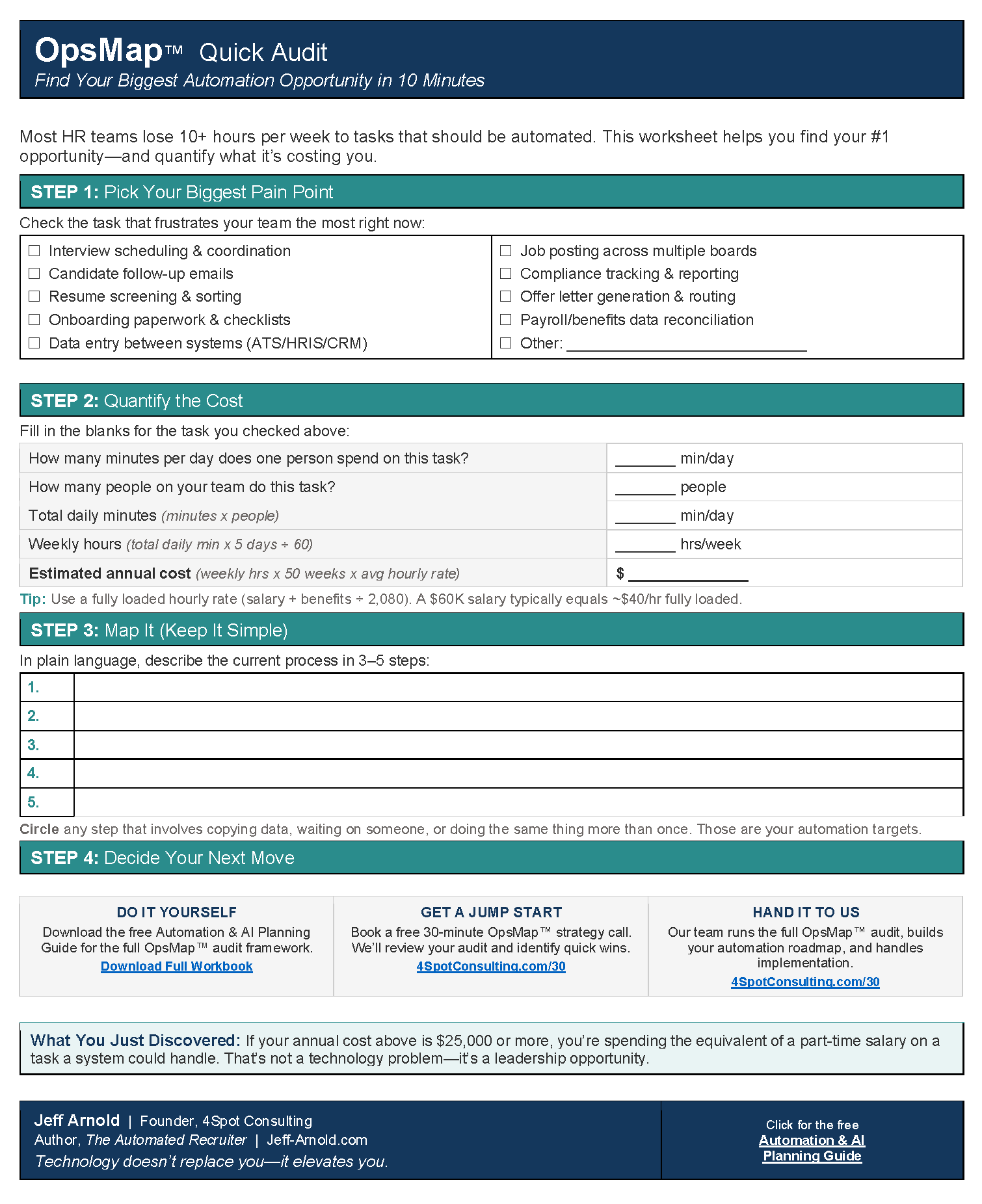
This sequence is consistent with the OpsMap™ audit process 4Spot Consulting uses to prioritize automation opportunities. TalentEdge, a 45-person recruiting firm, identified 9 automation opportunities through OpsMap™ and achieved $312,000 in annual savings with 207% ROI inside 12 months — the module sequence above reflects the build order that produced those results.
Common Mistakes to Avoid
- Building scenarios without error handlers: The most common cause of “automation doesn’t work” complaints. Add error handlers before, not after, a scenario fails in production.
- Using Filters where Routers belong: A Filter on a single path will block data that should flow to other paths. When an event needs multiple simultaneous actions, use a Router first, then apply Filters on each branch.
- Ignoring API rate limits: High-volume Iterator scenarios hit rate limits silently. Test with 5-record batches before running 500-record batches overnight.
- Using Google Sheets as an operational state database: Sheets is for human-readable reporting. Data Store is for machine-speed operational state. Conflating them creates race conditions when multiple scenario runs write to the same sheet simultaneously.
- Skipping the HTTP module because it feels technical: Two hours with any HR system’s API documentation is enough to build a working HTTP call. The ROI of connecting a legacy system far exceeds the learning investment.
What Good Looks Like at 90 Days
A mid-market HR team of 3–5 people that deploys these 9 modules across their highest-volume workflows should expect: candidate acknowledgment emails firing within 30 seconds of application submission; zero manual ATS-to-spreadsheet transcription; interview scheduling confirmations sent without recruiter involvement; onboarding sequences triggered automatically on offer acceptance; and a compliance error log that captures every failed automation event for audit purposes.
That outcome requires no AI. It requires structured automation built in the right sequence. When the automation spine is solid, AI layers (resume parsing, sentiment analysis, policy exception flagging) slot in as discrete modules inside proven workflows — not as replacements for the workflow itself. That sequencing discipline is what separates sustained ROI from expensive pilot failures, as the parent pillar’s framework explains in full.
For teams evaluating platform options before committing to this build, see the analysis on comparing automation platforms for HR. For teams ready to eliminate the bottlenecks blocking strategic HR work, the path to eliminating HR workflow bottlenecks starts with these 9 modules in the sequence above.


RELATED POST

