

Post: From Manual Strain to AI Gain: Nexus Talent Group Saves 150+ Hours Monthly in Talent Acquisition
Nexus Talent Group’s recruiters were spending 150+ hours per month on manual resume parsing and CRM data entry. 4Spot Consulting built an AI-powered intake pipeline on Make.com that extracted, standardized, and pushed candidate data directly into Keap — eliminating manual entry and scaling candidate processing capacity by over 300%.
The Client
Nexus Talent Group is an HR consulting and executive search firm that places skilled professionals with client organizations across multiple industries. Their business model depends on recruiters spending time on relationships and placements — not on copying data from PDFs into a CRM. As application volumes grew with the business, the gap between what the team needed to do and what they were actually doing kept widening.
The Problem
Before the engagement, every incoming resume required human hands at every step. Hundreds of applications arrived daily through email inboxes, web forms, and direct submissions — in formats ranging from structured PDFs to free-form Word documents. The breakdown showed up in four ways:
- Manual parsing consumed recruiter time. Opening each resume, extracting contact details, work history, and skills, then re-entering that data into Keap CRM — this cycle repeated hundreds of times per week across the team.
- Inconsistent CRM records. Without a standard extraction process, candidate profiles varied in completeness and field structure, making search and candidate matching unreliable.
- A hard scalability ceiling. More applications meant either more admin staff or slower processing. The team estimated it was collectively losing 150+ hours per month to low-value data tasks.
- Candidate experience lag. Application backlogs delayed acknowledgments and stalled candidates early in the funnel — a reputational risk for a firm that competes on service quality.
The pattern is predictable in growing recruiting firms: an intake process built for 50 applications a week breaks at 500. Nexus Talent Group needed a system that absorbed volume without human hands on every record.
The Solution
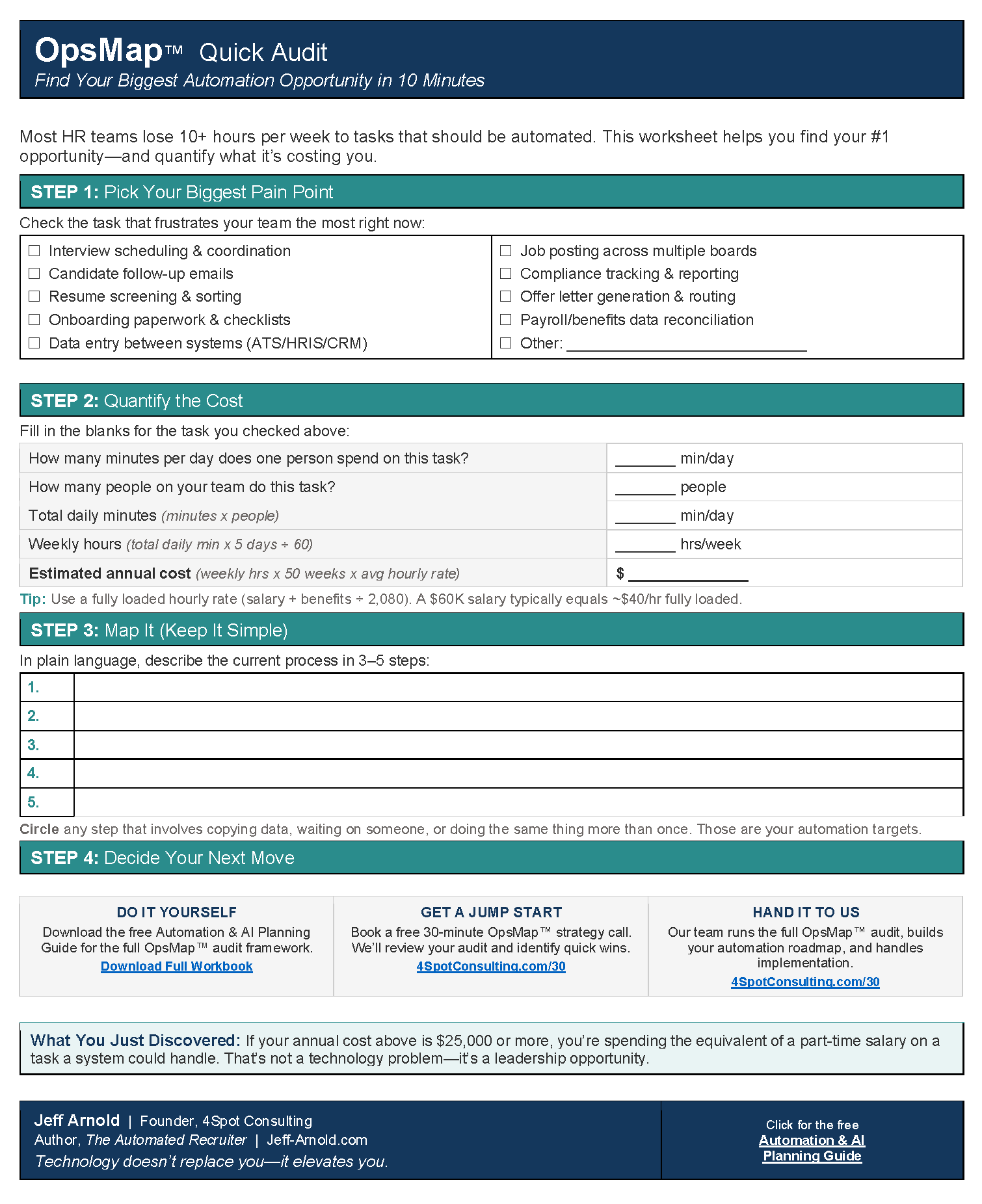
4Spot Consulting ran an OpsMap™ diagnostic to document the existing workflow end to end, identify the highest-friction points, and define the automation architecture before building anything. Make.com served as the orchestration layer, with AI parsing handling document extraction and Keap as the system of record.
Six components drove the build:
- Centralized intake. All incoming resumes — regardless of source — funneled into a single Make.com entry point. Email inboxes and web form submissions merged into one monitored pipeline.
- AI resume parsing. Every document routed automatically to an AI parsing service that extracted candidate name, contact details, work history, skills, and preferred job titles — format-agnostic across PDFs, Word documents, and unstructured submissions.
- Data standardization. Extracted fields ran through normalization rules before touching the CRM — cleaning formatting inconsistencies, categorizing skills, and enforcing field structure so every record matched the same schema.
- Keap CRM push with deduplication. Parsed, standardized data flowed directly into Keap as a complete candidate record. The system checked for existing contacts first and updated rather than duplicated when a match was found.
- Instant candidate acknowledgment. A personalized confirmation email fired the moment a candidate record was created in Keap — automated, but written to feel individual.
- Recruiter notifications. Relevant team members received automated alerts when new candidates entered the system, with direct links to the Keap profile and the original resume attached.
Expert Take
The highest-leverage component in this build wasn’t the AI parser — it was the deduplication logic sitting in front of Keap. Most firms that automate resume intake discover their CRM integrity was worse than they realized. Building clean deduplication into the intake flow means every automation downstream runs on reliable data. That’s the difference between a faster broken process and a process that actually works at scale.
Implementation
The build ran through 4Spot’s OpsBuild™ methodology — structured, phase-gated, with no deployment step until the previous stage was verified:
- Phase 1 — OpsMap™ diagnostic. Workflow documentation, current-state process mapping, technology stack review, and selection of the AI parsing tools best matched to Nexus Talent Group’s volume and format variety.
- Phase 2 — Blueprint design. End-to-end automation architecture, data field mapping, API selection, and review of the full process flow before development began.
- Phase 3 — Build and integration. Make.com scenario construction covering every stage: intake routing, AI API calls, data transformation, Keap record creation, email triggers, and recruiter notifications. Custom logic for edge cases and error handling included.
- Phase 4 — Quality assurance. Testing with a representative set of real-world resume samples across formats and complexity levels. End-to-end flow validation to confirm CRM record accuracy and communication triggers.
- Phase 5 — Training and deployment. Recruiter-level user acceptance testing, team training on monitoring and managing the system, and staged rollout from pilot group to full deployment.
- Phase 6 — OpsCare™ support. Post-launch monitoring, performance review cadence, and ongoing optimization as Nexus Talent Group’s volume and requirements evolved.
Results
The automation delivered measurable impact within the first month of full deployment:
- 150+ hours recovered per month. Recruiters and administrative staff stopped doing manual resume parsing and data entry entirely. That time moved to candidate screening, client consultations, and business development.
- Near-zero data entry errors. Removing human intervention from the extraction and entry process eliminated the inconsistency that had made CRM searches unreliable.
- Hours-to-minutes processing time. Resume receipt to a complete Keap record now takes minutes — not a portion of a recruiter’s day.
- 300%+ increase in processing capacity. The system handles substantially higher application volume without adding administrative headcount.
- Improved candidate experience. Instant acknowledgments reduced early-funnel drop-off and strengthened the firm’s standing with candidates.
- Single source of truth in Keap. Standardized intake means every candidate record follows the same structure — searchable, filterable, and reliable for reporting and decision-making.
“Working with 4Spot Consulting was a game-changer for our firm. We went from drowning in manual resume processing to having a fully automated, seamless system that just works. The 150+ hours saved each month are invaluable — our team now focuses on what actually matters: finding the best talent for our clients.”
— Sarah Jenkins, COO, Nexus Talent Group
What This Means for Your Recruiting Operation
The Nexus Talent Group engagement shows what happens when automation is built around a mapped process, not bolted onto a broken one. The OpsMap™ diagnostic is what made the difference — knowing exactly where friction lived before designing the solution meant the build solved the right problem instead of a faster version of the wrong one.
Three lessons apply directly to any HR or recruiting operation facing similar volume pressure:
- Map before you build. Automating a broken intake process creates a faster broken process. The diagnostic phase isn’t overhead — it’s what separates a system that works from one that fails at scale.
- AI parsing is format-independent. The value of AI document extraction is that structured PDFs and free-form Word documents both produce the same clean Keap record. Format variety stops being a problem.
- OpsCare™ keeps the system calibrated. Recruiting volume and candidate data patterns change. A post-launch review cadence means the automation stays accurate as the business grows.
For a deeper look at what to require from an AI parsing tool before committing to a build, see 10 Must-Have Features for Peak AI Resume Parser Performance. For the metrics that tell you whether the automation is actually working post-launch, see 11 Essential Metrics for Optimizing Your Resume Parsing Automation.


RELATED POST


