Post: How to Transform HR Operations as a Director: From Tactical Automation to Strategic Orchestration
How to Transform HR Operations as a Director: From Tactical Automation to Strategic Orchestration
Most HR Directors have used an automation platform to fire a Slack notification when a candidate is hired or copy a resume attachment into a cloud folder. Those wins are real. They are also the floor, not the ceiling. HR automation requires wiring the full employee lifecycle before AI enters the picture — and the gap between a collection of tactical connectors and a true strategic orchestration layer is where most HR functions are leaving the most capacity on the table.
This guide gives you the exact sequence to close that gap: from lifecycle mapping through data synchronization, workflow prioritization, AI integration, and measurable verification. Follow the steps in order. The sequence is not arbitrary — each phase removes the failure mode that would undermine the next.
Before You Start
Before building anything, confirm you have four prerequisites in place. Missing any one of them will cause the implementation to stall or produce workflows that solve one problem while creating three others.
- System inventory: A written list of every platform that touches the employee lifecycle — ATS, HRIS, payroll, LMS, e-signature, background screening, IT provisioning, and primary communication tools. You cannot map handoffs between systems you have not named.
- Admin credentials: API access or admin-level credentials for each system. Workflow builds fail most often not because of design problems but because the builder lacks the permissions to connect the systems.
- A baseline measurement: Record your current time-to-fill, onboarding task completion rate in the first week, and data error rate across systems. You need a before number to prove the after.
- Stakeholder alignment: IT, payroll, and at least one operations leader must know this project is happening. Automation that crosses department boundaries without prior coordination gets blocked at the IT firewall or unraveled by a payroll admin who does not know why data is arriving from a new source.
- Estimated time investment: Allow four to six weeks for lifecycle mapping and priority sequencing before a single workflow goes live. Organizations that compress this phase into a weekend produce fragile automations that require constant manual intervention.
Step 1 — Map the Full Employee Lifecycle Before You Build Anything
The lifecycle map is the entire project. Everything that follows depends on the accuracy of this document.
Print or whiteboard every stage of the employee journey in your organization: job requisition approval → job posting → application receipt → screening → interview scheduling → offer generation → offer acceptance → background check → HRIS record creation → IT provisioning → LMS enrollment → day-one check-in → 30-day review → ongoing performance cycles → offboarding. For each stage, answer three questions:
- Which system owns this step?
- What data needs to move, and to where, when this step completes?
- Is that data movement currently manual, partially automated, or fully automated?
Every “manual” answer is an automation candidate. Every “partially automated” answer is a failure-mode risk — partial automation often means someone is manually completing the step that the partial workflow missed, invisibly, without documentation.
Asana’s Anatomy of Work research found that knowledge workers spend a significant portion of their week on work about work — status updates, handoff messages, and duplicate data entry — rather than on the skilled work they were hired to perform. In HR, that pattern is amplified because the data moving between systems (compensation figures, start dates, role classifications) carries compliance weight. A missed handoff is not just an inefficiency. It is a risk event.
Deliver this map as a document, not a mental model. Every subsequent step references it.
Step 2 — Rank Your Automation Opportunities by Error Cost and Frequency
Not all manual handoffs are equal. Prioritize the workflows that carry the highest combination of error cost and occurrence frequency.
The clearest illustration of error cost in HR data handoffs: an HR manager at a mid-market manufacturing firm manually transcribed a candidate’s accepted offer from the ATS into the HRIS. A single digit transposition turned a $103,000 offer into a $130,000 payroll record. The employee was paid at the higher rate for months before the discrepancy surfaced. The $27,000 cost was unrecoverable. The employee left shortly after the correction. That specific failure mode — manual ATS-to-HRIS transcription — is one of the highest-cost, highest-frequency error categories in HR operations. It is the first workflow to automate, not the fifth.
Use a simple prioritization matrix. Score each identified manual handoff on two axes:
- Error cost: What does a single mistake in this handoff cost in dollars, compliance exposure, or employee experience damage?
- Frequency: How often does this handoff occur per month?
Multiply the two scores. Build the top five first. This approach ensures your earliest automation wins are also your highest-impact ones — which matters for securing continued organizational support for the broader initiative.
For a structured breakdown of automating new hire data from ATS to HRIS, the six-step framework in that satellite covers the sequencing in detail.
Step 3 — Architect Data Synchronization Before You Add Any Workflow Logic
Data integrity is the foundation. Workflow logic built on top of inconsistent, siloed data produces automated errors at the same rate as manual errors — just faster and at greater scale.
Parseur’s Manual Data Entry Report establishes the fully-loaded cost of a dedicated manual data entry role at $28,500 per year. That figure understates the true cost because it excludes the downstream organizational cost of decisions made on inaccurate data — workforce headcount projections built on misclassified roles, compliance reports generated from desynchronized HRIS records, or compensation benchmarking skewed by data entry errors.
The synchronization architecture has three rules:
- Designate a single system of record for each data type. The HRIS owns compensation. The ATS owns candidate status. Payroll receives from both but does not originate. No data type should have two authoritative sources.
- Every update in the system of record triggers an automatic downstream update. A compensation change in the HRIS propagates to payroll automatically. An ATS status change to “hired” triggers HRIS record creation automatically. No human should be manually mirroring data between systems.
- Build audit logging from day one. Every automated data movement should write a log entry: what changed, when, and which system triggered it. Compliance reporting and error forensics both depend on this log.
McKinsey Global Institute research on workforce automation consistently identifies data harmonization as the prerequisite for the workforce analytics capabilities that HR Directors most want — real-time turnover visibility, time-to-fill trends, and training completion impact analysis. You cannot get to those analytics without the synchronization architecture underneath them.
The hidden costs of manual HR processes satellite quantifies the organizational cost of skipping this step in more detail.
Step 4 — Build the Candidate-to-Employee Workflow as Your First Full Sequence
With the lifecycle map complete and the data synchronization layer in place, build your first end-to-end automated sequence: candidate acceptance through day-one ready status.
This workflow is the highest-leverage first build because it spans the greatest number of systems, eliminates the most manual steps, and produces the most visible outcome — a new employee who arrives on day one with access, equipment, training, and documentation already in place.
The full sequence from offer acceptance to day-one readiness includes:
- Offer letter generation and delivery — triggered automatically when ATS status changes to “offer accepted.” For the workflow architecture behind this step, see the guide on automating offer letter generation.
- HRIS record creation — populated with data from the ATS, no manual transcription.
- Background screening initiation — triggered by HRIS record creation, not by an HR coordinator remembering to log into a separate portal.
- IT provisioning request — email account, system access, and hardware request all triggered by start date confirmation in the HRIS.
- LMS enrollment — new hire added to required training modules triggered by HRIS record, completed before day one.
- Welcome sequence delivery — automated email and task checklist sent to the new hire on a schedule tied to the start date, not to an HR coordinator’s calendar.
- Manager notification and pre-boarding task assignment — hiring manager receives a structured checklist of pre-day-one actions automatically when the HRIS record is confirmed.
This sequence, when built correctly, means that from the moment a candidate clicks “accept,” every downstream system is updated and every stakeholder is notified without a single HR coordinator manually touching the process. Gartner research on HR technology investment consistently identifies onboarding automation as one of the highest-ROI categories precisely because the cost of a poor onboarding experience — in early attrition and productivity loss — is measurable and significant.
For the tactical build of interview scheduling automation earlier in the funnel, that how-to covers the pre-offer stages of the same journey.
Step 5 — Add AI at the Judgment Points, Not at the Foundation
AI belongs in your HR automation architecture. It does not belong at the foundation of it.
Deterministic workflows — if this event occurs, execute this action — handle the vast majority of the employee lifecycle reliably. The ATS-to-HRIS handoff does not require AI. Neither does background check initiation, IT provisioning, or LMS enrollment. These are rule-based sequences. They should execute identically every time, for every employee, regardless of context. AI introduced at this layer does not improve outcomes. It introduces variability where consistency is the requirement.
AI belongs at three specific points in the HR workflow:
- Resume and application screening — where the volume of inputs exceeds human processing capacity and pattern recognition improves selection quality. For a full treatment of this application, see the guide on AI and automation in the recruiting pipeline.
- Attrition signal detection — where behavioral data across performance, engagement, and tenure systems can surface flight risk patterns that no human analyst reviews systematically.
- Workforce demand forecasting — where historical hiring, attrition, and business growth data can inform headcount planning with more accuracy than spreadsheet-based projections.
RAND Corporation research on AI in workforce planning consistently emphasizes that AI model reliability depends on the quality of the upstream data it processes. If your data synchronization layer (Step 3) is incomplete, AI outputs at these judgment points will be unreliable — not because the AI is wrong, but because it is working with inconsistent inputs. This is why the sequence is non-negotiable: data integrity first, workflow automation second, AI augmentation third.
Step 6 — Establish Governance and Continuous Improvement Protocols
An automated HR system without governance degrades. Vendors update APIs. Systems add or deprecate fields. Org structures change. Workflows built for a 200-person company break when headcount reaches 500.
Governance for an HR automation architecture requires three standing practices:
- Monthly workflow health checks: Review error logs for failed automation runs. A workflow that fails silently — where the trigger fires but the action does not complete — reverts the process to manual without anyone knowing. Error logging (established in Step 3) makes these visible. Monthly review keeps them from compounding.
- Quarterly lifecycle map reviews: Revisit the lifecycle map from Step 1 every quarter. New systems get added, processes change, and departments acquire tools that the original map did not include. Each new system is a potential new integration point or a potential new gap.
- Annual ROI audit: Measure the same metrics you baselined before you built — time-to-fill, onboarding task completion rate, data error rate, and HR administrative hours per hire. An annual comparison makes the business case for continued automation investment concrete and defensible in budget conversations.
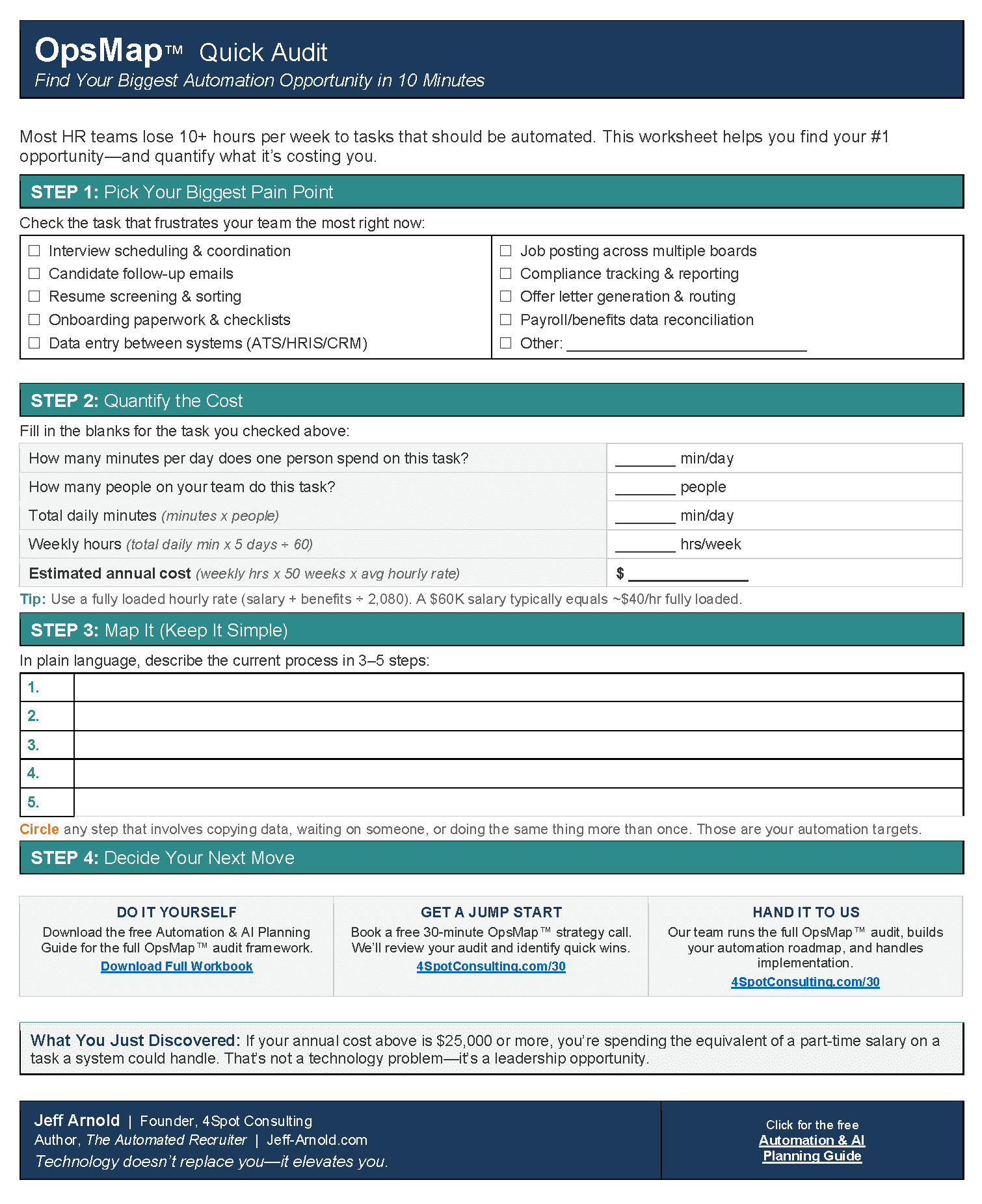
The TalentEdge recruiting firm, a 45-person organization with 12 recruiters, followed this governance model after implementing nine automated workflows through a structured OpsMap™ process. The result was $312,000 in annual savings and a 207% ROI within 12 months. The ROI was not a product of any single workflow — it was a product of the cumulative effect of nine well-governed workflows operating consistently at scale.
For a detailed look at implementing a full HR automation strategy across the function, that listicle covers the organizational change management dimension that governance requires.
How to Know It Worked
Strategic HR orchestration has succeeded when you can answer yes to all five of the following verification questions:
- Is every ATS-to-HRIS data handoff automated and error-logged? If any compensation figure, start date, or role classification still moves between systems via manual entry, the foundation is not complete.
- Does a new hire’s day-one readiness (access, equipment, training enrollment, welcome sequence) occur without HR coordinator intervention after offer acceptance? If the answer is “mostly yes, except for IT provisioning,” that exception is the next build.
- Has your data error rate across systems decreased measurably from baseline? Forrester research on process automation consistently identifies error rate reduction as the most reliable early indicator of a functioning automation architecture.
- Are HR administrative hours per hire trending down while candidate volume stays flat or grows? Sarah, an HR Director at a regional healthcare organization, reclaimed six hours per week by automating interview scheduling alone. A full lifecycle automation should produce a proportionally larger reclamation.
- Can you produce a real-time workforce report — turnover by department, training completion by cohort, time-to-fill by role — without manual data pulls? If generating that report still requires exporting spreadsheets from three systems and assembling them manually, the data synchronization layer is incomplete.
If any answer is no, return to the step that governs that outcome. The verification checklist is not a graduation test — it is a diagnostic that tells you exactly which step needs more work.
Common Mistakes and Troubleshooting
Mistake 1 — Building workflows before mapping the lifecycle
The most common failure mode in HR automation is building a workflow to solve the most visible pain point without understanding where it sits in the broader system. A team that automates offer letter generation before fixing the ATS-to-HRIS handoff produces beautiful, accurate offer letters that feed into a payroll system still receiving manually transcribed data. The automation did not reduce risk. It reduced one symptom while leaving the underlying cause untouched.
Mistake 2 — Treating partial automation as complete automation
A workflow that automates eight of nine steps in a sequence leaves one step invisible — because everyone assumes the automation handles it. Partial automation creates accountability gaps. Document every step the workflow covers and every step it does not. The undocumented steps are where errors reappear and where audits find compliance gaps.
Mistake 3 — Adding AI before the data layer is clean
AI-powered resume screening built on top of an ATS that contains duplicate candidate records, inconsistent job title classifications, and missing compensation data will produce outputs that reflect the quality of the underlying data, not the quality of the AI model. The Harvard Business Review has documented repeatedly that organizational AI initiatives fail most often at the data preparation stage, not the model selection stage. Fix the data first.
Mistake 4 — Skipping stakeholder alignment with IT and payroll
An automated workflow that creates IT provisioning tickets without IT’s knowledge of the new process will have those tickets ignored or misrouted until IT understands the new system. Automation that crosses department boundaries requires cross-department alignment before the first workflow goes live, not after the first failure.
Mistake 5 — Not defining success metrics before building
Without a baseline and defined success criteria, every post-launch conversation about whether the automation is working becomes subjective. Define the metrics in Step 1, baseline them before you build, and measure them at 30 and 90 days post-launch. If the metrics do not move, you have a diagnostic, not an argument.
The Strategic Shift That Follows the Technical Work
When the six steps above are complete, the HR Director’s function looks different — not because the technology changed the job, but because the technology reclaimed the capacity to do the job differently. SHRM research on HR time allocation consistently finds that HR professionals in organizations without automation spend the majority of their time on transactional and administrative work, leaving strategic workforce planning, culture development, and leadership coaching chronically underfunded.
The inverse becomes possible when the administrative spine is automated. Calculating the ROI of HR automation investment in concrete terms — capacity reclaimed, errors eliminated, attrition cost avoided — is the tool that secures organizational investment in continued automation and positions the HR function as a measurable driver of business outcomes.
For HR Directors ready to layer AI on top of the deterministic foundation built through these six steps, the guide on future-proofing HR operations with AI-layered automation covers the next phase of the architecture.
The sequence — lifecycle mapping, data synchronization, workflow prioritization, end-to-end build, AI augmentation, governance — is not a project plan. It is the operating model for an HR function that competes at the speed modern organizations require.