Post: AI for HR: A Business Leader’s Strategic Playbook for Efficiency & ROI
Navigating the AI Revolution in HR: Strategic Imperatives for Modern Business Leaders
The landscape of human resources and recruitment is undergoing a seismic shift, driven by the rapid advancements in Artificial Intelligence. For many business leaders, this revolution can feel overwhelming – a deluge of new tools and buzzwords that obscure the true strategic value. However, for those willing to engage thoughtfully, AI presents an unprecedented opportunity to redefine operational efficiency, mitigate human error, and unlock new levels of scalability within their organizations. It’s no longer about adopting technology for technology’s sake; it’s about intelligent integration that directly impacts your bottom line and frees your most valuable assets – your people – to focus on strategic initiatives.
The Unseen Costs of Sticking to Tradition
Before AI, HR departments were often mired in manual, repetitive tasks: sifting through hundreds of resumes, scheduling countless interviews, managing mountains of employee data, and ensuring compliance. These processes are not just time-consuming; they are fertile ground for human error, introduce significant bottlenecks, and directly impede a company’s ability to scale. High-value employees, capable of driving innovation and culture, often find themselves trapped in low-value work. This isn’t just inefficient; it’s a drain on resources, talent, and ultimately, profitability. Many leaders aren’t even fully aware of the cumulative financial and operational drag these traditional methods impose, costing their business 25% or more of potential daily productivity.
Beyond the Hype: Practical AI Integration in HR and Recruiting
The real power of AI in HR lies not in replacing human judgment, but in augmenting it. It’s about creating intelligent systems that handle the heavy lifting, allowing human experts to focus on the nuanced, strategic, and empathetic aspects of their roles.
Automating the Talent Pipeline with AI
Consider the talent acquisition process. Traditionally, it’s a marathon of manual screening. With AI, this process transforms dramatically. AI-powered tools can intelligently parse resumes, identify key skills, and even conduct initial screening interviews, filtering candidates based on predetermined criteria with far greater accuracy and speed than human reviewers alone. This dramatically reduces the time-to-hire and ensures that recruiters are spending their valuable hours engaging with truly qualified candidates, not sifting through unqualified applications. For example, we’ve helped HR tech clients save over 150 hours per month by automating their resume intake and parsing process using platforms like Make.com and AI enrichment, seamlessly syncing the refined data to their Keap CRM. The results speak for themselves: “We went from drowning in manual work to having a system that just works.”
Streamlining Employee Operations and Data Integrity
Beyond recruiting, AI can revolutionize internal HR operations. From automated onboarding workflows that ensure every new hire has the correct paperwork and system access, to intelligent data management that maintains a “single source of truth” for all employee information, AI minimizes human error and boosts consistency. Performance management, training assignment, and even compliance checks can be intelligently automated, ensuring that crucial tasks are never missed and that your operations are always audit-ready. This level of automation means less time spent correcting mistakes and more time spent fostering a productive and engaged workforce.
Your Strategic Navigator: The 4Spot Consulting Approach
At 4Spot Consulting, we understand that simply buying AI tools isn’t enough. True transformation requires a strategic framework. Our OpsMesh™ strategy provides that overarching structure, ensuring that every AI integration and automation serves a clear business objective.
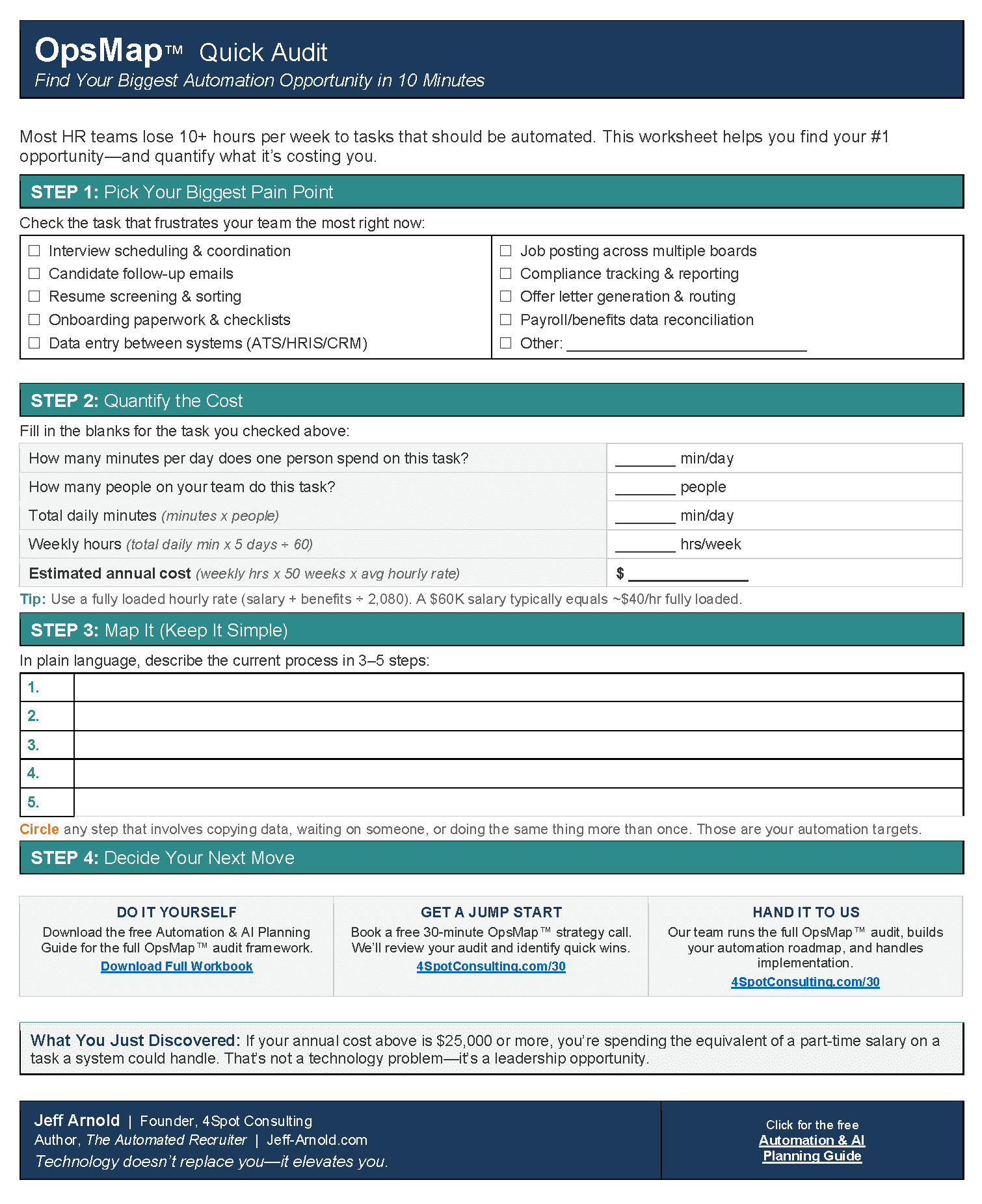
Our process begins with an OpsMap™ – a strategic audit designed to meticulously uncover inefficiencies, identify automation opportunities, and roadmap profitable automations tailored to your specific business needs. This isn’t a theoretical exercise; it’s a deep dive into your current processes to understand where you’re losing time and money. Following the OpsMap™, our OpsBuild™ phase focuses on the precise implementation of automation and AI systems, leveraging powerful tools like Make.com to connect disparate systems and create seamless workflows. Finally, our OpsCare™ offers ongoing support, optimization, and iteration, ensuring your automation infrastructure remains robust, efficient, and aligned with your evolving business goals. We specialize in connecting dozens of SaaS systems, building bridges between critical platforms like Keap, HighLevel, PandaDoc, and more, creating a truly unified operational environment.
The ROI of Intelligent Automation: What Business Leaders Can Expect
The return on investment for strategic AI and automation is not theoretical; it’s measurable and substantial. By eliminating low-value, repetitive tasks, you’re not just saving hours; you’re reallocating human capital to innovation, client relations, and strategic growth. Our clients have experienced dramatic improvements, including production increases of up to 240% and annual cost savings exceeding $1 million. This comes from reduced human error, optimized resource allocation, and the ability to scale operations without proportionally increasing headcount. It’s about building a resilient, agile, and future-proof business that can adapt to market changes with unparalleled speed.
The AI revolution in HR is here, and it’s an imperative for modern business leaders to navigate it strategically. It’s an opportunity to move beyond merely managing human resources to intelligently empowering them, transforming your operational core, and securing a competitive edge in an increasingly automated world. Our strategic, ROI-focused approach ensures that every automation is tied to a tangible business outcome, allowing you to save 25% of your day and drive unprecedented growth.
If you would like to read more, we recommend this article: Navigating the AI Revolution in HR: Strategic Imperatives for Modern Business Leaders



RELATED POST