Post: Strategic AI for Recruitment: Transforming Talent Acquisition for Growth
The Strategic Imperative of AI in Modern Recruitment: Beyond Buzzwords
In today’s fiercely competitive talent landscape, business leaders face immense pressure to not only attract top talent but to do so efficiently and strategically. The conversation around Artificial Intelligence in recruitment has moved past theoretical discussions; it is now a critical strategic imperative. AI, when implemented thoughtfully, offers more than just incremental improvements—it redefines the entire talent acquisition lifecycle, allowing high-growth B2B companies to achieve unprecedented scalability and reduce the burden of low-value work.
The Hidden Bottleneck: Why Traditional Recruitment Models Strain Resources
For too long, human resources and recruitment departments have grappled with manual, repetitive tasks that consume valuable time and resources. Sourcing candidates, screening resumes, scheduling interviews, and managing candidate communications are often fraught with inefficiencies. This isn’t merely about administrative overhead; it’s a systemic bottleneck that impedes growth, inflates time-to-hire, and, critically, compromises the quality of hire. The ripple effect is profound: increased operational costs, decreased employee morale due to being stuck in menial tasks, and a less than ideal candidate experience that can tarnish your brand.
The traditional model, reliant heavily on human intervention at every stage, is inherently prone to human error and unconscious biases. Furthermore, it struggles to cope with the sheer volume of applications generated by modern job postings, leading to qualified candidates being overlooked and a significant drain on internal resources. Business leaders striving for a 25% reduction in operational time often find their recruitment processes to be a major obstacle, necessitating a paradigm shift in how talent is identified, engaged, and integrated.
From Reactive to Proactive: How AI Redefines Talent Acquisition Strategy
AI’s true power in recruitment isn’t just about automation; it’s about transforming a reactive, often chaotic, process into a proactive, data-driven strategy. By leveraging sophisticated algorithms and machine learning, AI tools can perform tasks with unparalleled speed and accuracy, freeing up human recruiters to focus on strategic initiatives and meaningful candidate engagement.
Intelligent Sourcing and Screening for Precision Talent Matching
One of the most immediate and impactful applications of AI is in intelligent sourcing and screening. Instead of keyword matching or manual review, AI platforms can analyze vast datasets of candidate profiles, resumes, and even public information to identify individuals who are not just qualified, but an ideal fit for company culture and long-term potential. This goes beyond simple filtration; AI can identify subtle patterns and indicators that human reviewers might miss, significantly reducing time-to-shortlist and improving the quality of applicants presented to hiring managers. Moreover, well-designed AI systems can help mitigate unconscious biases inherent in human decision-making, fostering a more equitable and diverse talent pool.
Streamlining Candidate Engagement and Experience
The candidate experience is paramount in today’s market. AI can personalize interactions at scale, ensuring every applicant feels valued and informed. AI-powered chatbots can handle initial inquiries, answer FAQs, and even pre-screen candidates based on custom criteria, providing instant responses 24/7. This not only improves candidate satisfaction but also reduces the administrative burden on recruitment teams. Furthermore, AI can automate interview scheduling, sending reminders and handling rescheduling requests seamlessly, ensuring that valuable human interaction is reserved for critical interview stages rather than logistical coordination.
Predictive Analytics for Talent Retention and Performance Optimization
The strategic value of AI extends beyond the hiring process itself. By analyzing internal data, AI can offer predictive insights into talent retention, identifying potential flight risks and suggesting proactive interventions. It can also help in optimizing team composition, predicting future skill gaps, and even personalizing professional development plans. This transition from merely filling roles to strategically managing and nurturing a workforce is where AI truly unlocks sustained competitive advantage, aligning talent strategy with overarching business objectives and ensuring a continuous pipeline of high-performing individuals.
Implementing AI in HR: A Strategic, Not Just Technical, Endeavor
While the allure of AI is strong, many companies attempt implementation without a clear strategy, leading to underutilized tools and unmet expectations. True success with AI in recruitment isn’t about acquiring the latest tech; it’s about integrating it seamlessly into existing workflows and ensuring it serves tangible business outcomes. This requires a robust framework that accounts for the unique complexities of an organization.
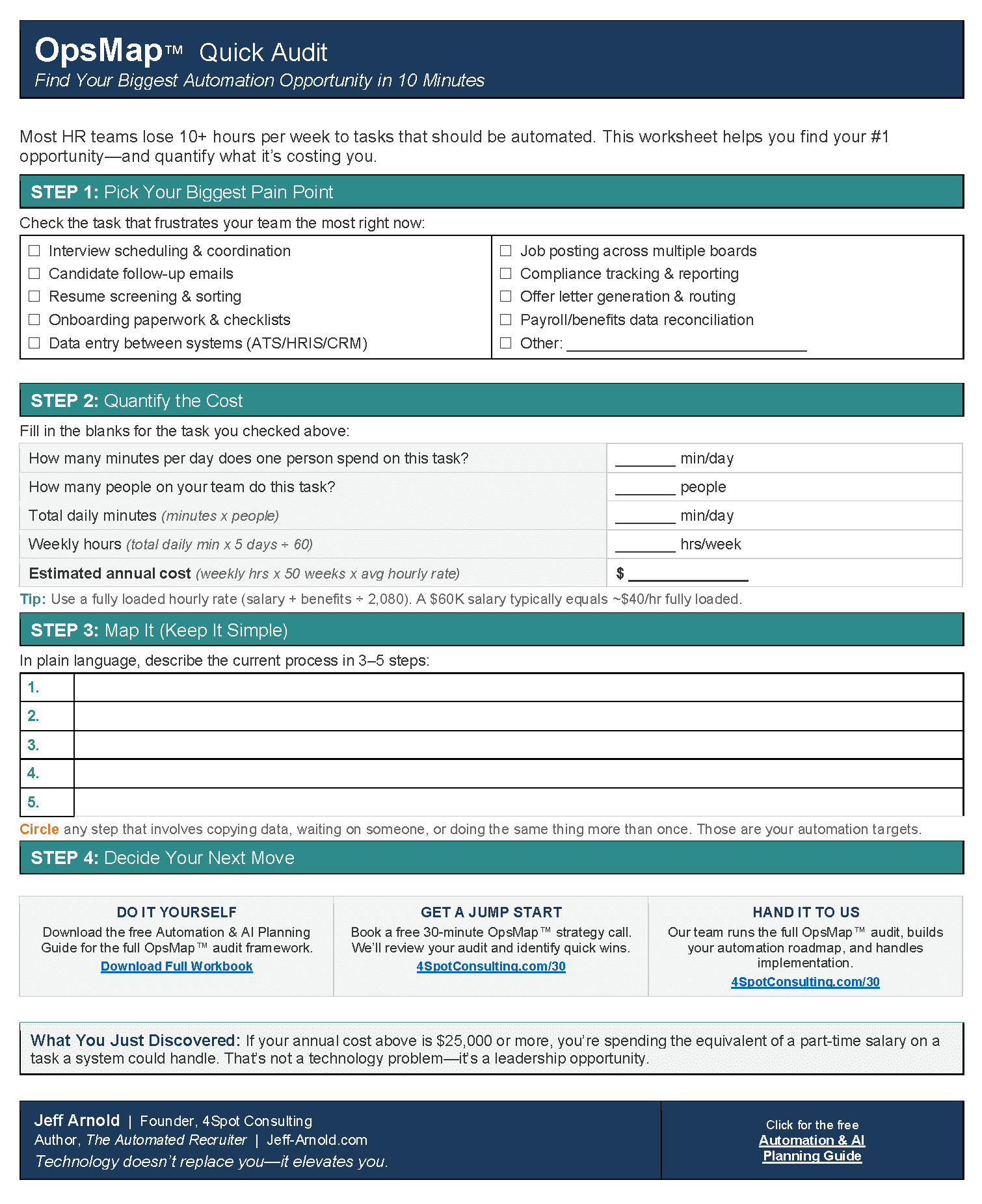
At 4Spot Consulting, our OpsMesh framework is designed precisely for this. We don’t just build systems; we strategically plan how AI and automation will eliminate human error, reduce operational costs, and increase scalability. Our journey begins with an OpsMap™—a strategic audit that uncovers inefficiencies and identifies the most impactful opportunities for AI and automation within your HR and recruitment processes. This isn’t a theoretical exercise; it’s a hands-on deep dive into your operations, ensuring every AI implementation is tied directly to ROI and a clear, measurable business outcome. From there, OpsBuild handles the expert implementation, connecting dozens of SaaS systems via platforms like Make.com, ensuring a single source of truth for your critical talent data. Finally, OpsCare provides ongoing support and optimization, adapting your AI infrastructure as your business evolves.
Realizing Tangible ROI: A Case for AI-Powered Recruitment
The proof of strategic AI implementation is in the results. We’ve seen firsthand how thoughtful automation and AI integration can transform HR operations. For example, we helped an HR tech client save over 150 hours per month by automating their resume intake and parsing process using Make.com and AI enrichment, then syncing this data seamlessly to their Keap CRM. This wasn’t just about saving time; it was about elevating their team from manual drudgery to strategic engagement, ensuring no valuable candidate slipped through the cracks. The client’s feedback was clear: “We went from drowning in manual work to having a system that just works.” This kind of outcome is precisely what strategic AI adoption delivers—a fundamental shift in operational efficiency and talent acquisition effectiveness.
Beyond the Hype: Building a Future-Ready Talent Strategy
The future of recruitment is undoubtedly intertwined with AI. However, separating the genuine strategic advantage from mere technological hype is crucial. For business leaders, the imperative is to view AI not as a cost center, but as an investment that yields significant returns in efficiency, talent quality, and scalability. By embracing a strategic approach to AI implementation, one that focuses on integrated systems and measurable outcomes, companies can transform their HR and recruitment functions into powerful engines of growth.
Ready to uncover automation opportunities that could save you 25% of your day and revolutionize your talent acquisition? Book your OpsMap™ call today.
If you would like to read more, we recommend this article: The Future of Business Automation: Unlocking Efficiency with 4Spot Consulting



RELATED POST