Post: AI for B2B HR & Recruiting: A Strategic Path to Growth
Navigating the Future: How AI is Reshaping HR and Recruiting Operations for B2B Growth
In today’s fast-paced B2B environment, human resources and recruiting teams face an ever-growing set of challenges. From attracting top-tier talent in a competitive market to managing complex compliance, and fostering an engaging employee experience, the demands on HR are immense. Historically, many of these processes have been manual, time-consuming, and prone to human error, creating bottlenecks that hinder scalability and divert high-value employees from strategic initiatives. The promise of digital transformation has long loomed, but it’s the advent of advanced AI that is truly catalyzing a fundamental shift in how HR and recruiting functions operate, especially for growth-oriented B2B companies looking to optimize every facet of their business.
At 4Spot Consulting, we’ve seen firsthand how business leaders struggle to keep pace with operational demands, particularly in areas as critical and people-centric as HR. The manual review of countless resumes, the coordination of complex interview schedules, the repetitive aspects of onboarding, and the constant need for data analysis to inform workforce planning all consume an incredible amount of time. This isn’t just an inefficiency; it’s a drag on productivity, a barrier to strategic growth, and often, a source of significant frustration for both HR professionals and the employees they serve.
Beyond Basic Automation: AI’s Transformative Power in HR
While basic automation has offered some relief by streamlining routine tasks, artificial intelligence introduces a new dimension of efficiency and insight. AI doesn’t just automate a process; it learns, adapts, and makes intelligent decisions, transforming reactive HR functions into proactive, strategic powerhouses. For B2B firms with $5M+ ARR, this transition isn’t just about saving a few hours; it’s about fundamentally rethinking how talent is acquired, developed, and retained, ensuring every operational aspect supports sustained growth.
Consider the sheer volume of data HR departments manage, from applicant tracking systems to performance reviews and compensation structures. AI can analyze these vast datasets in ways no human team ever could, uncovering patterns, predicting trends, and providing actionable insights that drive better decision-making. This moves HR beyond transactional work towards a pivotal role in shaping business strategy, directly impacting an organization’s ability to scale and innovate.
Intelligent Sourcing and Candidate Matching
One of the most immediate and impactful applications of AI in recruiting is intelligent sourcing and candidate matching. Traditional resume screening is tedious, subjective, and often fails to identify the best-fit candidates due to human bias or oversight. AI-powered tools can quickly parse hundreds, even thousands, of applications, identifying keywords, skills, and experience that align with specific job requirements and company culture. More importantly, AI can learn from successful hires to refine its matching algorithms over time, leading to more accurate, equitable, and efficient candidate selection.
This capability dramatically reduces time-to-hire and improves the quality of candidates presented to hiring managers, allowing them to focus on interviews with truly promising individuals rather than sifting through irrelevant applications. For a B2B company that relies on specialized talent, this precision is invaluable, ensuring critical roles are filled faster with the right people.
Streamlining Onboarding and Employee Experience
Beyond recruitment, AI significantly enhances the onboarding experience. New hires often face a deluge of paperwork, training modules, and new systems to learn. AI can personalize onboarding journeys, delivering relevant information and tasks at optimal times, answering frequently asked questions through chatbots, and even facilitating initial introductions to team members. This creates a smoother, more engaging welcome for new employees, boosting early productivity and retention rates.
Furthermore, AI-driven tools can monitor employee sentiment, identify potential attrition risks, and provide personalized learning and development recommendations. By understanding employee needs and preferences, organizations can foster a more supportive and productive work environment, directly impacting employee satisfaction and long-term engagement.
Predictive Analytics for Workforce Planning
The strategic value of AI extends to long-term workforce planning. AI algorithms can analyze historical data, market trends, and internal employee metrics to predict future talent needs, identify skill gaps, and forecast potential attrition. This foresight allows HR leaders to proactively develop talent pipelines, invest in targeted training programs, and adjust recruitment strategies to meet anticipated demands, rather than reacting to shortages when they arise.
For B2B companies eyeing aggressive growth, this predictive capability is a game-changer. It ensures the right talent is in place at the right time, minimizing disruptions and maximizing operational continuity. It’s about building a resilient, agile workforce ready to adapt to market shifts and seize new opportunities.
Integrating AI Thoughtfully: The 4Spot Consulting Approach
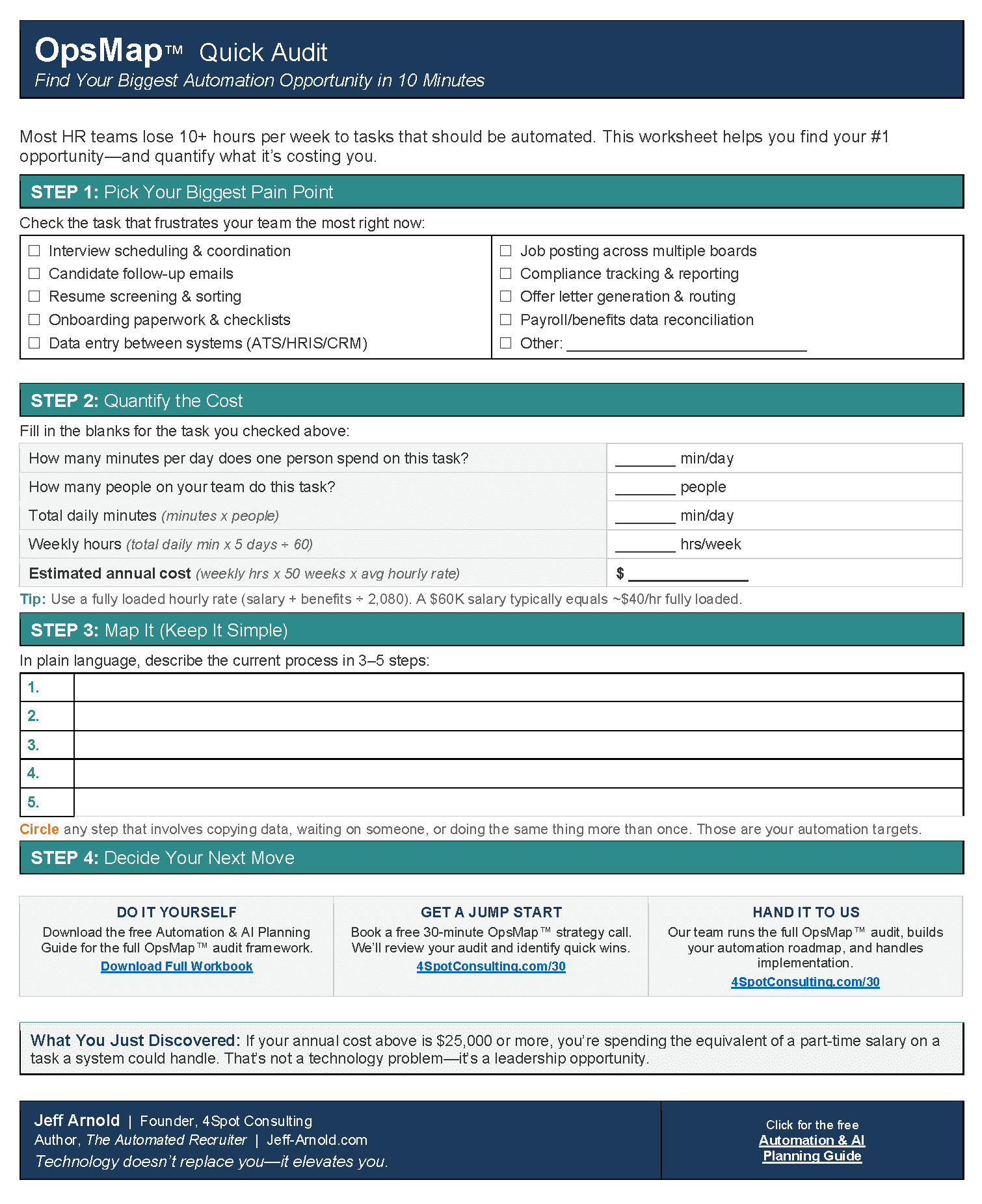
While the benefits of AI in HR are clear, successful integration requires a strategic approach. It’s not about implementing technology for technology’s sake, but about solving specific business problems and achieving measurable ROI. At 4Spot Consulting, our OpsMap™ diagnostic is precisely designed for this purpose. We conduct a thorough audit to uncover inefficiencies in existing HR and recruiting processes, identifying where AI can deliver the most significant impact—from automating resume parsing to intelligent scheduling or predictive analytics.
Our OpsBuild™ phase then leverages tools like Make.com to connect disparate systems and implement AI-powered workflows that eliminate human error, reduce operational costs, and increase scalability. We apply our OpsMesh framework to ensure all automated processes are integrated seamlessly, creating a single source of truth for critical HR data. We’ve helped clients, such as an HR tech firm, save over 150 hours per month by automating their resume intake and parsing process using Make.com and AI enrichment, syncing directly into their Keap CRM. This isn’t theoretical; it’s proven results that transform daily operations.
The Imperative for AI Adoption in HR
The landscape of HR and recruiting is undergoing a profound transformation driven by AI. For B2B companies aiming for high growth and operational excellence, embracing these technologies is no longer optional; it’s an imperative. By strategically integrating AI, organizations can unlock unprecedented levels of efficiency, enhance employee experience, make data-driven talent decisions, and ultimately, free up their high-value HR professionals to focus on human connection and strategic initiatives that truly move the needle. The future of work is intelligent, and those who lead with AI will be best positioned to thrive.
Ready to uncover automation opportunities that could save you 25% of your day? Book your OpsMap™ call today.
If you would like to read more, we recommend this article: The Definitive Guide to Automation and AI for B2B Operations



RELATED POST