Post: Strategic AI for Recruitment: Beyond Hype, Towards Measurable Growth
Unlocking Strategic Growth: The Power of AI in Recruitment Beyond the Hype
For many HR leaders and operational executives, the mention of “AI in recruitment” often conjures images of futuristic chatbots and complex algorithms promising a revolution that hasn’t quite materialized. The reality is, the market is saturated with tools that offer superficial efficiencies, often failing to deliver on the promise of strategic impact or a measurable return on investment. Businesses today demand more than just buzzwords; they need tangible solutions that eliminate bottlenecks, reduce human error, and free up high-value employees from low-value work. The true power of AI in recruitment isn’t about replacing humans, but about empowering them to be more strategic, proactive, and ultimately, more successful.
The Illusion of Efficiency: Where Traditional AI Tools Fall Short
Many off-the-shelf AI solutions are designed as standalone products, offering limited scope and often creating new silos rather than breaking them down. They might automate a single task, like initial resume screening, but then fail to integrate seamlessly with existing applicant tracking systems (ATS), human resource information systems (HRIS), or customer relationship management (CRM) platforms. This lack of interoperability means data gets trapped, insights are fragmented, and the overall recruitment process remains disjointed, forcing manual interventions that negate any perceived efficiency gains.
The problem isn’t the technology itself, but its isolated application. Without a holistic strategy, these tools become yet another piece of software that complicates workflows rather than streamlines them. Business leaders are left questioning the ROI, seeing only a marginal improvement for a significant investment. This disconnect highlights a critical need for integrated, custom-tailored AI solutions that understand and adapt to an organization’s unique operational DNA, ensuring that every AI-driven process contributes to overarching business objectives.
Beyond Keyword Matching: Reimagining AI for Strategic Talent Acquisition
The real value of AI in recruitment emerges when it’s used to enhance strategic decision-making and elevate the entire talent acquisition lifecycle. This means moving beyond simple keyword matching to embrace more sophisticated applications.
Predictive Analytics for Proactive Hiring
Imagine knowing your future talent needs before they become urgent. AI, when fed with historical hiring data, market trends, and internal employee movement, can provide powerful predictive insights. It can forecast skill gaps that will emerge in six months, identify departments at risk of high attrition, or even suggest optimal times to initiate hiring for specific roles. This shifts recruitment from a reactive scramble to a proactive, data-driven strategy, allowing companies to build robust talent pipelines and plan workforce development with foresight, rather than hindsight.
Intelligent Candidate Engagement and Experience
The candidate experience is paramount. AI can personalize interactions at scale, from intelligent chatbots answering FAQs 24/7 to automated, tailored communication streams that keep candidates engaged throughout the process. This isn’t about impersonal automation; it’s about using AI to ensure timely, relevant, and consistent communication, freeing recruiters to focus on deeper interactions with top-tier candidates. It ensures that no promising candidate falls through the cracks and that the company’s brand as an employer of choice is consistently reinforced.
Eliminating Bias and Enhancing Diversity
One of the most compelling applications of AI is its potential to mitigate unconscious bias inherent in human screening processes. By analyzing resumes and initial applications against predefined, objective criteria, AI can help ensure candidates are evaluated based on skills and experience, not demographic markers. While AI models themselves must be carefully trained and monitored to prevent perpetuating existing biases, a well-designed AI system can be a powerful tool for promoting diversity, equity, and inclusion, leading to a richer, more innovative workforce.
The 4Spot Consulting Approach: Integrating AI for Tangible ROI
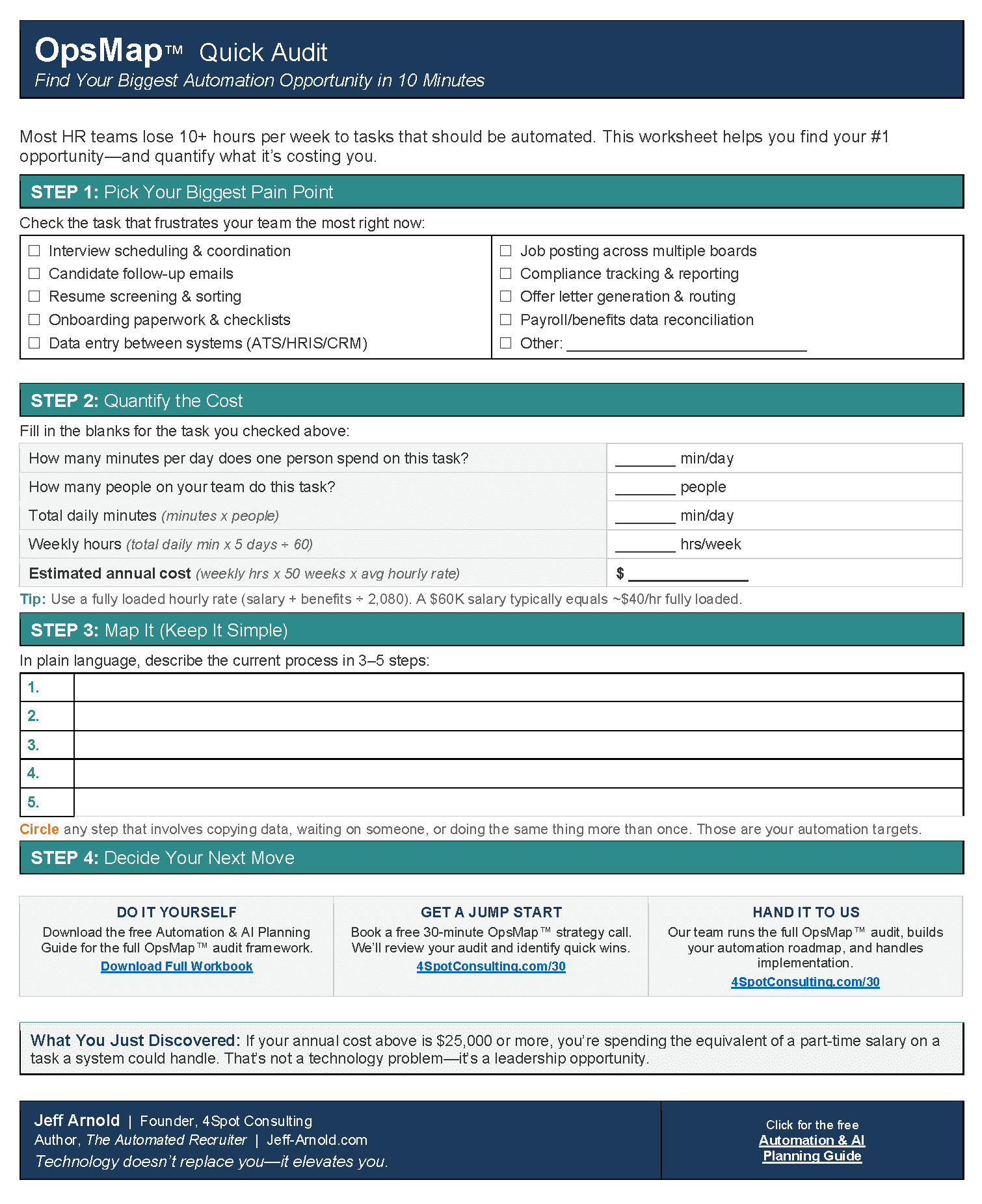
At 4Spot Consulting, we view AI not as a standalone magic bullet, but as a crucial component within a larger, interconnected automated ecosystem—what we call OpsMesh. Our approach is strategic-first: we don’t just build, we plan. This begins with an OpsMap™ diagnostic, a deep dive into your current operations to uncover inefficiencies and pinpoint exactly where AI and automation can deliver the most significant ROI. We understand that every business is unique, and generic solutions simply won’t cut it.
Our expertise lies in connecting dozens of disparate SaaS systems using powerful low-code platforms like Make.com. For instance, we helped an HR tech client save over 150 hours per month by automating their resume intake and parsing process using Make.com and AI enrichment, then seamlessly syncing this valuable data into their Keap CRM. This wasn’t just about saving time; it was about transforming a manual, error-prone task into a precise, automated workflow that drastically improved data quality and speed to market for qualified candidates. This is a testament to how intelligent integration of AI can lead to transformative results, reducing low-value work from high-value employees.
Realizing the Future: Measurable Outcomes of Strategic AI Integration
The benefits of strategically integrating AI into recruitment are not abstract; they are measurable and impactful. Businesses can expect to see a significant reduction in time-to-hire, often by 25% or more, allowing them to secure top talent ahead of the competition. Candidate quality improves as AI helps identify best-fit candidates more accurately, leading to higher retention rates and better overall team performance. Operational costs associated with recruitment decrease due to optimized workflows and reduced manual effort. Ultimately, AI-driven recruitment enables scalability, allowing companies to grow and expand without a proportional increase in the recruitment operations headcount.
If you would like to read more, we recommend this article: Why Your Current CRM Data Backup Strategy is a ticking time bomb


RELATED POST