Post: Manual Processes: The Silent Profit Killer in High-Growth B2B
The Hidden Cost of Manual Processes in High-Growth B2B Companies
In the relentless pursuit of growth, many B2B companies, particularly those scaling rapidly beyond $5M ARR, often overlook a silent adversary: inefficient manual processes. While the allure of new revenue streams and market expansion dominates strategic discussions, the foundational operational inefficiencies—the tasks that chew up valuable employee time and introduce human error—are quietly eroding profit margins and stifling true scalability. At 4Spot Consulting, we’ve witnessed firsthand how these seemingly minor manual tasks accumulate into significant operational bottlenecks, costing businesses far more than they realize.
Consider the daily grind: an HR manager manually sifting through hundreds of resumes, a sales team painstakingly updating CRM records across disparate systems, or an operations lead wrestling with document generation and approvals. Each of these actions, when performed by high-value employees, represents a direct cost and a missed opportunity. It’s not just the salary paid for that specific hour; it’s the opportunity cost of what that expert could have achieved if their time were dedicated to strategic initiatives, client engagement, or innovation.
The Pervasive Impact on Your Bottom Line and Beyond
The financial drain of manual processes is multifaceted. Beyond direct labor costs, there are hidden expenses like increased error rates leading to rework, compliance risks from inconsistent data entry, and the delayed time-to-market for critical projects. For high-growth companies, this translates directly into reduced scalability. If your core processes require a linear increase in human input as your business grows, you’re not truly scaling; you’re simply adding more variables to an already complex equation.
Furthermore, manual workflows breed employee dissatisfaction and burnout. The most talented individuals in your organization—your recruiters, your sales leaders, your operations specialists—are often hired for their strategic thinking and problem-solving abilities. Forcing them into repetitive, low-value tasks not only wastes their potential but actively disengages them, increasing turnover and the associated costs of recruitment and training. This erosion of morale can be a silent killer of productivity and innovation.
Unmasking Inefficiencies: Where Time and Money Vanish
The areas most susceptible to these hidden costs are often core to business operations:
- HR and Recruiting: From resume intake and parsing to candidate communication and onboarding, manual HR processes can lead to missed talent opportunities and a poor candidate experience.
- CRM & Data Management: Inconsistent data entry, lack of a single source of truth, and fragmented customer information plague sales and marketing efforts, leading to inefficient outreach and inaccurate reporting. Think about the nightmare of CRM backups or merging data from multiple tools like Keap and HighLevel without automation.
- Document & Data Organization: Manual document generation, approval workflows, and disorganized file systems create bottlenecks, slow down client onboarding, and introduce compliance risks.
- Internal Operations: Any task that is repetitive, rule-based, and performed frequently by multiple team members is a prime candidate for automation. This includes everything from expense approvals to vendor management.
The critical element here isn’t just identifying these pain points, but understanding their interconnectedness. A bottleneck in HR can impact sales velocity, which in turn affects revenue forecasting and operational planning. It’s a domino effect that permeates the entire organization, reducing agility and making it harder to adapt to market changes.
4Spot Consulting’s Strategic Approach: From OpsMap™ to Scalable Growth
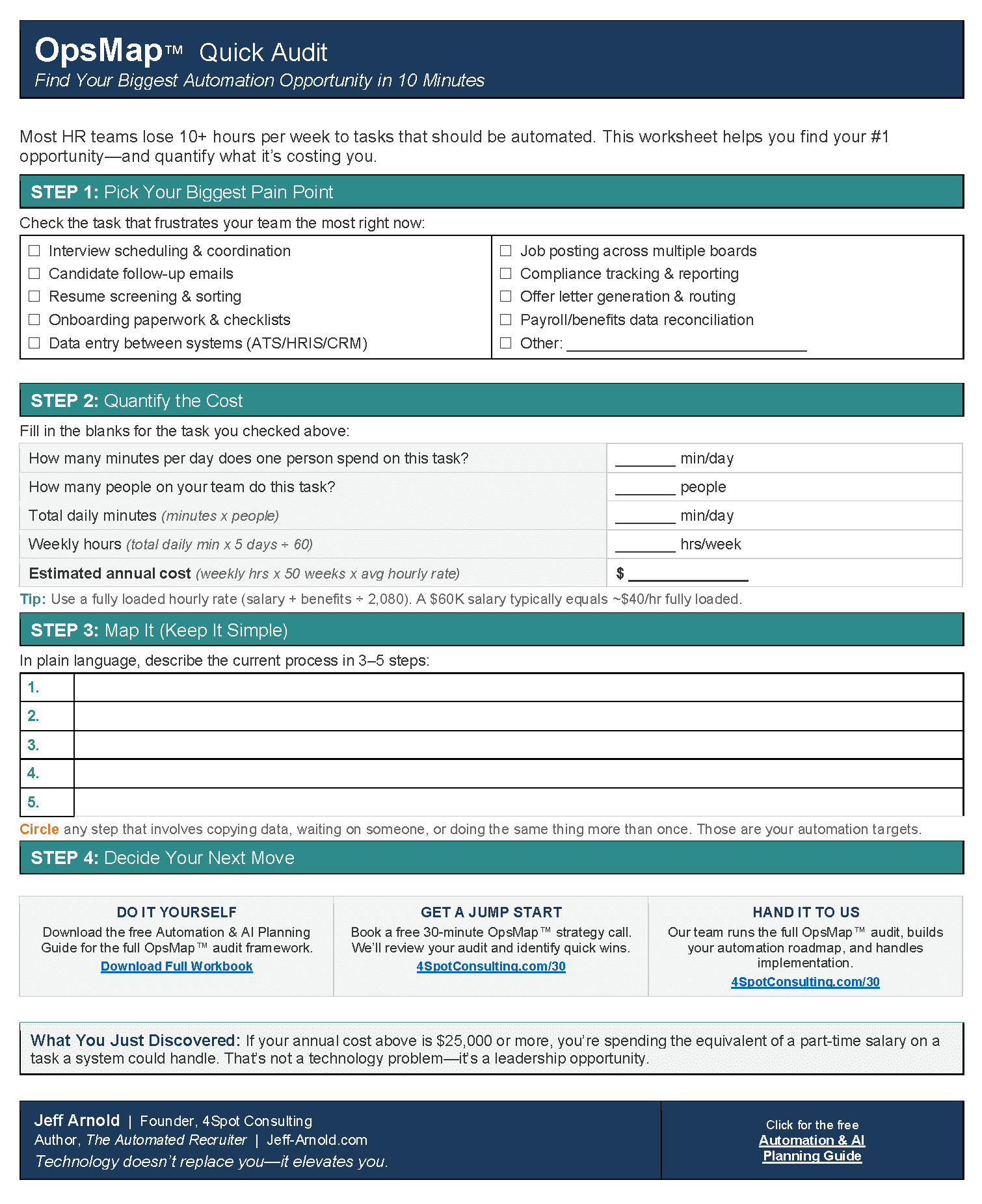
At 4Spot Consulting, we approach these challenges with a strategic, ROI-focused methodology, beginning with our proprietary OpsMap™. This isn’t just about implementing technology; it’s about fundamentally re-architecting how your business operates to eliminate human error, reduce operational costs, and increase scalability. Our experts, with decades of leadership experience, understand that automation isn’t ‘tech for tech’s sake’—it’s a critical enabler of business outcomes.
Our process starts by meticulously auditing your current workflows, identifying where time and money are truly being lost. We then design and implement robust automation and AI systems using preferred tools like Make.com, Keap, and PandaDoc, ensuring seamless integration across your existing SaaS ecosystem. We’ve seen clients like an HR firm save over 150 hours per month by automating their resume intake and parsing process using Make.com and AI enrichment, directly syncing to Keap CRM. This isn’t just a time saving; it’s a strategic reallocation of resources, allowing their team to focus on high-value candidate engagement rather than manual data entry.
The result is a more efficient, error-free, and scalable operation. Your high-value employees are freed from mundane tasks, allowing them to focus on what they do best: driving your business forward. This strategic-first approach, where we plan before we build, has consistently led to outcomes like 240% production increases and millions in annual cost savings for our clients. We build an OpsMesh—an overarching automation strategy framework—that ensures your systems are interconnected, data flows seamlessly, and your business operates as a cohesive, automated unit.
Ready to Reclaim Your Day and Drive Real Growth?
The hidden costs of manual processes are real, pervasive, and detrimental to sustainable growth. Ignoring them is a luxury high-growth B2B companies simply cannot afford. By strategically integrating automation and AI, you can transform operational bottlenecks into pathways for accelerated growth and increased profitability.
Ready to uncover automation opportunities that could save you 25% of your day? Book your OpsMap™ call today. Our automation playbook starts with the OpsMap™—a strategic audit to uncover inefficiencies, surface opportunities, and roadmap profitable automations.
If you would like to read more, we recommend this article: The Future of Business Automation: Strategies for Scalable Growth



RELATED POST